Alex Baddeley, auctioneer at Kerry Taylor Auctions, and Bob Verhelst, curator of the Martin Margiela exhibition, give System exclusive insight into the auction of the designer’s personal archive.
By Houssem El Ghoul
Alex Baddeley, auctioneer at Kerry Taylor Auctions, and Bob Verhelst, curator of the Martin Margiela exhibition, give System exclusive insight into the auction of the designer’s personal archive.
Alex Baddeley, fashion specialist and auctioneer at Kerry Taylor Auctions
System: This auction was curated by Martin Margiela himself. Does that change the way we should look at these objects?
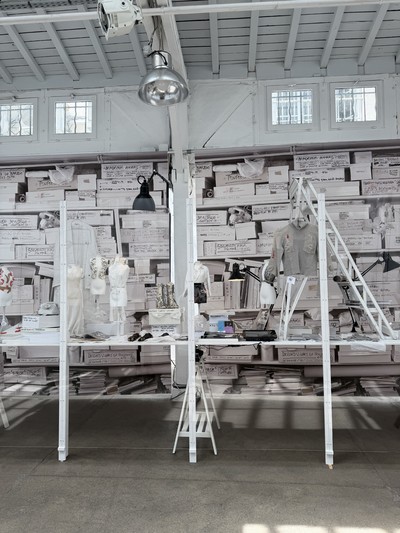
Alex Baddeley: Usually, an exhibition or an auction is shaped by a curator trying to do justice to a collection. Here, everything has been selected, curated and installed by Martin himself. It isn’t simply an auction. The entire exhibition can be understood as an art installation.
This project actually began after an exhibition and auction we organised last year, bringing together some of the rarest early Maison Margiela pieces. It became the most successful fashion auction ever held in France at the time.
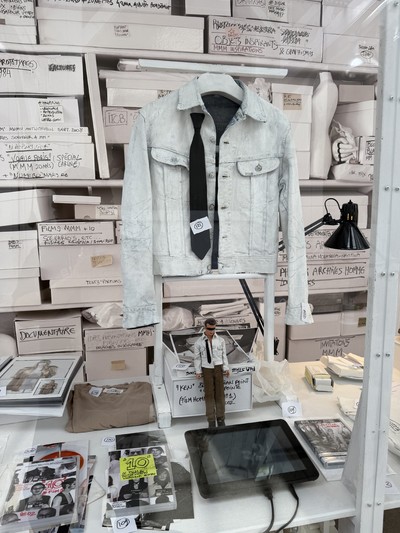
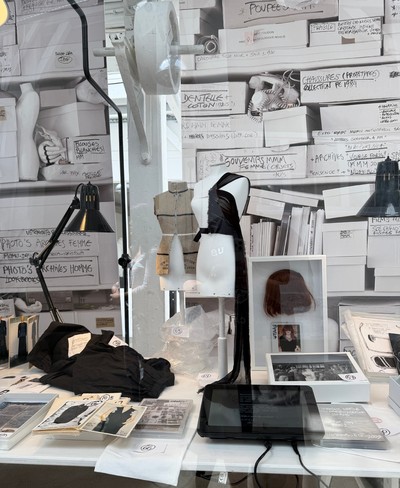
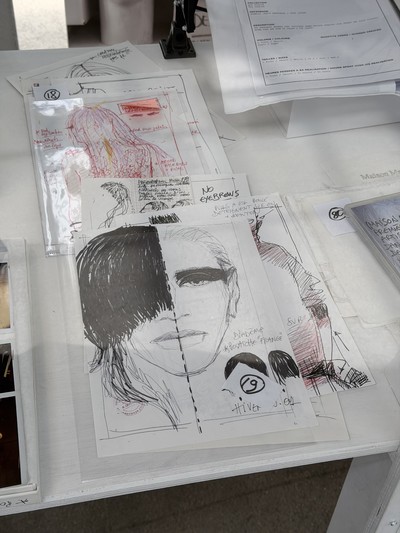
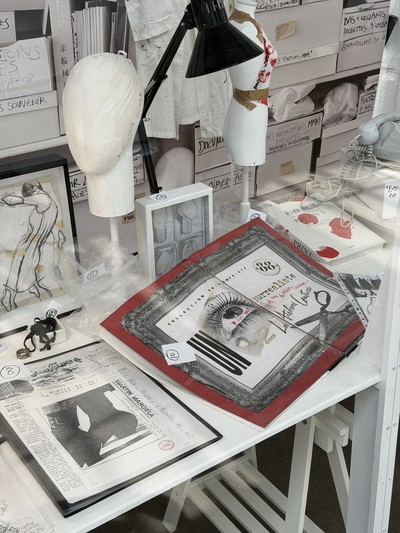
We reached out to Martin afterwards, hoping we had done justice to his work, and that’s how this collaboration began. What fascinates me most isn’t necessarily what Martin kept, but why he kept it. Rather than preserving the clothes themselves, he preserved the ideas behind them: sketches, prototypes, invitations, photographs, and show ephemera. Looking through the archive, you begin to understand how he thinks, rather than simply what he made.
You worked closely with Martin on this project. Did anything about the way he approached his own archive surprise you?
Martin has always played with anonymity. He created the blank label with the four stitches so people would focus on the clothes rather than the name.
Ironically, those four stitches became one of the most recognisable signatures in fashion. The same happened with the voile masks. At a time when everyone wanted to celebrate the supermodel, Martin wanted people to look at the clothes instead. The masks themselves became iconic.
What’s remarkable is that this archive contains many deeply personal objects, yet it still reveals very little about Martin himself. That tension has always been part of his work.
Throughout his career, he constantly challenged expectations. To become the first living designer to curate his own auction in this way feels completely true to him. To me, it almost feels like his final intervention in fashion.
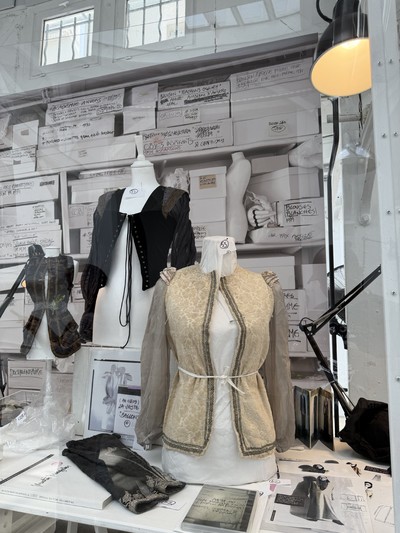
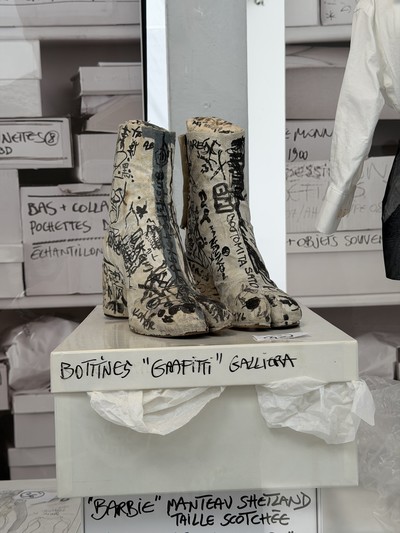
If you had to save two lots from this sale, which ones would you choose, and what do they say about Martin Margiela that the others don’t?
The first would be the painted Tabi boots. They were originally exhibited at the Palais Galliera, where visitors were invited to write on the gallery walls. Instead, they started writing directly on the boots, and Martin loved that unexpected reaction. While cataloguing them, I turned one over and realised someone had written my own name on the back. I’d only ever seen them photographed from one angle before, so it became a very personal moment.
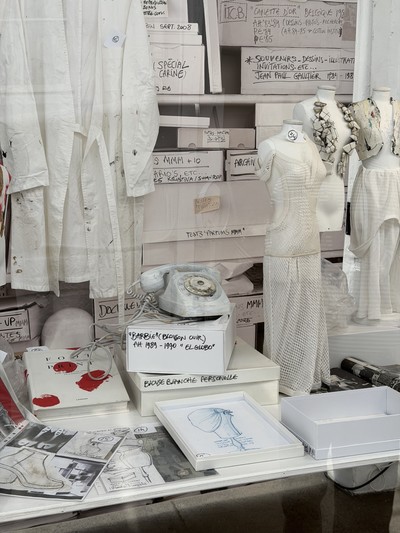
The second would be Martin’s white blouse. It’s covered with traces of paint, ink and years of work. Seeing it hanging there without the designer wearing it perfectly captures the spirit of the blank label. His presence is everywhere, even in his absence.
Martin Margiela has spent decades protecting his anonymity. What does it mean that he’s now choosing to reveal his archive?
I don’t think Martin is revealing himself as much as he’s revealing the consistency of his ideas. Throughout his career, he always designed with the wearer in mind. He never wanted to objectify women or create clothes that belonged to a single moment. At Hermès, he designed garments that could be worn season after season, repeating silhouettes in different fabrics and colours so they would never feel out of date.
Even the smallest details reflect that philosophy. The only visible branding appears on certain buttons, where six stitches subtly form an ‘H’ – a world away from the overt branding that defined luxury in the late 1990s. The cashmere gloves are knitted entirely without seams, so they can be worn inside out or either way around and still feel perfect. It’s a very discreet idea of luxury, entirely rooted in craftsmanship and wearability.
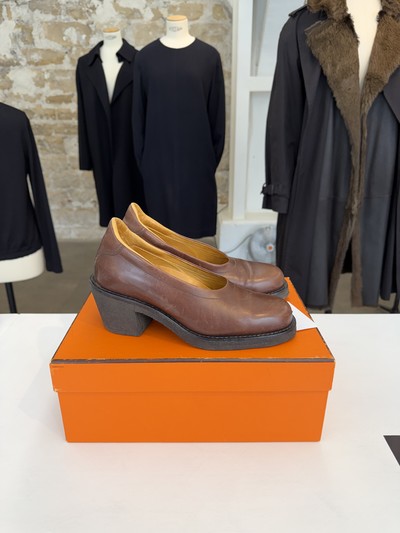
Looking through the archive, you also realise how consistently Martin returned to the same ideas. His earliest shoe designs, his original drawings, the miniature mannequins he used to explore proportion, the painted Bianchetto garments and the Hermès collections all belong to the same conversation. Rather than constantly inventing something new, he kept refining the same ideas throughout his career.
One of the most moving sections of the exhibition is dedicated to the wardrobe of Martin’s mother, Lea Bouchert. While he was designing at Hermès, she became an important point of reference for the way he thought about clothing. The garments are incredibly luxurious but deliberately understated, designed to be worn by anyone rather than to signal status.
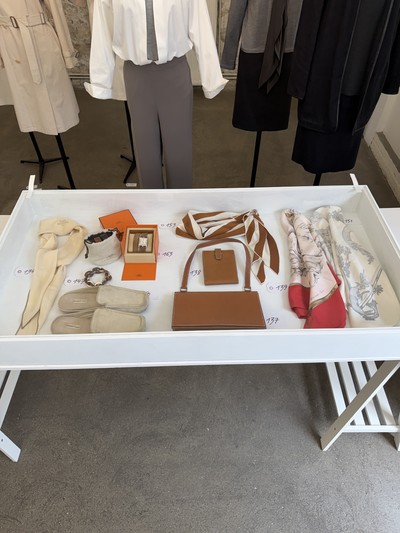
Some of those designs, like the Double Tour watch, are still in production today, which says a great deal about the strength of his vision. Others reveal his fascination with layering: instead of a twin set, he imagined a three-piece cashmere set that could be worn in multiple ways, or doubled coats made from two identical garments fastened together at the back. They’re deeply luxurious objects, but they never lose sight of function. That’s what makes Martin’s work feel so relevant today. He wasn’t interested in novelty for its own sake. He was interested in refining ideas until they became timeless.
Bob Verhelst, Martin Margiela’s friend and curator of the exhibition
You worked very closely with Martin Margiela from the very beginning. Can you tell us about your role and what it has been like working alongside him over the years?
I met Martin at the Royal Academy of Fine Arts in Antwerp. We studied together in the fashion department and when he started the house, I offered to help.
During the first eight years of Maison Margiela, I worked on everything. We organised the shows, the exhibitions, even stamped the invitations. We did everything together, so we know each other very well. Since then, every time Martin works on a new project or an exhibition, we work together again.
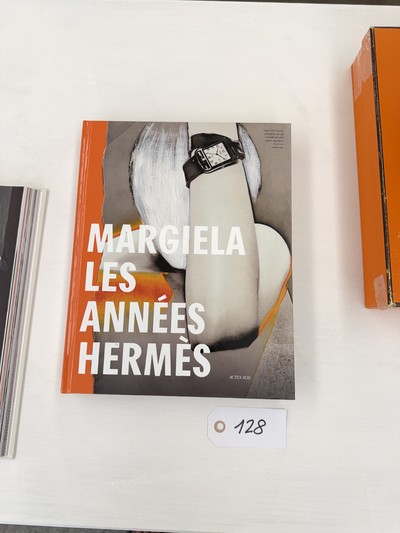
I have previously worked on the exhibition Maison Martin Margiela ‘20’ at MoMu and the Margiela, the Hermès Years exhibition in Antwerp, which later travelled to Paris and Stockholm. Now I’m working on this project.
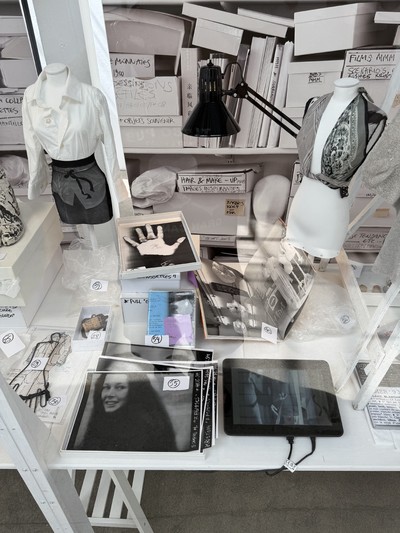
Working with Martin is very easy because we’ve known each other for so long. We only need to exchange a few words to understand each other. I understand his language, he knows the way I work, so everything feels very natural. I know the house and its spirit so well that installing an exhibition like this comes naturally.
How did you approach the scenography for this exhibition, and what were the first conversations you had with Martin?
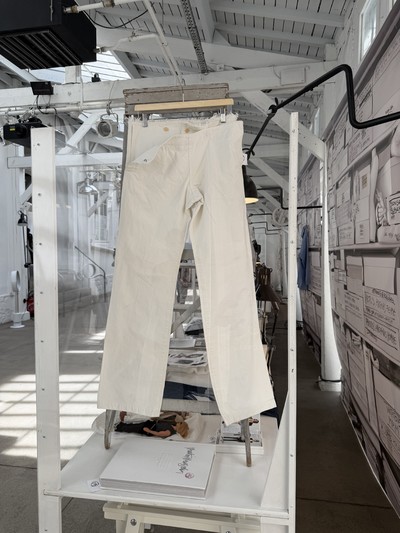
Every exhibition starts the same way. We first visit the space, then decide how to organise it. Here, we wanted to clearly separate the Maison Margiela years from the Hermès years.
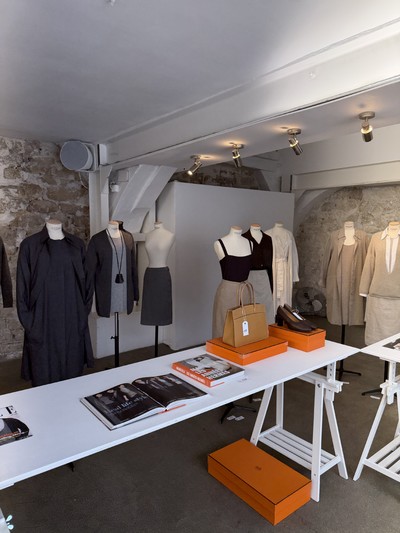
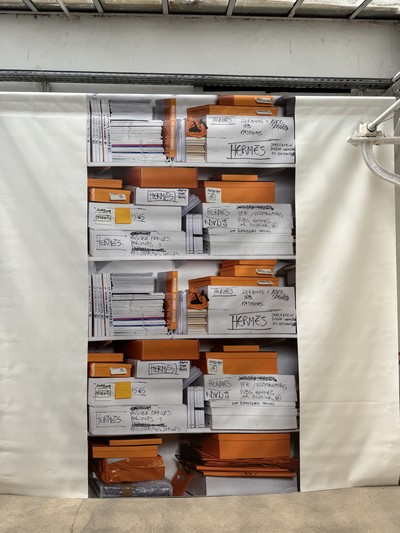
The idea was to reconstruct Martin’s office and archive by printing them onto canvas. The large table was conceived as if we had simply opened boxes from the archive and laid everything out. It was meant to feel natural and organic. The Hermès section, on the other hand, belongs to a completely different world, so it required a different approach.
Was there one piece or one object that brought back a particularly strong memory while putting the exhibition together?
One piece that always stays with me is the pair of Tabi boots covered in graffiti. During the exhibition at the Palais Galliera, everything was white – the garments, the shoes – and we left markers for visitors to write messages to Martin.
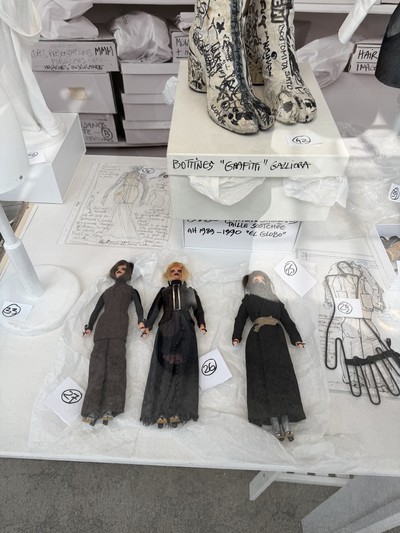
After four months, every surface was completely covered with graffiti and messages. It’s something I’ve never forgotten. We recently recreated the same idea for another exhibition at MoMu, and once again people immediately started writing on them. I think they’re still one of the most beautiful pieces.