By Mary Cleary
The Fondazione Dries Van Noten is a new institution committed to celebrating craft in the age of AI. Ahead of its opening, System spoke to Van Noten and some of the artists involved in its first show.
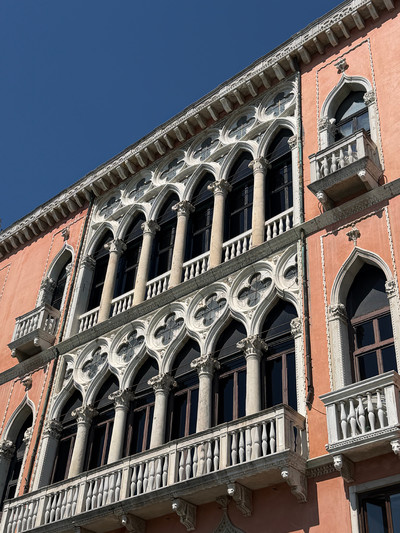
Two years after retiring from his namesake fashion brand, Belgian designer Dries Van Noten has unveiled his latest creation: Fondazione Dries Van Noten, a cultural institution located inside Venice’s historic Palazzo Pisani Moretta that celebrates handmade craft and human creativity.
Under the stewardship of Van Noten and his partner, Patrick Vangheluwe, the baroque palace along the Grand Canal has become a centre for contemporary exhibitions, residencies, and educational programmes for students, all in the name of preserving craftsmanship and celebrating human creativity at a time when it seems like it may be under threat.
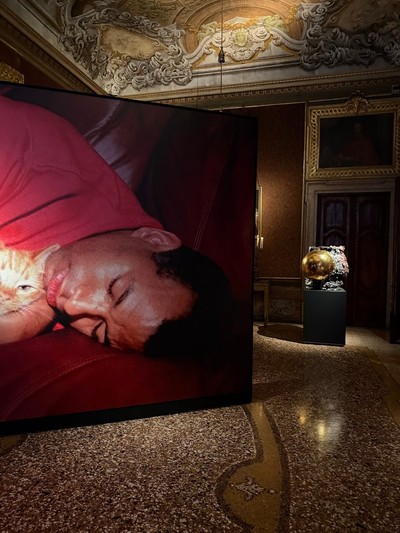
Photograph by Steven Shearer and sculpture by Peter Buggenhout.
The Fondazione’s first project is the exhibition The Only True Protest Is Beauty, on view from 25 April to 4 October 2026, which unites the works of over 50 artists from around the world and across disciplines, including fashion design, sculpture, film, jewellery design, and more.
Below, we take you through the exhibition, with insights from a few of the artisans and artists involved, as well as from Dries Van Noten himself.
Dries Van Noten: I think that everybody knows that after stepping down as a fashion designer, I was looking for a new challenge. I didn’t want to stop, I wanted to do something else. So I started this Fondazione about arts and crafts, because craft gave us so much that, for me, it was necessary to give back and to show people the importance of craftsmanship, especially in these times of AI and ChatGPT. Creativity, things which are made with your hands, and art with your brain, are still more important than these AI computers.
For me, this Fondazione is a different thing from being a fashion designer. Of course, there are quite a few connections, because it’s what I did in the past, but this project creates even more possibilities. Craftsmanship gave us so much. We always loved printing, hand painting, embroidery, all those things. And now we can expand much more. We can look at many more different disciplines of craftsmanship, which I think is really exciting, and gives us a freedom, which maybe fashion didn’t give us.
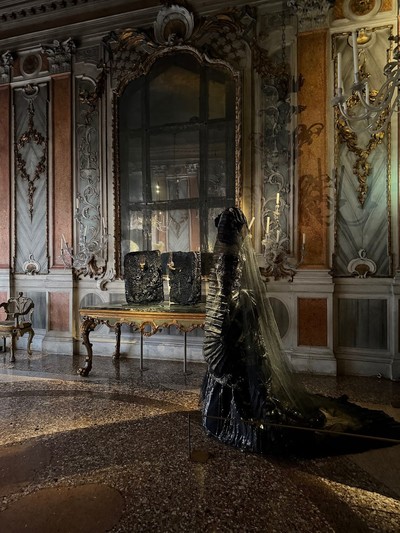
Christian Lacroix’s ‘Black Bride.’
Dries Van Noten: The working title for the presentation was a sentence from a Phil Ochs protest song, in which the line ‘in such ugly times, the only true protest is beauty’ appears.
It was really sad to see that the title was more relevant now than a year ago… But we didn’t want to work on something negative, so that’s why we dropped the first part of the sentence. I think we are reminded enough that we are living through such ugly times, so we said OK, let’s work with ‘the only true protest is beauty.’
I hope what [visitors] discover is really going to make them think. Think about the importance of beauty, the importance of beauty getting through to the human being, and all the different aspects of beauty, because we are showing a lot of different things. We want to challenge people [by showing them] that beauty can be so many different things, and be so helpful to become a better human.
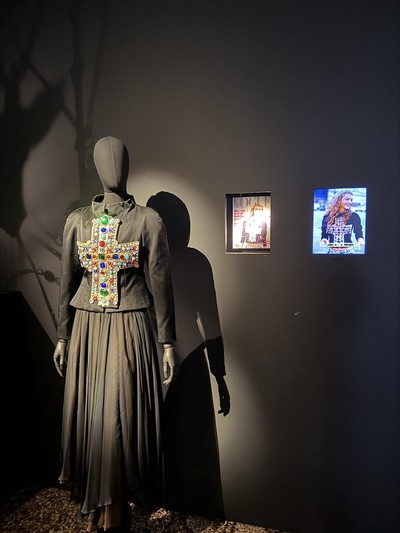
Design by Christian Lacroix.
Dries Van Noten: This piece is by Christian Lacroix and [the model on the magazine cover] was pregnant and couldn’t fit in the skirt, so she was still wearing her jeans with the big belly, and the idea was to crop the cover and the photos so that you couldn’t see that. But Anna Wintour had the genius to see that with the jeans it was much more new, because it was really putting couture on the street, which now feels very normal and classic. But then, in 1988, it was quite the revolution to take it out of the stuffy salons and to put it on young girls with loose hair. So for me, it’s quite interesting to see it here as a symbol [of the fact] that there is constant evolution in how people see things, and things which now look like ‘whatever’ and quite normal, it has been at a certain moment, a kind of revolution.
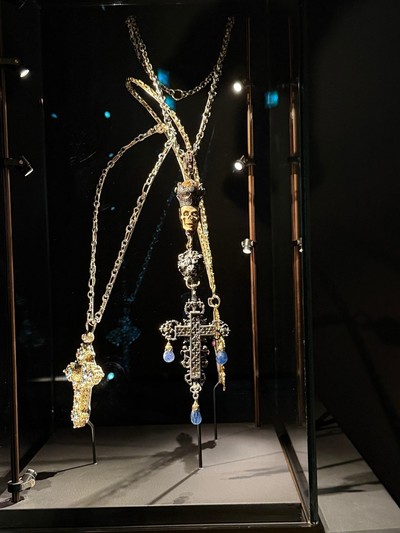
Jewellery by Codognato.
Dries Van Noten: Then you have the relationship of the outfit with the cross with the jewellery by Codognato. You have all the darkness, the memento mori, the vanitas.
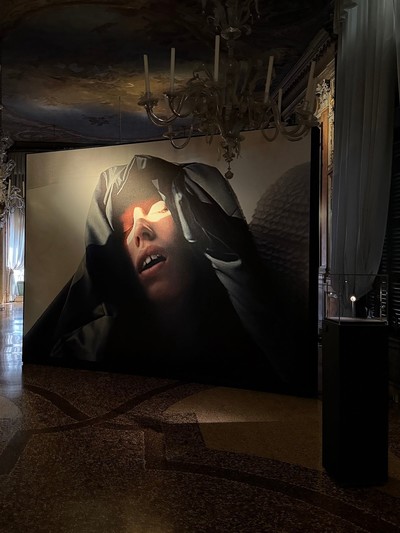
The Steven Shearer photograph that greets visitors to the museum.
Dries Van Noten: Vanitas [still lifes] are a kind of eternal life. Within them, there are always people passing away, but there’s also a next side; there’s always a butterfly that flies away. You have the things that are on earth, which are rotting, which are disappearing. We have always liked a little insect, and later on, you see a glass case, which is a small glass butterfly as a symbol of eternal life. The first photo [by Steven Shearer] you see when you enter is also like that, so from the beginning, you already see all the references we try to build into the presentation.
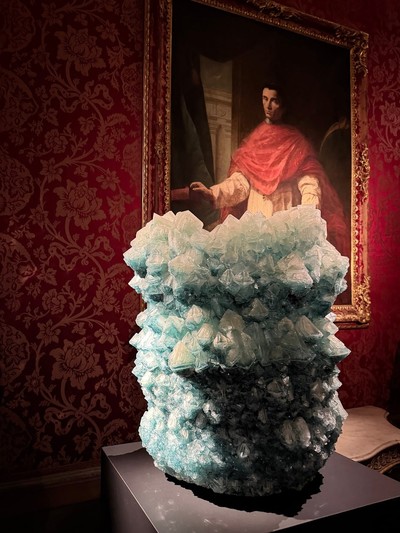
Vase by Isaac Monté.
Isaac Monté: I created this vase especially for the show. Some people think that I sourced this [material] from nature, and then I sculpt it, but I actually grow the vase. It’s a technique I developed where I dissolve minerals and oxides in very large tanks of water, and I play with the temperature of that solution.
So first I heat it up to just below boiling point, and when the solution cools down, the minerals transform into pieces of glassware and ceramics. I put it in the solution, and the crystals grow off the objects that I put in the solution, and I can repeat that process several times, the same way as how candles are made. Every time you dip, you get layer upon layer upon layer. The difference with candle making is that, for me, every layer takes 48 hours. So this piece, which has seven or eight layers, took about three weeks to grow, and then, because it’s made under water in large tanks, it also took a month and a half to dry.
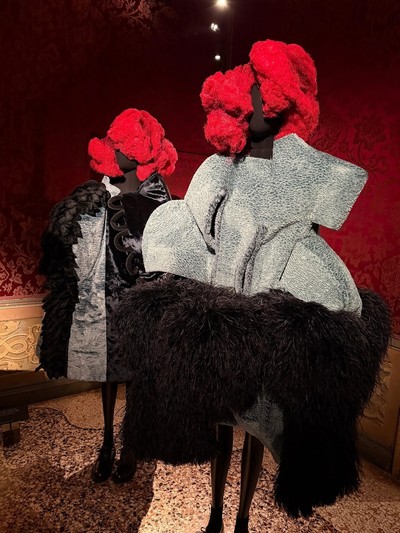
Designs by Comme des Garçons and hair pieces by Julien d’Ys.
Isaac Monté: The nice thing is that Dries asked for a very specific bluish, green colour, and he was very particular about that. And I didn’t understand why. Then this morning, when I arrived here, I understood because on the other side there is a dress from Comme des Garçons, which is very similar in sculptural look, its colour, and its texture. I really like the dialogue that the two pieces have.
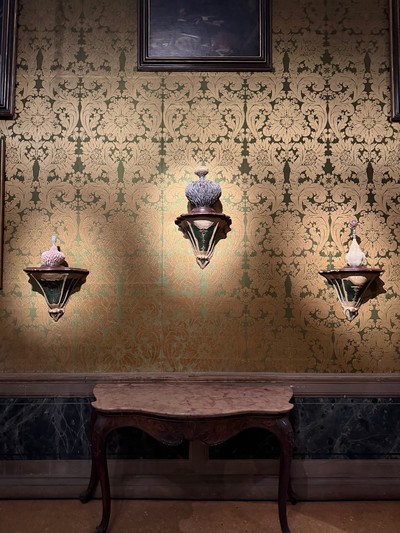
Ceramics by Kaori Kurihara.
Kaori Kurihara: I’m a Japanese ceramic artist living in Paris, creating ceramic sculptures inspired by plants and natural forms. I have been working on this series for many years, which explores the visual harmony that exists in nature. My process is very intuitive. I don’t decide on the final shape or colour in advance. I let the peace grow freely, like a living organism. For me, it’s about expressing the vitality and beauty of life.
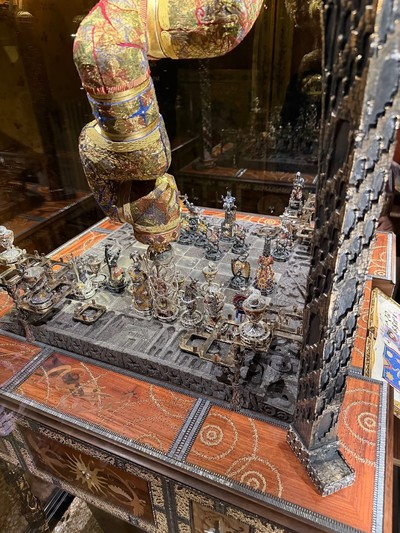
Chessboard by Joseph Arzoumanov.
Dries Van Noten: We used the music room to let Joseph [Arzoumanov] create his chessboard of dreams. All the chess pieces are blackened silver, completely dressed in gold embroidery, and [the project] is really about the story of his family – the King is his grandfather, the Black Queen, and his little brother plays a role in this. There’s a small bottle of perfume hidden in the mother-of-pearl temple, in which you have Murano glass columns. On the bottom, you see inlaid wood; he designed everything, and it’s inlaid with precious stones. He’s 23 years old, and he was at school last year. I saw him on social media, and we started to talk. He needed some help, and we said OK, we have a Fondazione, we want to help him, so we helped him financially to help him make this for his presentation.
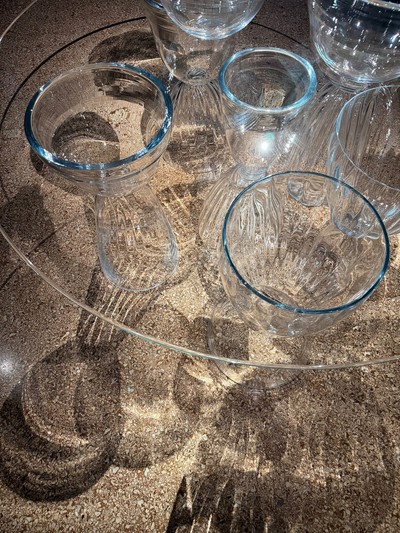
Table by Wave Murano Glass.
Roberto Beltrami: I’m the founder of Wave Murano Glass, which is the youngest glass company in Murano. This table is something we custom-made for this room. After Dries came to us, we came to [the palazzo] to check out the space, and the first thing that caught our eye were these amazing chandeliers that are everywhere throughout the palazzo, but the one in this room in particular is amazing.
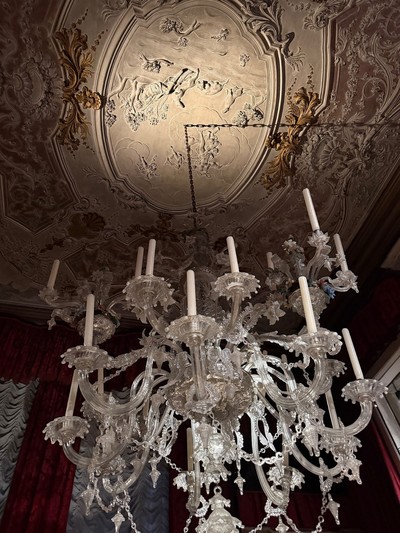
Original chandelier in the Palazzo Pisani Moretta.
All of them have incredible technical things about them, which have never been seen before. They’re from the 1700s, so even though they’re incredibly old, they’re amazingly modern. The idea was to zoom in on the details, the amazing details, of this chandelier and reflect them down into this table as something more minimalistic.
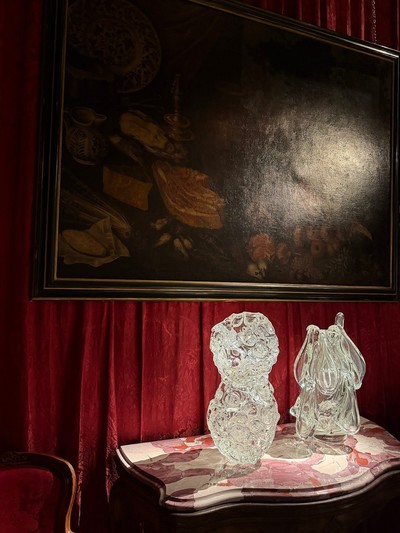
Glass work by Ritsue Mishima.
Ritsue Mishima: I am a Japanese artist, working with glass for 35 years now. I live and work between Kyoto and Venice, and create glass strictly in a Murano glass factory. I always work exclusively with transparent glass because my [focus] is light, not the material, and the transparent glass contains all of the colours and reflects whatever is around it, even becoming the colour of the viewer. These glasses, for instance, were created to communicate with the room. Dries gave me the idea to work in response to the paintings [in the room], and I adapted that idea into these.
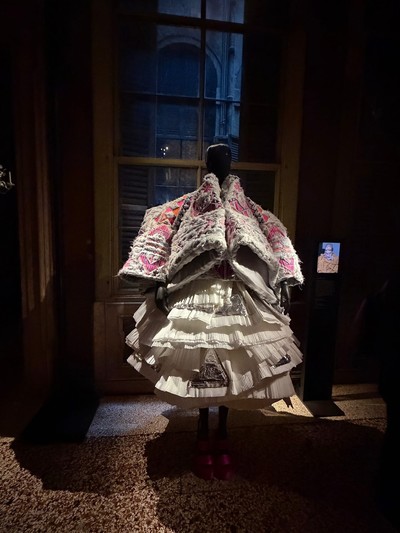
Designs by Ayham Hassan.
Ayham Hassan: I grew up in Ramallah. I got accepted into the Central Saint Martins Master’s Program, but unfortunately, I couldn’t afford the tuition fees. So I crowdfunded my tuition fees and made it to London. What you see here is my graduate collection, which Emma Davidson wrote a story about for Dazed that went viral.
This piece features traditional embroidery through a modern lens. The colours in Gazan dress are often very vibrant because they are by the sea, and in every region of Palestine, the embroidery and motifs are inspired by the landscape. When you see a dress, you immediately notice which landscape it is from. In this look, I focused mainly on Gazan inspirations, but I also worked with a lot of different references, because I was born into an occupation and it was very interesting for me to see how I could combine my atmosphere in London and being in Central St Martins with the completely different atmosphere of where I grew up.
This Fondazione creates a phenomenal conversation. For instance, you can see in this room, with the historical references in the piece by Lacroix, and then wearable, abstract art from Comme, and a very brutalist sculpture by Peter Buggenhout.
Dries was very inspiring. He always has so few words, but they are very beautifully chosen words to describe someone’s work and to inspire them. It’s a huge inspiration for me, because he is one of my favourites. I’ve been a fashion boy since I was 12 years old, and I watched all of these incredible, iconic designers as I grew up, and so to be recognised by someone like Dries is an incredible honour.
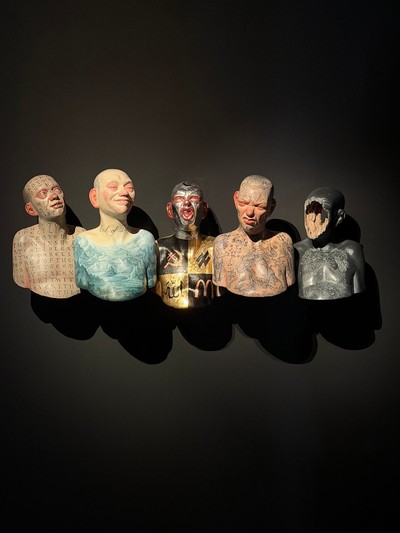
Sculptures by Richard Štipl.
Richard Štipl: These are wooden self-portraits. Each portrait is made out of clay first. I hold the pose in the mirror for several days, modelling the clay until I’m happy with the expression, and then it’s transferred into wood. So these are hand-carved and finished in a technique 17th-century Spanish sculptors used to achieve high realism. I like using processes and techniques of the past, so each head is finished in a different way and uses different symbols.
They’re all sort of expressions of what’s on the inside is presented on the outside. On the far right, we have a reference to the material itself. I made a cave inside the head, so you can see the actual wood, so you know it’s not cast in plastic or printed. Also, the cave is in reference to the origin of art. As we know, art started in the cave before moving into the world. In the middle, I use a gold and silver leaf technique and different symbols, referring to all the ways of ruling the world, while the [portrait] to the far left is a reference to old parchment. I’m using that visual language of letters, but the text itself is taken from a novel by Sylvia Plath, The Bell Jar, which deals with stripping of the skin and feeling and being vulnerable in front of the world.
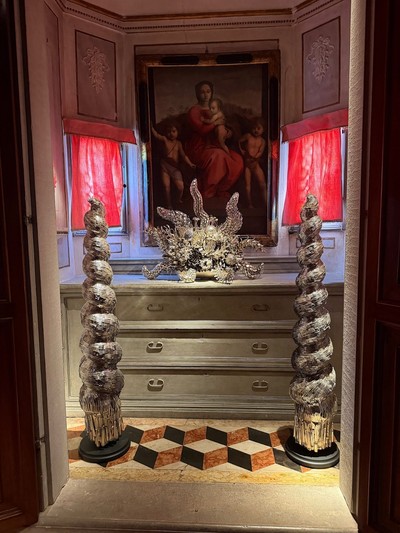
Altarpiece at Ann Carrington.
Ann Carrington: In my practice, I like to use quite a lot of recycled found materials, because anything that you look at, whether it’s a door, a tile, or a piece of cloth, comes with its own history. This piece here first came about when I was in the Rijksmuseum looking at the Dutch ‘Vanitas’ paintings, which are intended to remind you that one day you will die. Often they will have a laid table with a knife, a fork, and a spoon to show you the pleasures of life, and perhaps some flowers, which are symbolic of the passing of time.
I was wondering how you could make a contemporary version of that, maybe a sculpture, and it occurred to me that the only thing from those paintings that would survive in the world now would be the cutlery; everything else would have disintegrated, so that was the genesis of the idea.