With the new major Helmut Lang exhibition, System spoke to the seminal designer’s close collaborators – including Jenny Holzer, Juergen Teller and Elfie Semotan – as well as Helmut Lang himself.
By Jonathan Wingfield
With the new major Helmut Lang exhibition, System spoke to the seminal designer’s close collaborators – including Jenny Holzer, Juergen Teller and Elfie Semotan – as well as Helmut Lang himself.
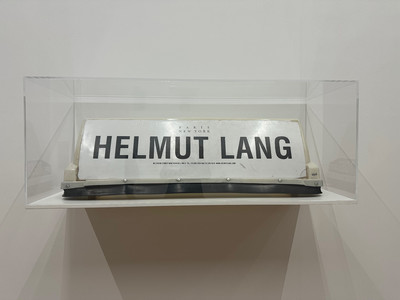
Helmut Lang, New York City Taxi Top, 2002.
Helmut Lang Archive, MAK Museum.
It’s easy to forget quite how progressive, radical, different, Helmut Lang’s take on fashion was when it first emerged against the baroque landscape of the mid-to-late 1980s. Time has a habit of softly eroding fashion’s more abrasive expressions, yet Lang’s spiky minimalism still smacks of something cultish, alternative, a little sinister. In a 2015 Artforum interview he claimed, ‘My work was a reaction to the opulence of the time, and it was part of what in hindsight became an essentialist anti-movement.’
Wrapped around, and equally important to, his pared-back and sensual apparel, were the many creative developments within Lang’s eponymous brand. Here, architecture, store design, photography, graphics, advertising, artist collaborations, fragrance and so much more converged to offer signifiers of how he saw the world: informed by fine art, subdued yet often dramatic, with an undercurrent of sexiness that, when taken together, resulted in an unerringly modern vision.
Operating from his hometown of Vienna, then Paris, and ultimately New York, Helmut Lang’s 20-year-stance was one of fashion’s most memorable authorships of the zeitgeist. And then, in 2005, he stepped away from fashion entirely, devoting himself to fine art, creating sculptural artworks from his studio on Long Island. He was hardly seen nor heard from (certainly in the context of a fashion industry which felt increasingly informed by his aesthetic and philosophy), until 2011 when, following a fire at his studio which destroyed parts of his fashion archive, Lang donated what remained to Vienna’s MAK Museum of Applied Arts. Last week saw the opening at the museum of Séance de Travail 1986–2005, a major exhibition that sets out to present Helmut Lang’s world through the wide-spanning ephemera contained in the archive.
Against the backdrop of this remarkable achievement – not least because Lang himself has always resisted any opportunity for nostalgia, hubris, or, indeed, a retrospective – System set about gathering some thoughts, insights, memories and reflections from those closest in proximity to the work: MAK Museum’s director Lilli Hollein and curator Marlies Wirth; Lang’s friends and artistic collaborators Elfie Semotan, Juergen Teller and Jenny Holzer; fashion writer Tim Blanks; and the enigmatic Helmut Lang himself.
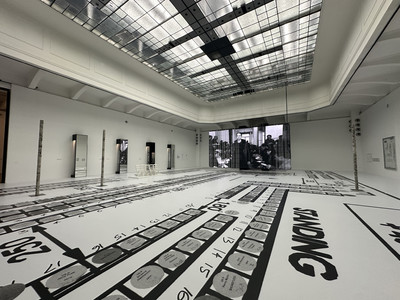
Installation view, Séance de Travail 1986-2005, at MAK Museum.
Tim Blanks, writer and editor-at-large, Business of Fashion: Back in the day, when you were in the moment of Helmut Lang, you didn’t realise quite how complete the world he was building was. The art-world word for it is Gesamtkunstwerk – the ‘total artwork’, where every single element is important. Helmut has also used the term ‘alles gleich schwer’, which translates to ‘everything has an equal weight’, and so the tiniest little things – for example, those rubber band bracelets you’d wear as backstage ID – held as much importance for his brand as what was on the runway at his mesmerising shows, which he called his Séances de Travail.
Lilli Hollein, general director, MAK: When I became the MAK’s director four years ago, my first trip took me to Long Island to speak with Helmut Lang about doing a show using the archive he had entrusted to the museum in 2011. After some discussions with him, it quickly became clear that this would mean presenting the Gesamtkunstwerk: the architecture, graphic design, artist collaborations, behind-the-scenes procedures, use of video, advertising and, of course, the strategies for the garments. Because everything about Helmut Lang’s philosophy and work is held within this archive, which is very important for a museum of applied arts – the idea of really showing an artist’s process.
Marlies Wirth, exhibition curator: Convincing Helmut Lang to agree to do an exhibition looking into his past, from the 1980s to 2005, was not an easy task. The MAK holds the largest archive of his work from this period, containing more than 10,000 data entries, so we achieved it under the premise that it was not going to be a ‘fashion’ exhibition. As the exhibition curator, I was summoned to Helmut’s studio, where I had the pleasure and honour of pitching my concept to create a scenography and fill it with life and narration through the individual items from the archive.
Tim Blanks: Helmut calls what he donated to the MAK a ‘living archive’, because it’s all the ephemera that makes up a life. As a fashion-adjacent show, it echoes both in culture and in real life. Considering that most of the people who visit this exhibition will never have been to a Helmut Lang show, never been in a Helmut Lang shop, never experienced the sheer totality of his vision, what’s presented here really gives it to you.
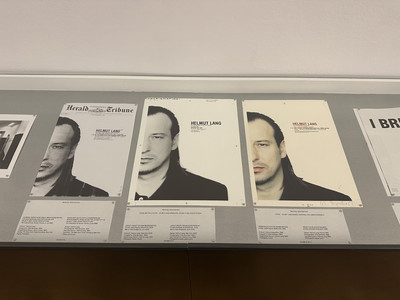
Installation view, wraparound advertisement proofs for the International Herald Tribune, July 1996, featuring a portrait by Elfie Semotan.
Helmut Lang Archive, MAK Museum.
Lilli Hollein: I totally understood that Helmut wouldn’t want to be confronted with a life that he has left behind. At a certain point we were able to build a trust that this could be something that reflects on those years without becoming a retrospective or sentimental journey… and that we could tell the story of Helmut Lang through today’s eyes and today’s means. It was clear that the show would contain a lot of media – documentation of the runway shows, visual material, ephemera from his working processes, many of which have never before been exhibited.
Marlies Wirth: For the scenography of the exhibition, I purposefully wanted to recreate the spatial mood of Helmut Lang’s aesthetics and design principles. This included one-to-one scale, black modular containers, which are the translation into exhibition display of what used to be the displays at 80 Greene Street in New York, his flagship store that he conceived and designed with the architect Richard Gluckman, who was known for designing museums and gallery spaces. As well as their sheer monumentality, the containers also express the conceptual idea of being a philosophical form that can contain, reveal or conceal whatever you place in them. In the flagship stores, they contained items to purchase. Now, in the museum, they display archival materials that show, among other things, what the containers were originally conceived for.
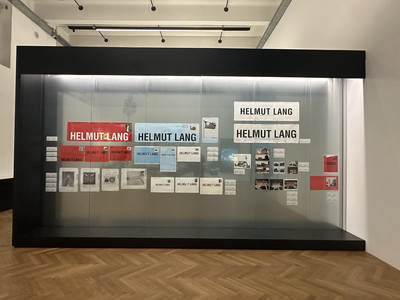
Installation view, Séance de Travail 1986-2005, at MAK Museum.
Marlies Wirth: As the project progressed, I had the feeling that Helmut was becoming more comfortable with dealing with his past. I was allowed to ask him personal questions: ‘Why did you choose to do that? How did you happen to meet this person?’ And when you speak with him about his work, there’s still a very emotional and nuanced response in the way he talks about the people he worked with closely, and is still in touch with.
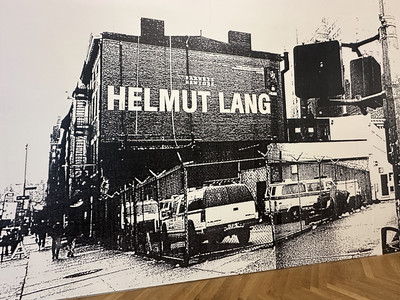
Installation view, test print of a Helmut Lang Barneys New York wall advertisement for Spring/Summer 1997, featuring a photograph by Elfie Semotan.
Helmut Lang Archive, MAK Museum.
Elfie Semotan, photographer and Helmut Lang model: It must have been 1987 when Helmut phoned because he wanted to work with me. And of course, I wanted to work with him too but had never had a chance to do so before. So we began talking about me taking photos, the kinds of photos he wanted, and we immediately felt very at ease with each other. It was the start of both a long collaboration and a long friendship.
Juergen Teller, photographer: From the first time we met, in the early 1990s, I liked Helmut personally. I also felt a strong connection with him because we were both outsiders. At the time, the fashion industry felt ruled by the bourgeois uptightness of the French or the arrogance of the English. It was horrific to go to Paris in the 1990s if you couldn’t speak French; they made you feel like a complete idiot, and you certainly didn’t get taken seriously. So it was comforting to know Helmut, this guy from Vienna doing something exciting in fashion, and having real success making work that I could respond to intelligently. And it felt extra good that we could speak to each other in our shared language of German.
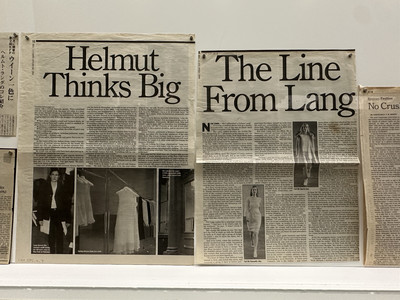
Installation view, archive press clippings.
Helmut Lang Archive, MAK Museum.
Elfie Semotan: I quickly realised that Helmut’s approach was very free and artistic. He wasn’t somebody who was thinking of ‘fashion’, or making lots of money, or who wanted everybody to love it. He just thought about the things he wanted to express and he followed his instincts. His fashion was never too far-out, because he always considered what had come before, but then he changed and evolved those things through subtle differences. And because of that, it looked different to everything else at the time: more modern, more elegant, more interesting.
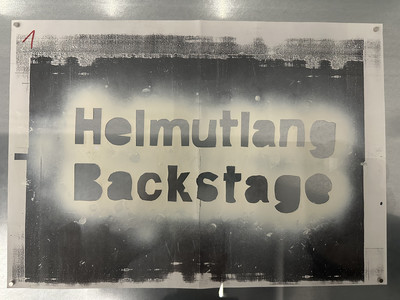
Installation view, stencil from Séance de Travail Spring/Summer 1994 and Autumn/Winter 1994-95.
Helmut Lang Archive, MAK Museum.
Juergen Teller: In 1993, I was commissioned by i-D magazine to photograph backstage at one of his shows. I remember thinking to myself: ‘Everything you’d want to capture about Helmut Lang is back here.’ These modern and abstract clothes; the cool girls like Kirsten Owen, Kristen McMenamy and Stella Tennant, who I already knew and were my friends, as well as the supermodels like Claudia Schiffer, Stephanie Seymour, Christy Turlington and Linda Evangelista; the hair and makeup by people I knew like Guido and Dick Page; and Kruder & Dorfmeister doing the music. It was an incredibly exciting moment in fashion and photographing it backstage in this spontaneous way felt more modern than the contrived, pompous shoots that everyone was doing for other brands.
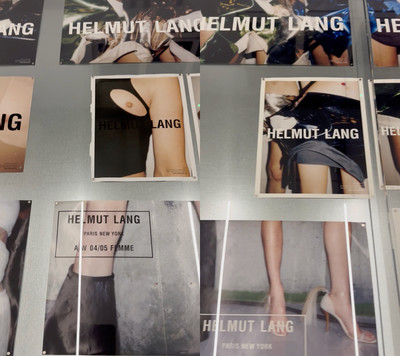
Installation views, Juergen Teller’s photographs for Helmut Lang advertising campaigns.
Helmut Lang Archive, MAK Museum.
Juergen Teller: It was clear to me that this was the most intelligent way to photograph his clothes, focusing on details and textures of the new materials he was using – shiny, unfamiliar fabrics instead of just wool – and the way he cut them. The details mattered more than the silhouette. And it was sexy, too, but in a non-clichéd way, and equally sexy for men and women, which was rare at the time. That came from Helmut’s mind. I just made sense of it through photography. Helmut immediately saw the value and said, ‘You should come to every show, this is the perfect document of what I’m doing.’
Jenny Holzer, artist and collaborator: Ingrid Sischy of Interview magazine introduced and paired us. She was astute – we worked and lasted. Helmut and I met at my kitchen table and I was startled by how much I wanted him to stay. I’m an odd recluse, so long and happy meetings are rare. Helmut was and is intelligent, extreme, disciplined, harmed, kind, nuts, courageous, obsessive, supportive, visually cruel, plus plenty more fine words that strangely do not contradict.
Marlies Wirth: Upon entering the Helmut Lang stores you’d see first a sculpture, not a product, and as a staple in all flagship stores from 1997 onwards were site-specific, text-based LED installations by Jenny Holzer. This collaboration derived from an artistic project that Jenny Holzer and Helmut Lang did together the year before, at the Florence Biennale, and later resulted in another collaboration for the Helmut Lang Parfumerie store and fragrance launch, which was accompanied by the seminal I Smell You On My Skin text-based advertising campaign.
Jenny Holzer: Helmut and I hatched electronic signs integrated with architecture all the way to crumpled handouts. We went through and around media and disciplines. We proffered our pasts, motion, white light, colour in space, the better not to know, and fast eye and throat grabbing. Touch was there. We attempted an incomprehensible whole. A rule for content was ‘don’t lie’. Following Louise Bourgeois’ recommendation and confession, there may have been plenty of ‘sublimation’ going on. We meant no harm.
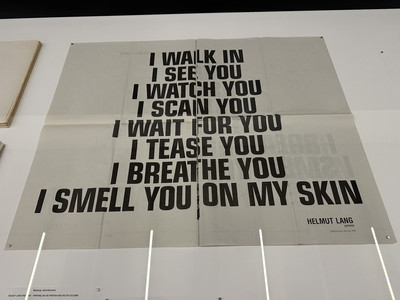
Installation view, Helmut Lang Parfums supplement from the New York Times, 2001, featuring Jenny Holzer’s text.
Helmut Lang Archive, MAK Museum.
Jenny Holzer: Helmut’s personal and professional qualities were evident when we imagined the ‘perfume’ for the art and fashion show in Florence [at the Biennale, 1996], the show that was our first collaboration. Of course, our scent needed to summon sperm, sweat and starch, plus maybe tears. The text for the Florentine light projection, realised on and across the Arno River, could not have been harder or more tender. It lit sex, loss, incandescent lust, dying, abuse, unbreakable attachment, betrayal, glorious sensation, abandonment, love everlasting… Its words were reflected on and from the river’s flow and onto hard ancient surfaces. There was light glimmering and flickering. I have been projecting ever since.
Lilli Hollein: The absence of garments in the exhibition is a design strategy that we learned from Helmut Lang. It was important to show how much detail Helmut Lang put into developing a brand that is, in many respects, a way of living – that requires much more than just dressed mannequins with complete looks. The few garments we do show are representatives of the essence; key points where you can understand the play with materials. You immediately understand the development of the sources of inspiration, be it folklore, Austrian traditional clothing, playing with materials that haven’t been used in fashion before – like the stingray skirt, for instance – or the deconstruction of the tank top, which again reflects an almost architectural approach.
Tim Blanks: There’s one room in the exhibition that, to me, totally defines Helmut Lang’s radicalism; his purity and rigour of vision but also the fetishism that underpins his work. It’s a display of these things he called accessoire-vêtements, pieces which are the framework of clothes – a shirt collar, a placket, a waistband. Right from 1986, his preoccupation was this kind of modernism and this distillation of clothing into fetish objects. One of the most incredible things about Helmut Lang is that he could refine the basest instincts into things of the purest beauty that endure forever. They haven’t been seen like this before, which is why I think this exhibition is so incredible.
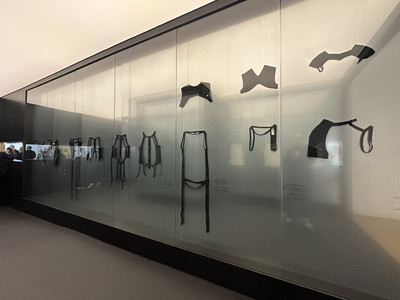
Installation view, accessoire-vêtements.
Helmut Lang Archive, MAK Museum.
Elfie Semotan: Later on, in about 1998, I modelled for Helmut, which was wonderful. I already knew the scene of his shows from before, from taking photos there, but it’s something else to model… The clothes made you look really good. And still today his fashion never looks old. I still dress in Helmut, it always works.
Juergen Teller: Later, as the company grew and Helmut began advertising, he used extremely clever, mostly very small images on double-page spreads with the big Helmut Lang logo. Sometimes they were my backstage photographs, sometimes works by Louise Bourgeois or Mapplethorpe. It was incredibly powerful. He used advertising language in a completely new and modern way.
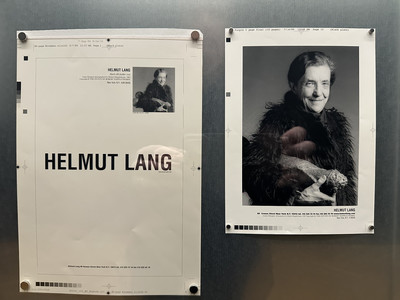
Installation view, Louise Bourgeois photographed by Robert Mapplethorpe (1982), seen in Helmut Lang Autumn/Winter 1999-2000 advertising campaign proofs.
Helmut Lang Archive, MAK Museum.
Marlies Wirth: Many of Helmut Lang’s ideas still have an uncanny contemporary relevance, which is largely because he did a lot of cultural inserts that were unusual, not only for the brand he was working in, but also for the time. Sometimes they weren’t understood within their time, or maybe they’re read differently now since so much has changed in the world. A lot of new-media shifts have taken place, and many things that he anticipated – or tried out of courage, intuition-driven, to increase the authenticity of the human touch or emotional resonance that he always inserted into his strategies – now feel very commonplace to a younger generation. But we can’t forget that there was a time when this was definitely not the norm, a time when Helmut Lang really challenged societal ideas, traditions, and hierarchies. And that’s what’s so fascinating about reconsidering or discovering his oeuvre today.
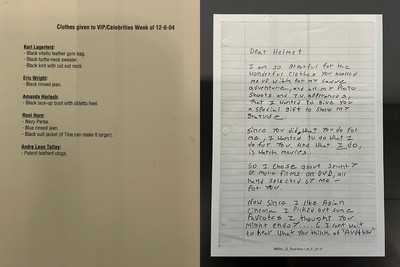
Installation views: Left, VIP clothes listing document;
Right, a letter to Helmut Lang from Quentin Tarantino.
Helmut Lang Archive, MAK Museum.
Juergen Teller: In 1996, I did a story for Süddeutsche Zeitung magazine with Edward Enninful on the theme of fashion and morality. I photographed Kristen McMenamy with the Versace heart for the cover. When it came out, people either loved it or hated it. Kristen said it was the most honest photograph ever taken of her, but others claimed I had ruined her career in this one photo. Helmut completely supported it and said, ‘Let’s put a copy of Süddeutsche Zeitung on every front-row seat at my next show, because Kristen is part of me, Juergen is part of me.’ Like so much of what he did, that gesture had a huge impact on the fashion industry. Just like when Helmut moved from Paris to New York, he changed fashion history. New York had always been at the end of the fashion-show calendar, but he moved New York Fashion Week to the beginning because he wanted to be first, not last. He was also the first to stop doing a traditional fashion show and present it on the internet. Again, these things had a huge impact on the fashion industry.
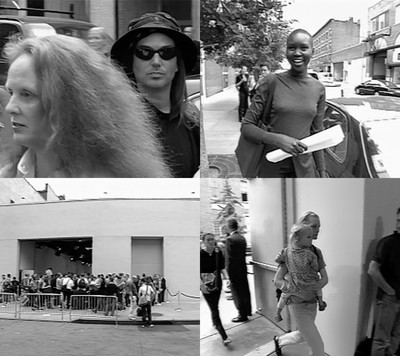
Video stills from TV show Fashion File’s coverage of the Spring/Summer 1999 Séances de Travail, New York.
Helmut Lang Archive, MAK Museum.
Lilli Hollein: If you look at the recent 2026 runway collections, you can see a lot of presence of the work and thinking and process of Helmut Lang in them. But just wait for the 2027 collections, once people have seen the exhibition.
How do you feel about the MAK’s Helmut Lang Séance de Travail 1986–2005 exhibition?
Helmut Lang: I wish they would have done it after my death – which obviously did not happen. But after six months of emotional turmoil – both some good ones and some old traumas – as well as brutal hard work with Marlies and her team at the MAK, it stands on solid ground and is probably a groundbreaking way to deal with an archive.
For a young person coming to see the exhibition and discovering the work for the first time, what would you want them to know about your intentions and ambitions, or philosophy around your work at the time?
Helmut Lang: All intentions, ambitions or philosophies are seen as way more thought-out in retrospect. It did not happen that way because most things just happened through the work process. The aim was always to do good work that one could hand over to the public without regrets. That is how my mind works for anything. It was the convergence of hard work 24/7, of authenticity, of courage without thoughts of consequences, of caring about the human condition, and of working within the confines of being short on money – which is probably one mother of invention. Beyond that, everything else was elaborated and interpreted by journalists and others in the industry once the work was handed over to the public. So for young or new people discovering the work today in the context of the exhibition, I assume they will take from it what they are able to through both today’s general and individual lens.
You sold your brand and stepped away from fashion in 2005 to concentrate on your work as a fine artist. What first comes to mind when you reflect today on your previous life as a fashion designer?
Helmut Lang: Different work, different level – just evolving the medium. The past is implemented in my present and future, as I feel time is equally past, present, future. Ultimately, the past is never easier than the present. And the present is always the opportunity.