By Houssem El Ghoul
System speaks to HAUS NOWHERE about using robots, fashion, and sculpture to create spaces that challenge the concept of retail.
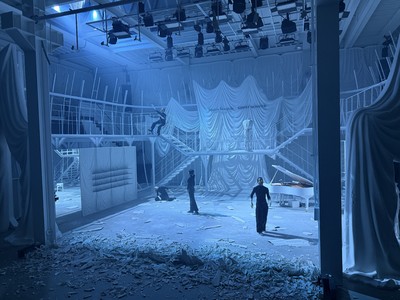
The Gentle Monster and Maison Margiela performance. Choreography by Damien Jalet. Artwork by Ian McMahon. Music by Koki Nakano. Performed by Aimilios Arapoglou, Astrid Sweeney, Ju Young Lee, Seoljin Kim and Vinson Fraley.
Choi Woo Seok directs HAUS NOWHERE, the Seoul-based spatial design team behind Gentle Monster’s giant robot heads, kinetic installations and landmark stores. The Korean eyewear brand’s fourth collaboration with Maison Margiela centred around the concept of ‘deconstruction’, with designs that deconstructed and distorted the brand’s signature eyewear. For the unveiling of the collection at Studio Layer41, HAUS NOWHERE worked with sculptor Ian McMahon on a plaster curtain that was brought to life by choreographer Damien Jalet.
Here, Choi Woo Seok talks to System’s Houssem El Ghoul about deconstruction, working without an architecture degree, and why he hopes the stores of 2036 are impossible to picture today.
System: The thing that struck me most when I first encountered Gentle Monster was the giant robot head, which was shown in HAUS Shanghai in 2021 and drew so much buzz that people lined up to see it. Where did an idea like that come from?
Choi Woo Seok: For us every idea, from installations to spatial design, starts strictly from the perspective of the people who will encounter our creations. We keep asking ourselves what people might have never experienced before.
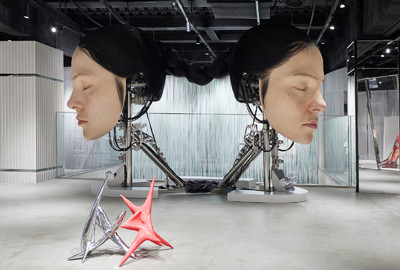
The giant robot head is an extension of that same approach. What we found interesting was not so much the robotics technology itself, but the unfamiliar feeling people have when they come face to face, inside a store, with a giant being that takes a human form but is not human. We believed that when a familiar object takes on an unreal scale and movement, the way people perceive it can change completely.
The robot was built by Gentle Monster’s own in-house robotics lab. Is the lab part of the team you lead, or do you give them a direction and collaborate separately?
Gentle Monster has a number of creative teams, each with its own expertise, and the robotics lab is one of them. Rather than having each team carry out only its assigned role to realise an idea, we value sharing perspectives and possibilities with one another from the earliest concept stage and developing the idea together.
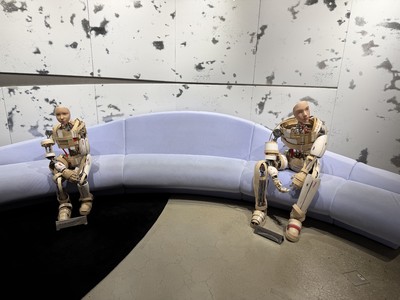
Kinetic installations in particular go beyond simply engineering technical movement; we see them as an important creative tool for generating new sensations and experiences within a space. Sometimes a spatial vision becomes the starting point for technical development, and conversely, technical experiments sometimes reveal new spatial possibilities we never anticipated. I think this way of working, where creators from different disciplines collaborate toward a single goal, is one of Gentle Monster’s greatest strengths.
You didn’t study architecture. Does that actually liberate you when it comes to designing spaces?
I believe we live in an era where, when it comes to creativity, the ability to connect diverse experiences and knowledge from different fields has become just as important as studying a single field in depth. Of course, deep expertise in a particular field is still important. But to create something new that has never existed before, I think you sometimes need to step outside your familiar territory and look at things from the perspective of an entirely different field.
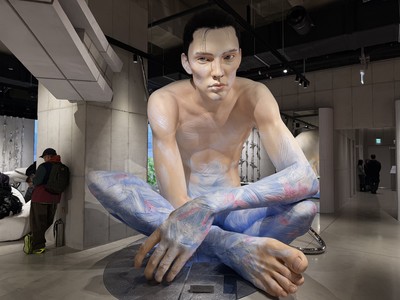
I, too, naturally expanded into spatial design through experiencing work across many different fields. Because I didn’t study architecture, I think I was able to imagine space a little more freely, without being bound by existing architectural conventions or set ways of doing things. Ultimately, I believe new creation doesn’t happen within a single field. It is born at the moment when the boundaries between different fields break down, and unexpected things become connected. I think what matters more than how well you know architecture is how much you can imagine something new through architecture and inspire people with it.
How would you describe your spatial design team to someone who has never seen it at work?
Our team designs for offline, physical spaces, but we work a little differently from a typical architecture or interior design team. I see our team as a creative collective that explores all kinds of possibilities to turn imagination into reality.
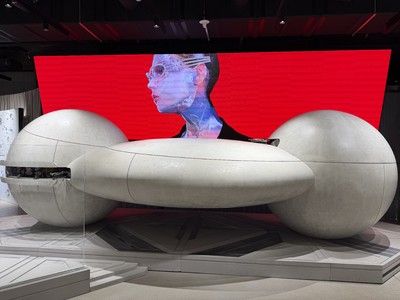
What we consider most important in our process is constantly exploring how the spaces and experiences we create can give people new inspiration. In particular, from the earliest stage of ideation, we try not to draw clear lines between each discipline’s role or limits. We value people from different backgrounds sharing their opinions freely and the unexpected new ideas that emerge from that process.
Let’s talk about the new Maison Margiela project in Seoul.
What we considered most important for this project was turning the concept of ‘new creation through deconstruction’ into a single spatial experience. We see deconstruction not simply as an act of destroying or separating something, but as a creative process of discovering new possibilities by breaking down existing forms and order.
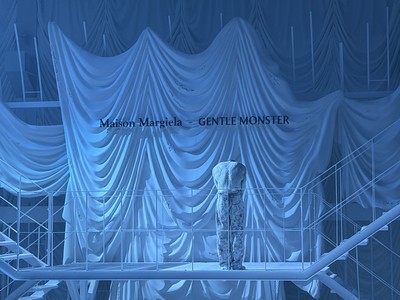
To express this concept, we worked with sculptor Ian McMahon and choreographer Damien Jalet. Ian McMahon created a monumental installation in the form of a curtain, made from plaster. What we found interesting was that a curtain, normally made of soft, flexible material, was realised in plaster, a hard and fragile substance. As the familiar form collides with the nature of the material it is made of, visitors come to see an everyday object from a completely different perspective. Damien Jalet’s performance added a new dimension of time and movement to this space.
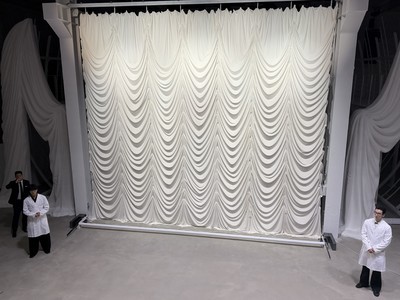
As an installation made of fixed matter meets the constantly moving human body, the space transforms from simply something to look at into a place where an event unfolds. Rather than presenting the installation and the performance as separate, independent artworks, we wanted them to influence each other and create a single experience together. Ultimately, what we wanted to show through this project was that deconstruction does not mean an ending, but can be the moment a new creation begins.
Margiela is known for anonymity and deconstruction; Gentle Monster for striking visual staging and overwhelming scale. Were there points where the two approaches clashed?
I think that although the two brands have different aesthetics and modes of expression, they share the same philosophy in their attitude toward creation. If Maison Margiela discovers new beauty by deconstructing and reinterpreting existing forms and conventions, Gentle Monster seeks to look at familiar things from an unfamiliar perspective and create new experiences that never existed before. I don’t think the most important thing in a collaboration is simply combining each other’s aesthetics or adapting to one side’s way of working.
Rather, I believe the true value of collaboration lies in different creative approaches coming together to create new possibilities that neither could have discovered in its own domain. This project, too, was less a process of reconciling our differences and more a process of further expanding each other’s imagination on the basis of a shared creative philosophy. In the end, what we were after was creating something new that could only be born from the meeting of these two brands.
This is your fourth collaboration with Margiela. Compared with the previous three, what was especially important for this Seoul project?
Until now, Gentle Monster and Maison Margiela have broadly expressed the two brands’ creative philosophies through products, spaces and a variety of visual expressions. This time, however, we thought about a new way to let people go beyond simply looking at a finished result and directly experience the overall concept and message of the collaboration. The format we chose as a result of that thinking was performance.
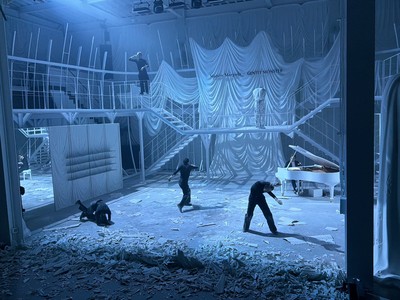
Unlike spaces or installations, I believe performance is an art form that can continually offer the passage of time, human movement and unpredictable moments. To that end, we connected Ian McMahon’s installation and Damien Jalet’s performance into a single experience. As a fixed space meets constantly moving bodies, the space is no longer a static result but a living experience that changes over time. Ultimately, this project was an attempt to take the two brands’ collaboration a step beyond visual expression and expand it into a new experience that acts directly on the audience’s senses and emotions.
Gentle Monster started in Seoul and is now a brand people from around the world travel to experience. When did you first realise the impact of this spatial work?
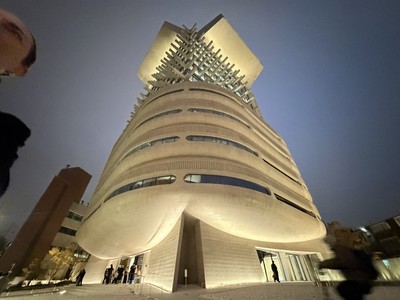
Through HAUS NOWHERE SEOUL, which we recently completed, I’m once again feeling the impact of the spaces we have created. HAUS NOWHERE SEOUL is a project we prepared for a long time. We started it with the goal of going beyond simply building a brand headquarters or retail space, hoping it would become a new landmark representing Seoul. Rather than having the building remembered simply as an unusual piece of architecture, we hoped it would become a place people make a point of visiting to find new experiences and inspiration.
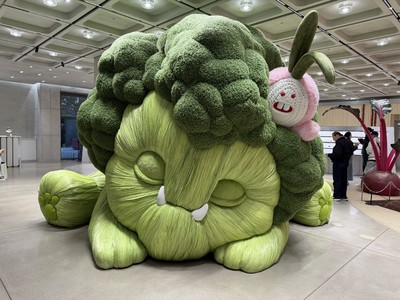
It is deeply rewarding to see customers from countries all over the world actually coming to experience a space we completed after so much deliberation and experimentation over such a long time. It feels meaningful that the imagination and experiments that began in Seoul are now reaching people of different cultures and backgrounds as new experiences.
You started as a media artist and now build entire worlds. What will Gentle Monster’s stores look like ten years from now?
If we could imagine exactly what Gentle Monster’s spaces will look like ten years from now, perhaps that would not be the future we are striving for. Because the future we can imagine now ultimately stays within the bounds of the experiences and possibilities we already know.
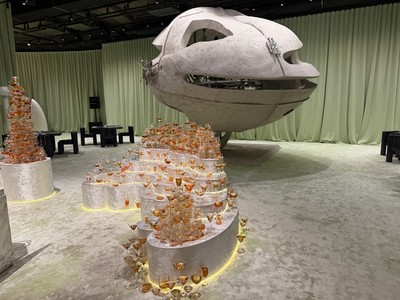
Gentle Monster has never talked about the past; it has always explored the possibility of the new. And I believe this creative attitude will not change in the future. The boundaries between technology, art and architecture will become even more blurred, and the very concept of space may evolve in ways completely different from today. But through all of those changes, the essence of what we pursue will remain the same: delivering to people new sensations and inspiration they have never experienced before. I hope that ten years from now, Gentle Monster will be creating spaces that we cannot even begin to imagine today.