System speaks to the school’s 2026 graduate students and most prestigious alumni, including Matthieu Blazy, Nicolas Di Felice, and more, about what they learned from the famed school in Brussels.
By Houssem El Ghoul
System speaks to the school’s 2026 graduate students and most prestigious alumni, including Matthieu Blazy, Nicolas Di Felice, and more, about what they learned from the famed school in Brussels.
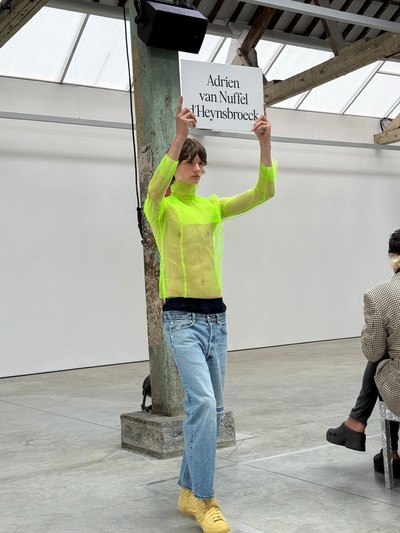
In its 40 years, La Cambre Mode(s), the fashion design department of the Ecole Nationale Supérieure des Arts Visuels de La Cambre in Brussels, has earned a reputation as one of the world’s most prestigious fashion schools. To mark the anniversary, the school assembled a jury of distinguished alumni to judge its graduating students’ annual end-of-year show.
Titled ‘SHOW OFF 26’, the presentation featured the work of eight students from around the world, each reflecting their unique vision of the world and fashion’s place within it.
Following the show, System’s Houssem El Ghoul spoke to this year’s graduating class and some of the jury, which included Matthieu Blazy, Anthony Vaccarello, Nicolas Di Felice, and more.
Student: Adrien van Nuffel d’Heynsbroeck
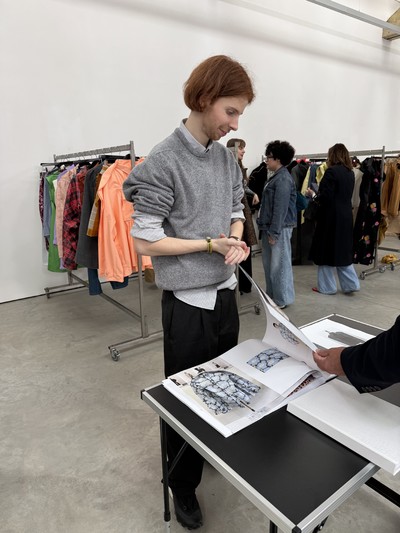
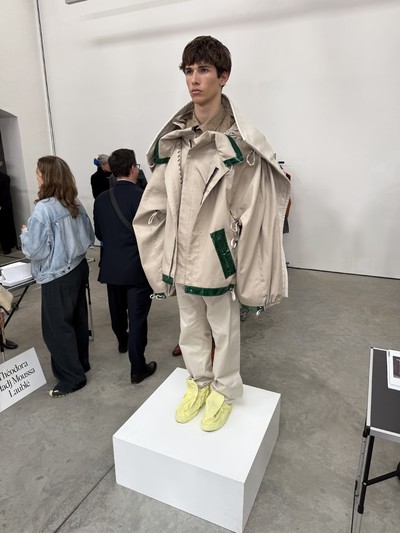
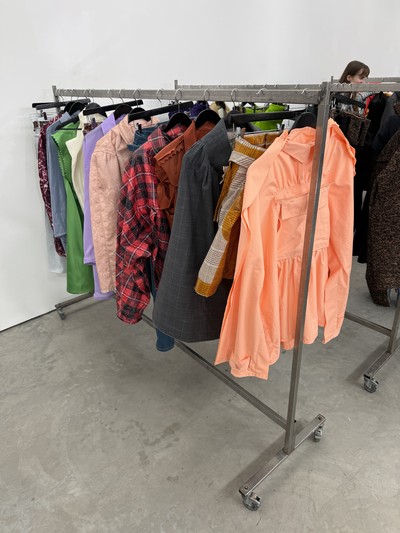
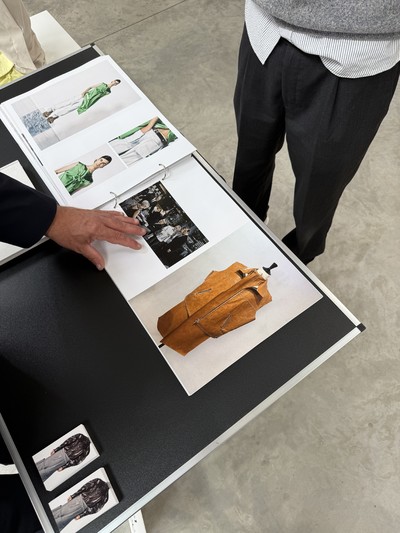
Can you tell us about your collection and how your experience at La Cambre has helped create your fashion world?
My collection is mainly based on old fashion books from the 1950s and earlier. I tried to reinterpret what I saw in them, especially the folded clothes and the feeling of something old and preserved through time.
I was also interested in the presence of paper on the pages alongside the garments. From there, I challenged myself to make clothes using paper and to create an image from those references.
I think La Cambre is one of the best schools you can attend because it asks a lot from you and requires complete dedication throughout the five years.
At the same time, it’s very rewarding. When you arrive in first year and look at the Master students, you think you’ll never be able to do what they do. Then, by the end, you realise that you can.
Alumni: Matthieu Blazy
What did La Cambre bring you as a student, and how did it shape your approach to fashion?
The most important things were the friendships I made and the method I learned there.
We studied at a time before social media, which gave us a certain freedom and ambition. What La Cambre brought me was a very physical approach to the garment. It wasn’t about dreaming without substance; it was about making. And ultimately, making with a dream.
We had extraordinary teachers. They encouraged us to think about fashion through movement, technique and modern art. The education was always rooted in the reality of making while remaining open to broader cultural references.
Is there a particular memory from your time at La Cambre that has stayed with you?
In my third year, we had a teacher named Marianne. One day, she put on techno music and covered the walls with huge sheets of white paper.
The exercise was about translating the physicality of sound. I still remember it because it showed me that fashion could be that too. It could be something physical, emotional and instinctive.
What do you think this generation of designers can bring that previous generations couldn’t?
Every generation brings something new to the table. It wasn’t better before, and it won’t necessarily be better after. It simply has to be new.
Student: Théodora Hadj Moussa Laublé
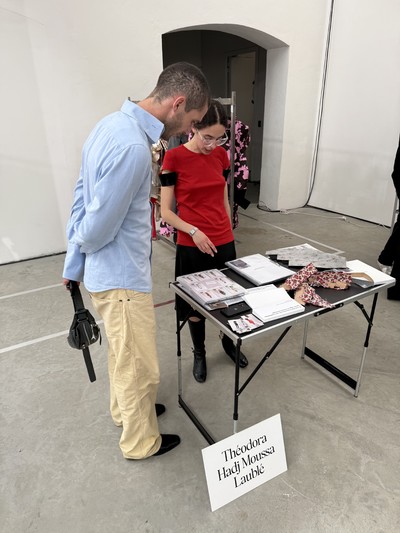
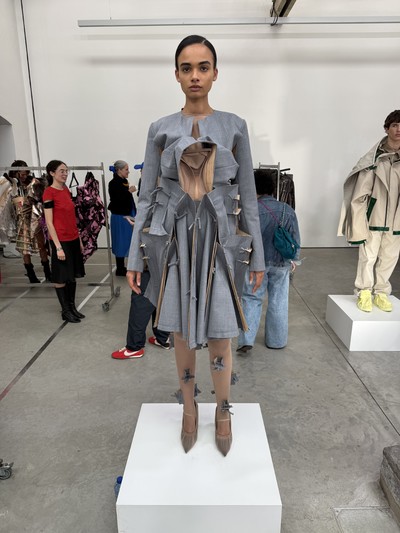
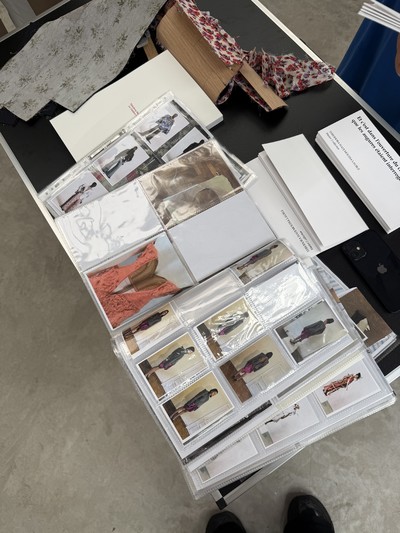
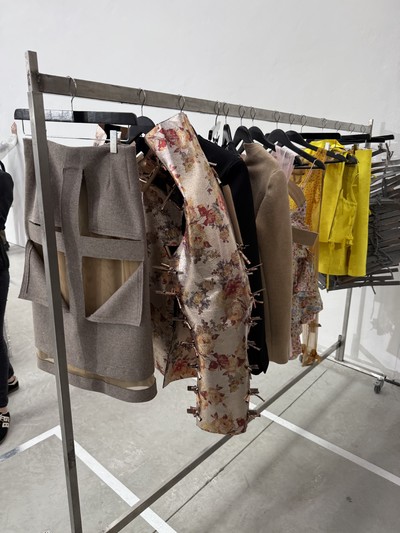
Can you tell us about your collection and how your experience at La Cambre has helped create your fashion world?
The starting point of the collection was a reflection on space and how to make space tangible. I started looking at architectural essays and at the way buildings are constructed. During that research, I came across the work of Gordon Matta-Clark. I loved the way he changed lines and our perception of space, while making visible what we do not usually see.
From there, I developed construction systems with wood integrated into the garments. I was also interested in the inside of garments, which led to me drawing parallels with lingerie construction. That’s why lingerie pieces appear throughout the collection.
At La Cambre, we begin by studying and analysing things as they are. That process gives us a strong foundation in what we do. From there, you can take your work wherever you want, but you always retain that sense of reality.
Alumni: Anthony Vaccarello
Looking back, what made your time at La Cambre such an important part of your development as a fashion designer?
La Cambre was an incredibly intense experience for me. Those five years were entirely dedicated to work, but they were also the years during which I built friendships that remain very important to me today.
It’s where I learned discipline. It’s also where I learned individuality — how to find yourself, how not to look at what everyone else is doing, and instead focus on what genuinely drives you.
When I was a student, the atmosphere was very competitive. Looking at the students today, I have the impression they’re much closer to one another and more united. In the early 2000s, things felt more tense and competitive.
Is there a specific memory or experience that still resonates with you?
One person who left a lasting impression on me was a teacher named Nadine, who taught me during my first two years. She was an incredibly elegant woman. She taught us sewing, but what she transmitted went far beyond technique.
She had such an elegant eye. I still remember her perfume, her jewellery, her posture. Even today, she’s someone who has stayed with me.
What do you think this new generation of designers can express that previous generations couldn’t?
I’m not sure I believe today’s designers express more than we did. If anything, they’re growing up in a world saturated with images, and that can sometimes make it difficult to know what is truly relevant or what belongs to them.
Everything feels a little more uniform today. When we were students, the process of finding what inspired us felt more personal. Now there is so much information and so many images available at all times.
That isn’t necessarily a bad thing. But it can sometimes lead to things becoming flatter or more common. The challenge remains the same: preserving your singularity.
Student: Fantin Delattre Pirenne
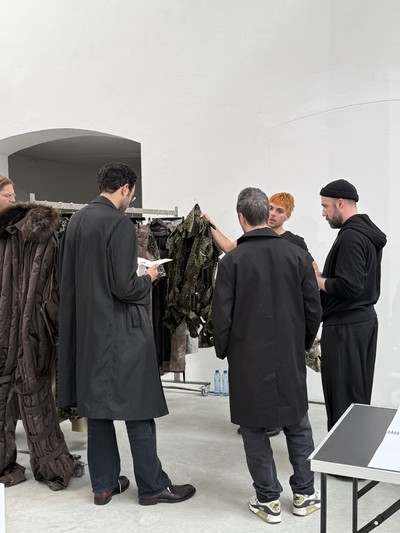
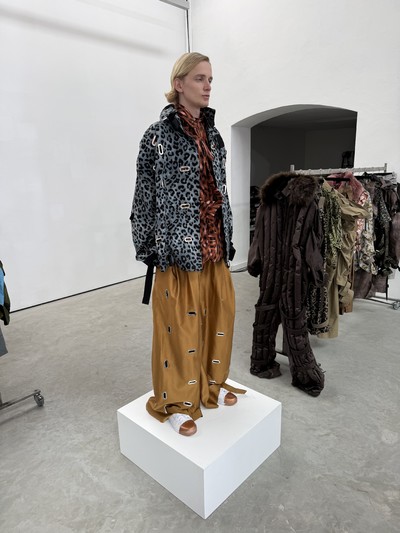
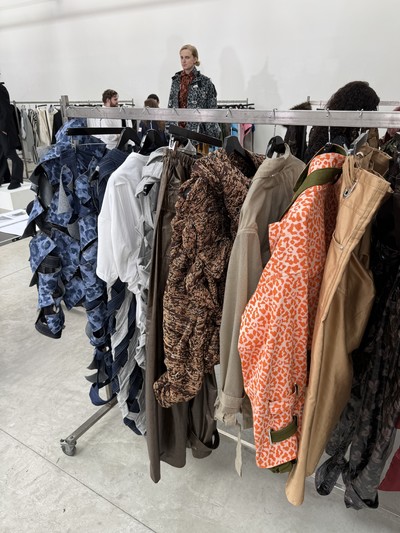
What was the starting point for your collection?
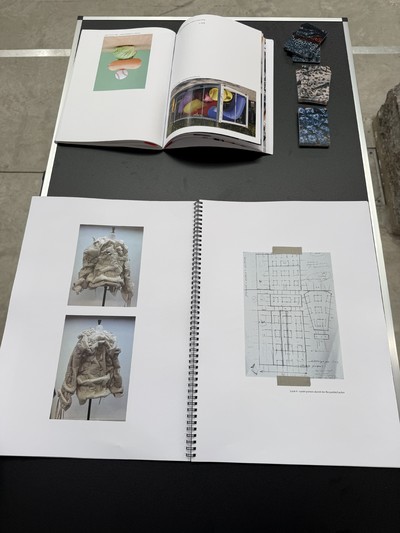
This year I worked with Mario Merz. I was interested in the structures he creates, particularly his igloos and the different elements that appear within them.
I translated those ideas into clothing through straps, draping and different ways of creating volume.
How has La Cambre helped you develop your creative universe?
La Cambre helped me understand the importance of looking directly at an artist’s work rather than relying on a background story.
It encouraged me to be more direct and, at the same time, more personal in my work.
Alumni: Nicolas Di Felice
Looking back, what made your time at La Cambre such an important part of your development as a fashion designer? Is there a specific memory or experience that still resonates with you?
It’s more a general feeling than one specific moment. What stayed with me is the way education is approached here. It’s very global. The goal isn’t simply to make a good collection or to be interested only in fashion.
The school cultivates curiosity. We shared classes with students from all the other departments, so it was really a 360-degree education. Of course, fashion remained the focus, just as sculpture students focused on sculpture, but that openness makes a huge difference.
What has always defined La Cambre is its commitment to helping students find themselves and develop their singularity, rather than fitting into predefined boxes. The school encourages students to cultivate their differences and push them further.
At the same time, it provides a very strong technical foundation, whether through direct cutting, flat pattern cutting or drawing. The emphasis is always on developing a personal language rather than reproducing stereotypes. In that sense, it’s really an anti-stereotype education.
What strikes you about the new generation of students presenting their work today?
What I find interesting is that the students are encouraged to question all the fashion automatisms they already know. They’re constantly pushed to move beyond familiar references and established ways of working.
Honestly, I was surprised by some of the things I saw today. You sometimes feel like you’ve already seen everything, but there were at least a couple of students whose work genuinely surprised me. I was struck by their combinations of materials and by unexpected technical solutions – one student [mention name] even used wood as boning.
I think that willingness to explore unusual ideas comes directly from the fact that they’re encouraged to step outside the beaten path.
Student: Loïc Bernier
Can you tell us about your collection and how your experience at La Cambre has helped create your fashion world?
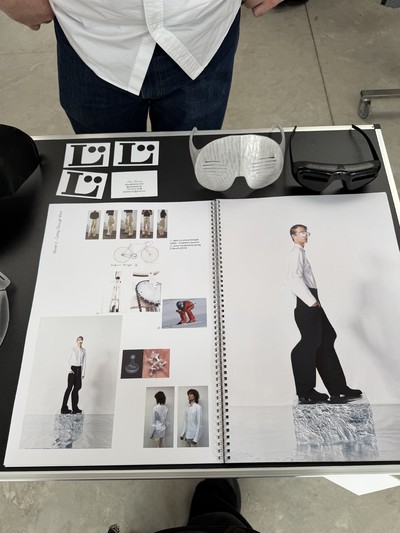
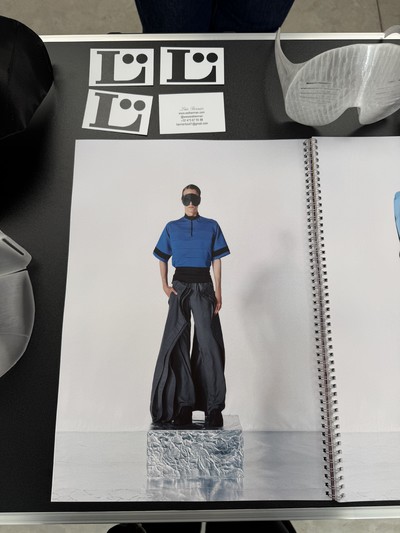
My collection, ‘Cutting Through Wind’, began with research into the shapes and positions that bodies take in speed sports such as track cycling and speed skiing.I developed those shapes into prosthetic elements and then used those prostheses to create a wardrobe that integrates those forms into garments.
La Cambre helped me by providing a set of principles and guidelines for developing a collection. It taught me how to move from influences to garments and how to work from things that are real rather than from vague concepts
Alumni: Marie Adam-Leenardt
Looking back, what made your time at La Cambre such an important part of your development as a fashion designer?
La Cambre isn’t a factory for designers. It’s not a place that tries to produce the next big name in fashion. There’s something very humble about the school. It’s about work, above all else.
Nobody makes you believe in fairytales. You’re taught that where you end up depends on your work and your commitment.La Cambre is also a family. There are very few students, so there’s a real focus on each person individually.
What I find incredible about the school is that we study clothing in three dimensions. You’re immediately working with materials, directly in 3D. Over time, you learn the entire wardrobe and all of its archetypes.
That’s something that remains central to my work today. It creates a practice that is deeply rooted in reality, and in the way people actually dress. What people wear, and what they want to wear, is incredibly important.
The school also teaches you not to make things for the sake of it. The strength of the idea always comes first. The concept and the thinking behind a garment are essential.
Is there a particular memory from your time at La Cambre that has stayed with you?
My first year at La Cambre was probably the best year of my life.
Before arriving there, I didn’t come from a creative background at all. I didn’t even really think I was capable of creating. Then suddenly you’re surrounded by people who push your ideas further and encourage you to develop them.
Realising that you’re capable of creating, while being immersed in that constant exchange of ideas, is an incredible feeling. The people around me played a huge role in that. Sangha [name, role] was incredible. Tony [name, role] was incredible. The whole environment gave me confidence and made me believe I could do this.
What do you think this new generation of designers can express that previous generations couldn’t?
I think we’re living through a moment where fashion feels quite stagnant. Everyone agrees that things need to change, but very little is actually happening. Not many risks are being taken.
We’re in a strange period of transition. It feels like we’re at the end of one era, but not yet fully inside the next one. There’s a sense of suspension-an in-between moment. The question for my generation, but also for the generations before us, is how to reimagine a system that is struggling today.
People still want to be surprised. They still love fashion. The challenge is finding ways to keep that alive while responding to the world we live in now.
At my scale, it’s different because I don’t have the platform of a major fashion house. But that’s exactly the question: how do you create fashion that remains intelligent, thoughtful and capable of pushing things one step further?
Student: Lalou Weyrich
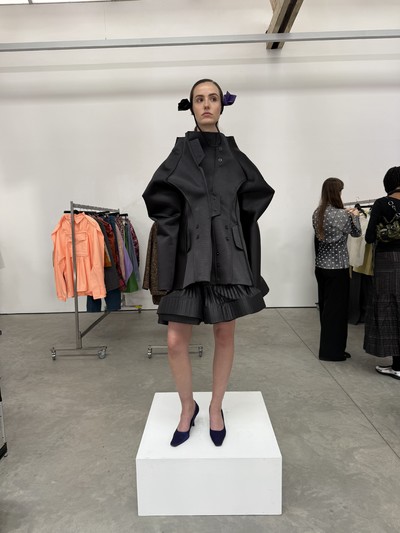
Lalou Weyrich’s presentation.
Can you tell us about your collection and how your experience at La Cambre has helped create your fashion world?
I referenced a pop-up book. I use a lot of maquettes to begin my work and to create volume. For example, I made a paper maquette in the form of a book, which later became a coat.
Throughout the collection, I developed systems that open and close like a pop-up book. You can see it in the skirts and trousers, where parts of the garment unfold and create volume in the same way a pop-up page expands when a book is opened.
This year, I was very happy to work on a womenswear collection. I wanted to create something chic, fluid and full of movement. At the same time, I like to introduce playful elements into my work. That’s why I incorporated colours such as green to disrupt a more classic and elegant wardrobe.
At La Cambre, we have a very particular way of working, and that’s what I appreciate most. We begin with maquettes and work directly on the mannequin. We don’t start with mood boards. We start by creating volume and construction. That’s something that has been very important in shaping my approach to design.
Alumni: Léa Peckre & Julien Dossena
Is there a particular memory from your time at La Cambre that has stayed with you?
Léa Peckre: It’s really my friends. Looking back, it’s funny because we barely had time to support one another in the traditional sense. The rhythm was so intense. But we were together all the time, and somehow that created a kind of symbiosis.
You don’t always realise it at the time, but you’re sharing the same struggles, the same constraints and the same moments of joy.
Julien Dossena: I remember moments when I was struggling and finding letters from classmates in my mailbox. I still remember getting notes from Matthieu [Blazy] telling me to keep going, that everything would be fine and that we were all in it together. We all lived in the same neighbourhood, and there was a real sense of solidarity.
What strikes you about the new generation of designers?
Julien Dossena: One thing that surprised me today is how articulate they are. When they present their work, they’re very precise in the way they explain their ideas and the vocabulary they use. I don’t remember being that precise or that confident when I was a student. You can feel that communication plays a much bigger role than it did for our generation.
Léa Peckre: I think the relationship between students and the industry has changed as well. There is more guidance and more kindness than there was when we were studying. The environment we entered 20 years ago was very different. Certain behaviours were accepted then that simply wouldn’t be today. Thankfully, things have evolved for the better.
Julien Dossena: I was actually surprised that only one student today talked about starting their own brand. Most wanted to work within existing houses. I think that reflects a clear understanding of how difficult it is to build a business today.
They’re very aware of the opportunities offered by social media and digital platforms, but they’re also realistic about the challenges that come with turning a creative project into something sustainable.
Student: Manon Schied
Can you tell us about your collection and how your experience at La Cambre has helped create your fashion world?
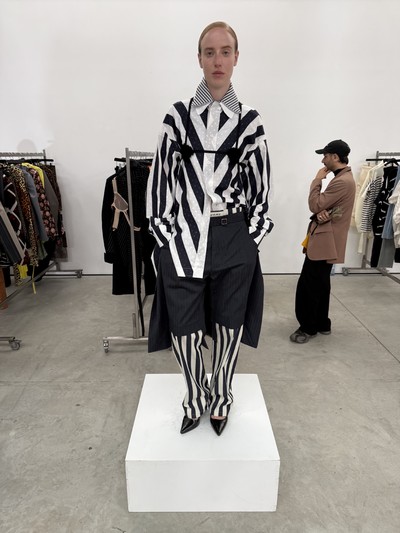
At the beginning of the collection, there is a technical principle based on my third corners. When two perpendicular folds meet, a forty-five-degree angle is created in order to avoid excess fabric. Starting from that principle, I realised that by adding pieces of fabric within the same pattern, I could generate new volumes. By varying different parameters, such as the length of the seam or the depth of the fold, I was able to place those volumes in different areas of the garment.
At the same time, I researched references from queer and lesbian culture in the 1930s. Those references informed the formal wardrobe, the shirts, the trousers and the striped fabrics.
Alumni: Louis Gabriel Nouchi
Looking back, what made your time at La Cambre such an important part of your development as a fashion designer? Is there a specific memory or experience that still resonates with you?
I always wanted to do something playful during the fashion show. I remember exchanging clothes on the runway. It was very student-like, but at least it wasn’t a classic runway. What’s funny is that everything I did at school still feels like a laboratory for what I do with my brand today. I think that’s true for a lot of us.
I loved being pushed. It was a great time, even if we barely slept and it was completely hardcore. The energy was incredible. It also gave us a sense of professionalism because we learned everything: stitching, casting, sound design, textile development. It was a real 360-degree education.
What was special about La Cambre was its perspective. There’s something very Belgian about it. A lot of humour. Even though people are perfectionist, they don’t take themselves too seriously. That’s rare. It’s probably why Belgian designers are so appreciated in studios. There’s a balance between professionalism and humanity.
What strikes you about the new generation of students presenting their work today?
What’s interesting is that I see a lot of nostalgia. Personally, I feel this generation should be looking towards the future. I was surprised not to see more projects engaging with AI, for example.
When I was studying, we were witnessing the arrival of social media. At the time, image was secondary to me. The priority was making clothes. Today, AI and digital tools are part of this generation’s DNA, and I don’t see that as a bad thing. It’s a tool. Like any tool, it can be used well or badly.
People reacted the same way to e-commerce and social media. They thought it would destroy everything. It didn’t. As creative people, we should see these developments as opportunities.
Fashion school is a laboratory. Students don’t need to sell anything yet. They can experiment. For me, school was almost cathartic. You work constantly; you’re completely immersed in your own world. There aren’t many moments in life when you get that freedom.
What surprises me today is that so few students seem interested in starting their own brands. Most want to work in studios. I understand why — the industry is much tougher than it was for us.
But I think they should take risks. Don’t worry about making something ugly. What matters is whether it creates emotion. This generation is growing up with social media, AI, political tension, war, and constant crises. If anything, they have even more reasons to create work that makes people feel something.