By Anano Shalamberidze
At ‘Schiaparelli: Fashion Becomes Art’ at the Victoria & Albert Museum, creative director Daniel Roseberry and others discuss the innovation and artistry of the famed designer.
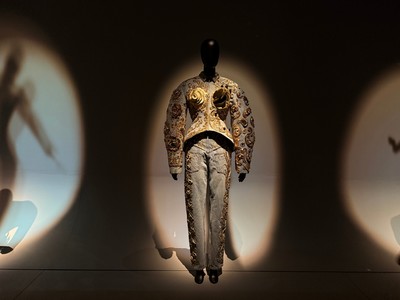
Design from the Schiaparelli Haute Couture Autumn/Winter 2021 collection.
Spanning the 1920s to the present day, the first-ever Schiaparelli exhibition in the UK explores the history and influence of one of the 20th century’s most innovative designers, Elsa Schiaparelli, as well as the house’s present-day reimagining at the hands of creative director Daniel Roseberry. For the occasion, System spoke to exhibition curator Sonnet Stanfill, as well as actress, model, and granddaughter of Elsa Schiaparelli Marisa Berenson, and Roseberry himself.
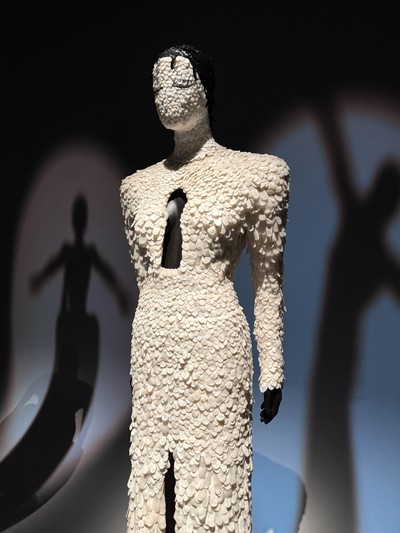
Dress from the Schiaparelli Haute Couture Spring/Summer 2024 collection.
Daniel Roseberry, creative director of Schiaparelli
How does it feel to have your work exhibited alongside Elsa’s at the V&A, and to be contributing to such a legacy?
I think of this exhibit as telling her story – one that has not really been told – and I feel that my work, or the work of the past seven years, is here to support that storytelling. So it’s a huge honour. But at the same time, I don’t feel like this is about me; it’s more about her.
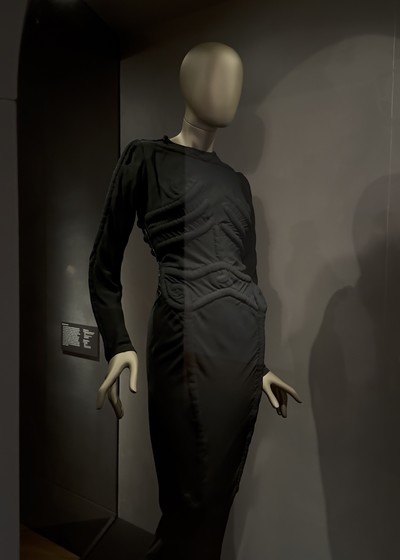
The Skeleton Dress, designed by Elsa Schiaparelli in collaboration with Salvador Dalí in 1938.
Please tell us about three objects in the show which mean the most to you.
The first one is the bone dress [Skeleton Dress] of hers, displayed right next to my lung dress. The bone dress was the first time a garment from Schiap really spoke to me. It’s still incredible to me that this dress is from the 1930s. It’s so modern, it looks like Comme des Garçons from the 1980s.
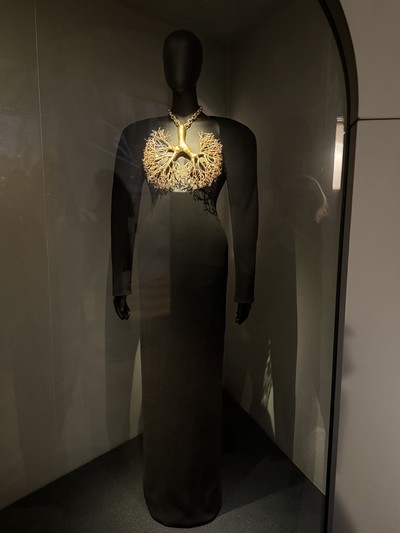
The lung dress Bella Hadid wore to Cannes in 2021.
Bella Hadid wore the lung dress at Cannes, it was the first red carpet after lockdown. It felt like surrealism was coming back to the red carpet. I grew up in a time when people were wearing things like the American Express dress, and when Björk was hatching eggs on the red carpet. By 2018 or 2019, nothing like that was happening any more, and I think the lung dress brought some of that energy back.
My second favourite would be the sweater, the trompe-l’œil knit. It’s cool because people think of Schiap as couture, but really, her foundation was knitwear and ready-to-wear.
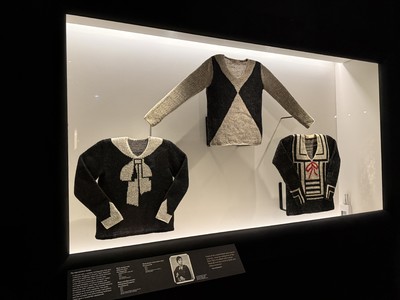
Schiaparelli knitwear.
Then I love the red dress made for Ariana Grande. I love working with performers. I love supporting a moment for them. I loved it when she turned around in the performance, and you saw this shoe on her back, it sent a chill up your spine. For me, that’s what Schiaparelli is all about.
If Elsa were alive today, what specific question would you ask her or what would you want to tell her about her work?
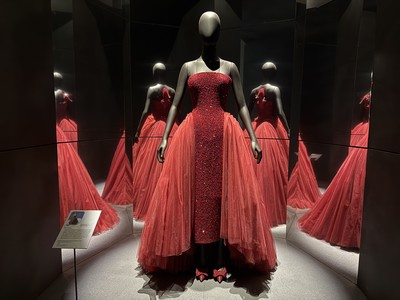
Dress designed for Ariana Grande’s 2025 Oscars performance.
I would want to ask: ‘Did you have fun?’ It looks like she was having fun. I also feel that she was constantly stretching the boundaries of the medium. You can sense a frustration that gives rise to a lot of innovation.
Sonnet Stanfill, senior curator of fashion, V&A Museum and exhibition curator
What narrative were you most intent on shaping for visitors?
A narrative that we hoped to shape and leave as a lasting impression on our visitors is one of exuberant creativity. Elsa Schiaparelli, the founder of Maison Schiaparelli, worked with some of the greatest artists of her day. She used the word ‘exhilarating’ to describe the process of collaborating with artists like Salvador Dalí and Jean Cocteau.
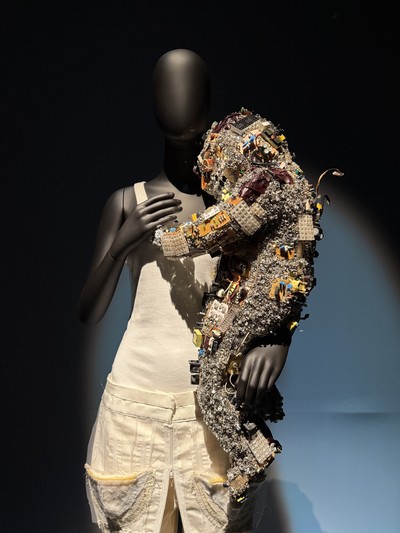
Schiaparelli Haute Couture Spring/Summer 2024 ‘robot baby.’
I think that, looking around this exhibition, with its array of garments, accessories, and exuberant perfume bottle designs, you see that kind of creativity come to the fore. In addition, of course, in bringing the exhibition up to date, the work of Daniel Roseberry, creative director since 2019, follows on from that tradition of incredible creative outpouring. By harnessing the couture skills of the Schiaparelli Atelier, he is able to express his imagination through all manner of silhouettes, beautiful construction, and intricate technique, often with that unexpected design element that is the hallmark of the Schiaparelli house.
Was there a particular piece or collaboration in the exhibition that surprised you?
In the exhibition, in a section devoted to Elsa Schiaparelli’s London house, which she ran from 1933 to 1939, there’s a day suit that was worn by the fashion editor Francis Rodney, editor of British Harper’s Bazaar in the 1930s. The suit’s jacket actually has its pockets on the back – an unexpected design detail. Very sadly for the visitor, because the pockets are on the back and the mannequin is facing forward, you can’t see them. But trust me, they’re there.
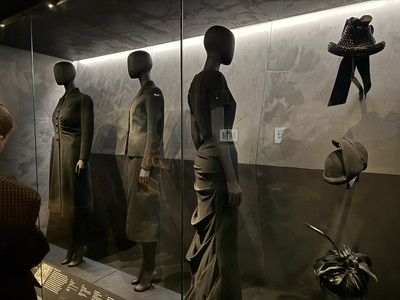
The day suit Schiaparelli designed for Francis Rodney.
When putting together this exhibition, what was the main challenge?
I think the main challenge in putting this exhibition together was finding the right objects to include in order to tell the story. For the Elsa Schiaparelli material, this was particularly difficult because the pieces are very fragile, and some of the fabrics and textiles she used were quite experimental. As a result, not many original designs survive compared to those of some of her contemporaries.
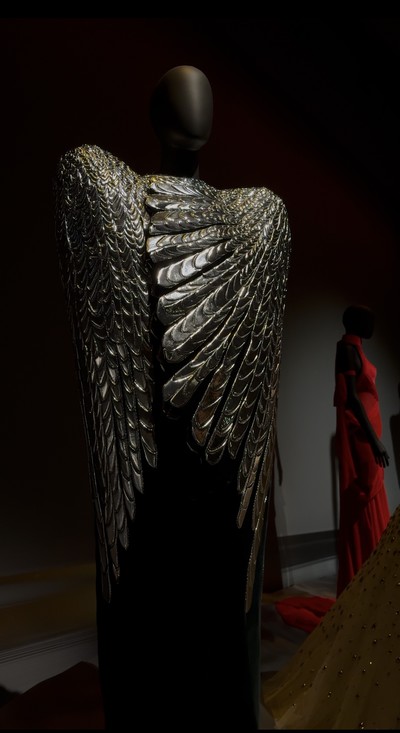
The phoenix dress from Schiaparelli Haute Couture Autumn/Winter 2024.
So finding original Schiaparelli garments from museums and private collectors was a bit of a sleuthing, detective job. In terms of the work of Daniel Roseberry, we really wanted to bring the story up to date. We were absolutely delighted when we were given permission to include a design from the most recent couture collection, the Spring/Summer 2026 collection. We weren’t sure if we would be able to include it, but happily, we were.
Marisa Berenson, actress, model, granddaughter of Elsa Schiaparelli
How does it feel seeing Elsa’s work celebrated like this tonight?
It’s very emotional for me to see this incredible conversation between my grandmother, Elsa Schiaparelli, and Daniel Roseberry, who is the creative and artistic director of Schiaparelli today, and to witness the continuation of her legacy. I think it’s very important that people all over the world know who she is. She was extraordinary – an independent, very free-spirited woman who liked to empower other women. It’s wonderful that new generations are discovering her and are inspired by her, and that her legacy continues, as it should, as with all great artists. This beautiful conversation between her and Daniel feels very special. I think my grandmother would be very happy and would have chosen him to carry on her name.
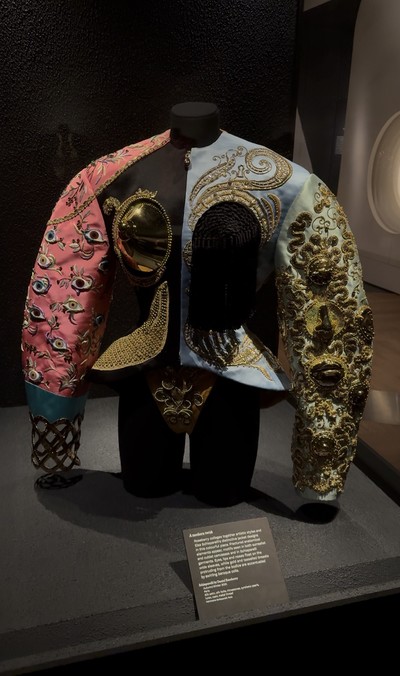
Jacket from the Schiaparelli Haute Couture Autumn/Winter 2021 collection.
What makes something unmistakably Schiaparelli to you?
I think people will be surprised by who she was, both as a person and as a creative talent. She was a pioneer in her day, a woman working in the 1920s,1930s, and 1940s during the war, when it was very difficult for a woman to have a career, let alone achieve what she did. If you know anything about history and the artistic movements of the time – Surrealism, Dada – you see how important they were, and still are, as reflections of freedom of expression, originality, imagination, and a real sense of play. She was part of all of that. What’s unmistakably Schiaparelli is really just her incredible talent and originality. What she did was dress women to express their personalities, to be daring, to be themselves, to be elegant, chic, and beautiful. There’s also a lot of humour in her work. Because she was an artist, she wasn’t just a dressmaker. Everything is astounding: every little detail is a symbol, inspired by her curiosity about life, cultures, the stars, the moon, and her mystical side.