The Mexico City-based photographer on the new campaign shot alongside Steven Meisel and Frank Lebon.
The Mexico City-based photographer on the new campaign shot alongside Steven Meisel and Frank Lebon.
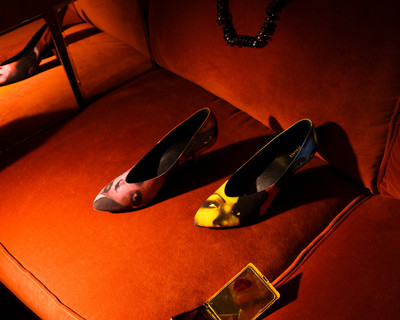
Photograph by Tania Franco Klein.
Earlier this month, Versace unveiled its first and last campaign under the creative direction of Dario Vitale. It is a unique project for the brand, both because of the context in which it was created, as well as the method of its creation. Three photographers, two established in the world of fashion and one very new to it, were enlisted to create a unified vision for the collection.
The most recognisable name of the three is, of course, Versace veteran Steven Meisel, who revisited an iconic image from his archive to inspire a new vision for the house. Then there is Frank Lebon, the London-based artist known for his raw, often analogue images that lend a streetwise verve to traditional fashion photography. Rounding off the cohort is Mexican artist Tania Franco Klein, who creates surreal, voyeuristic images exploring the complexity of desire in our digital age.
Following her inclusion in MoMA’s recent Lines of Belonging exhibition, Versace approached Franco Klein to feature her work alongside Meisel and Lebon’s for this historic campaign. Here, we speak to her about what it was like to work on this historic campaign, the joys of having complete creative freedom, and how to make commercial imagery with impact.
‘In [Meisel’s], you have a sense of the whole universe, almost like a drone. In [Lebons’s], you’re in singularity, almost like you’re sitting in front of the person. While mine, it is like you have a magnifying glass or are looking at things as if you were a little bug.’
System: This is your first time working on a fashion campaign. How did creating images in a commercial context compare to making them as a purely artistic practice?
Tania Franco Klein: I’ve always been in my own little universe. Usually, my relationship with garments or with objects are things that are from my past, or from the past of the people that I love. My studio has become this place where I deposit things that I love, but also friends will come and leave things too. The mum of one of my best friends in London, for example, passed away a few years ago, and there were all these different things that nobody wanted to take, so she brought them to my studio. My relationship with fashion is very related to memory.
How did it feel, then, to work in a completely different way, with objects that don’t have a memory attached to them?
In my practice, people, objects and spaces have equal identity. A lot of my work is still life, and my still life images have the same imprint of human experience. Even if they don’t have people, the objects tell you stories about the people that use them – spaces too. Even though the pieces from the collection didn’t carry a personal memory, I could still imagine how they might have lived in the world and the stories, or particular moments, that could give them special memories.
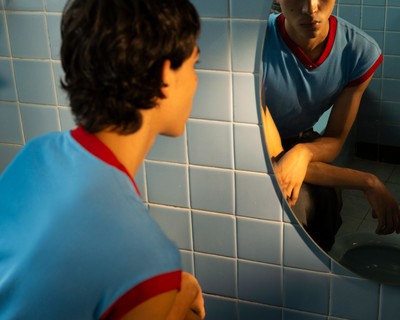
Photograph by Tania Franco Klein.
What kinds of stories were you creating for this collection?
It’s never one single story. It’s very important for me that when people see my work, they get a sense of a fragmented reality. I imagine my pictures like flashbacks of little moments, because this is how our memory also operates. You don’t remember things like a short film. You remember little flashbacks of yourself in different settings in life. When you look back, you think of yourself in very particular setups.
I work with very cinematic narratives. I’m fascinated by how cinema is so relatable for people all over the world. It’s not really about what the person is doing. It’s that sense of connecting with the emotional experience of unfamiliarity, or not belonging. I feel like the human experience is very relatable. It doesn’t matter the time, and it doesn’t matter the place, we can connect with the experiences of others. I try to draw on that in my work.
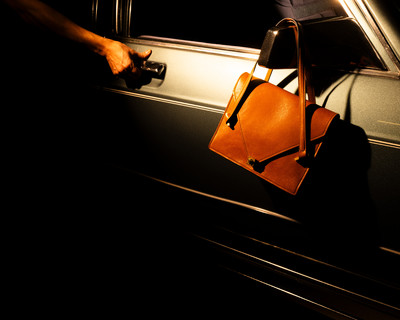
Photograph by Tania Franco Klein.
Working within that common, cinematic language could make an image more accessible to viewers, but, by that same token, in a culture so saturated with images, how do you make an image that has impact?
I trust my instincts a lot. My images, in general, for my personal work or for the campaign, are simple in the sense that you can easily name all the objects. It’s not like you have 2,000 things happening. They’re very straightforward. They’re very zoomed in. You usually have a strong sense of intimacy with something that feels out of scale to the way that you would usually experience it in life.
I cannot explain what makes an image iconic, but I always try to find this combination of colour, light and magic. There’s always something missing in the image, but I think that’s very important, that you can never read the end of the story, that you get the sense that it’s just a fragment. I feel like that really activates the unconscious, because you’re not presented with a finished narrative. It is also important that there are things that connect us to the experiences of others. The interiors that I use, for example, they are very Mexican. Not in a folkloric way, but they are recognisably Mexican. The beauty of the images, though, is that it doesn’t matter where you are. You’ve seen a place like this, you can relate to it in some way.
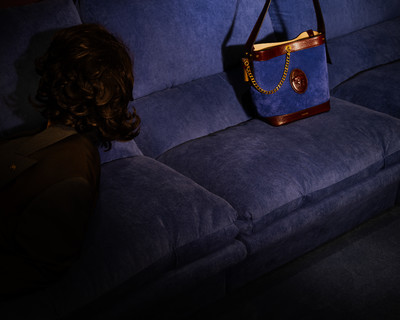
Photograph by Tania Franco Klein.
Do you work quite instinctively on set then?
Yes. That’s why doing a project like this was very hard. For my personal projects, I can take up to a week to make one image, and I usually work alone. I’m the set builder, set designer, lighting technician, the model. I do everything, so I can go back and forward and construct the image little by little. I have enough time to play around and make it alive.
I was nervous [working on this project] because it was a very big campaign, the biggest production I’ve ever done. I had to deliver fifteen images in two days, and I wanted each image to have its own life. I didn’t want to do one set and put characters coming in and out, because for me, that kills the story.
Originally, they wanted me to shoot in New York City, but I told them that if you want me to give you 100 per cent for this project, I have to do it in Mexico City. They said yes, but that required a very big level of trust. They didn’t ask me for anything. They were like, ‘send us a mood board.’ I don’t even know how to do fashion mood boards, to be honest, so I basically sent them a PDF with images of mine and said, ‘This is my universe’.
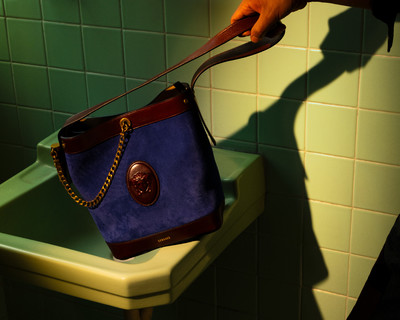
Photograph by Tania Franco Klein.
So they really gave you complete creative freedom?
Yes. I think a lot of people think that the bigger the brand you work with, the more restrictions you’ll have. Especially with this project, as it became a very historic collection because of the context around it. So I feel like there was more of a magnifying glass on it than there usually would be. Still, they trusted me 100 per cent.
I’ve noticed throughout my career that real artists and creatives trust other artists and creatives. It’s very interesting because this project was very high stakes. It must have been super exciting and nerve-wracking for them too when I finally delivered the project because I gave them the images like four days before we did the first press release, and anything could have happened.
Did the experience give you more confidence in your practice?
Yes, and it was also very special, because I feel like growing up as a creative, I was always told that if you want to make it, you have to be in New York, Paris, Milan, London, but I’ve always been very stubborn about the importance of working in my home and how special Mexico City is. I lived in London, I lived in Los Angeles, but I know that there’s something so magical about this place that really brings the best out of me creatively. With this project, we have a production 100% made in Mexico.
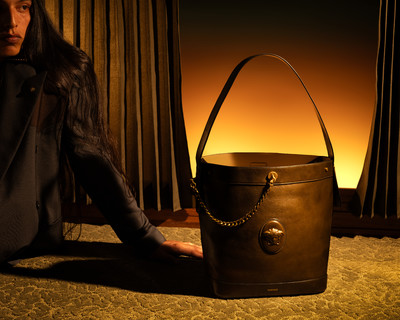
Photograph by Tania Franco Klein.
It makes sense, then, that the images align so well with the brand and also your practice.
With this project, I really wanted it to go back to basics for myself, because this collection also felt as though the brand was going back to basics. It felt like Versace was going back to its essence, touching on some kind of nostalgia, finding the spark where it started I feel like we’re living in a moment in time where everything feels so ephemeral and so out of touch. We’re all so lost and we’re seeking this sense of something that brings us back home. I feel like that’s why this collection felt so powerful, and I connected so much with it. It is also why it made sense with my work, which also deals with nostalgia.
Were you aware that Steven Meisel and Frank Lebon were the other photographers involved in the project while you were working on it?
No, I had no idea. I discovered it in the press release! I was very shocked and surprised – in a good way, because I feel like we really complement each other, even though our visions are distinct. Each of us has a different visual language, which means you see different sides of the collection in each photographer’s work.
The way they’ve chosen the artists allows you to see a different layer of it. In [Meisel’s], you have a sense of the whole universe, almost like a drone. In [Lebons’s], it’s almost like you’re sitting in front of the person. While in my photographs, it is like you have a magnifying glass on the collection.I was talking to a friend earlier about why I loved studying architecture. It took me years to understand, but the reason I loved it was not about the spaces – it was that you use so many different languages to communicate the same idea. You use models, renders, floor plans, and each is technically its own, but they’re talking about one place and so, together, they’re complete. I feel like that’s what Versace did with this campaign – they have different languages to talk about the same idea and, because of that, they show the complexity of the collection.
So I was very excited to see the final collection of images, and I was very honoured to be part of the roster, especially because this is my first campaign.
Discover the full Versace Spring/Summer 2026 campaign here.