Text by Vince Aletti
Lisette Model,
Harper’s Bazaar, February 1946.
Some of the best – the most arresting, nuanced, and unexpected – fashion photographs weren’t taken by fashion photographers. Julia Margaret Cameron, August Sander, Walker Evans, Bill Brandt, Diane Arbus, Roy DeCarava, Francesca Woodman, Sally Mann, Dawoud Bey: whether they intended to or not, practically anyone who made a picture of a person in clothes made a fashion photograph. Often a terrific one.
Maybe because they came into their own in a period when fashion spreads were beginning to look like snapshots or reportage, contemporary photographers like Nan Goldin, Philip-Lorca diCorcia, Cindy Sherman, Collier Schorr, and Wolfgang Tillmans slip more easily between fashion and personal work and often exhibit them side by side. It’s the work that was made without any conscious concern for fashion that seems especially eloquent and revealing about the essence of style. Look closely and fashion photographs are everywhere, but they have nothing to do with models or designer credits. Captioning an image ‘This Is Not a Fashion Photograph’ alerts the viewer to its casual complexity and the potential for a more layered reading.
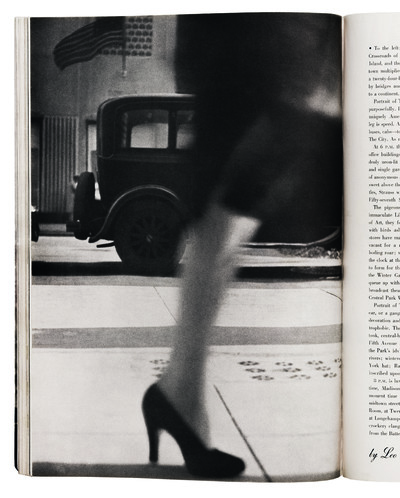
Of course, context helps. The photograph here opened the editorial section of the February 1946 issue of Harper’s Bazaar. It was taken on Fifth Avenue by Lisette Model, whose work for Bazaar was usually photojournalistic. From 1941 she reported on settlement houses, Bowery bars and circuses with work that legendary art director Alexey Brodovitch often printed in diverting, tumbling overlap, like spreads from a Sunday newspaper supplement. Here, Model’s photo fills a page and introduces a remarkable portfolio of other images of the New York street.
First, step back and consider the even larger context. Postwar New York was bustling; America was enjoying an economic boom while Europe remained wounded, devastated. Later in the same issue, Henri Cartier-Bresson’s photograph of a child wandering alone and overwhelmed in a displaced persons camp brings that point powerfully home. Model’s woman, striding confidently into a future that, for the first time in years, seemed nothing but bright, kicks off Bazaar like a casually chic chorus girl.
But the woman in the photo is hardly oblivious to the world at large. Black and white keeps Bazaar’s celebratory mood subdued, despite the American flag flapping in the background. Model’s work was not always subtle but it was complex, and Brodovitch gives her space to prove it. The pages that follow that opening spread are devoted to her now-famous images of reflections in shop windows that shimmer and shatter into abstraction. The first, an almost panoramic frieze of eight women on a New York shopping street (half reflected ghosts, the others no less ephemeral), looks like a Cubist version of a spirit photograph. With all the hats and coats and fur collars on view, it’s another fashion photograph. Accidental, but wonderfully rich and descriptive. No pedestrians stroll by in Model’s third image, but the reflection of a framed Picasso painting of two nudes floats above a stone façade like a collector’s dream.
Under the direction of Brodovitch and editor Carmel Snow since 1934, Harper’s Bazaar published the work of a number of photographers and artists who fled Europe just before and during the war. Model and her husband Evsa arrived in 1938 and joined a group that included Martin Munkácsi, Man Ray, Erwin Blumenfeld, George Hoyningen-Huene, and cover artists A.M. Cassandre and Marcel Vertès. Bill Brandt and Brassaï, both contributors to the February 1946 Bazaar, filed from London and Paris, respectively, and more regularly after the war. Even before its American contributors are taken into account, this was an extraordinary mix for any magazine, and it set a standard for fashion magazines that Vogue was challenged to match.
Model’s running leg was the inspiration for one of Richard Avedon’s most kinetic early Bazaar covers – the March 1948 colour shot of a woman stepping into a crosswalk in front of glinting cars. Although seen only from the knees down, her back leg nearly lost in a blur, she’s instantly recognisable as a New Yorker in a hurry. But she doesn’t have the iconic impact of Model’s stop-motion leg or its implicit promise of a future worth running toward. Maybe the more important difference here is that Avedon’s cover was made as a fashion photograph (the shoes get a credit) and Model’s was not. We can claim Model for fashion, but she can elude our definition, lose nothing, and move on.