Text by Alessio de’ Navasques
Paolo Roversi for Romeo Gigli
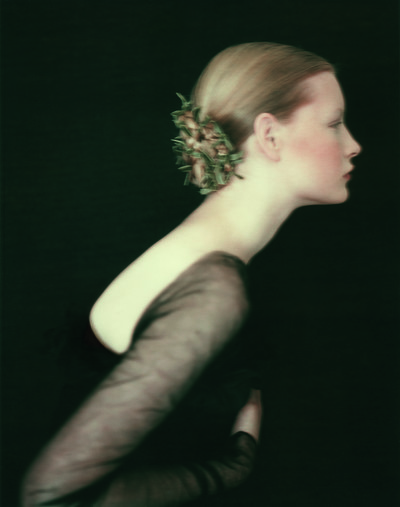
Autumn/Winter 1988-1989 campaign.
There are fashion images so powerful that they appear both contemporary and ancient – born of encounters and exchanges, sometimes casual or merely commercial – that have become icons. Manifestos for a paradigm shift, belonging to a new kind of imagery in motion, extending even beyond fashion itself. These are images that not only tell of the garment, its creator, and the photographer’s vision, but that succeed in capturing the spirit of the age, and often in anticipating it.
One such image is a photograph taken by Paolo Roversi for Romeo Gigli’s Autumn/Winter 1988-1989 collection, featuring a young Kirsten Owen: the profile silhouette, with rosy complexion, emerges ethereal from a timeless, dark background. Her hair, gathered back, reveals a long neck; the framing is half-length, the garment only glimpsed in the transparency over the shoulders and the deep cut at the back. It is the allegorical evocation of an idea, of a new vision. In the hint of an imminent movement, one perceives a tension that disrupts rigidity. The encounter between two extraordinary sensibilities, Gigli and Roversi, gave form to a silent revolution in both fashion and photography.
We are in the second half of the 1980s, dominated by the exuberant silhouettes and sculptural forms of Jean Paul Gaultier, Thierry Mugler, Claude Montana, Azzedine Alaïa and Gianni Versace. The clear simplicity of this image, recalling Italian Quattrocento iconography, breaks with the context of its time, anticipating the conceptual and minimalist sensibility of the 1990s. Still recognised today as one of the images that best distils a pure idea of beauty, it draws upon the classical world to give form to the new.
Roversi and Gigli revive a Renaissance vision rooted in their cultural DNA, tied to Italy and in particular to Emilia-Romagna, where both were born. Kirsten Owen is portrayed in profile according to the 15th-century tradition derived from medals and Greco-Roman glyptics. Gigli has often declared his love for the painter Piero della Francesca, even using him as a reference for lookbooks. It is inevitable to think of the pose of the Dukes of Urbino, but also of the complexions and refined hairstyles of Pollaiolo and Ghirlandaio. Romeo Gigli was already defined as ‘The Master of Understatement’ by his first Autumn/Winter 1983-1984 collections, as Holly Brubach remarked in the 1988 edition of American Vogue. His silhouette, like a gem in bloom, freed the female body from rigid forms, heavy make-up and forced hairstyles. It was an operation of subtraction, seeking the essence of form through journeys across distant times and worlds, onto which he layered decorations and embroideries.
This made him the only Italian designer close to the revolution pursued in Paris in those years by Japanese designers. Thanks to tailoring skills acquired in men’s ateliers in New York, Gigli created layered, knotted, draped forms of which similar styles are found across Asia both historically and in the contemporary moment: a wrapping of the body that enhances movement and energy. He employed fluid materials such as Lycra or jersey – among the first designers to do so – or metallic fabrics produced especially for him, but also silks, linen gauze, chiffon, wools, velvets and brocades in tones of garnet, ochre, bronze, copper green, tobacco and his signature aubergine.
This was a new femininity, fragile and mutable, which Gigli himself defined as ‘not asexual but modern,’ and which Paolo Roversi knew how to shape. After some initial catalogues made with his assistant Marc Roger, the long-desired collaboration with Roversi finally began with the Spring/Summer 1986 collection, continuing until 1989; also with the brand Callaghan. ‘Photography is not a reproduction, but rather a revelation,’ declared Roversi, thanks to his discovery in those years of Polaroid film with a large-format view camera.
The meeting of the two visionaries became light that defined an idea, a new mode of communication that made catalogues and lookbooks resemble art books. To embody this new vision was the young Kirsten Owen, whose career began almost by chance. As Gigli recalled: ‘It must have been in London in 1986 or 1987. Paolo and I saw a girl playing guitar in the street. She seemed very pretty, so we invited her to the studio and began taking photographs. That’s how Kirsten’s career began.’ Thus these photographs were born, melancholic and eternal.