Jonathan Anderson and Magdalene Odundo.
Moderated by Andrew Bonacina
Portrait by Juergen Teller
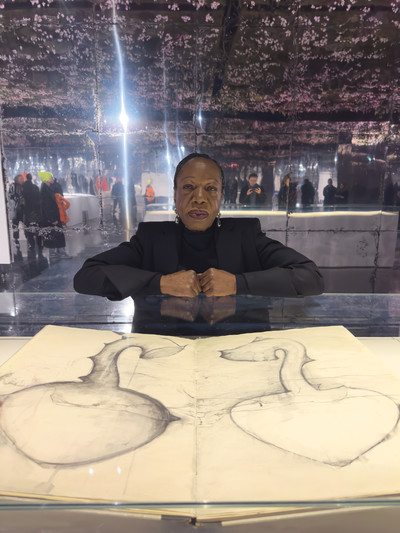
In January, Jonathan Anderson presented his first haute couture collection for Dior in the sculpture garden of the Musée Rodin in Paris. Immediately following the runway presentation, the museum opened Grammaire des Formes, an installation that placed 15 of Anderson’s new couture silhouettes in direct conversation with seven ceramic works by Magdalene Odundo, alongside nine historic designs by Christian Dior, weaving fashion, sculpture, craft and history into a single spatial encounter. The week-long exhibition was conceived not as a straightforward archive or backdrop, but as an active dialogue between disciplines, offering visitors a rare opportunity to see Anderson’s couture alongside the forms that inspired it.
We recorded this conversation in the days that followed the couture show, in that brief, charged window when the work had just entered the world. Jonathan was already looking ahead to his next deadline; Magdalene was ready to retreat back to the studio. The adrenaline of the show hadn’t fully cleared, but the intimacy of the process was still present.
The seed of this collaboration was planted more than a decade ago, during my time as the chief curator at The Hepworth Wakefield, when I invited Jonathan Anderson to curate the 2017 exhibition Disobedient Bodies that included Magdalene Odundo’s sculptural forms. The show was something of a blunt proposition: what happens when labels, hierarchies and the boundaries that keep disciplines in their lanes are set aside, and fashion, art, craft and design are allowed to share the same space. It was a group show, but within that wider constellation, questions of status, value and categorisation felt heightened for Magdalene and Jonathan.
For Magdalene, the art world still had a habit of tripping over that tired ‘craft versus art’ binary, as if ceramics needed to justify its seriousness. For Jonathan, fashion was powerful, yet still treated as adjacent to visual culture, rarely granted the same kind of cultural weight as art. The aim was to suspend those value systems long enough for people to look differently.
The recent project for Dior is the most public manifestation of a dialogue that has been unfolding in the background for years. Friendship has been the constant, punctuated by intermittent collaborations, sometimes visible, often private. What links the work is a shared set of preoccupations: the body, the intelligence of craft, the refusal of tidy categories, and the idea that the new only becomes meaningful when it’s in conversation with what came before.
Andrew Bonacina
Magdalene Odundo: How do you feel, Jonathan? Do you have any thoughts of what you’re going to do next?
Jonathan Anderson: I feel great after the couture show. What am I going to do next? I have a show to do in three weeks today!
Magdalene: I thought the [couture]show and exhibition were beautiful. I just couldn’t believe the glass pieces.
Jonathan: The dresses based on your glass?
Magdalene: Yes, I just keep thinking about them. I know you explained how they were made, how each flower is stitched, but I still can’t believe that they feel so close to the glass.
Jonathan: It is amazing what you can do with knit. And when you see them just as pieces in an exhibition, they become so conceptual, objects in their own right.
Magdalene: I think once they got onto the body, they became alive.
Jonathan: I was quite surprised how well they turned out because as much as they’re conceptual, they still feel relatable. There’s something in them that worked better than I thought they were going to as structures.
Magdalene: I left with the feeling that it didn’t really matter to get accolades. It meant a lot more that something was accomplished between the two of us.
Andrew Bonacina: This collaboration comes out of a long arc of friendship, and many other collaborative projects, but it’s hard not to feel like the momentum has been building up to this. Jonathan, this first haute couture show was always going to be the big one in your first year at Dior – what made you turn to Magdalene for this important moment?
Jonathan: I needed to start with something personal. I came across Magdalene’s work when we were curating Disobedient Bodies. Then after that show, I purchased a piece from her that I’ve lived with ever since. It’s hard to say why the piece has been so important for me, but I think it has something to do with not being able to place the work in any one time period. You can’t say, ‘Oh, this was made last week – or even a thousand years ago.’ There is an iconography in it that I find miraculous. I get bored of things quite quickly; I’m sure Magdalene is the same. I live with art. There are many things I fall out of love with, but I’ve always been in love with that piece. There’s something human about it. When I joined Dior I knew the biggest challenge was going to be haute couture, and it’s the thing I’ve been most excited about because it taps into my love of craft, my love of people, my love of making. It was always going to be my way of getting into the mindset of Dior, because it’s ultimately about form.
In fashion, couture is the pinnacle of craftsmanship. It’s about deep time and knowledge. I think there is an obvious kinship with your work, Magdalene, which draws on so many histories and languages that you have synthesised into these charged objects.
Magdalene: The influences can go both ways, but the central part of our interest is the body. That wonderful word ‘disobedience’ is the fact that we’re both very strong-minded in what we do. That piece that you’re talking about is one that I made while I was surrounded by a whole lot of people in Philadelphia, and I don’t really work much with people, but I do take information, in one way or another, from bodies around me. I think this is why I’ve always made vessels, so I can gather these ideas within a container.
‘When I’m making a vessel, it’s not an object in isolation; I’m making a container to hold something human inside it, even if that human is imagined.’
I think it goes back to those qualities in your work that Jonathan was talking about – they feel so timeless because they are built on this vast archive of research and looking that you have undertaken throughout your lifetime.
Magdalene: Research for me was never about being academic; it was about finding myself through looking. I looked at histories because I needed to understand how form carries memory, and then you distil it until it belongs to you. The research is a kind of nourishment, but the work only begins when you stop quoting and start making. I’m interested in universals: the body, containment, gesture. So research feeds the language, but the object must become independent. Otherwise you’re decorating history rather than building form.
Jonathan, this is the first time that you have a truly great fashion archive to think about and use. How does the idea of research function for you in the service of creating something new?
Jonathan: With an archive, even if it’s an incredible one like Dior, the danger is you become too polite. You end up doing a ‘Dior’ thing. I’m more interested in the archive as a provocation: why something worked, what the construction logic was, what the attitude was. Then you can argue with it. Research is also about removing awe. Once you strip away the mythology, you can use it. Otherwise you’re just worshipping it. And in a weird way couture needs you to be practical, it needs to ask: ‘What’s the point of this technique now, who is it for, what does it do on a body?’
Magdalene, you’ve reflected on the fact that you are both thinking about bodies in one way or another. Was there a moment over the past 10 years when you realised you had more in common between the way in which you work? What do you recognise and relate to in Jonathan’s process, even if the materials are worlds apart?
Magdalene: I think the recognition came through the body. I’m not dressing bodies, but I am always thinking about a body being present. When I’m making a vessel, I’m not making an object in isolation; I’m making a container that has to hold something human inside it, even if that human is imagined. With Jonathan, the materials are different, but there is a similar negotiation between structure and movement. You build something with rigour, give it form, but then it has to have another life. That’s very close to what happens for me between the raw clay and the fired form: you are trying to hold energy without killing it. Over the years, I realised the overlap isn’t just that we both like form. Actually, I think it’s often about the process of taking away – the edit. The idea that you remove until the work becomes definitive. I see that in Jonathan’s way of looking. That’s when it clicked for me: we’re both trying to distil the world into something you can feel without being told what to think.
As well as looking at the history of ceramics and sculpture, you’ve talked about looking to fashion in the past, and how it’s fed into your own language. How did it feel for the table to be turned and for your work to be inspiring a collection?
Magdalene: Obviously I was intrigued. I trusted and I wanted that magic to happen. I wanted to be surprised, but I didn’t know to what extent. And when I was looking at the models coming through during the show, I was seeing not only my work but also lots of the things that inspired me early on, like Elizabethan dress, court headwear and those beautiful narrow-toed silk shoes that courtiers would have worn. I saw echoes of my interest in Zulu costume and beaded work which I know Galliano also referenced in his collections.
Jonathan: Yes, John made some amazing pieces for Dior [for Spring/Summer 1997], which were based on the Maasai.
Magdalene: I just thought, ‘Well, it’s all come round again.’ Maybe it’s because I know other things you’re interested in, but I could see so many other references in this collection.
‘With ceramics, you’re constantly aware of balance: where something wants to sit, or tip, how it holds itself. It’s like what a garment has to do on a body.’
Jonathan, you’ve been an avid scholar and collector of ceramics for many years. Has it shifted how you think about designing? Not necessarily as inspiration, but really in the process of creating something bodily and three-dimensional?
Jonathan: I think it’s changed the way I think about that relationship between volume and line. With ceramics, you’re constantly aware of balance, not just visually, but physically. Where something wants to sit, where it wants to tip, how it holds itself. That’s very close to what a garment has to do on a body. Also, when you live with objects, you stop treating them like images. You start seeing the logic. And that’s useful for couture, because couture can’t just be a look. It’s engineering. It’s structure, it’s restraint, it’s obsession with where something lands on the body. So yes, it changes the thinking. Not because I’m copying a pot, but because the pot teaches you to be precise about form. It teaches you that a small change in curve changes the whole feeling, and it teaches you to respect the time it takes to make something that looks inevitable.
Magdalene: This respect that you have for craftsmanship extends beyond just one medium though. I love the fact that behind the scenes we could see the sketches and the drawings of each costume. The other thing that I respect so much about you is that you extend your thoughts and creativity to sharing in the dialogue of making. Physically and intellectually. It allows those that are working with us to also stretch their imagination, and to be happy that they’ve collaborated. It’s very rare because most artists want to have all the glory.
You’ve carved out a very particular way of collaborating with artists, Jonathan. What’s the deeper intent for you beyond simply referencing? Indeed, what is collaboration doing for you, and for the house of Dior, and ultimately for the audience?
Jonathan: Collaboration stops the house from becoming a closed system. It interrupts the autopilot. If you’re not careful, you end up producing an image of yourself over and over, and the brand becomes self-referential. An artist gives you a different conversation and asks different questions.
Artists bring with them a certain kind of license, they are given permission to do things that you often can’t do within your own industry. I always think that’s why artist-curated exhibitions are often the most popular, because they break the rules, they don’t have to respect the way things are usually done. Couture is such a protected space, do you think you were looking to bring in something of that when you turned to Magdalene?
Jonathan: With couture specifically, I wanted a lens that wasn’t fashion. Couture can become theatre, or it can become pure technique. An artist helps you get to something more human. It also makes you accountable, because you can’t hide behind a trend, you’re forced to ask what you actually believe in. I like that it opens a door: you’re not telling people what to think, you’re giving them a way to look. It’s about adjacency, letting people make connections without turning it into a slogan.
Magdalene: For me collaboration can be a way of testing the boundaries of my language without abandoning it. It’s not an antidote in the sense of escape, but it’s a different kind of energy. Other people bring different questions and skills that can refresh the imagination, and it can also challenge you to articulate what you normally do intuitively. If I collaborate, it must be with someone who respects the work of making and the people who make. Then it becomes a shared question rather than a compromise.
Jonathan: I think what has been really interesting about the process of making this collection and then showing it in an exhibition, was having children come and see the show. We are in such a complex time in the creative world. As much as we all try to break out of different ways of how to deal with hierarchy, it’s all still very siloed, or it becomes very politically led. Is craft art, or not? Are ceramics contemporary art or not? People get so precious about things. What I love when we work together is that I think we get above all that. It’s about: ‘How do you feel? What is new?’ Collaborating and trying to get people to look at similarities, or look at adjacencies without boiling it down to one thing. I think we achieved what we did over that week because it’s really nice for me to introduce more people to your work, and it’s a nice way for people to understand my relationship to Dior through your work. But also because there is no hierarchy in it.
‘Collaboration stops the house from becoming a closed system. It interrupts the autopilot. Artists give you a different dialogue and ask different questions.’
The exhibition Disobedient Bodies that we all worked on together was almost 10 years ago. Do you think the questions that we were asking then are the same now? Have things moved on?
Jonathan: It has, and it hasn’t.
Magdalene: What we are all trying to do – and what I think that exhibition was trying to do – is to encourage people to look at the world through a different prism. We’re trying to open up creativity in all its forms.
I’m asked about that exhibition constantly because it changed the terms of permission. And the questions weren’t abstract, they were embodied in all work included in the show because it’s how most creatives think and work.
Magdalene: I agree. I think that exhibition, the exhibition now, and the work in between has been saying: ‘You’re allowed to dream, you’re allowed to use your imagination to make things.’ What I want to stress is the fact that both of us are really respectful of craftsmanship. To be radical and to make art, you don’t have to trash it, it doesn’t have to be ugly. It can be simple. It can be reductive. Chaos can be distilled into something that is peaceful and thoughtful but says a lot more than is made explicit. You don’t have to feed people with ideas. You allow them that privilege of being able to think and reflect.
I think both of these exhibitions, 10 years apart, were made in a way to allow that open sense of thinking and making. I know, Jonathan, you have something of a hatred for fashion exhibitions, so have you been trying to find a new way to bring fashion into the museum context?
Jonathan: Yes. When I started at Loewe and I started the craft prize,
I was trying to look at fashion as craft. That was 10 years ago, a long time ago. In a way, there’s been so much progress. But I think people still have this idea that craft is a provincial thing. It was not until this morning that I realised that, in a weird way, I hate the idea of conceptual art. I hate the idea of contemporary art because I think it siloes it into this idea of being something which is untouchable. It’s a veneer.
If you think of Michelangelo or you think of Rembrandt, these people were craftsmen. If you think of Holbein, for me, one of the greatest painters in history, he was a craftsperson. Holbein, a court painter who has a workshop, is technically a craftsman. He is hired as a craftsman to paint the court and is a genius in his field. But then within the period that we’re in now, we still want to say, the potter is here, the filmmaker is here, the contemporary artist is here. I think today we’re too excited about trendiness. I work for Dior. It’s one of the biggest brands in the world, but at the same time I want it to have a sense of humility. To be curious about people and to be able to strip away all this pomp. To just say: here is a dress. Here is a vase. Here is my outcome. I think Christian Dior was humble too. It was not until this morning that I realised something: that ‘contemporary’ is a bit like the word ‘luxury’, which I have a problem with, too. It’s a word used to contextualise something that has to sit in a certain place.
We’re talking about haute couture here, which is one of the most rarefied manifestations of craft. It’s not something most people can own, but they want to engage with it. 35,000 people visited the exhibition after the show in just six days, that’s quite amazing. I think most people are drawn to things that are made with such skill and care.
Jonathan: Newness, I think, can be found in how to get couture to open up to people. If not, how do you celebrate it? The person who has spent thousands of hours and tens of years training to make these things. It is something that should be experienced. You have to get up close to these things. It’s something of pride, and it is a part of French history. It needs the viewer to be able to engage with it, to understand why this thing exists and why it is important. If we remove the pomp and ceremony from it, why is it important to keep this? If there is no reason, it will just die.
The magic was in seeing those garments almost as soon as they left the atelier – before the media had recycled it or before we’ve seen it worn. That doesn’t often happen with couture, and I think that is what has excited people.
Magdalene: I think that potential to astonish and amaze is the most powerful thing here. If the audience takes away those feelings from the exhibition and from the show, then I think we’ve achieved something, because with that, you leave the audience with a hunger to want to get close to these crafts and that will keep them alive.
Jonathan: The ultimate goal is to preserve couture, because it could so easily be lost.
By the time this conversation is published in early March – just after the next womenswear collection – the couture show will already be ‘old news’ in fashion terms. Jonathan you’ve talked about wanting to approach your collections in a different way, where ideas accumulate and build rather than each being a completely new proposition. Can you say something about that?
Jonathan: I don’t want to work to feed that fashion calendar. I’m more interested in continuity and building a story, letting ideas grow so the audience can feel the logic over time. Accumulation is also how craft works: you learn through cycles. Especially with couture, you need to live through it to understand what you’re doing – the first time is always a lot because you’re learning the system while trying to make the work. So I’m trying to make the pace serve the idea, not the other way round. If the conversation is real, it should be able to continue and deepen, instead of restarting every season.
Magdalene, has this experience made you think any differently about your own work?
Magdalene: It reminded me that the work can travel without losing itself, if the conversation is honest. I’m protective of my language, but I’m not precious about context, I’m interested in what happens when my work meets a new public. It also made me think about education, not in a didactic way, but in the sense of opening the imagination. If this kind of collaboration invites people to look harder, to value making, then that’s meaningful.