Moderated by Olivier Flaviano
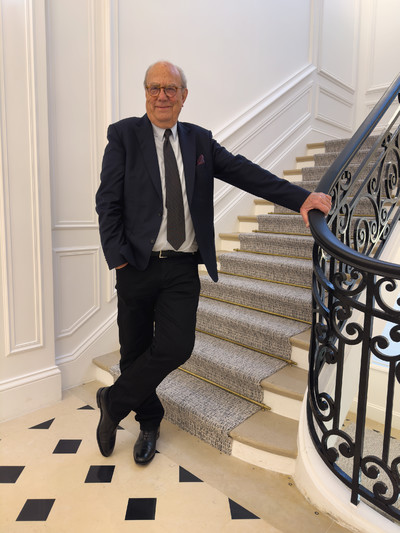
Portrait by Juergen Teller
In 1956, when a 21-year-old Yorn Michaelsen knocked on the door of Christian Dior’s headquarters on 30 Avenue Montaigne, in search of an apprenticeship, it seemed the stars had aligned. An avid reader of Harper’s Bazaar and Vogue, Michaelsen arrived from his hometown of Bremen in Germany with a folder of garment sketches, but no experience of couture. Nonetheless, he arrived just as one of Monsieur Dior’s design assistants was being summoned for National Service and so found himself promptly summoned to replace him, working alongside a young Yves Saint Laurent.
Within the studio, couture revealed itself to Yorn not as myth or image, but as an intricate method: sketches, materials, techniques and bodies animated by a coterie of formidable women. Figures such as head of studio Raymonde Zehnacker, technical director Marguerite Carré, and Dior muse Mizza Bricard formed the creative backbone that underpinned Dior’s vision. This was a time when Dior’s name was already known the world over, and his company was expanding exponentially, turning it into the first truly modern couture house of its age.
Seventy years have passed since Michaelsen first entered the maison, but his reverence for Christian Dior, the man and the couturier, has not faded. Shortly before Jonathan Anderson’s debut couture show in January, System invited Michaelsen and Anderson to meet to record a cross-generational conversation, moderated by the affable and errudite director of La Galerie Dior, Olivier Flaviano. Together, they reflect on their unique connections to the House of Dior, each linked to defining moments in its storied history.
Olivier Flaviano: So Yorn, when you arrived in Paris you were only 21 years old and you joined Christian Dior’s studio. What did the House of Dior represent to you at that time?
Yorn Michaelsen: I had just finished school in Hamburg, and it was my first time in Paris. Even though I had never been there, I knew I loved France. I was very interested in fashion and I was drawing the whole time, but I didn’t know for whom I was drawing. My only rapport with Parisian haute couture was through magazines, and the only name we really knew in Germany was Christian Dior because of his New Look.
What about you, Jonathan? What did the house of Dior represent to you before you joined as creative director?
Jonathan Anderson: When I was a student, Dior was synonymous with the amazing John Galliano. The New Look is something you learn about straight away when you go to fashion school. It was a radical brand, so for me it was a creative Mecca. One of the pinnacles in terms of the fashion industry. It was the top, you know. But now I’m here, it’s surreal.
Yorn, you arrived in November 1956, and hired as an assistant at the studio, when Christian Dior was about to start work on the Spring/Summer 1957 collection. What was Christian Dior’s first step when creating a collection?
Yorn: The first things were the materials. Two months before the presentation of the collection, Dior chose the materials – out of thousands of swatches proposed by the fabric suppliers – before he left to La Colle Noire, his country home in the South of France where he used to do his drawings. A Christian Dior collection started with 600 to 800 sketches, done within a few days, which constituted the first physical shape of his idea. Then he would come back with his drawings, and everybody was waiting for this great moment. The whole collection in a little box! He opened the case with all the sketches inside, and there was such excitement in the studio. It was incredible. There was Mizza [Bricard, a Christian Dior muse], there was Raymonde [Zehnacker, his right-hand woman]… For me, it was like a dream. The excitement was incredible. 220 sketches which best represented the ideas and themes of the collection were selected by Christian Dior. These would become a reference point for the ateliers as they created the toile, their three-dimensional transposition of the sketches before the choice of fabric. It was throughout this key step that the main silhouettes for each season took shape to embody the new line.
So what about you, Jonathan? How do you start your creative process?
Jonathan: I approach it very holistically, starting with the body – it’s really about the raw material first, and then how it’s applied. It often begins with a single dress, which then evolves as the story develops. There’s never one moment where it’s like, Bam! – here are 600 sketches. Instead, it starts with an overarching idea, then moves into fabric direction. Once the fabrics arrive, we work directly on the body, and from there the shape or the attitude begins to emerge. From that point, it becomes an editing process – refining and distilling each look through repeated fittings. Some dresses are now on their ninth toile. It’s about finding the right balance between material, form, and structure. Couture allows for a great deal of freedom, but at the same time, because everything takes so long to make, you have to reach a moment where you can say, ‘Enough – this is it,’ and let go.
You mentioned the importance of the body. And in Monsieur Dior’s sketches you can feel that the body is alive. He used to say ‘for a dress to be successful, you need to know how it will move in the movement of life’. Yorn, what was the importance of the house models during the process of creation?
Yorn: They were very important to him because they were representing different kinds of women, and different femininities. He devised his collections for several types of women. He knew exactly for whom he was doing a collection.
Jonathan, do you also have a specific kind of woman in mind when you’re working?
Jonathan: For me, it’s about asking: ‘What is the vibe you want to communicate?’ What’s the energy around it? What’s the attitude, and how are they going to carry themselves in it? When I start a collection, I like to find a new face – someone who hasn’t done anything before. From there, I build the entire collection around that one person. It creates a sense of neutrality, so that when we come to the final casting, you can find a feeling of newness through the process.
‘My only rapport with haute couture was through magazines, and the only name we knew in Germany was Christian Dior because of his New Look.’
Is that ‘face’ in your mind, is it an abstract woman, a celebrity?
Jonathan: When I first started at Dior, I was very into the severity of someone like Lee Radziwill.2 Something quite done up, quite smart but, at the same time, could be at Studio 54. The couture starts with this idea of going to the opera and coming out of it, getting into a car. Then this merges with the work of the artist Magdalene Odundo, who’s a very dear friend of mine, who is a completely different type of woman. Her work [and influence on the collection] is more about form, and informing the shape.
Yorn: I think it’s fabulous.
Yorn, tell us a little bit about the studio. There were three important women around Christian Dior, can you tell us who they were?
Yorn: There was Raymonde Zehnacker, head of the studio. Raymonde was the shadow of Christian Dior. They met when he was working at Lucien Lelong. She was everywhere. And he didn’t make any decision in his life without the ‘OK’ of Raymonde Zehnacker. She was very important in the life of Christian Dior; in his social life, his private life, the life in the studio, she organised everything and she knew everybody.
Then you had Marguerite Carré, directrice technique. Christian Dior used to call her ‘Dame Fashion’. She was incredible, his ‘dressmaking self’. She was like a dream-maker: Christian Dior had his dream, his sketches, and Madame Marguerite would explain what she thought Christian Dior wanted to express with his sketch to the premieres d’ateliers. They would then do the toile under her supervision. She was very, very important. And she was there from the beginning. The New Look really was her technical work, too.
Then you had Mizza Bricard. Elegance was her raison d’être said Christian Dior. I think she was the first trendsetter we had in couture. She created the panther look for Christian Dior. She dared when Christian Dior couldn’t.
Do you have someone like this, Jonathan?
Jonathan: I work with a stylist called Benjamin Bruno who is my ears and eyes. And we have a very transparent and rigorous relationship. You always need to have someone who is going to say no. Someone who is free to disagree with you, who you can argue with. You need someone to work against. I have Ben for that. Conflict can be quite important in creativity so that you’re pushing yourself to do better. It’s about how you create tension in the pursuit of newness. You’re trying to find balance and newness when you put the look together. So you need someone to have a conversation with that you trust, and who is going to make you take risks that you may not be comfortable with.
Let me just quote Christian Dior from the 1956 Dior by Dior book. He recalls the New Look, and he says, ‘In order to satisfy my love of architecture, and clear-cut design, I wanted to employ quite a different technique in fashioning my clothes from the methods then in use – I wanted them to be constructed like buildings. Thus I moulded my dresses to the curves of the female body, so that they called attention to its shape. I emphasised the width of the hips and gave the bust its true prominence; and in order to give my models more ‘presence’ I lined nearly all of them with cambric or taffeta, thus reverting to an old tradition.’ Yorn, would you say it was easy, at the time, to recognise a Dior dress by its technique, by this architecture?
Yorn: Yes and no. Dior dresses had such a distinctive shape they were easily recognisable, but the technique which creates the shape is something that you can’t see. If you see a dress, you can’t see the technique inside. For example, the famous corset he did inside of the dress. You couldn’t see it, but the clothes of Christian Dior, you could leave them on the floor and they’d stand up like architecture. That was incredible. You could feel it, but you couldn’t see it. You could see the flamboyance, the luxury, but if you see all the work under the clothes, the dream is over.
‘When I was a student, Dior was synonymous with John Galliano, who turned it into characterisation, and who added another layer for the 21st century.’
Jonathan, does this Dior technique have an influence on your work?
Jonathan: Well, I had never worked in couture. It is slower, but at the same time the detail becomes more impactful. For example, hand-done double face is insane because they’re pulling the fabric apart and then re-stitching it together. So, it’s like looking at the skeleton of a garment differently. What I find interesting, which is something we’re so used to in today’s world of fashion, is that everything has become very flat. When you do couture, everything’s a bit more rounded. Because the stitch is by hand, it doesn’t get the same tension in it. You get more roundedness to a jacket. The underpinnings of a Dior dress, are like the inside of a watch. There are so many ways in which they build up structure.
That structure has evolved over time, over 50, 60 years. Each generation passes on information and then they adapt and then they change it and they find other ways in which you can deal with structure, how to do it without too much weight. That is very, very different from ready-to-wear. It’s an entirely different world. It’s deeply romantic. Even if you were to make a T-shirt in couture or a jean in couture, it is a completely different thing. It has a really different energy to it. It makes you love fashion.
Yorn, one of your roles was to complete the ‘collection boards’. Can you describe them to us?
Yorn: Every collection had a storyboard consisting of several pages, which provided Christian Dior with a holistic vision of his collection. This allowed him to balance the looks by category: morning, cocktail, evening dresses. On each of them was the name of the look, the little sketch, a little piece of material, the name of the mannequin, the name of the premières and premiers who supervised their creation. Then he could see if there were too many morning dresses, not enough evening ones.
One collection was 180 or 200 looks, and they were divided by day dresses, cocktail dresses, and evening dresses, because a woman would change her garment several times a day. Jonathan, would you say that fashion today still reflects our way of living?
Jonathan: Well, I think we’re really boring now because we don’t have that sense of occasion. We don’t have occasion-wear, apart from weddings, funerals… There is no etiquette. What I love about Dior is that the house comes from this moment when everything has been destroyed [after World War II]. You have the birth of America as a global superpower. Speed, modernity, cars. The 1950s is a decade in which you have the decline of the British aristocracy. You have the birth of a new social elite in America. They bring a sort of British etiquette to America, repackaged with speed. I think what was interesting about Dior’s period is that when we look at occasions, people were coming to it with a different viewpoint. They were like, ‘Can I project myself into this for this moment?’ There wouldn’t be two moments per year, there could be 24 moments! I think if Dior was alive today he would be like, ‘What the hell is going on?’ Fashion has gone from being something which had an inner nucleus, to something which has become a popular global phenomenon. It’s really fashionable to be into fashion. It’s part of the public imagination.
‘A Christian Dior collection started with 600 to 800 sketches, done within a few days, which constituted the first physical shape of his idea.’
Let’s talk a little bit about the fashion shows. Yorn, can you tell us about the shows when you were working at Dior?
Yorn: There’s a big difference between being a guest at a fashion show and working at one. When I first arrived in Paris. I saw this magic world in front of me. Madame Luling would direct the shows like it was a ballet. Then you had this marvellous fashion show, set in the beautiful couture salons which could accommodate 250 guests. The 180 looks of the collection were presented, in complete silence, one after the other to the press, buyers and, the following weeks, private clients.
Jonathan, how do you design the fashion show? Particularly now it is no longer just a presentation of garments.
Jonathan: I would love to go back to the days of 250 people. This would make my life a lot easier! The show has now become a huge marketing tool. So, it’s less insular and you end up having to become a director in the end. The job has become so big that there’s no longer this idea of being a designer. But I think the most important thing about a show is its ending point. That is why the show, as much as we can question the show as a creative medium, is a full stop. There is a before and after. Then you move on to new ideas.
It used to be that no photographers were allowed into shows, and the first photographs were seen only a month and a half after in the magazines. So, what was at stake? Were they scared of people copying the clothes?
Yorn: Oh, Christian Dior was so afraid of the copy. When the clothes were coming from the ateliers and going to the salon to be presented they were always covered with paper or white cotton so no one would see what he was going to present. Now, though, you show your show and half an hour later, you have it on your phone.
There’s an interesting quote by Christian Dior from Dior by Dior, where he says the weeks which followed the first show had a decisive influence on the collection, which is yet to be born. Jonathan, how do you react to the immediacy of images, and do they change how you think about a collection, too?
Jonathan: Christian Dior was lucky. Like all designers today, I live in a world where there can be millions of comments on a single collection. You end up in a quagmire of information. The day I finish the collection, I can barely look at it because I’ve seen it from every possible angle. I have looked at thousands of viewpoints. By the time you’ve shown it, you’ve already consumed it. Christian Dior was very lucky to work in a moment where there was a much narrower window of criticism. There was the reviewer, the newspaper – it was all very tight. Today it is a free-for-all, and it’s difficult to even sense what is happening. One of the reasons I wanted to work in fashion was that I have always been obsessed with the future – with the idea of what comes next. A fashion show used to exist six months ahead of its moment. Now, people don’t have the patience to digest it, or to allow it to be relevant in six months’ time – which was the whole point.
The joy of fashion lies in that distance: it gives you time to distil an idea, because the reality of a runway is very different from the reality in-store, or from the reality of a garment as a three-dimensional object rather than a two-dimensional image. Everything has become so fast that you’re now dealing with people’s recreational outrage. You have to find patience within yourself and resist being pulled into the noise.
Yorn, when you joined in 1956, Dior was already a global brand. Christian Dior New York opened in 1948, Christian Dior London in 1952. Dior was also the couturier who used communication the most. When he passed away, Carmel Snow said: how can couture survive Christian Dior’s death? It was such an important brand in the world of fashion. So, did you feel that this was a global brand, working in a studio that was a little family?
Yorn: I think it was Christian Dior who really made the house feel like a family. He chose everybody working in his house more or less by himself. I think he was very talented at knowing exactly who or which person can work at what. He started with the idea of doing a very small haute couture house. Very important for a small clientele, you know. Suddenly, after his first successes, he realised, ‘My God, we must evolve, we can’t stay still.’ But as house got bigger – from 85 people and 3 workshops when it started, to 1,000 people and 28 workshops in 1953 – he also felt a greater responsibility.
He had this marvellous idea to create a perfume, Miss Dior. I think it’s the most important accessory you can have, and the most marvellous marketing support for a couture house. He was the first one who had the idea to go out of Paris, past the frontier, at such scale developing a worldwide organisation of fashion. He predicted the future and adapted fashion to a changing world after World War II. That was the most important talent he had, to do exactly what he wanted to do next, and he prepared all of it. So, when he died, everything was more or less in place to continue.
‘For me, it often begins with a single dress. Once the fabrics arrive, we work directly on the body, and from there the attitude begins to emerge.’
At that point, the Dior name was all around the world. Jonathan, is the branding of Dior something you looked into when you joined the house? How important was it for you to define your own vision of Dior?
Jonathan: I love the Dior logo. I think the Dior logo is a design classic. It gives you a sense of exactly where you are. When I first joined, I had an entire biopsy done on the logo because I wanted to know the history of it. What is so fascinating is that he chose a French font. When you look at historical fonts, there are not a lot of French fonts from that period. For me, the logo as a branding tool is one of the most important things because the final act of finishing a garment is when you put in the label. And when you look at the history of Dior, by looking at all the labels, you can tell the period that you’re in. This is important, that there is another layer that is added.
Sometimes you can use the branding for nostalgia, or you can use it as an idea of modernity. For example, for ready-to-wear we have a new label. But then in couture we have gone back to the idea of the original couture label, where it is numbered, because that is the nucleus of the brand. When you see it on an archival dress, it still has so much value. I think sometimes we associate heritage with leather goods companies. We forget that Dior is a heritage brand. It has transcended multiple different creative directors. Everyone has added to it. But ultimately the nucleus of the brand will always be there, you know? That’s why Dior has survived this long. Because the idea was good at the beginning. So, it just means that you have to keep fuelling it.
Christian Dior used to say that the most profound purpose of couture is not only to make, but to create clothes, to invent new forms, new techniques of cutting, and using of material. A couture house is first and foremost a research laboratory. Yorn, was Monsieur Dior researching new shapes, new lines, new techniques as he created a collection?
Yorn: You are not a couturier if you don’t think like that. If you are a couturier, you have a talent to detect the future. It’s not only to create something beautiful, it’s more intellectual. You must know exactly where you are going, to do something today that is for tomorrow. Like Cocteau said, ‘One must do today what everyone else will do tomorrow.’
You’ve approached couture the same way, Jonathan?
Jonathan: For me, couture is a remarkable exercise. It is completely void of any form of logic. That’s what I love about it. It is illogical because it is ultimately about freedom. You don’t have to think, ‘Oh well, how is this going to work?’ Or, ‘How can we afford to do that?’ It’s more about, ‘We are going to make this fantasy into a reality.’ That’s why the lab is the most important part of it because it’s the ideas machine, it’s where you are trying to birth out new ideas, which then can go on to the outskirts of the brand. It is a freedom machine. There is no wrong or right in it. It is about exploring, experimenting, and if someone wants it, they can have it. Is it for everyone? No. But it’s imagination that is needed at a brand like this. Dior, in terms of couture, is very, very, very unique. You have Dior himself, and a series of other designers – someone like John Galliano, who comes in and turns it into this other characterisation. He adds another layer into it for the 21st century.
Dior was about fashion. It was not about the everyday. It was about fantasy. It was about dressing up. It was about the new. Dior has an immense historical strength in that it is able to embrace the idea of ‘Fashion’ with a big ‘F’. It is there to be radical. We look at Christian Dior now as a historical figure. But if we are to think about his work in that period, it was radical. The things he was doing were quite a lot for people to digest. As a couture house, it is unique in that way. Ultimately, couture is an elitist practice, it exists for the very, very wealthy. It is incredibly expensive, because the amount of time that goes into each garment is extraordinary. That said, I think there are different responsibilities embedded within it.
For me, one of them is the protection of couture as an endangered craft. That feels like a real responsibility. Another is the emotional connection we have to clothing – the idea of searching for something new, and of translating fantasy and desirability into something that is entirely handmade. Every day on my way to work, I pass people queuing to enter La Galerie Dior, and it reminds me that Dior also has a responsibility to the public: to tell its story. That’s what I want couture to engage with. With each collection, we’ll take elements from Dior’s history and confront them – whether through an artist or in dialogue with another brand and share that narrative with a younger audience.
When you go to a museum, you experience something to fuel creativity. So, for me, there’s this part of couture which is about why we make. Why do we look at form? Why is Christian Dior important? What is couture today? And I think it’s about the exploration of fantasy. The museum is as powerful a part of the brand as the New Look, because it is experiential, it is emotional. Even if you don’t buy couture, there is always curiosity to see the making of craft. For me, that’s what is exciting in couture at the moment in that it can be multiple layers in and of itself, but at the same time it’s also the spine of the brand. Without the couture, what is Dior?
Lesley Manville, who is a dear friend, played in a 2022 film which is called, Mrs Harris Goes to Paris. It shows you the power of Dior as a brand. Because ultimately, movies are made about it. It is about a turning point in modern history, and I feel like as a designer I have a responsibility to that. Not to the owners of Dior, but to the idea of Dior, the essence of it, which is part of the public domain. If you get into a taxi, a taxi driver will know Dior, and they have their own fantasy of it. That’s why I love that film, it’s so touching because it shows you the idea of the fantasy. When I go to the couture atelier, it’s like being in a Disney film. You’re very much like… Can I touch this? Fashion needs that, as much as we want to radicalise everything, sometimes you need a bit of austerity and a bit of the magic behind the clothing.
Talking to you, Yorn, I’m reminded of how the brand is bigger than me. It’s bigger even than Monsieur Dior himself. In a strange way, I think a lot of people associate Dior with something quite narrow – the idea of a dress. A pretty little dress, often imagined as pink. But when you really look at Dior’s work, the range of colour and texture is remarkable. It was deeply textural, and the way he combined colour was entirely unique. I think Christian Dior has been typecast, probably through marketing, but the Dior language is far more complex than it appears. He made some of the greatest coats in fashion history, yet somehow we don’t associate Dior with coats at all.
‘When I go to the couture atelier, it’s like being in a Disney film. Fashion needs that magic, as much as we want to radicalise everything.’
Because of the Bar suit. And the black and white.
Jonathan: As much as designers don’t want to look back, it is nice to look at someone else’s history because you don’t own it. You feel less precious with it.
And besides Christian Dior’s history, there’s a Christian Dior character. He was extremely superstitious. Yorn, can you tell us more about this side of his personality?
Yorn: Christian Dior was superstitious. He was consulting a fortune teller from time to time. And he always had in his pocket a little string with a series of charms attached – a star, a piece of wood, a lily of the valley, a gold coin. But he never showed this side of his personality in the studio. He was concentrating only on the work.
In 1955, Monsieur Dior appeared on American TV, and the journalist asked him, ‘Do you believe in luck?’ So, Jonathan, may I ask you the same thing?
Jonathan: Do I believe in luck? Yeah, I do. I don’t think I would be doing this today without an element of luck, you know? For me, luck is a meeting of things that go right and things that go wrong. It’s the equilibrium of it. I think you need a bit of luck in life. I come from Ireland, so we’re incredibly superstitious. We believe in all different forms of things that tell you if something is lucky or not. That’s another thing I like in Monsieur Dior, the fact he was superstitious, because I think that makes him real. Ultimately, we feel designers must be invincible, but they have more insecurity than anyone. I think with insecurity comes the idea that we need signs and luck, things like that, because you are trying to find something and you’ve asked everyone else, so now you might as well ask the gods what to do [laughs].
I have one final question for you both. When Christian Dior passed away, Jacques Rouët, who was the administrative and financial head of Dior, made a statement. He said that Christian Dior not only created a house, a silhouette and an empire, but he also created a school of taste and style. So I wanted to ask you both: what is the most important thing that Christian Dior taught you?
Yorn: He truly changed my life. I came here with nothing and I’m here 70 years after, so lucky to be in Paris. He was an example for me, but more as a man than a couturier. His qualities were so evident, so rare. He was really an example of kindness. He left this impression on the whole house.
Jonathan: I think if you work at Dior, you’re working in service of the Dior legacy – because you believe in it. Of course, there’s the commercial side and everything that comes with it, but ultimately you do it because you believe in the idea. Dior has influenced so many designers. I was looking recently at collections by Yohji Yamamoto and realised how deeply he was inspired by Dior – something I’d never fully recognised before. You begin to understand just how far Dior’s work has permeated fashion globally. People aren’t only investing in the idea of Dior itself, but in the idea of putting ideas into fashion. Ultimately, he is the fashion designer’s designer.
A good way to end.
Jonathan: There we go. And thank you so much for doing this.
Yorn: Thank you, Jonathan. For me, it’s marvellous to have been there in 1956 and to still be here now with you.