Interview and text by Jerry Stafford
Photographs and layout by Juergen Teller
Creative partner Dovile Drizyte
Styling by Tallulah Harlech
Amanda Harlech on shaping fashion’s imagination – from the rue Cambon to rural Shropshire.
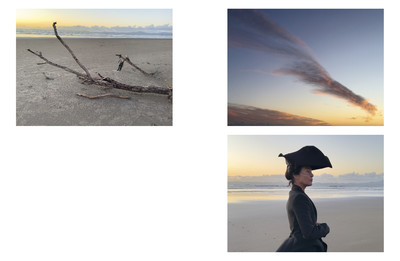

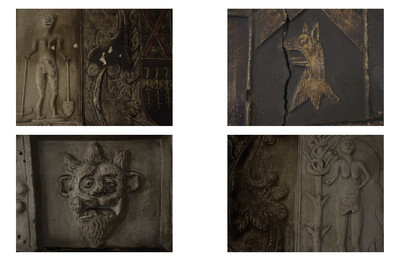
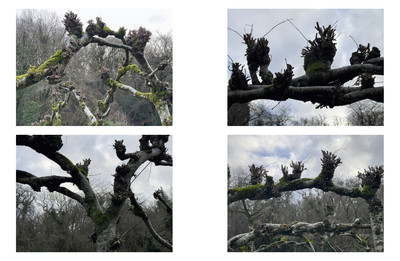

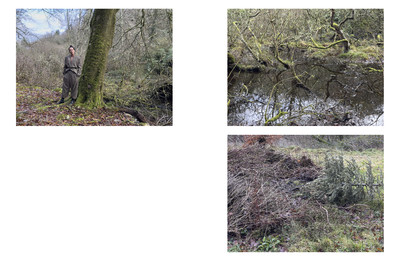
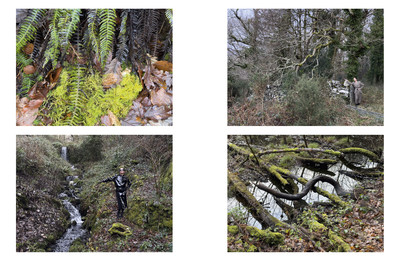
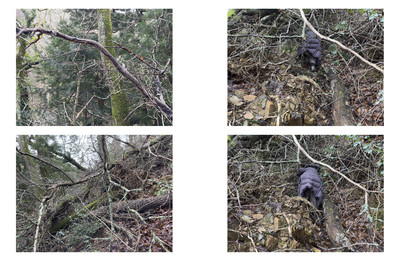
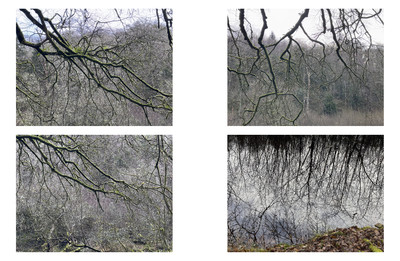
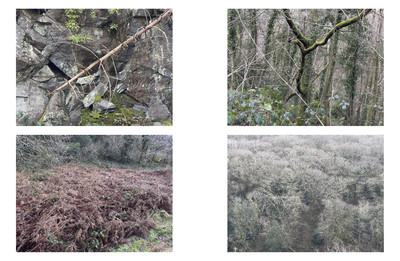
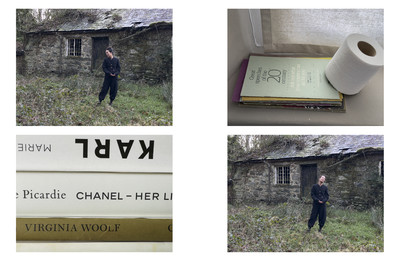
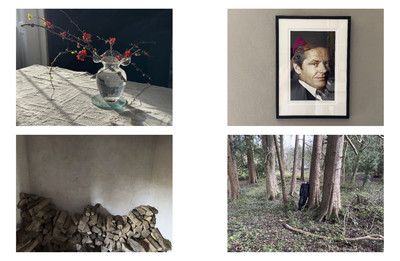
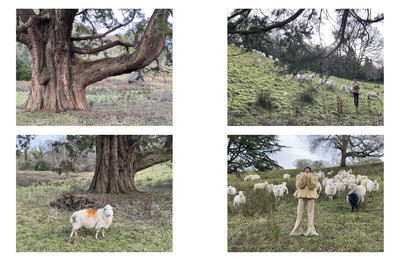
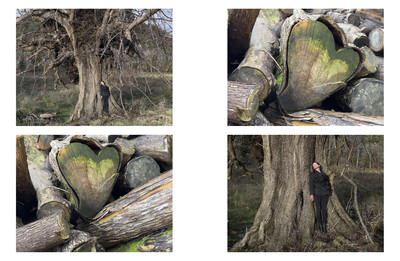
A woman sits on the ground, leaning against a pine. Its bark presses hard against her back, as hard as life. Its needles scent the air and a force hums in the heart of the wood. Her ears tune down to the lowest frequencies. The tree is saying things, in words before words.
Richard Powers, The Overstory
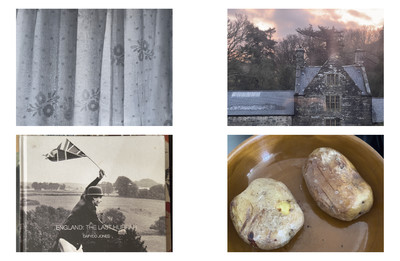
A dawn mist lifts over the gentle curves of the surrounding landscape and a single standing oak reveals itself to one’s gaze. The wide bay windows of the 18th-century farmhouse look out upon the generously spreading branches, its red brick walls nestled in the medieval hamlet of Shrawardine in Shropshire where Amanda, Lady Harlech has made her home for over two decades.
Each morning in all seasons and in all weathers Harlech takes a photograph of her tree from the window, describing its presence as ‘a constant which will outlive me, a connection with the past and the future – it is my lodestar and the first thing I see when I wake up.’
Like the mighty oak, which she embraces each day on her first brisk walk with her greying black whippet, Albertine Harlech is a delicate yet demonstrative presence, a force of nature whose roots and rings reach down through time and verse and across myriad boundaries and disciplines.
Whether she is dressed in a battered Barbour and old riding breeches to muck out the stables and hack her dark bay gelding Ed, or making breakfast by the Aga stove draped in Phoebe Philo cashmere and shrink-wrapped in Comme des Garçons, or descending a staircase in Galliano’s Boldini brushstroke of bias-cut vieux rose organza or spike-heeled and décoiffé in black-feather and pearl-embroidered Chanel couture, she is, like the infamous Countess of Greffulhe, the essence of insouciant elegance and intractable flair. And as Proust once said of his muse: ‘It is difficult to judge her, because to judge her is to compare.’
She has been described as a fashion historian, a memorialist, a creative consultant and curator, both stylist and sibyl, and an eccentric Casati-like muse. But she is above all an artist, whose navigation of the fashion globe has been the stuff of operatic drama and silk-spun dreams. She is one of the industry’s most enigmatic and influential figures, a woman whose celebrated style, poetic sensibility and storytelling have discreetly informed and delighted designers, photographers and social commentators alike since her early days in 1980s London as a fashion editor, through her mythical collaborations with master couturier John Galliano, and almost quarter of a century of intense and intimate collusion with the imperious Karl Lagerfeld at Chanel in Paris.
‘Bringing in the logs, mucking out a stable… I find that when you’re doing something physical and repetitive, that’s when you have quite good ideas.’
Also a painter, writer and pianist, she now divides her time between Shrawardine House and her elder son Jasset Ormsby-Gore the present Lord Harlech’s ancestral home Glyn Cywarch in North Wales. She herself spent many years at Glyn with her late husband Francis Ormsby-Gore, the previous Lord Harlech, and she brought up Jasset and her daughter Tallulah between this rambling Jacobean house and estate and their family home, The Mount in nearby Oswestry.
Born Amanda Grieve in 1958, she was raised with her brothers Charlie and Ivan in a 1960s London milieu still peppered with an eclectic mix of burlesque and baroque characters, enjoying a rather disjointed and disparate childhood of divorced parents and drafty dormitories. Harlech’s memory of this time is threaded with the precious fantasy, the radiant simile and romance, the gilded layers of memory, words and images which have been the opalescent touchstone for all her work with the more celebrated names she has so often inspired and influenced.
Harlech, both an astute observer and a curious mind, has left an indelible imprint on the rich tapestry of fashion not only through her unparalleled work with John Galliano but also at the house of Chanel where she continues to work closely on brand heritage, while mentoring students and young creatives through their sponsorship programme. It’s that excitement which, as she explains, ‘connects me with someone like John again, it’s the explorative curiosity and hunger of the student, encouraging them to dare to go on.’
Innate eloquence, boundless fantasy and whiplash intelligence guide her eye and her hand. Her spontaneity and unconscious desire, her vulnerability and fragility coordinate her map to the stars. In her precisely chosen words, ‘Fashion is very personal, we’re potentially losing the human connection with a creative endeavour where teams and departments, usually from the commercial side of a business, move in and take over the creative studio.’ Yet in an industry which increasingly chooses political strategy over poetic creativity, and the conveyor belt of commodity and control over craftsmanship and conversation, Harlech still stands tall, sylvan and proud, her back braced against the ill winds of commerce, and continues to forge her own inimitable illuminated flower-strewn and ivy-clad path towards a shimmering aqueous light.
Jerry Stafford: We’re at the kitchen table in your house in rural Shropshire. Can you describe the landscape and the countryside around here, and what attracts you to this part of England?
Amanda Harlech: It’s the Welsh Marches. The natural frontier between Wales, mid-north Wales and England is the River Severn, and I live literally on the river, with a 180-degree view of the Welsh hills. When I was looking for somewhere I wanted that long view because it’s something that always feeds me. Why did I come to Shropshire? I fell in love and got married.
How would you describe your life here?
Very manual labour. I tend to tell myself that it’s a sort of monkish or nunnish way of living, with a lot of meditative routine – bringing in the logs, mucking out a stable. I find when you’re doing something physical and repetitive is when you have quite good ideas. So that’s what my life here is: a dance that, like with all quarters of my life, is rather too full of things to do. Horses, the garden, piano, reading, painting, immersion in the River Severn. I don’t know quite how I manage to pack it all in, but I definitely do.
Let’s zap back in time. How were your parents influential regarding your early interests? Did they influence your taste in literature, poetry, clothes?
I think parents are influential whether you perceive that to be a good thing or a bad thing. My mother had an extraordinary sense of colour and texture but she wore clothes that sometimes made me wrinkle my nose.
Because you thought they were slightly bad taste?
Not bad taste. I think children naturally have quite bad taste. I mean, my penchant for all the things I wasn’t allowed to wear, like a pale blue organdie party dress with pointy shoes and lace ankle socks, was forbidden to me. I had to wear burnt orange corduroy culottes, black patent pumps and black tights. And my hair was very severely cut in a bob to go on the TV show Crackerjack – I was mortified. My mother was definitely cool, ahead of her time. She didn’t really care. She had this sort of strange, Balenciaga-ish kind of thing and refused to be, I think, the trophy wife my dad wanted her to be. I remember them having a huge argument because she’d chopped all her hair off. Mum was great.
‘I remember Izzy [Blow] saying to me, ‘I honestly don’t know how you can live in the country. I would turn into a boiled egg.’’
And how was dad?
Dad was the suave silver ghost: he had silver hair; used to drive a vintage Rolls-Royce to pick us up from fucking Brownies. I lived on Regent’s Park Terrace, adjacent to Gloucester Crescent, and there was a whole gang of kids outside playing and everything, in the way that I wish children did now. Anyway, you know the way fathers are very conditional, it was like: ‘No talking in the car except to answer my general knowledge questions,’ with my friends in the car – to my mortification. But dad was wonderful. Very stylish: the flannel suit with the good shirt, always. And a lovely dark brown, ‘oily’ fishing sweater that he’d sail his boat Southerly in.
And was little Amanda Grieve a well-behaved child?
No. My mother said I was too independent. Sometimes she was like, ‘I just don’t know what to do with you.’ I remember writing ‘I HATE MUM’ in capital letters in spit down the stairs. That didn’t go down very well. Often it was because she couldn’t protect my brothers from my father’s wrath. I didn’t escape the punishment, but I didn’t get the beating.
Were you aware of the way you presented yourself from an early age? Did you have a certain discernment?
I think it’s so wonderful that children aren’t self-conscious when they’re very young. I wasn’t. And then suddenly I was. So, I can remember being five, and getting into my Sunday C of E [Church of England] best, which was a very Chanel-esque pink-and-white checked pleated skirt and sort of Chanel jacket. A little girl’s thing. I knew that I had to dress up to meet a very young Jasper Conran, who lived two doors down the Terrace, to play in the muddy gutter, picking up taillights and headlights from which we made tiaras.
Oh, that sounds fun. Did you understand the power of clothes from an early age? In what sense?
That it was the key you needed to go through the magic basement – to be accepted by other people.
Can you remember a particular piece of clothing which empowered you at that time?
We had a dressing-up box with all my great aunts’ stuff; they were artists and suffragettes and spent part of their life in Buenos Aires because their father – my great, great grandfather – was a painter. He was Scottish, Kay Robertson. I had their clothes because everybody else was killed in the Blitz, in Hampstead. It was so upsetting for everyone. I remember Mum posting me through a little doorway in the attic and seeing all these boxes of clothes – my great aunt Helen’s beautiful, embroidered shawls. And my great aunt Anne, who was a miniaturist. I obviously have this idea that she was an opium addict and lived in the dark and only wore black velvet and a black velvet hairband because it was so beautiful against her white skin. So, all these boxes of those clothes and my grandmother’s clothes and my mother’s clothes, like the black Dior cocktail dress that I cut up into little bits to be a witch for Halloween.
Do any of those clothes still remain?
No. Mum chucked everything out when we left home. She was quite a clearer-outer and she’d already moved, got divorced. So, that all went – my dolls house, my Cindy dolls, wardrobe, boxes of shoes, all gone. It was sad.
As a young horse rider, the riding uniform became closely linked to you as a person and influenced your own personal style. Was that very empowering?
Not when I was very little. By this time, my father had moved to Chalk Farm with his wife, my stepmother, and they lived in Chalcot Square. I remember him telling me, ‘OK, you’re going to get the scholarship for your senior school, South Hampstead Girls Public Day School Trust. For you to get this scholarship, you’re going to have to give up all sports. And if you get a scholarship, I’ll get you a pony.’ Because all I wanted to do was ride. I’d be sent off to a riding establishment in the middle of the New Forest, where my brothers did things like shooting and sailing. I couldn’t wash the horse smell off me, and I would do that whole thing of working myself up into a fever when I came back, which actually involved putting the thermometer between the bars of the electric heater so that my mother would send me back, but she never did. She’d just say, ‘If this is your temperature, you would be dead.’
‘I was not a well-behaved child. I remember writing ‘I HATE MUM’ in capital letters in spit down the stairs. That didn’t go down very well.’
School uniform is one of the first vestimentary codes we try to subvert. When you were at school, did you customise your uniform?
Totally. You weren’t allowed to cut it, so you rolled the waistband up so that your skirt – which is meant to be just two inches above the knee – became sort of a pelmet skirt. And you’d bend the rules. Desert boots; socks rolled, half falling down, not all pulled up. I wasn’t that rebellious though. I think uniforms are quite a good thing, actually, because within a uniform, you can still have your own identity.
What was growing up in Camden like at the time?
It was fantastic. In the 1960s and 1970s Gloucester Crescent was full of characters, like Alan Bennett or George Melly. My best friend Melanie Taylor’s mother was a prima ballerina at the Rambert and taught us ballet. Elizabeth Robbins, my friend Lucy’s mum, had been in the theatre. And Mrs. Peacock, her mother, was definitely in the theatre, like something out of the 1920s. So we’d do productions and dress up; there was lots going on. My mother took us all to the V&A costume gallery and Bethnal Green Museum of Childhood. It was the most amazing time.
Were you a grade A student, or a bit of a slacker?
I was always trying too hard. I was a grade A. But I never felt that I was good enough. I remember being teased for taking things like poetry too seriously. I mean, there were very clever girls in my class and we had very good teachers too. But it was hard. I remember I was sat next to somebody called Elizabeth Dione who would pinch my thigh really hard if I didn’t tell her the answer. Junior school was wonderful though. There was complete freedom to paint and make papier mâché. And we had fantastic dance productions, where you’re a water nymph or a fire bird or whatever. And we loved the sports: there was rounders on Hampstead Heath, hockey in Regent’s Park, and netball. I was captain of all of them until my dad put the kibosh on that. Probably didn’t want to have to ship me to the matches or something, I don’t actually know.
![In the words of… Amanda Harlech - © London, 1963.
‘Perfecting a look on my least favourite doll, Jean. My brother Charlie and Jasper [Conran] had daubed my dream doll Daisy with navy blue gloss paint, so she was out of action.’, System Magazine](https://system-magazine.com/media/pages/issues/issue-25/in-the-words-of-amanda-harlech-jerry-stafford/d308e8d387-1777277600/amanda-000-400x.png)
London, 1963.
‘Perfecting a look on my least favourite doll, Jean. My brother Charlie and Jasper [Conran] had daubed my dream doll Daisy with navy blue gloss paint, so she was out of action.’
Was home life happy or tough?
It was great but it was also really tough. I loved where we lived and I think it was very sad that my brothers were sent away to a prep school when they were tiny seven-year-olds. And as the marriage fell apart, you could feel the fracture lines running through Mum. I mean, Dad at this point had left. One of my brothers ran away and there was a sort of anxiety… Then I was by myself. My mum went to work, and I would come back from school. You had to let yourself in and make your own supper, which was something out of the freezer – boeuf bourguignon, chicken something-or-other, or sweet and sour pork, none of which I really liked. But I was very happy at my desk doing my drawings, making magazines, or whatever was going on in my head at the time.
Were you yearning for something else?
No, I think I made it better in my head. In this imaginative space, I had complete freedom, and I think I probably retreated there because I got quite bullied at school. I was called ‘No Nose’ or ‘Miss Perfect’.
Well anyway, ‘No Nose’ or ‘Miss Perfect’ went up to Oxford…
First my parents both moved out of London. I had just done my O-levels and Mum said, ‘Right, I’m moving with your stepfather, we’re getting married, and we’re going to move to Kent.’ And my father and my stepmother were moving to Berkshire, which meant I couldn’t go on living in the [London] home. I think home for me is such a soul, and that was deeply upsetting. I was sent to the sixth form at Marlborough [school] where you were allowed to wear your own clothes, and I wore only black and was known as the Whipper!
So, boarding?
Yes. I was a day girl who’d never set foot in a dorm, among all these very experienced girl boarders.
How old are you at that point?
15 or 16 maybe. But Marlborough had the most extraordinary art school. I was very lucky to be taught by Robin Child and Simon Brett. I always had great music teachers and the most brilliant English beak called Andrew Davis. I was just really lucky. But I was also unlucky because neither set of parents would come and see me. You’d have reverse charge calls. I can remember calling my father to ask if he could take me out for the weekend, and I’d hear the operator saying to him, ‘Will you accept this call?’ And I’d hear him say, ‘no’. It was really, really hard.
‘In the attic were all these boxes of my mother’s clothes, like the black Dior cocktail dress that I cut up into little bits to be a witch for Halloween.’
You did eventually get through your education.
I did. Got into Oxford with a scholarship, where I read English Literature. Initially, I rocked up in Laura Ashley – and exited wearing Boy. Definitely during my time at Oxford, I discovered how I could reinvent myself through what I wore. I had this favourite dress, which In my mind was like a 1920s flapper dress, but was just some sort of nylon-mix shiny green thing. But I really loved it. I would talk to myself and say, this is who I am. Again, it’s that imaginative world that was my security because the rest of it was quite frightening.
In what way?
You know, when a boy who’s invited you out to dinner then presses himself against you a bit; I can only describe it as a bit like one of those plunger things for unblocking a sink. And I’m saying something like, ‘No, no, no, that’s not what I meant at all.’ And then the white-hot fury of that rejection, which involved, in that instance, a funeral wreath being sent to me! I remember it being in the porter’s lodge with my name on it, and the card read, ‘I pray that I will be able to forgive you.’ While also being aware that all his friends were that gang – Alan Hollinghurst, Stephen Pickles and everybody – all those King’s Head people…
The King’s Head pub, being a sort of set…
Yes. And so I retreated into my tower blocks of books and my essay crises and my endless romantic love affairs that inevitably went wrong. Somerville was a funny college, it was all girls at the time, but it had this funny rule: you could have more than one person in your room until 11pm, but then you could only have one person after that. So, it’s like, you’d have one person in the room and then the other guy would be sleeping outside my room to make sure nobody else came in.
Were you already going down to London at this point?
Yes, in the final year we did, because somebody could drive. By that time there was quite a gang; it was also a set that went and stayed in wonderful country houses. It’s very old fashioned, it was a time where those places still existed and a whole gang of 20-year-olds would stay for the weekend. It meant dressing up, although I didn’t have a gown from Bellville Sassoon or whatever those girls who could dress up, had. So I wore my great Aunt Helen’s bias-cut thing, which when you’re doing a Scottish reel [traditional folk dance] is really inappropriate.
When was this final year at Oxford?
1979, 1980.
So, were you aware of what was going on in London at that time? For example, punk…
I was definitely aware of Seditionaries. I’m not quite sure how I was aware of that, except we did things in London and my friend the screenwriter Pierre Hodgson was very ‘film noir’ so he would dictate what we wore. I think Tom Bell was making dresses then. We’d go to pubs that were open all through the night, and then on to the Connaught hotel which was the cheapest place for breakfast. It was sort of like you were in a movie.
Were you going to nightclubs, had you started exploring, say, subcultures?
I hadn’t got there yet. I think I was going to Monkberry’s! There were some strange places. I remember a bunch of us gatecrashed a lot of parties too.
Who was your first crush, platonic or otherwise?
My first crush. He was the son of Mrs Harris at the riding establishment in Sway, Hampshire. He was called Drew. God, he was like Robert Redford. I can remember, we’d all be swooning, these teenage 13-year-old girls. Then, aged 17, I fell madly in love with my first boyfriend, Marcus, who was a very brilliant historian, a very brilliant pianist, and we’d play piano concertos together. We did serious tours of Italy and the Byzantine and things like that.
Was he seduced by your style or your elegance?
No, no, I didn’t really use that. Dressing was not a weapon of seduction. Definitely not. I think the weapon for seduction is nakedness, it’s certainly not clothes.
Can you remember the first photograph, a fashion photograph or otherwise, that captured your attention?
Grace Coddington’s shoot in China with Esme [Marshall]. She was wearing a red Fiorucci boilersuit, so I went to Fiorucci and spent more buying that than I’d ever spent on anything. By then, I was going out with a painter named Johnny Dewe Mathews who was much, much older than me, and was also a friend of Ossie [Clark]. He said, you should really buy Antony Price. So I bought a purple silk boilersuit, then went to Zapata, which was Manolo [Blahnik]’s first shop, and bought red strappy sandals.
‘I went and got a job as a receptionist in Vidal Sassoon. I’d always had long hair, and they immediately cut it in a shaved-up-the-back haircut.’
Did you buy the Antony Price boilersuit from Plaza on the King’s Road?
I can’t remember. But it was proper amethyst purple.
Obviously fashion had become an interest by this point.
Yes. I realised that it had. That sense of aspiration.
Let’s not call it fashion, let’s say clothes.
That feeling you get with a still image. It would drive me to want to be her, to be right in that world. Your clothes were the way to get there.
Which magazine was that Grace Coddington image in?
[British] Vogue. I was also looking at Harpers & Queen, where I ended up working. I came down from Oxford and walked straight into a job there. I was the first person in my family to embark on a career in fashion. My father did not consider it a career. He wanted me to work as a journalist, or if not, do my PhD. He couldn’t even talk to me. Travelling to London, I couldn’t be in the same carriage as him because of what I was wearing. The Seditionaries long-sleeve T-shirt was hanging on the line…
So was that when you became aware of a more progressive kind of fashion?
I’m wondering… I mean, there was a time in London, during the holidays, when I went and got a job as a receptionist at Vidal Sassoon. I’d always had long hair, and they cut it in a shaved-up-the-back haircut. I don’t know that I knew about subculture or anything, but there were movements and currents and sounds, and the way people were dressing and talking that was so alive.
Were you aware that that kind of movement was also about undermining a certain class system, and shaking up the status quo?
All I knew was that the status quo was really boring. I’m not a confrontationalist at all. So, being able to beat them down wasn’t part of it, but I had nothing to do with it and continue to have nothing to do with it. I mean, throughout the 1980s and then 1990s, all my choices have been against what I would call power dressing or brand dressing or bling dressing or whatever.
Status dressing.
Status dressing. Exactly. I always think you might as well wear a paper bag with the label on it, the name of it with the price tag, done!
You said you joined Harpers & Queen after Oxford. How did you get that job?
One of my friends, Sophie Hicks, was a fashion editor there.
Was she your contemporary at Oxford?
She wasn’t actually at Oxford, as far as I can remember, but she was around. It was quite a gang. I remember, I think I’d worn something outrageous to the Piers Gaveston Ball or whatever it’s called. So outrageous that I remember getting a lift from a police car, which I thought was great, especially when they put the siren on. Anyway, I’d had my picture taken by Costantino Ruspoli for Harpers, I think, so I’d been in a photo studio. Sophie and I must have been talking about it and she said ‘If you’re that interested, why don’t you come and assist me on a shoot in London?’ So I went and I watched and I packed and unpacked and ironed and made tea. But mostly, I was just fascinated that in the course of the day you could actually transmit your ideas and feelings – from a story into an image. That was so exciting because, actually, to write a novel takes a lot longer.
So, from the beginning it was all about storytelling?
Yes, it was the story of that woman or that being or those people. Then Sophie left to go to Vogue and the brilliant Willie Landels – the editor-in-chief of Harpers & Queen at that time – asked me if I would take over Sophie’s four pages of ‘Shopping Bazaar’. To be given four pages was extraordinary. It wasn’t really clear what the brief was. Nobody really said. But I charged off with my ideas for doing shoots like, ‘I’m going to do fake jewellery’, stuff like that. And because I was a junior fashion editor, I worked with emerging photographers.
‘Status dressing? I always think you might as well wear a paper bag with the label on it. Just put the name of it with the price tag, done!’
Who were you shooting with at that time? People like Mario Testino, Kim Knott, Andrew Macpherson?
And Perry Ogden too. Everybody who was beginning to be published. They’d been assistants of photographers and they were beginning to strike out. I’d work with them and then I’d be told by the fashion editor, ‘No, you can’t shoot [the model] Nikki Shulman surrounded by camellias in a black dress with pearls. You’re doing still lives in a studio against a white background.’ But I persisted, and I did quite good stories.
Do you have an example of one memorable story?
I remember doing a whole story about shadows, which involved practicing with Andrew Macpherson in the studio beforehand and then doing this shadow dressing. A bit like Peter Pan and his shadows, which involved me leaping around and Andrew working out the lights.
Can we put a date on this? It must have been the early 1980s? Was it during that new wave of young British fashion designers?
Yes. There was BodyMap, PX, John Richmond and Maria Cornejo. You know, we’d go to Lynne Franks [fashion PR] in Covent Garden, and everything would be down there.
And your childhood friend Jasper [Conran]?
Jasper was already very established. He came straight from Parsons to do a very chic pair of shorts and stripy T-shirt show. It was for the fashion editors, not junior fashion editors like me!
Did you go to Paris? Did you go to the shows at this point?
The magazine begrudgingly agreed to take me. I just had to go to see Mugler, to see Gaultier. I was staying on the floor of the photographer Javier Vallhonrat. The first show I saw was Chloé.
Chloé by Karl Lagerfeld?
Yes. I remember watching that show and going, ‘That’s how you do it.’ You have a beginning, middle and end. And by the time you come to the end, you understand what the first outfit was. It was that coherence that I took forward. It has to mean something. Things can be much more random now, and collaged in a way where, actually, the reasons why they go together don’t have to add up. But where I came from, things had to mean something. I remember Sally Brampton, bless her, saying, ‘Fashion can’t be intellectual. It’s got nothing to do with it having a meaning.’ And I remember arguing my case.
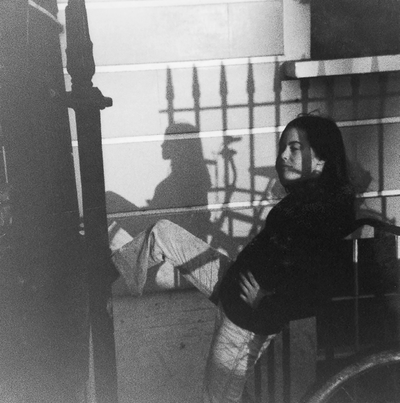
Modelling session, London, 1969.
‘I had instructed my brother Charlie to photograph me with the shadows of me and my bike on Regent’s Park Terrace. I made my own ‘fashion’ magazines, writing all the editorials and drawing the covers.’
So you began attending the shows while at Harpers?
Yes. And I would sketch them. This was before you had so many photographers at the shows. I remember watching Grace Coddington, because she also sketched, and as each passage came out that’s when she made her selection – she’d sketch it. So that’s how I did it.
Why did you leave Harpers & Queen?
The main reason was because I fell in love with Francis, my husband-to-be. And it was a long commute from London to Shropshire [where he lived]. Sometimes he’d forget to pick me up from Wolverhampton and I’d have to do things like hitch a ride with only a penknife for protection. But also, I’d reached a point where I remember saying, ‘I don’t see why I should photograph just the advertisers in my shoots. They should want to be part of the creative vision, but not the entire focus of it!’
Did you feel that whole construct with advertisers just compromised your creative input?
Yes, because you’d have to photograph this, and you’d have to photograph that. And inevitably it was very dull.
So, you took the decision to move on, for personal and creative reasons.
I went freelance for The Times with Andrew Neil. And I remember reporting in Paris and things like that. That was crazy. And then I also did things for The Face and i-D.
I think the first time I was aware of your work, and possibly crossed paths with you in a nightclub or at a party, was when you styled the cover of punk svengali, Malcolm McLaren’s album Fans – with a then-unknown fashion designer called John Galliano – featuring the models of the moment Eugénie Vincent and Dovanna Pagowski. Was that part of that period of freelancing?
Yes. I think that was in 1984. I’d met John and totally fallen in love with him. I knew that I couldn’t do anything without him, and he worked on that with me. We made that fan together for the cover of the opera-inspired album which included a version of ‘Un bel di vedremo’ from Madame Butterfly. We went to Gerrard Street to get Japanese newspapers to make it.
‘I rocked up to Oxford University wearing Laura Ashley and exited wearing Boy. I discovered how I could reinvent myself through what I wore.’
At the time in London, did you buy fashion brands or were you more inclined towards vintage or homemade clothes?
I couldn’t afford to buy much. And anyway, what was happening in the mainstream was not what I wanted to wear. I wanted to wear a pair of velvet knickerbockers from the boutique PX, which I would mix with a lot of vintage to do an Artful Dodger look with a top hat and a lot of ivy. You just made the looks up. That was part of the joy. But also, I had a Norma Kamali moment.
Didn’t we all?! At that time in the 1980s, London’s subcultural network of clubs and underground scenes was a hotbed of creative action. This is where everything was coming up from. Who did you meet over those years and who would become lifelong friends and collaborators?
Aside from John and of course Sibylle de Saint Phalle, there was the milliner Stephen Jones whom I met at PX.
And Tom Bell, of course, was in your life at that time.
Very much. I lived with Tom Bell in Nicky Haslam’s house off the New Kings Road. That time was all about dressing up, and Tom would make these dresses. I remember going to a friend’s wedding and I went in a fingered leather Velasquez dress. I remember I was madly in love with the photographer Johnny Pilkington around that time, and when he discovered that I’d fallen in love with Francis, he was so incensed, he threw all my clothes out of the window onto the Fulham Road. And Tom Bell came to my rescue.
You forged relationships around that time with three other significant, influential and stylish women – Lucy Ferry, Isabella Blow and Daphne Guinness. Can you describe them both collectively and individually?
Well, Lucy I met probably a little bit before Izzy. Daphne I didn’t meet until later. But Lucy was so beautiful, so glamorous, and she had this outrageous fashion sense and a really incredible sense of colour. That’s why she liked Christian Lacroix and all of that. I was in bits of vintage and rags, but Lucy was something else. Being with Lucy, there was never a sort of compare-and-contrast with what you were wearing. Our friendship went beyond that. I can remember her mother, Mrs Helmore, saying, ‘Yeah, my daughter’s going out with Bryan Fairy.’
Isabella Blow, was that around the same time?
Izzy was then mentoring Philip Treacy. He came in and was involved with hats for John for one collection, and Izzy was always very conspiratorial, whispering in your ear like, ‘We’ve got to do this.’
And then Daphne.
Daphne was much later. I remember, one just fell in love with Daphne, seeing her in her wrecked, embroidered McQueen, with a completely shredded hem, and blood-stained Manolos. She was flawless. When I was working with John, I would also see Izzy more and Lucy less. I was also rattling back and forth on a regular basis to Shropshire, where I had my two children, Jasset and Tallulah. I remember Izzy saying to me, ‘I don’t know how you can live in the country. I would turn into a boiled egg.’
You’ve mentioned John Galliano now a couple of times. This was obviously a pivotal moment in your life. Where did you meet him for the first time?
I had a friend called Caroline Kellett, who was extraordinary and very beautiful. I think we’d been at Oxford together, we were definitely running in the same crew. I remember walking with her near PX, past Zanzibar the cocktail bar and saying, ‘I really want to do this shoot with these 17th-century creatures with jewellery and hats, but I just can’t find the clothes.’ And she said, ‘Oh, you need to go and see John Galliano’s degree collection.’
Was that the 1984 Saint Martin’s show?
Yes. I saw that collection and, I can’t remember how, but I got his number. I said, ‘Would you come to tea?’ And at that point, I was living in Old Church Street opposite Manolo in this beautiful house that was owned by Max Reed. I remember John bringing his book of sketches and I mean, they were unparalleled, exquisite; tremulous lines approaching a fragile perfection. I had left Harpers, it was Christmas 1984, and in the New Year he said, ‘I’d like you to come and work for me. I can’t pay you any money.’ And that was for ‘Afghanistan Repudiates Western Ideals’. There was no turning back after that.
‘I wanted to wear velvet knickerbockers from the boutique PX, which I’d mix with vintage to do an Artful Dodger look with a top hat and a lot of ivy.’
What do you think he taught you? And what do you think you taught him?
I don’t know what I taught him but he taught me about the inside of clothes, about construction. He taught me about texture, about colour, but also about that courage to splice something with something else off the street – something really urban. To take something completely out of context. I mean, there was also music, but what I could bring to him was a narrative. If he was talking about shrunken suits, I would say, ‘Well, if she was in the bar and she rubbed up against the wall, actually the brick dust would have come off onto the pinstripe.’ And that became a weave. It was those things that I could bring. The patina, the mark of a man or woman. It was the flaws, I suppose, that made it unique. We always agreed that fragile beauty held perfection; that something that was perfect, wasn’t.
Like the hairline crack in the Ming vase.
Yes, exactly. And that electrified both of us. John was like somebody I’d known all my life. The long-lost brother standing at the little bar in the Spain of my childhood, at the end of the track with the black and white telly with the bullfight and the pinball machines. We literally finished each other’s sentences. We had this complete openness together. It was never ever a case of, ‘Well, that’s a stupid thing to say.’ And I think that is the most creative thing.
Did your new family embrace him?
Yes, he came to stay several times at The Mount in Oswestry in Shropshire and at Glyn in North Wales. We did a lot of shoots there because of my love of the countryside and the land. He understood all of what that meant for me, and that’s where I could really tell a story. I remember him coming once to The Mount and there was a whole gang of us. We’d actually live it. It wasn’t just dressing up a model and being detached. You were all part of it. Like, at John’s first show in the Pillar Hall, I got dressed in the clothes, and I remember John looking at me and asking, ‘Why are you wearing that?’ And I was like, ‘I have to go down the runway because I can’t not. It’s so important.’ Not as a model, my excuse was, ‘I’ve got to pick the things up that have fallen off the models’ hats.’ I just needed to be part of it, to be on the runway.
You were swept up in the moment. I remember the show in London, one of the first of John’s shows I went to with a 12- or 13-year-old, Lucie de La Falaise opening the show, it was magical…
I call it the ‘little wild child’ show. Kate [Moss] was in that show. I think my niece Zita Lloyd too. I remember they had sugar in their hair. That’s when they had bare feet and a black bias-cut dress.
Backstage at those shows must have been amazing.
‘Fallen Angels’ in a tent at Chelsea Barracks was a beautiful show. They were in Dorothea Lange-style dungarees. I got lots of baling twine from home and I’d done the straps. We had lots of fuller’s earth, it was so poetic. The ending of that show was when they came out in those white Empire-line dresses, and they had water thrown over them by the hairdresser Julien d’Ys and the black stamp of the John Galliano label trickled down their faces. It was amazing. Patrick Cox, who’d made the shoes, had given us all something which I think was ecstasy. It put you in a state of high anxiety, so I could not undo the knots for the girls to get into their next outfits. It was fucking scary. That was a lesson for me; not touching that again! John, also freaking – everybody was freaking – was like, ‘No, they can’t go out, Mimi’s going to fall.’ You know, the end of the metal shoe was sort of like armour. It had a really sharp point, and the dresses were quite long, they were going to fall. And so, they went on without shoes!
How were those early years of close creative collaboration?
There was a huge amount of freedom to explore, and because there was no money, there were no boundaries to how much you could give. There was another time he came to Shropshire to The Mount and there were all these young heifers that came bounding towards us, and he was like, ‘Oh, no!’ And I said, ‘Well, where’s your Spanish blood? You’re meant to be a bullfighter.’ Then he got stung by a nettle and I remember him saying, ‘I’m just a city girl, I can’t cope with this.’ The fashion industry was much smaller back then. There were two shows a year, and I lived in the countryside and came to London to put the show together. In the meantime, we communicated constantly on the landline, and he would send me parcels of sketches with fabric swatches. Then he’d come and stay and we’d go through it all.
Your relationship was extraordinarily personal, poetic, intuitive and mutually stimulating. There was an end point though, when John was offered the position at Dior.
Well, I was thrilled for him and I knew that was his dream and I couldn’t think of anybody more perfect. [After working with John on four collections for Givenchy] I wasn’t reckoning on the toughness of LVMH to cut me out of a living wage and expect me to sign the contract [for Dior] that they sent me. I had to be in Paris for six months, and I had two children.
‘You start working with a creative director and the relationship is potentially so intimate. It’s like going to bed with a stranger. You just don’t know.’
So you were actually in the contract to begin with?
Yes, I’d started work on that first couture collection. As you know, I had that weekend where my life fell apart, where I discovered that the love of my life, my husband, was having an affair and had been for the last two years. That I would have to get divorced because the children were being affected and, then, if you married a peer of a realm, you weren’t entitled to anything. I was going to stay with Izzy that weekend. I remember talking to Steven Robinson and he was saying, ‘You’re going to carry on being paid what you get for Galliano for now.’ And I was like, ‘It’s going to be a lot more work!’, as I had been asked to do the accessories for Dior. But there was no wage increase. Just 25% off in the boutique.
How did you experience the finality of that rupture with your dear, dear friend?
I couldn’t get to speak to him. He was obviously very protected. But then what I did was speak to my friend the designer Patrick Kinmonth about his lawyer, who was an opera lawyer, who drew up a proper contract and we sent it. At this point, Karl [Lagerfeld], through André Leon Talley, knew that I was in real dire straits and didn’t know what to do. Karl said, ‘I would love you to work for Chanel, but I respect your relationship with John. This is the contract we would give you at Chanel. Send that to LVMH.’ I did. And then there were explosions!
All hell broke loose.
He [John] probably didn’t understand about the divorce. And the fact that I’d have to employ a nanny…
He didn’t understand the personal implications of it for you?
I think that’s often true. I mean, creative people, they’re under a huge amount of pressure. What happened to Izzy with Lee later [when McQueen took over Givenchy after Galliano left] was the same. It’s heartbreaking and will remain heartbreaking. There’s always a version in my mind where that didn’t happen, where actually there was a considerate contract.
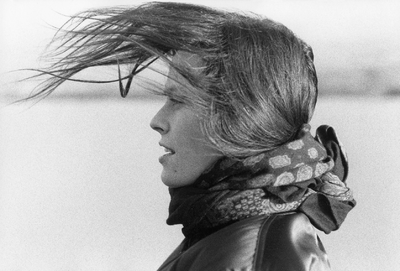
Harlech, North Wales, 1988. ‘Andrew Macpherson took this portrait of me on the estuary at Glyn Cywarch.’
A page was turned though, and then Karl Lagerfeld became a part of the next chapter of your life.
I didn’t get to know Karl properly for a long time. Well into the 2010s. He was a very private man, very guarded and very vulnerable. They all are. Karl was somebody with wit and he was very seductive. He was like a king or an emperor, it was extraordinary to be in his presence, sitting at his table in his hôtel particulier at 51 rue de l’Université, which was charged with the 18th century. But actually working at Chanel, I was left all alone. It was very much sink or swim. Karl didn’t lay anything out for me, and I didn’t know what I was supposed to do. I just thought that I was supposed to do what I did for John: you worked on the set, you worked on the clothes, you listened to the music, you did the soundscapes. You were part of everything. So I started to do that… only to look at the faces in the studio, absolutely frozen in horror that I’d dared touching the clothes, that I’d put on a jacket and wore it in my own way to demonstrate how you could change the shape. I had broken every single rule.
And were you aware of what your presence provoked in other members of the Chanel team?
Yes, very quickly. It was a very different studio initially. There was Gilles [Dufour], who was Karl’s right-hand man, and there was Victoire [de Castellane]. But you also had the whole Chanel team who would come in their tailleurs and pearls and brooches, and sit during fittings like an audience. Karl at one point was feeling really frustrated and stuck, because sometimes when you want to try something new you don’t want to be observed by 25 people. He left the room and beckoned me to follow him. So, I went out through the door, marked ‘Mademoiselle’ – that one. He turned to me, and he said, ‘I want you to go back in there and tell them that I’m not coming back in unless they all leave.’ And I remember thinking, ‘OK, well, I’m going to get fired.’ So, I went in and in my best French told them that, and they got up and left.
So a definite feeling of discomfort.
I was very alienated. Karl was very friendly to me, but more often privately.
‘These heifers came bounding towards us, and John was like, ‘Oh, no!’ And I said, ‘Where’s your Spanish blood? You’re meant to be a bullfighter.’’
You did forge a relationship with him, through your shared love of books, paintings, poetry, music, photography, history – particularly the history of fashion. How did that evolve?
It evolved slowly. I remember thinking, ‘I’ve just got to be myself.’ André would be giving me lectures, like, ‘You cannot turn up to work without make-up on.’ Initially it was very scary. In the end, I just thought, ‘No, I’ve just got to be myself.’ So back came the vintage bias dresses and the bits of this and that, and I thought, ‘Look, all I can do is give 110%. If it’s not right, then it’s not right. But I can’t do it any other way.’ So that’s what I did. One of the most wonderful things was the fax machine splurging out faxes all through the night with all his sketches, and then we would talk about them the next day.
Just you and Karl.
On the phone. Or the famous dossier de presse when he photographed the dress rehearsal with hair and make-up to see where the whole thing landed. That car journey at three or four in the morning, back to his place, and then I’d be dropped off later. Or sometimes I’d walk back at dawn. That car journey was very important because he would turn to me and say, ‘Well, what do you think?’ That was the moment that I could explain to him what I felt the collection meant. Its emotional impact in the context of the time we occupy.
That was obviously something that you probably felt inhibited to express outside of that intimate conversation?
He would ask, but there was a chorus that surrounded anything that he did… I think there’s a danger in any creative studio where everybody will say, ‘Oh, c’est sublime, c’est magnifique!’ But the thing I learned from Karl is you can’t just be negative. You’ve got to explain the positive. As he said, there’s no such thing as a problem, there is only a solution.
From the outside it looked like this extraordinary fantasy you were living out, taking on the mantle of Coco Chanel; a gilded life. But the reality of the situation was very different. How did you feel when you started to realise things were not as you had hoped?
Karl was a very different designer to John. He’s not so much inclusive as exclusive. All ideas come from him. I had to understand that. With a designer, it’s their name at the end of the day, it’s their collection. And sometimes a suggestion might reappear as something they did, of course. It was a strange double life because then there would be crazy things happening, like when I turned up and Karl was shooting a Gone With the Wind editorial for Vanity Fair with André! John Galliano was in that shoot and I was a soldier. Gianfranco Ferré was also in that, it was a very potent, high-octane time, all at great speed, which I hadn’t experienced before. Rather like when Karl was choosing fabrics, it was done so fast!
Did you feel that there was a shift in the attention that Karl gave you or that your position wasn’t as performative as you’d hoped it to be?
Definitely. I felt like I was the secret weapon that was being disarmed. I wasn’t meant to do anything except to ‘be’. Which was difficult because I’m a do-er, and a team player.
Were you following John’s progress at Dior while you were there?
I was looking at the shows. You have this whole connection to something because you can read the language, and yet you’re not part of it. I remember Karl was giving me a lift after the Ibsen-inspired couture show, the Norwegian one – a very Karl collection. Anyway, in the car I was thinking about John, and Karl, who was very sensitive – he could read anybody’s emotions at a hundred yards – was so upset that he told André he felt like a second husband. He didn’t want me to feel anything for John.
How did he feel about John?
He probably felt very competitive.
Threatened?
I don’t know that Karl felt threatened.
I think that he felt challenged. That was how he liked things to be because it drove him on. It made him work harder.
How did he maintain that? How exactly did he manage his court, so to speak?
Divide and rule.
How did that manifest itself?
Well, nobody was allowed to be friends with anybody in the studio.
‘One just fell in love with Daphne [Guinness], seeing her in her wrecked, embroidered McQueen, with a shredded hem, and blood-stained Manolos.’
Did that affect you?
Well, they were friends, but I was the English woman. At one point we were all given a studio outside the creative studio. This is when he brought in his loyal team from Chloé. We were all put in this building. I remember coming into the office, my little room, and there were pictures of roast beef all over the wall… In all my time at Chanel, not one person from the studio invited me back to their place for a cup of tea or a glass of wine. Only Karl, who I spent a lot of time with, and Sébastien [Jondeau].
Was the figure of Coco Chanel always very present?
Very. Gabrielle Chanel is very present in the house of Chanel. There is an indelible spirit of that woman. And she was personified, whether it was by Inès [de la Fressange] or Stella [Tennant].
Do you think there was a facet of yourself that was Coco?
I rode horses over the same country that Coco Chanel did when she was going out with the Duke of Westminster. There were a lot of parallels, that practical logic of the countryside and the tweed jacket.
Do you think that you kind of channelled her spirit?
We all do. Even as a teenager, I had an idea of who Gabrielle Chanel was. That’s why it’s so interesting, there is a grace and elegance that is very quiet and therefore very strong.
What would be your lasting memories of being at Chanel?
Karl, working on these sets, having these ideas and being so infectiously excited. Months before a set was being built – literally as the last model would be going out onto the catwalk – he’d turn to me and say, ‘I know what the next one should be.’ It was this never-ending story, a constantly evolving and refining line. That was Karl.
Can you remember what your last conversation with Karl was?
My last conversation with Karl was on the phone. I was very sick. Not very sick, obviously, relative to what Karl was going through, I wasn’t. But I had a really heavy cold and there was a Fendi fitting. I rang him to say that I wasn’t going to come. He said, ‘That’s OK. I’m sick too.’ That was a very lovely, gentle moment, and that was the last time we spoke. I remember him saying, ‘Bye bye, bye, love, bye.’ And it was that voice fading away. He’d done his last couture, which I think was all his favourite things – you could see every house code in that show. After the fitting, the final accessorisation, we left, and he was visibly wrenched. I mean, he was exhausted, coming apart in the lift. He said to me, ‘What music would you have for the show?’ And I said, ‘Oh, the Tchaikovsky Violin Concerto.’ And he went ‘No, that’s too romantic. It should be Mahler’s, Das Lieder, von der Erde.’ I didn’t know the piece, and when I got home, I listened to it and rang him to tell him I’d got the [Kathleen] Ferrier version. He just said, ‘It is so beautiful.’
And that, to me, was Karl telling me what he was feeling. He was dying, but he will go on and on.
Paris was obviously central to your relationship with Karl as well.
He threatened to come here [to Shropshire], but never did, thank goodness.
What was your relationship with Paris? Where would you stay?
Initially, I was at the Ritz in a room. I didn’t live there, but I’d have the same room. 252. It was great. The Ritz then was a sort of place of pyjama parties and madness and André.
Can you tell me something unexpected about Karl, something that people might be surprised by.
I think we were all surprised by how much he loved Choupette [Karl’s cat]. That was something that came out of nowhere. Up to that point, although he denied it, he hated cats. I mean, Ingrid [Sischy] and Sandy [Brant] had their beloved cat Cassidy who’d come with them. But the cat escaped one time, and Karl was like, ‘Oh, why are they making such a fuss about a cat?’ Well, you know, fast-forward to Choupette. That was one hell of a high-maintenance princess. I remember once in Saint-Tropez she escaped! I had to go down the embankment towards the road and scoop Choupette up. I remember thinking ‘I’ve only got one chance to do this. Do not get it wrong.’
Let’s talk about your relationship with Silvia Fendi and the Fendi sisters. When did you first meet Silvia and the family? Was it with Karl?
Yes, Karl took me to Fendi. I wasn’t actually working there yet, but he would bring his court, his friends. He also wanted to have a good time. I never met Jacques [de Bascher], but I think Jacques brought arabesques of gaiety and absurdity and great style. It was like, keep it moving, keep it alive. The one thing Karl hated was meetings. He didn’t want anything formal, it was all electrifying, it was like, ‘Let’s go!’ Anyway, Fendi was always that place of ideas. Working with the five sisters, it was all about them bringing him workmanship that he could never even have dreamt of – he loved it. By the time I went there, there had been a lot of changes. There was Gilles, initially, and then Eric [Wright] came in, and Vincent Darré. I think Eric did a great job. I think Silvia did a great job. I think Vincent did a great job, but it lacked direction and a creative director and designer like Karl who just goes, ‘No, this is what it needs.’
‘I don’t know that Karl felt threatened by John. I think that he felt challenged. That’s how he liked things to be because it made him work harder.’
Describe Silvia a little bit.
Mystery. Elegant. Roman. Authoritative. Sphinx-like, wise, hilariously funny. Twisted, like her daughter Delfina, in the most superb Roman bourgeois way, and so wise-crackingly modern. She’s really out there, that one. She’s also very strong.
How was her relationship with Karl in those days?
Up and down. I mean, Karl was not great with her or Delfina or any of them – or me. I remember him telling me I was the cloud that passed across the sun of the perfect summer, and he didn’t recognise my voice.
You continued to work with Silvia, though, after Karl passed.
We had a really good team: Charlotte Stockdale and Katie Lyall. And me. And Silvia obviously didn’t want to break that. She did some very good shows. The Colosseum couture, that workmanship is extraordinary.
When Kim Jones came on board at Fendi, you continued to work with Silvia and Kim for several years.
That was, again, another nerve-wracking time. I had met Kim, thanks to you, and I sensed this febrile, intuitive, brilliant man. But I didn’t know him. You start off with a creative director and the relationship is potentially so intimate. It’s like going to bed with a stranger. You just don’t know. I remember he invited me to his extraordinary house in Notting Hill Gate, and I was terrified, looking at the sketches with Alister Mackie and immediately trying to join the dots. It’s like, what’s this about? What is that? How does this work? We had some great times. Like Karl, he’s extraordinarily generous. Not brutal as Karl could be. Silvia came back and said, ‘I want to put the team back together.’ So, we were back again.
![In the words of… Amanda Harlech - © Paris, 1997.
‘Karl Lagerfeld took this photo of me at 51 rue de l’Université, when he first invited me to dinner. Wearing John [Galliano]’s ephemeral ghost dress and Odile Gilbert’s wig from the last Galliano show, I felt protected. It was overwhelming and frightening to be in such 18th-century finery with the Emperor of fashion.’, System Magazine](https://system-magazine.com/media/pages/issues/issue-25/in-the-words-of-amanda-harlech-jerry-stafford/0e5236ec9e-1777277641/amanda-003-400x.png)
Paris, 1997.
‘Karl Lagerfeld took this photo of me at 51 rue de l’Université, when he first invited me to dinner. Wearing John [Galliano]’s ephemeral ghost dress and Odile Gilbert’s wig from the last Galliano show, I felt protected. It was overwhelming and frightening to be in such 18th-century finery with the Emperor of fashion.’
Let’s shift the emphasis. You’ve been photographed by Mario Testino, Bruce Weber, Tim Walker… How do you experience this process in contrast to creating an image from behind the camera?
Agonising. The fashion industry is a tough industry. If you want to be aware of your faults, you are going to be. If there’s any Achilles heel that you don’t feel fits whatever the template of perfection is at any given time, you feel terrible – and I am not particularly confident. It was hard doing the documentary [entitled Karl] with you and Nick [Hooker] and William [Middleton]! I was constantly aware of my imperfections under the scrutiny of the lens. I mean, maybe a documentary film is harder than a still…
You were photographed on multiple occasions by Karl. Was that a particularly collaborative process?
No, it was a command. He was obviously extremely visual and also could sketch. So he had the idea of what he wanted you to look like. And you had to get there.
Which was the case for most of the subjects of his photographs. Were they all very studied in that sense?
Yes, you wouldn’t get a sort of Corinne Day feel happening with Karl. He had a thing in his head and that was that. Although we’d try to bend it.
One of the most recent shoots that you’ve worked on [as a stylist] was for American Vogue with Rafael Pavarotti – for the first Chanel prêt-à-porter collection designed by Matthieu Blazy. It just seems like a wonderful beginning to a new era. I’m sure it must have been very exciting for you.
It was very emotional and very exciting. It was amazing to be asked to do it and amazing to shoot with Rafael. We’d already shot that big story for the Met, for the Karl Lagerfeld exhibition and got to know each other. You follow that dance, and you give what you can. He’s enlightened and humble and so generous. He gives with love and abandon. I love that. That’s what we felt in the shoot.
It felt like the energy that we had all been waiting for.
We were all loving it and hugging each other. It was very, very special. I think Matthieu has that loving embrace and humility in the inclusiveness of his design. You have the emotion of the workmanship, and you have the line that’s so lyrical.
‘One day I know that John and I will sit down together again. There’s a lot to talk about and a lot to laugh about.’
You were very closely involved in the Met show that surveyed Karl Lagerfeld’s career in 2023.
With Andrew Bolton, who was just a joy to work with. The best thing about Andrew, I often say, is that it’s a bit like playing tennis with somebody who’s much better than you. It constantly ups your game. So, brainstorming with Andrew was revelatory. There was a point where Andrew was describing the process of storytelling the exhibition, ‘Well it could be like this, and Karl’s brain is like a computer. And then it short circuits,’ and that was how it was working with John.
Did it remind you of working with him?
Yes, it really did. Where you travel to somewhere you would never have got to by yourself.
What do you think is Karl’s legacy?
Karl’s legacy to me personally? To get on with it. Stop being so lazy. Commit. Don’t hang around. Write. Paint. Get on with it. That’s his legacy to me, personally. His legacy in terms of fashion…
Fashion history. The industry.
I think it’s his design discipline and his understanding of structure. Which I miss because now we are in a time where things are, in a sense, softer and more voluminous. Not everywhere, because some stuff is tighter. But the way Karl would construct a shoulder, it was very rigorous.
The rigour of the architecture.
I think his other legacy would be his intelligence and ability to absorb not only fashion history or the history of the world, but also to understand the history or iconography of the house. So, he could absolutely riff on that ad infinitum. That’s how creative directors do that now, when they move into a house they’re taking a leaf out of Karl’s book. They don’t start off with something completely new. They take, if you like, the legible signs and then they reconfigure them.
![In the words of… Amanda Harlech - © London, 2002.
‘Me, Izzy and Daphne for Philip [Treacy].’, System Magazine](https://system-magazine.com/media/pages/issues/issue-25/in-the-words-of-amanda-harlech-jerry-stafford/2678be7696-1777277650/amanda-004-400x.png)
London, 2002.
‘Me, Izzy and Daphne for Philip [Treacy].’
Talking of which, you were an early supporter of Jonathan Anderson. What did you see in his work?
I remember wearing a divided, heavy felted wool skirt and a top to a Chanel couture backstage. Karl looked at me and was like, ‘What’s that?’ He was always quick off the mark. He could tell when something’s good. Karl had clocked that I wasn’t wearing couture Chanel. I was wearing JW Anderson. I continue to wear it – his Loewe as well.
How did your personal relationship with him come about?
We shot a film about collaboration. Artist Johnnie Shand Kydd made it here with Albi [Amanda’s dog] under the tree. That is when Jonathan and I sat at this table for hours and hours and hours and became friends. We had that openness, about the fears and the joys and how you can orient yourself through this really difficult terrain which is the fashion industry. Jonathan is a strategist. I mean, so is Kim and so was Karl.
Who do you still admire and do you feel has maintained a consistency and dignity and singularity in their work over the years in the fashion industry?
Well, apart from Rei Kawakubo? I am a disciple who made the pilgrimage to every show without fail. Phoebe Philo, who, if anybody, is like Gabrielle Chanel. She herself is the spirit that imbues the clothes, that makes them so desirable that you want to be her without even knowing her. She pushes the dial, as does Jonathan. If something feels uncomfortable or wrong, within 36 hours it’s suddenly the only thing. That is his genius. It has a rightness. Even though I can’t necessarily always feel it myself.
He breaks rules?
It can be something like a colour. A combination of colours, that’s like, ‘I can’t relate to that.’ And then in its difference, you do. I think that’s really exciting as we are all naturally drawn to what we understand and have experienced, the shapes that make sense in our memory. Also I respect Haider Ackermann whom Karl admired and whose clothes are majestic and emotional, and I’m a devotee of Michael Stewart’s incredible Standing Ground work, he is a masterful and poetic craftsman.
How did you feel when you saw the final Galliano show at Margiela?
Well, I didn’t know it was his final one and I’d broken my foot so I couldn’t go. To my cost, because I’ve had the world telling me that it was the show that has changed the landscape of fashion forever. I have to say that I recognised everything in it. I’m not saying that in a complacent way at all. It’s just that it was a language I know, the way everything had been resolved. It was extraordinary.
Have you been able to reestablish a relationship with John since your parting of ways?
We sat next to each other at a dinner in Anna Wintour’s honour when she became a companion of honour to the King. That was glorious. I was talking about how much I love ruffs. And John was telling me how you could have a swan’s down ruff. We started talking again and I was like, ‘I missed this,’ and was threatening to go and stay with him. We nearly saw each other in October, when I was in Paris, but then we didn’t. He has his life and his friends, and he’s probably working on some new thing, I hope so. One day I know that we will sit down together. There’s a lot to talk about and a lot to laugh about.
‘Karl’s legacy to me personally? To get on with it. Stop being so lazy. Commit. Don’t hang around. Write. Paint. Just get on with it.’
We began by talking about this beautiful home of yours here in Shropshire. Let’s end by talking about your son Jasset’s historical house and estate, Glyn. You and both your children, Jasset and Tallulah, have dedicated the last few years to its restoration and renovation. Can you just describe Glyn, the house, the history, the landscape, its meaning to you. And how do you feel when you’re there?
It’s like an ancient magic, wound up with legend and myth and all the wood sprites and Rhiannon the sorceress, with its standing stones and lakes and the moon up the top. The house itself is such a warm place. It’s a place of gathering and people and exchange of ideas. It’s a really special place that has belonged to one family for hundreds of years, sitting in the palm of Snowdonia, where the actual steps and the land have been carved by those generations. And that investment, that emotional investment, is palpable.
What single word immediately comes to mind?
Jacobean. It’s where I imagine myself riding a horse up the hillside wearing a veil. Something I have done and plan to do again. It carries that deep time. It’s really less about the house than the outside. Sometimes when I’m sleeping there I feel that the house has no walls, because all the windows are open, and you can hear the owls and see the foxes and the stars. It’s so uniquely placed and so far away from any mark of man.
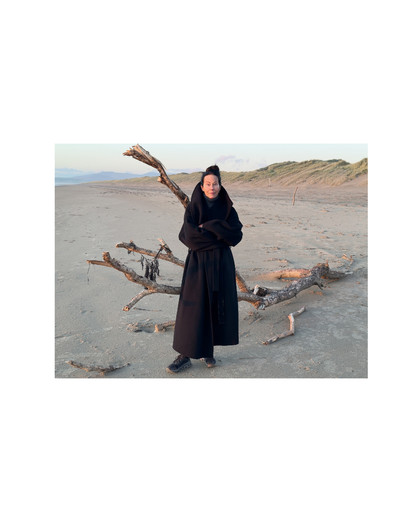
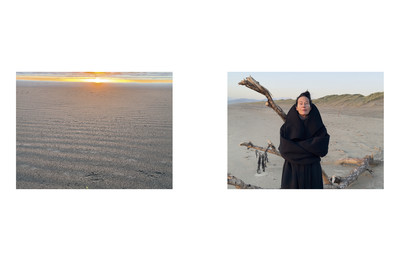
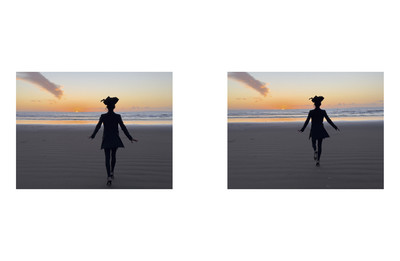
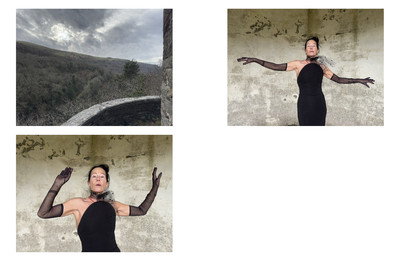
And the accompanying photoshoot that you’ve just done with Juergen took place at Glyn. Talk a little bit about that. And how was it to collaborate with your daughter on it?
Tallulah is brilliant, turbocharged. She’s just unstoppable. Incredible creative energy. We know each other so well, and yet she pushed me forward. I never thought I would wear an Alaïa dress like that. Ever.
How was it working with Juergen?
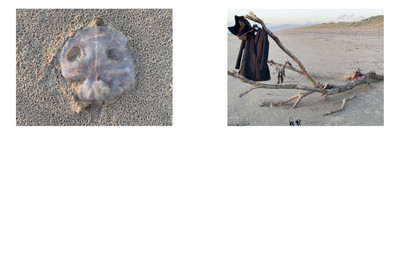
Really incredible. I’ve obviously met him and Dovile a few times, but I’ve never worked with Juergen before. There was an openness, a tale-telling and understanding of the wild, which is very important for Glyn. It’s not about a showy interior or anything. It is about what is sacred, which is the wild.
There’s no hair and make-up in the shoot. There’s no artifice.
That just felt right. I think it was really about me. They allowed me to be me. They didn’t actually change what I was doing, I would just decide to go up to a tree and lean against it. It just all happened like that. There was never a moment when I felt like I was in freefall thinking, ‘Oh God, I don’t know what to do.’ It was like we were on a journey going somewhere together. And the weather was just so benign. It was extraordinary. It didn’t rain, and it normally does.