Jonathan Anderson on his first year of becoming ‘L’Homme Dior’.
By Tim Blanks
Photographs and layout by Juergen Teller
Creative partner: Dovile Drizyte
Jonathan Anderson on his first year of becoming ‘L’Homme Dior’.

The news of Jonathan Anderson’s appointment as creative director of Dior Men’s in April last year was met with fanfare and high expectations. By June, his remit had expanded to include the house’s women’s collections and couture – an unprecedented consolidation of power and influence that sent anticipation soaring.
Anderson, arguably the defining designer of his generation, has never concealed his ambition. His creative direction rests on the three essential ‘C’s: collections, collaborations, and celebrity. At Loewe, he struck a rare balance: playful yet rigorous, avant-garde yet commercially astute.
But this is Dior: a French institution operating at a global scale, with a designer lineage stretching from Monsieur Dior to Saint Laurent to Galliano et al. And, crucially, a house generating north of €10 billion annually.
Anderson’s first year has been marked by Big Ideas, fashion-as-entertainment, sculptural silhouettes and an abundant arty curation befitting of the time. Reactions have ranged from elation to confusion; whether it is the universal triumph many predicted remains uncertain. Still, early sales forecasts seem encouraging, and his debut couture collection suggested a turning point – a designer deeply attuned to craft embracing the prowess of a world-class atelier. He speaks resolutely of his five-year masterplan for Dior’s redevelopment, underscoring the enormity of reshaping such a behemoth in his own image – ‘For me, at Dior,’ as he puts it.
Soon after his arrival, System requested an audience to observe this transformation up close. Given Anderson’s appetite for curatorial challenges, we proposed a selection of conversations from which to choose one, possibly two to record: a dialogue with longtime interlocutor Tim Blanks; a meeting with 90-year-old Yorn Michaelsen, former assistant to Christian Dior; a red-carpet reflection with Jennifer Lawrence; a discussion about form and cultural intent with ceramicist Magdalene Odundo; and a three-way exchange with photographer David Sims and stylist Benjamin Bruno.
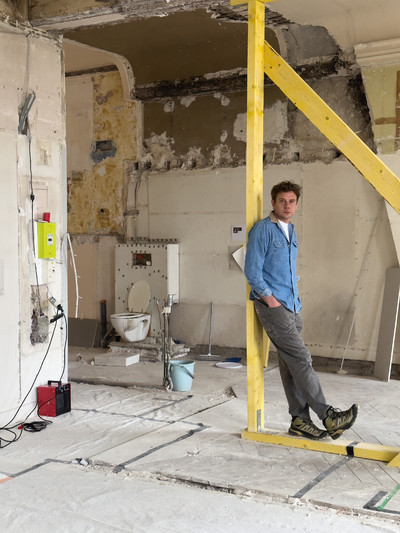
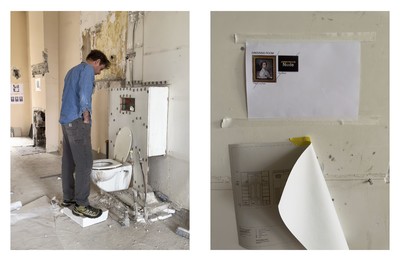
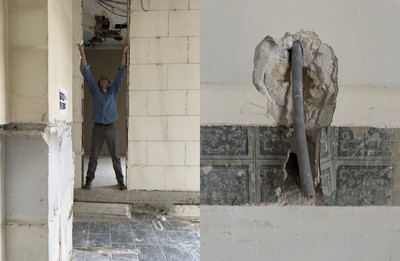
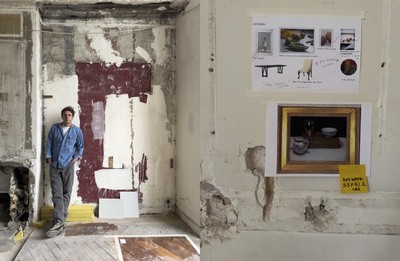
Anderson’s response was unequivocal: let’s do them all. And let’s invite Juergen Teller for a visit to his Île Saint-Louis apartment mid-renovation (yes, the visual metaphor was lost on no one) and then ask Sims and Bruno to create an audacious interpretation of his debut couture collection.
And so, across the following pages: Jonathan Anderson’s first year of becoming ‘L’Homme Dior’.
In Conversation. Jonathan Anderson and Yorn Michaelsen
In Conversation. Jonathan Anderson and Jennifer Lawrence.
In Conversation. Jonathan Anderson and Magdalene Odundo.
Dior Couture Spring/Summer 2026.
In conversation. Jonathan Anderson, Benjamin Bruno and David Sims.

Jonathan Anderson’s office is a catalogue of obsessions. A huge bare-backed Wolfgang Tillmans monochrome rules the room.
One of the same artist’s colourful vernacular still lifes fills another wall. A small but splashy Howard Hodgkin anchors a third wall. The Hermes 3000 manual typewriter that dominates Anderson’s desk is a 1960s design classic. He uses it to write thank you letters when the muse takes him.
On the fourth wall is another small, but ravishing, painting by Giangiacomo Rossetti, a young Italian artist Anderson found to memorialise his first collection for Dior. That men’s show last June already, curiously, feels like an aeon ago. Much more of the moment is a reminder of Anderson’s most recent first, the couture collection he showed at the end of January. Japanese artist Hiroshi Sugimoto photographed the opening look, a black silk dress sculpted after the monumental ceramics of Magdalene Odundo. His image is propped on the sofa alongside textile artist Sheila Hicks’ multi-tasselled re-imaginings of the Lady Dior bag from Anderson’s womenswear debut in October.
Odundo sat in the front row of the couture show with that bag in her lap. Hicks, seated opposite, clicked away on her phone with unrestrained glee. The presence of the two women represented everything that has made Jonathan Anderson irresistible to fashion. His ardent love of craft, his boundless appetite for quirk, his unhinged curatorial vision and fearless idiosyncrasy fired up leathery old Spanish brand Loewe to the dulcet tune of billions, which greased the wheels of his ascension to what is probably the biggest job in fashion: creative director of Dior, lock, stock and barrel. Men’s, women’s and haute couture. No single designer has ever had that particular purview, so make that another first.
Quite what that might mean for Dior will become more obvious in the years to come. But what emerged in the hours and days after the couture show was a clear intent to communicate a new spirit. The fact that it emerged during haute couture, the rarefied pinnacle of Dior’s fashion pyramid, made it even more intriguing. Anderson conceptualised his couture debut in three chapters. The first was the show itself, a spectacle that anyone could visit via social media. The second was an installation he called Villa Dior where, immediately following the show, couture clients were invited to re-experience the collection they had just seen, and then some, with the addition of shoes, bags and jewels that weren’t shown on the catwalk. Baldly stated, it was a selling show, and hearsay says it sold out.
The third chapter was a week-long public exhibition in the show space at the Musée Rodin. It highlighted vintage Dior couture, alongside looks from the new collection and Magdalene Odundo’s sculpted pieces. Le tout Paris queued in the rain, many thousands more than anticipated. Social media highlighted enraptured children, sketching away as they scrutinised Dior, Anderson and Odundo.
So that’s a start. And now we talk, in that office with all the threads of Anderson’s own fascinations slowly being drawn into the Dior centrifuge.
Tim Blanks: A little while ago, you told me that the world could throw anything at you. Twenty collections a season, whatever, you could do it all. You’re in a situation now where you are kind of in that place. How do you feel right now?
Jonathan Anderson: Acclimatising. I think you probably got me on a very good day when I said that. It’s taking a bit of time. When you go into a new business, you’re trying to understand the people, trying to understand what the flow is. This year I feel way more at one with it.
‘Loewe was more like a manufacturing company. With Dior you’re up against multiple legacies, some forgotten, others tremendously well known.’
What’s changed?
I think I am now coming to the end of the cycle of doing everything for the first time. So now going forward will be the second time. It’s easier, you start to get products in stores. It’s quite frustrating when you spend time and there’s no product in store because you don’t know what to argue against. I mean, there’s nothing to see on the street, no way to hear what customers are saying. Now, since the beginning of the year, I can see what works, what doesn’t work, what we need to do, what is resonating, what’s not. It feels more rewarding because it’s actually a real thing. It’s not like doing a hypothesis on it.
Do you check the numbers every day?
No, I don’t, but if I’m anywhere near a store, I always pop in just to see what the vibe is. You know, in the end, I always find it really fascinating watching
people shop.
With couture, you get an instant response, don’t you? You don’t have to wait months and months. The feedback comes right away from the clients, not just the press. Tell me about that experience, because that is the pinnacle of the Dior pyramid. It’s where it all comes from.
This was very daunting, I must admit, because I had never done it. The client is this mystical thing, and you have to sell the looks that are in the show. And you can only sell three of each look. It’s a completely different genre of people. They have way more opinions. But I found it really exciting because I had redone the showroom as this sort of wunderkammer where you could go in and buy different things that were made for the salon as well as the show collection. I liked this idea of what it would be like if you were going to meet Monsieur Dior, and what would be the feeling of buying this one singular thing? It’s really like the film Mrs Harris Goes to Paris with Lesley Manville. I love that film because it plays into the quintessential dream of having this one thing. I was thinking when I was building the salon, ‘What is that feeling like?’ The near-Disney feeling of putting on the dress. And it was amazing. It was such a wild week, to do all of it at once and then finish with the exhibition. It made me realise why couture exists, this endangered craft that you sit and make all by hand. There was something that made me enjoy fashion more.
‘There is a history of fashion language here. Everyone is like, ‘Well, that’s not Dior.’ The best comment was, ‘Coats are not Dior’. Well… coats are Dior!’
Fashion itself is notoriously struggling with relevance, but some very strange alchemy happened during the couture shows. It suddenly felt like couture was the most relevant kind of fashion that there is right now.
I’ve been looking at it, trying to understand it. I think couture is the purest form of fashion. It’s about craft, it’s about making. There is no sewing machine. It’s all by hand. There’s something truly romantic in the idea. And in a weird way, it’s very nostalgic, sort of like going into a bygone era of making these looks, these art forms, and there is a fantasy to it. I think it can engage with a larger audience because ultimately you don’t have to be the person who’s buying it, you can just see it as a kind of spectacle. I think people like the narrative behind it.
It also puts you in dialogue with Monsieur Dior himself. How did you find that? That’s a very different kind of relationship for you, having someone looking over your shoulder like that.
Loewe was more like a manufacturing company, more about the craftsmen. Whereas with Dior you’re up against multiple legacies, some that are forgotten, others that are tremendously well known. So, you’re dealing with all these odd voices which are the brand itself. You have the legacy of Dior, you have Yves Saint Laurent for this brief moment, you’ve got Marc Bohan, who’s quieter. Then John Galliano… All these voices, plus the public imagination of what Dior is. Each generation has a certain vision of what it is. They’re not all the same. For some, it might just be perfume. Or throwing jewellery on the ground. Or running through Versailles. Then you have people who know Dior because of movies and the story of the war and all of that. And then there’s my generation, which is all about Galliano mania. So, you’re dealing with a brand that ultimately means so much to people, and you’re trying to find a doorway into it all.
Is it a clamour?
Yes.
Who did you feel the most affinity with while working on that collection?
I think the very beginning part for me was very much looking at the psychology of Christian Dior. He was obsessed with construction. How do you build the inner architecture of a dress? What is underneath it, to maintain that volume? When you look at those dresses in museums or in the archive, they’re quite industrial. There’s a lot of very heavy crin, lots of boning, lots of corsetry there. A lot of stuff to maintain the fantasy that we know. So I was thinking, how do we keep that volume but make it incredibly light? Like those opening dresses, if you have not felt them, you would think they’re hard structures, but they’re actually soft. So for me it was finding new ways of doing structure today. You have Dior, who was the nucleus, and then you have a period where it was very well looked after. Marc Bohan was there the longest. Ferré becomes bows and frills and suddenly you have this moment where John Galliano arrives and Bam!, it’s about complete excess, amazing theatre, on a level that had Paris on its knees at one point. For me, it was like, ‘How do you bridge all of that? How do you say this is actually part of the historical DNA of the brand?’ That’s why when I did the first ready-to-wear show, it wasn’t really about the show, it was about what I did with Adam Curtis: creating a white space, but knowing that all of this pre-exists, and it will never disappear. So, it is better to be confronted by it than pretending that bias cut dresses don’t exist anymore.
Do you think your attitude changed from the first show, or was it your sense of what was possible? That film you made with Adam Curtis was quite confrontational, but the couture was an embrace of beauty like I haven’t seen you do before. Maybe it wasn’t a quantum leap, but it was a definite shift.
It was definitely a shift. For me, it was more about how long I’ve been there. I know it sounds like a really basic thing to say, but the women’s collection was done in 27 days, whereas with couture, I had the time to get into the company, understand it, and meet people. So instead of just being like, ‘I need a jacket! Who’s going to make it?’, now I know there is this person who will do the jacket. You work out what you want from them and how you collaborate.
‘I’m really bad at French. But I quite like French-ness, the historical things. What I like in Christian Dior is his obsession with the 18th century.’
Was that hard for you?
Yes, in the beginning it was very hard because you’re trying to juggle multiple plates. You’re trying to understand. You’re dealing with the outside world, the real world. You’re trying to know what you are doing. What I’ve realised since the beginning of this year is that the key to the job is you have to always know where you’re going. No one else does, but you know where you’re going. No matter how many things are going to be thrown into it, you have to keep going because you subconsciously do what is right. That’s what I reminded myself, I subconsciously know when I go to work in the morning, five days a week – or seven days sometimes – I know exactly what I need, where it’s going. It’s just always trying to remember that and not get thrown.
When you say what is right, you mean for Dior? Or for you?
For me at Dior.
And what’s that dynamic?
Now, I’m at one with that. I think I was in a big conflict with it last year because I was trying to work out how to break this cycle. Like, ‘How do I break the brand?’ It was like running after a horse and you’re trying to grab it, and it’s going faster than you. This year I feel I’m walking beside it and it’s fine. The first show, as much as people may have been confused by it, was the right show to do at that moment. Sometimes you go into a brand that everyone in the world knows so everyone has an opinion on it. So, you’re listening to Jane-from-Inverurie [writer’s note: let’s assume this mythical creature wields the power that the Secret Shopper once had in a long-gone world of retail] to see what she thinks about it. Then you wake up in the morning and you’re like, well, maybe Jane’s right.
And how the hell do you hear what Jane-from-Inverurie thinks?
Because you just see everything. Then I started to realise that you have to trust the process of change. And change ultimately means conflict. But you cannot get into that conflict because ultimately you have to say to people: this is the line. We’re not going behind that line anymore. We’re going this way now. It takes time for people to acclimatise to it.
So, you have to assert yourself. The thing about Dior is it’s not just a fashion house, it’s a cultural totem. One of the pillars of France. So, I would imagine asserting yourself requires you to be forceful in situations where people resist you. You must have to fight.
It’s not about fighting. You have to become quite stealthy because the thing is, you’re trying to remember what the end goal is, and not change midway. But once I’d had Christmas and I’d come out of the whole I’m-in-a-tumble-dryer at the beginning of January, the minute we had the windows installed and we had the product in and people were buying it, then I got this big [mimics a sigh of relief]. It is real. It is not me in a cupboard trying to design stuff in this imaginary world. Yes, there are shows, but it becomes a real thing the minute it goes in store.
The French-ness of Dior is another thing. How’s your French?
I’m really bad at French. But I quite like French-ness. I think it’s the historical things. What I like in Christian Dior is his obsession with the 18th century. I’m obsessed by English 18th century, which is actually very similar. One is a bit more flamboyant, the other is tougher. You know, like French furniture in the 18th century is a lot more gilded, way more over the top. Whereas in Britain we were trying to copy it in a cruder way. It’s a bit bigger. There’s something which I like in the meeting of the two, because that’s something Dior was very into. He was an Anglophile as well. He was very into English art, English furniture, English houses, English aristocrats. I like that there is a romance in that part of him.
Are you finding a surprising compatibility aside from that? When you’re actually in Paris and you’re working here, in this hub of French culture. Or are you conscious of a performance element for yourself? Like there’s a role you’re playing.
I don’t go in as the couturier in the morning. As much as people probably would love it if it was like that. It’s not like that. As my dad would say, it’s very rag trade. The difference ultimately from where I was before is that when you go to a restaurant or you walk down the street, you deal with more recognition. Paris is smaller than London as a city. If you’re being quite loud or animated on the phone, you start to realise you can’t be loud or animated on the phone. That takes a bit of time to get used to. And it happened quite quickly.
‘I don’t go in as ‘the couturier’ each morning. As much as people probably would love it if it was that. It’s not. As my dad would say, it’s very rag trade.’
How do you cope with that, then? It’s almost like you’re in a sort of ambassadorial role.
My father was a rugby player, and I remember going to rugby matches, and people would ask for his autograph and I always found it so embarrassing. Whenever I went to see my dad play rugby, it would take forever to get out of the place. My dad would talk to people forever. But you know, it’s part of how fashion has changed since I started. There’s the thing that we all love, which is designing and making clothing, but fashion has become part of the entertainment business. And that’s where I struggled last year a bit, because in my head it was just like, ‘Oh, I’m going to take this job and it’ll be just like going to Loewe.’ I wasn’t thinking like, every single designer is moving, the industry is in turmoil, it’s going to be survival of the fittest and which one’s going to win? You would go on Instagram, and it’d be like, ‘Oh my God, this is a nightmare’. It was intensified because ultimately it became like a TV show. Everyone was like, ‘Who’s going to be at the next house? Which show is going to be better?’ The first show, the men’s show, was very calm. It was very much those two Chardin paintings in a room. You either liked the collection or didn’t like the collection. And I was, like, ‘This is OK, this is going to be fine.’ But it was not until I did the women’s show, when you could feel the anticipation in Paris, which was quite exciting, and this guy Yorn [Michaelsen] came backstage beforehand – he’d been Christian Dior’s assistant – to wish me good luck… That was the moment where I was like, ‘Oh, this is a nightmare because you’re in France and there’s this reverence.’ I didn’t have this reverence. So then I was trying to work out, ‘OK, this is important but is it important?’ And it was not until the show was done, and there was a relief, an emotional thank-God-this-is-over, no more what-is-it-going-to-be? When we looked back on it, it was a big change in fashion. Two of the biggest houses were suddenly changing at the same time.
And with two designers who were very easy to position opposite each other to create this kind of irresistible heated rivalry…
Yes. So you end up in this thing where you’re just trying to do the collection, not dealing with the global picture, which everyone else was. You could feel it. It was a very strange year.
How sensitive are you to that sort of outside stuff?
I’m human.
I always thought you were kind of thick-skinned about it all.
Sometimes I am, but I’m ultimately human. It can be tough some days because you’re like, Why? Why? Why do you not understand? Why can you not just give it time? But then you become immune. Which is scary as well. I was in a situation at Loewe where I grew with the brand. We started and people just got used to it. People didn’t have any expectation of it. I was so used to working in a landscape which had a leather goods language, but no fashion language. You could do anything there. Here, you have to grow into it. There is a history of fashion language. When you come, everyone is like, ‘Well, that’s not Dior.’ The best comment was, ‘coats are not Dior’. Well, coats are Dior! You realise that you have to just silo yourself in the end, because there is the brand, there’s you, and then there’s you and the brand. I’ve never been to a psychiatrist – maybe one day I should – but I was talking to a friend about this idea that there are three Jonathans, or three Tims. Three different personas. There’s work Jonathan, then the outside thing, and then there’s you. You have to put these different hats on. Some days you have to be more personal, some days you have to be more like Jonathan, the designer of the brand, which is a different mindset.
And sometimes you just have to smile.
And sometimes you have to smile and, and as cliché and as boring as it will sound, I can only do my best. I get up every morning and I love what I do. You have to kick me out of the office because I really, really enjoy it. Is it difficult? Of course it’s difficult, but I love a challenge. I love, ‘How am I going to work all this out to get a solution?’ Even if I go mad in the process, I enjoy that process.
I sat next to Sheila Hicks at the show, opposite Magdalene Odundo, who inspired the dresses. And I was in Jonathan World there. Then I look at the online coverage and you’re in Bezos Land backstage. The strange bedfellows that this whole situation creates for you are slightly schizophrenic.
But fashion is schizophrenic. My whole thing is you have Jeff Bezos and Magdalene Odundo in the same room, because I think they can learn from one another.
‘I’d done these shows and people seemed confused by what I was doing. No one was gravitating to it and I was like, ‘What the hell is going on?’’
You actually love doing the business bit, don’t you? The level that you’re at gives you the resources to be as creative as you could dream of being, and yet at the same time there’s this massive machine you can involve yourself in. Best of both worlds.
The thing that drives me is creativity. I always believe that creativity will make good business if it’s done right. So, you need a partner in crime. I have Delphine [Arnault]. We work together on how we are going to take the business from here to here. For me, the success really comes from that meeting. You cannot silo creativity and business. In the history of fashion, that never worked.
We are going to use creative solutions to create money. If we create money, we create jobs. So that we can re-invest in something. That’s exciting to me because, in a weird way, it is very difficult to quantify creativity in fashion. We’ve blurred it. We ended up with some designers who did amazing collections, but weren’t financially successful. We are now living in this era where we judge a designer on the financial success of the brand. It’s not about the creative output. For me, you have to juggle these two. I have to produce something to take a brand that was here, and I have to bring that customer with me. No one wants to know that. Everyone just thinks that you just click your fingers, and you go from one customer to another. But Delphine and I have to work together on this very complex thing where you’re taking a customer that was used to buying one sort of silhouette…
But I enjoy that process because it’s like a riddle. You’re trying to work out what the business model is going to be, because I think the business models are always changing.
The fashion prototype is the creator and the businessman working in tandem: Saint Laurent and Bergé, Valentino and Giammetti, Ford and De Sole. Are you looking at yourself as a fusion of those two things?
I need someone to work with who enjoys that fusion. That’s why I enjoy working with Delphine. She is very creative on bags, for example, and is very good at business. I think we can have a debate. She’s a good partner in that way because you’re trying to work out a solution without arguing. I love that. I could sit for days, because for me, it’s very like, ‘OK, we’ve got €1, but we want to get to €5.’ And we just need to do this, this, this and this. But then I need to make sure that the product is this, this, this and this. And then you go, ‘OK, there’s the goal so we’re going that way’. So, no matter what people think of the show, no matter what other people are doing, you know that you are going to make sure that you are ticking those boxes so that you don’t have people saying it’s not working because it’s not a financial success. Because that’s how it works.
Famously, everybody knows what LVMH expects of you with Dior, how you’re supposed to take it from X billion dollars to Y billion dollars. And you have a game plan for that?
I’ve been in LVMH for 11 years and I don’t feel any pressure regarding that. The most pressure that I get is from myself. There will be no one harder on me than myself. I’ll be like, ‘It could have been better. It could have been this, it could have been that. Why is that person doing this? Why is this dress like that? Why is this happening?’ Every day is a correction on what we can do better. So, if I’m here to grow the business, that will come out of a compulsion to succeed. It’s not to win, it’s to succeed. Which means I have to take all these people – people who don’t know me, people who I brought with me – and we have to go this way. That’s the hardest part to get to. Once you get to it, then it grows. But you have to get everyone to go with you.
Do you feel you were made for a job like this?
Yes, if I didn’t enjoy it, I wouldn’t do it… When I’m bored, that’s the problem.
Out of the three Jonathans, which one is the bored one?
I think sometimes it can be me, myself. If I’m at home and I feel bored, then my brain starts, ‘Why is this not going right?’ For me, I need to be fuelled.
You’re not good with downtime.
No. But if I go on holiday, I’m good at it. I will pack it out. I will be, like, ‘We’re going to go to the beach and we’re going to a restaurant.’ I need to feel that I am continually propelling forward. That is what I enjoy. I like being around people. That is what turns me on. I like sitting around and trying to work something out because I know it will always work. I know it sounds crazy, but I know, no matter what, I will do everything I can in myself to make it work, and I will take it all on because I feel like if I don’t take it on, I don’t have anything to fight for. So, in a weird way, I sometimes have to create an invisible enemy just to feel like I have something to make it more competitive.
‘The minute we had the windows installed and we had the product in and people were buying it, then I got this big [mimics a sigh of relief].’
Who is the invisible enemy?
It could be anything. It can change, you know? But usually for me, it’s very much a target thing.
I will be like, ‘OK, where is the gap in this whole thing?’ For me, fashion can only be new by finding the gaps in what people are not focusing on. It’s not that I’ve never done anything with art before in my previous job or for my own brand, but I was thinking ‘OK, if I’m at Dior and we do art, that is different.’ It can’t be an insular, romantic world. People know Dior, so we can actually introduce them to someone like Magdalene Odundo, who they will have never heard of. If I can introduce 80 people to Magdalene Odundo’s work after the show, then I have won on why this brand can be amazing. It should be about access, you know? For me, that is the most rewarding thing. My end vision for couture was that I wanted to have school groups in the couture venue drawing. Because I went to see Magdalene Odundo’s show and there were all these kids drawing her vases – and drawing the vase and drawing the dress is the same thing. It’s about volume. If we can get people in, then I feel like that is going to make up for everything. And it did. I really do believe that was like a singular moment: having the bar jacket, and Magdalene’s vases and the new dresses in the exhibition and young people with naive eyes looking at it all and drawing. For me, that was the newest thing that happened in couture. Forget the collection.
It was quite radical. The sense of mission did feel like something new, but it was in the collection too. The craft, the quirkiness of all the stuff you’ve done your whole career, insinuated into Dior. Were you surprised that you were able to do that so successfully?
I didn’t know how the show was going to turn out. I knew exactly what the exhibition was going to be, because I’d worked on it for six months. We had requested the works, we had gone to the archive, and we had got the exact dresses. We had the right mannequin, the right platform, the kids’ book. Everything was already done. But the collection I was a bit worried about before. I had done all these shows and people seemed confused by what I was doing. No one was gravitating to it and I was like, ‘What the hell is going on?’ But then I realised that this is a creative process. If I was to do the perfect show on day one, then you would switch off because there would be no progress, and it has to progress. This is what I really believed. I thought it was going to take a year for me to put the work out, and then with the couture, I let myself go into the process of this being part of where this brand is going to go in the next five years. Instead of worrying about Jane-from-Inverurie, all that kind of stuff, I was, like, ‘I’m going to start and I’m going to keep putting the work out, and it may not make sense to me right now but at some point it will.’ That’s what I quite enjoyed after the show. There were some looks that looked way better in the show than they did in the fittings because they were moving. Suddenly a tuxedo was moving in a way that when it was captured in motion, it looked 10 times better.
You’ve talked about wanting couture to be the foundation of the whole business. A crucible of ideas. That’s always been an haute cliché, that couture is a kind of laboratory, but it never really translates like that in real life.
Dior has couture as some sort of reality-fantasy lab creating ideas and community. For me, it’s the backbone of the entire brand, because it is ultimately the top of the tree. If it doesn’t sit like this, then you can’t build from it. Which is the goal. I believe that couture should be radical. A journalist recently asked me what exactly is there to wear, which I found to be quite reductive, because you’re already forcing it towards commerce rather than asking what the idea or the emotion is. That’s why we love fashion. That’s why we all turn up to shows, or we like watching people wear the clothes. We want to feel the emotion of it. How I always worked on menswear is close to how I work with couture. When I do men’s, I’m always like, ‘What would I love to be able to wear? Could I wear it?’ I want to be able to walk down the street and be able to pull it off. I want to have that. In a weird way, the couture was like that. I wanted it to be these things that were about ‘The Idea’. I think this is why couture felt quite interesting this season, aside from the tension around ‘first shows’. It was like, let’s forget about what we’re wearing – because ultimately we’re all dogged by the idea of commerce – what is the fantasy of it? Sometimes they can be old fantasies, you know, but they’ll always be new in the moment. Everyone will have a projection. Is it Raf? Is it Dior? It doesn’t matter. It is about putting out what you think is fascinating to you. If you believe it, then there will be at least 10 other people who might believe it too.
‘Boredom is my biggest fear. If I retired, I’d have to become a gardener because there’ll always be leaves to mop up, grass to cut, new things to be planted.’
When you’re the third Jonathan, at home, can you stop thinking about this?
I can. When I get home, I go into things that are my own. Am I going to paint this wall, am I going to hang this picture, where am I going to go for dinner? Shall we cook, order Deliveroo, or see friends? I have to get into that because if I don’t, I feel that I’m stuck
in this person.
Which person?
The me-as-designer. I have to perform that during the day. So, when I go home, it’s not about performance, it’s reality.
I like cleaning the house. I like to be able to do that bit, because I think it is very easy in this job to lose a feeling of groundedness. I’m very, very much on the ground. I know exactly who I am and I’m very happy with who I am. But the minute I’m getting off the ground, I know it and I can feel it. But then I have people like Ben [Bruno] who will turn around and say, ‘Get back’.
How important is somebody like Ben? He’s been with you through all your incarnations.
I trust Ben implicitly on everything I do because I think Ben is very good at foresight. He’s very good at seeing something that’s coming before it does. I need someone to argue with or to keep me in place, I like the tension of it.
How many people like that do you have in your life?
Creatively I have that one person. You can’t have multiple people like that. You can only really count one person like that, because it keeps consistency.
What are you most proud of at this moment?
What am I most proud of? [Long pause] That’s a very difficult question.
Well, it’s nice to know that you haven’t reached that point yet.
I’m proud I was able to get here in one piece with the people that I wanted to come with me on this journey. I’m proud of the people that excelled more than I thought they were going to, because it means I made the right decision. I think that is the biggest thing, because sometimes when you convince people to go on a journey with you, there’s always the thing in the back of your head saying, ‘Have I dragged them the wrong way?’ So that makes me really happy. On the personal side, there’s probably more room for improvement, I think I need to spend more time with family. There’s certain things that I need to be better at. But, you know, it’s like a seesaw.
Are you afraid of anything?
At the moment? No. Ultimately I’m always afraid that there would be no work. There would be nothing to do. Boredom is probably my biggest fear. That there’s nothing new that I discovered. As a compulsive person, I feel like every day I need to learn something. That’s why I’ve loved the couture atelier. I’m a designer but I never knew how to do tailoring. Then you work with someone who only does tailoring, this guy who works with us called Rocco. You look at this garment and you say, ‘I want it like this,’ and he will do this and this and this, and you’re watching this person manipulate this thing, and you realise you know nothing. It’s the most amazing feeling because when I see him in the fitting, I’m looking at him to try to learn what he is doing.
I don’t need to do it, but I want to understand it because then with the next collection, I will be like, ‘OK, we did this, and maybe if we push it, we can do that.’ Then you have this dialogue with someone. That’s why I think if I retired, I would have to be a gardener because there would always be a problem in the garden. There are always four seasons. There’s always going to be leaves to mop up, grass to cut. There are always things to be planted or watered.
There will always be something that needs doing.
Solutions are so satisfying when you’re gardening.
That would be the only other option after doing a job like this. Because you would need something that would be from morning to evening. Dior is like a garden. Every day you have to make sure everything is working. You have to give everyone airtime because if not, they start to wilt and then they feel like they’re not supported. After that, it would have to be something like gardening. I’ve always wondered to myself how you would stop yourself from going mad.
Dior is the ultimate distraction from boredom.
Yes, it doesn’t stop.