By Jonathan Wingfield
Photographs by Ilya Lipkin
He’s leaving GQ for Pharrell, media for brands, and New York for Paris. Is Will Welch’s new move symbolic of where the industry is heading?
In the spring of 2013 (when, incidentally, System magazine was launching), American GQ’s latest issue to grace newsstands featured a Terry Richardson image of Beyoncé on its cover. The future Cowboy Carter was captured in red and black leopard-print knickers and an ultra-cropped sports T-shirt, flanked by the straplines: ‘The 100 Sexiest Women of the 21st Century’, ‘Gentlemen, Put Your Pants Back On’, and ‘Dads Gone Wild!’. Viewed today, it’s something of a relic, a cultural nadir for a magazine founded in 1931 under the original title Apparel Arts. Yet it remains a GQ landmark nonetheless: one of the most commercially and culturally successful issues of its era. Teasing a sneak peek of the cover, The Hollywood Reporter announced at the time, ‘We aren’t even bothering with a poll to ask you if you like this photo. We know you do. It’s a slam dunk, a hole-in-one, a touchdown.’
Six years on, and with a new editor-in-chief, Will Welch, at the helm, GQ delivered its November 2019 issue featuring Pharrell, not so much wearing as engulfed in a mustard-yellow, floor-length Moncler ‘puffer-gown’, accompanied by the words: ‘The New Masculinity’. An altogether different GQ landmark, the issue signalled the start of a major editorial shift, away from traditional ‘lad mag’ tropes and towards a more inclusive, progressive and (crucially) fashion-forward exploration of modern manhood. The overarching ambition was to interrogate what masculinity means today in a post-#MeToo world. Welch’s editor’s letter specifically framed empathy as the ‘antidote to toxicity’, and GQ partnered with a polling group to survey 1,005 Americans (men, women and non-binary individuals) to gauge how gender norms were shifting across the country. Other topics addressed in the issue included isolation, anxiety and male suicide – each linked to the pressures men face within a society of restrictive norms and stigmas surrounding mental health.
With the title’s ethos undergoing a paradigm shift, Welch began lavishing particular attention on #NewGQ’s website, social media accounts and video content, using a high-fashion-meets-entertainment lens to capture digital audiences and advertisers alike. Where once Pulitzer Prize-winning longform investigative journalism cohabited with cigar reviews, columns titled ‘Why a Gentleman Packs Whisky’, and Brooks Brothers editorials, Welch was presenting a new GQ for a new generation: the Virgil Abloh era of streetwear-meets-post-preppy fashion, FOMO-inducing parties at the Chateau Marmont and Paris Fashion Week, and an eclectic roll call of cover stars and kindred spirits, from Pharrell and André 3000 to Grace Wales Bonner, Law Roach, and Anok Yai; Sydney Sweeney and SZA to Lil Nas X, Lewis Hamilton, Paul Mescal, Willy Chavarria, Travis Kelce, Hailey Bieber…
‘As an intern at The Fader I was keeping trackof budgets, while writing pieces on spec with no expectation that they were going to get published.’
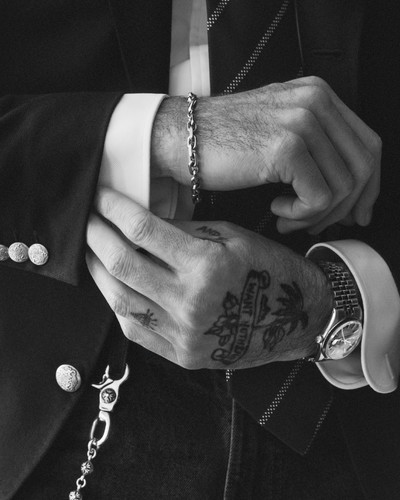
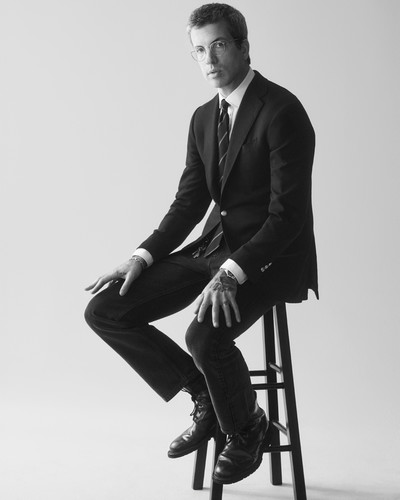
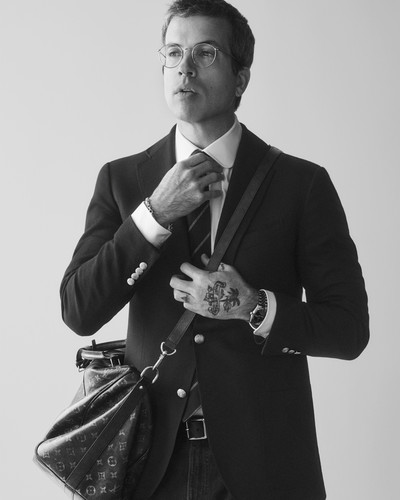
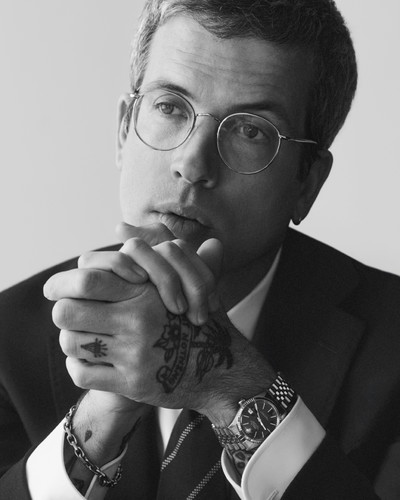
American GQ welcomed digital relevancy, a new hyper-engaged community, and year-on-year growth despite a challenging media landscape. In December 2020, as part of the Anna Wintour-led strategy to make Condé Nast both more streamlined and more global, Welch was promoted to global editorial director of GQ. His digital-first outlook, likeable manner, and relatable appearance – bespectacled, preppy without being stuck-up, tattoos – made him a hit not just in the Condé Nast boardroom, but also in the fashion, entertainment and media industries.
Then, in January of this year, he announced via Instagram that he was leaving GQ after 19 years; upping sticks to Paris and taking on a new role in partnership with Pharrell and Penni Thow, the founder and CEO of Copper, a talent investment and advisory firm. Welch’s shock move – from GQ to Pharrell, from media to brand-side, and from New York to Paris (with a be-brogued foot in Hollywood) – feels symbolic of where much of the industry is now heading.
With all this in mind, System caught up with Welch in Los Angeles: a week after he’d attended the men’s fashion shows in Paris, the morning after his appearance at the Grammys after-party, and just days before he was co-hosting Thom Browne’s Super Bowl fashion show in San Francisco. We discussed early 2000s downtown New York, his tenure at GQ, time spent with Kanye, Anna, and Pharrell, and what his new chapter in Paris is going to look like.
Tell me about the magazines that you loved as a kid.
I really loved Sports Illustrated, specifically Rick Reilly’s column. He was writing about sports from a very emotional perspective, and as a 12-year-old kid who desperately wanted to be a professional basketball player – which is hilarious when I think about it now – I found his writing deeply inspiring. Growing up in Atlanta, Georgia, I was also obsessed with OutKast. Their debut album came out in 1994, when I was 13, and I came to think of them as ambassadors for Atlanta. I’d go to the local newsstand each month, praying that the music magazines had written about OutKast and Atlanta.
Was there a turning point, when you began considering journalism as a potential career?
From 11th grade on, I excelled as a writer, and moved to New York in 1999 to go to college at Columbia as an English major. I loved writing but, you know, there was no way I was going to get a book deal any time soon…
Why not?
Because I didn’t even have any book ideas. Magazines seemed like an easier way to make money; I figured there was a magazine industry, which would mean there’d be entry-level jobs. I’d go to Kim’s, the indie record store,1 which had a rack of magazines, and started looking at mastheads. Through a fluke, I got the email address of this guy named Knox Robinson, who was one of the editors of The Fader. We met at a bar, and he ended up offering me an internship, which I started two weeks before graduating from college.
The dream…
Well, it was unpaid so I’d work at The Fader during the day and then barback for money at night.
Were your colleagues at The Fader kindred spirits?
Yes, it was a tiny team but we were all deeply ingrained in New York’s downtown music scene. We’re talking 2003, just after Strokes mania… Vice, Ryan McGinley, Dash Snow. I used to hang out pretty much every night at Max Fish, a bar full of musicians, skaters, artists, photographers. It was a really electric time in downtown New York City.
Were you immediately given a lot of responsibility at The Fader?
Totally. I learned about photography by going on assignments with photographers. I learned about graphic design by sitting with Eddie Brannan, who was an editor but also laid out the magazine. By virtue of it being so tiny, we were each other’s fact checkers and copy editors. You learned about all the constituent parts of putting a magazine together. As an intern I was keeping track of budgets, while pitching ideas and writing pieces on spec with no expectation that they were going to get published.
‘I’d hang out pretty much every night at Max Fishbar. We’re talking 2003, just after Strokes mania. So it was all Vice, Ryan McGinley, Dash Snow…’
People mainly praise your editing skills but the longform pieces that you’ve written for GQ – that big Kanye cover story in 2020, the Tom Ford exit interview – are really well-constructed. Whose magazine writing influenced you?
By the time I got to GQ, I was beginning to know real writers, the legends of magazine writing: Chris Heath, Mike Paterniti, John Jeremiah Sullivan… Tellingly, none of them were bound up in the office proofing pages. Mike Paterniti didn’t even live in New York, he lived in Portland, Maine, and John Jeremiah Sullivan lived in North Carolina. They were free to be deep in their research. I was just like, ‘I got into this industry because I wanted to be a writer, but maybe I’m better at this editing game where it’s more about the totality.’ Discussing story ideas with great writers, taking text and design and photography, writing headlines, putting all the pieces together, making it all make sense… I realised that was my actual calling. But since I became editor-in-chief, about once a year, I’ll dust off the tape recorder and write a piece myself.
Your proximity to your subjects means you’ve been able to negotiate great conditions for writing about them…
With Kanye, for instance, I ended up flying all over the world with him for the story: Mexico, Paris, Wyoming…
Was all of that negotiated upfront or did he just hijack you?
Well, we’ve known each other for a pretty long time.
You wrote his first ever cover story?
Yes. Knox and I co-wrote it, for The Fader [December 2003]. It happened to be my first ever cover story, too. I interviewed him at the Boston Market restaurant on 23rd Street, a couple of months before [debut album] The College Dropout came out. So, the start of my career paralleled the start of his career. I’d be in and out of touch with him over the years. Kanye can be ‘all or nothing’, so once you’re in his world, and writing about it, he just wants to show you more and more and more of it. For that GQ story, we took his jet from his ranch in Wyoming straight to LA, got into his Lamborghini and headed over to Beverly Hills for Kid Cudi’s birthday party. I remember still being covered in ranch dust. Then we went to Paris because four days previously he’d suddenly decided he was going to put on a Yeezy show during fashion week. He was like, ‘You gotta be there,’ so I just booked a flight. That was the fashion week when Covid was beginning to spread and people were getting sick, so the whole experience had this really eerie mood. By the time we got to Mexico I was like, ‘I can’t keep following you, I’ve got to go home and write this up.’
I’ve recently reread that 2020 story, and was struck by the fact that Kanye spoke with conviction and clarity about transforming his Wyoming ranch into a Yeezy campus. Did you have an inkling that it was all going to unravel for him?
I was certainly taken aback by the way it did. But throughout my time knowing Kanye, there has been this tension between what he said he was going to do and what everybody else thought he was capable of. Everybody was like, ‘You make amazing beats, but nobody needs you to rap.’ And then he proved everybody wrong. Then he was like, ‘I’m not just a rapper, I’m not just a musician. I’m this multi-talented, multifaceted, genius creative.’ And everybody was like, ‘Dude, it’s perfectly fine to be one of the greatest musicians of all time – chill out.’ But then he proceeded to do a version of what he said he was going to do: become incredibly influential as an apparel and sneaker designer, a wild centre of gravity and innovation in the fashion industry. He’s always made proclamations that seemed farfetched and unhinged and then delivered on some version of what everybody said he couldn’t do.
So what I tried to do with that piece was avoid the usual, ‘Listen to all the ridiculous shit this guy thinks he’s going to do.’ I was just trying to keep it neutral – neither credulous nor incredulous – because I thought he had never had that before. But the big X variable in the equation was his mental health. We’ve seen that become a bigger and bigger struggle. I have been, broadly speaking, disappointed with the discourse around his various offences and meltdowns and proclamations. I think we’ve proven that as a culture, we don’t have a very sophisticated understanding of mental health disorders and how that can interact with something like social media; where somebody who’s in a particular mental state happens to have millions and millions of followers and can mainline thoughts directly to a global audience. We’ve seen how harmful that can be. Not just for the person whose thoughts are being projected out to the world, but to the audience receiving those, especially when some very dangerous things are being said.
We’ve become sidetracked by Kanye, let’s go back to your move to GQ.
I got a call on a Friday in April of 2007 from an editor at GQ asking me to come interview for a job there. At first I was like, ‘I don’t know anything about GQ, I’m this downtown music guy, why would I go work for this mainstream men’s fashion magazine?’ I didn’t get it. Then, over the weekend, I realised that firstly, I had to let go of this narrow identity that I was holding on to for myself, and secondly, that I was in the minor leagues and the big leagues were calling, so I can’t be thinking I’m too cool for that call. I thought, ‘Just slap yourself in the face, put on a fucking tie, and go interview for the GQ job.’ Which I did, and I got it.
Were you thrown in at the GQ deep end: what I lazily imagine to be cigar reviews, whisky columns and Brooks Brothers showrooms?
I was doing front-of-book lifestyle service content, like, what are the fundamental differences between the Italian, the American and the English suit? Or, you know, what are the best restaurants in South Carolina?
What did you learn about the mechanics of making a magazine?
At the time, Condé Nast magazines were well-funded and full of incredibly experienced editors who really knew what they were doing. It was an awesome environment to enter into because I was working with the best of the best in terms of packaging, storytelling, headline writing, captioning; making it all make sense and dynamic and exciting and informative and sexy and all the things you want from a good magazine. I also brought that same fearlessness that I had shown as an unpaid intern. I remember going to an editorial ideas meeting in my first week, pitching a story, and getting it approved. My predecessor as editor-in-chief, Jim Nelson, rightfully gets a lot of credit for having created this open environment of ‘Best Idea Wins’. It was never like, ‘Will, you’re new here, shut the fuck up.’ So it was a huge priority for me to preserve that spirit when I became editor.
What did you change when you took over as editor-in-chief?
It was the era of GQ as a broad, general-interest title. At the time, our salespeople could go into meetings with clients and say, ‘We’re GQ – we speak to American men.’ And it was true. Men would read the New York Times, the Wall Street Journal, Esquire and us.
Give me some idea of the audience size at that point.
The circulation was about a million. But it was a way less fractured environment. You know, nobody was Tweeting or Instagramming. Only certain platforms had a megaphone and GQ was one of them. By the time I became editor-in-chief at the end of 2018, everything had changed, and the basic thesis of my era was: we’re going from this big, broad open door where you’re trying to welcome all American men, to becoming the flagship of men’s fashion. We’re going to be declarative and niche, and the way to grow in the Internet era is to pick a very tight niche and grow deep within it, instead of trying to be shallow and wide.
Were there specific elements of digital media you knew you had to engage with to stay relevant?
I was just paying attention and had the humility to recognise the evolving power dynamics and strengths and weaknesses of the GQ brand. One way to think about it, is the first time GQ did a LeBron James cover [in February 2009], LeBron needed GQ more than GQ needed LeBron. You know, if LeBron wanted to be knighted as a superstar and part of the highest cultural tier, he needed GQ. Cut to the most recent time we covered LeBron, he probably has, I don’t know, like eight or ten times as many Instagram followers as GQ does. If he wants to shift a narrative, it’s right at his fingertips. I was just paying attention to those changes and recognising that GQ still had an incredibly important role to play, but the exact nature of that role had changed. If you try to hold on to the role that you played when you were in a position of power, it’s just a matter of time before you’re tumbling downwards. So you have to be realistic about, for example, how you negotiate with the talent that you cover. If you call them up and you’re like, ‘You need us more than we need you, and we’re going to tell you what to do,’ which is how it was in 2007, you’re not going to get anywhere.
‘It was the era of GQ as a broad, general-interesttitle. Our salespeople could go into client meetingsand say, ‘We’re GQ – we speak to American men.’
Did that shift extend to the rapport GQ had with fashion houses and its advertisers?
When I started at GQ, fashion houses communicated through runway shows, campaigns and occasional events. Editorial occupied this middle position: you’re not the consumer, but you’re not the brand; you’re a place where a consumer can come and see the messages of the brand, but they’ve been re-spun and represented in a new way. They’d show another vision for how to wear the clothes that’s different from the runway or the brand’s own campaign. Fashion houses are now essentially in the media business, they are daily publishing houses via social media, via e-commerce. I still think that editorial continues to play that important second position. It can show the reader a way to think about fashion that is different to the way the brands themselves present it. This is why I’ve held firm against total-look policies. When luxury and fashion were super-performing and media was disrupted, I think the brands started taking advantage of their leverage over fashion media to start demanding that editorial become less editorial and more like advertising. I have resisted that because I don’t think it’s good for anyone, even the brands. You need that second voice, that second storytelling.
It’s a lot more powerful.
I just want to go back a bit. Prior to you becoming editor-in-chief of GQ, you oversaw the introduction of GQ Style, which presumably acted as the precursor to you shifting main GQ’s focus towards fashion.
In 2016, Anna Wintour asked me to meet her and do a small project – somehow she’d heard my name. Out of that came the opportunity of a baby editor-in-chief job for a spin-off magazine called GQ Style. The idea was that GQ was this huge mainstream men’s magazine that was really speaking to American men – some of whom had an interest in clothing and style and grooming – but it wasn’t a fashion readership. The company leadership at the time felt there was an opportunity to do a high fashion version of GQ for the American market. I got asked to be the editor and put together a tiny team. I basically got the opportunity to test my ideas in this smaller space that wasn’t under the level of scrutiny and commercial pressure that GQ had. It was intense because I had originally been brought in [to GQ] and taught, ‘This is how you do things, and this is the only way to do things.’ And then I got this opportunity to leave that aside and do things my way. It started working right away, and was quickly picking up steam. Readers liked it. The fashion industry liked it. I also got to hone my leadership skills, and out of that came the opportunity to be the editor of GQ proper.
That whole period was being played out against the backdrop of a major shift in society, politics and identity – nothing short of a revolution. But what changed within GQ itself?
I began to realise there was also a generational component. This isn’t so much a comment on the culture at GQ specifically, but in the fashion and fashion media industries at the time, I thought there was a lot of ghastly behaviour. People being wicked to each other as a matter of course; as though in order to have a great fashion shoot, you needed to be horrible to people. Stuff like that. Me and my little crew didn’t believe that was what it takes to be great. We actually believe you can lead with kindness. As you say, the broader cultural context was shifting as well, and would culminate in the #MeToo movement. The idea of this boorish editorial way of speaking about and photographing women was ending. Magazines like Maxim had really stolen readership from GQ and Esquire by doing the bikini girl thing, so, GQ and Esquire took in some of that and made it part of their mix. It was time to flush all that crap back out.
Was that a conscious thing? And was it a gradual process?
It was like, ‘We’re doing GQ Style, and it’s really important because community should be inclusive, not exclusive; self-selecting, not pushing people out.’ And of course, if you’re doing a community-based approach, you can’t not photograph women.
You’ve just got to do it in a different way.
There should be women in every issue of GQ, but they don’t have to be half-naked. Once I became the editor there was an opportunity to scrutinise some of the habits and mores of the machine. To take the best, get rid of the rest, and bring in a new energy.
Was there resistance to any the change?
Well, I had the total backing of Anna Wintour to rip things up and do it my way. And because of that short period where I was doing GQ Style, I had established a clear blueprint for my point of view and my aesthetic. So there was a lot of buy-in for what I was going to do.
‘There should be women in every issue of GQ, butthey don’t have to be half-naked. Once I became theeditor it was time to flush all that crap back out.’
If you had to define what it was you were doing in one sentence, what would it be?
A community-based approach to fun, sophisticated, expressive fashion. I remember doing an interview with BoF’s Chantal Fernandez which was like, ‘Let’s talk to the new editor of GQ and figure out what the hell he’s going to do.’ 4 And I basically said, ‘If you’re not interested in fashion and style, you’re not going to like this new GQ.’ And that did scare some people.
Were readers jumping ship?
I had total conviction that this new approach was the way forward. And that was really empowering. I was clear that I didn’t care that a lot of the regular GQ guys might feel alienated… By that point, I actually thought they were imaginary, these ‘regular guys’ who read GQ; I thought we had already lost them because this is the era of the Internet. There was nothing to lose.
How did you define what fashion meant for GQ?
It was defined through the GQ Style team. Mobolaji Dawodu, who was the fashion director, is Nigerian but grew up in the Maryland, Virginia area; he’s a man of the world. He specialises in street casting and street styling and has a really global point of view on fashion. He doesn’t hold European runway fashion in higher regard than the traditional dress that his grandmother wears in Lagos, or a particular store in New York City that makes Indian garments. He’d mix Italian tailoring with clothes from all over the world; fashion with traditional dress. That was really exciting. Then there was Noah Johnson, who grew up in Troy, New York as a skater, so he really understands – among many other things – skateboarding and American street culture. In particular, things like the very specific fit of your pants – he’s really into the details. Then, there was a very young Sam Hine, who I hired for GQ Style as my assistant and to be the editorial assistant. He brought the perspective of a new generation, who didn’t need the difference between American, Italian and British tailoring explained to them. Sam’s generation already knew all that.
A generation that had outgrown the previous one’s style bible.
The old approach to GQ had basically been: we are going to create a cookie-cutter mould of a man, and if you can just shove yourself into it, you’ll be successful at work, you’ll get laid, and your friends will think you’re cool. When I became editor of GQ in 2019, we’d reached a time where, if you did fit into the GQ cookie cutter, you were considered wack. It had become this incredibly expressive moment in men’s fashion. Virgil had just become the menswear designer of Louis Vuitton. It was a very new thing for people like me who grew up with sports – and not so much fashion – to be able to tell you who the designer was of each European menswear house. That was the new world that we were entering.
Within months of taking over as editor-in-chief, you put out GQ’s ‘The New Masculinity’ issue.
‘The New Masculinity’ – those exact words – was an idea that I actually brought up in our first editorial meeting with me as editor. I said, ‘This is where we’re going, we’re going to do this.’ My intention was to do it in April 2019 – my third issue – but my team helped calm me down and say, ‘This is going to take a second to get right, and if we’re going to do this, we have to get it exactly right.’ I became the editor of GQ right in the middle of the #MeToo movement, and although we began tagging everything #NewGQ on social media, it was still going to be recognisably GQ, and I really wanted to broadcast that there was something new going on here. I thought it was important to mark the shift in values that we were making with this new idea of a very historic brand.
I wanted to do that right away, but then I calmed down a little bit, and instead of doing it in April, we did it in November.
What did you learn from that issue?
If you make a really grand, ambitious statement and execute it at a high level, it can have a profound impact. I do believe there was a cultural understanding that masculinity was in crisis. We as GQ stepped out and said, ‘We have something to say.’ And people said, ‘Oh, GQ, this is actually your topic of authority, we care what you have to say about it.’ It made a lot of noise and kickstarted a cultural conversation. It’s the issue I’ve done the most press for to this day. I did all the morning TV shows – people just wanted to hear about it from us.
‘I resist this idea that the old toxic masculinity has‘come back’. Masculinity is not a pendulum thatswings from toxic to woke and back again.’
What impact do you think that had on GQ as this American men’s brand?
It had a big enough impact that a lot of people came to work at GQ because of that issue. I’d be interviewing people for an open position, and they’d be like, ‘I want to work here because of the ‘New Masculinity’ issue, I really believe in that kind of cultural statement, I want to be a part of the team that made it.’
I was blown away.
Last year, in October 2025, you revisited the same theme with the ‘State of the American Male’ issue. Why repeat the editorial premise, and what’s changed in those six years?
You do have to be really disciplined, because if you get high on the reaction to something like that, you want to do it all the time – and that doesn’t work. There was a lot of pressure from the team, and from outside the team, like, ‘Hey, that really worked, do it again.’ But we waited. And then last year we found that, especially in America, masculinity had reached a new crisis point. That was an opportunity for us to revisit the themes of the ‘New Masculinity’ issue, and ask a big group of American men some of the same questions we’d asked in 2019. What we found is that there definitely has been some degree of backlash to the elements of #MeToo that made men feel rebuked and chastised. But I really resist this idea that the old toxic masculinity has ‘come back’ in some way. Masculinity is not a pendulum that swings from toxic to woke and back again. We are in a new third space. Is there cause for concern, especially among young men who are chronically online? Yes. Is there reason for hope, especially as young men exhibit a new sensitivity and emotional intelligence that their grandfathers never could’ve dreamed of? Also yes.
The MAGA movement has been partly synonymous with young white American men, which also happens to be GQ’s traditional readership. When you refer to American masculinity being at a crisis point, has GQ engaged with the MAGA demographic to gauge their perspective?
I really hope that we are not just a voice of the progressive left speaking only to the progressive left. I have tried to construct GQ very carefully to avoid that. One of the first things I did with our daily web coverage was to get out of the business of soaking up traffic by talking about what an idiot Donald Trump is every day – although I’m talking about the first administration here, not the current one; it’s a different dynamic now – but there were a lot of rage clicks to be had by simply making fun of ‘The Orange Man’ every day. To me, all that was doing was further exacerbating the fundamental problem of stratification in American politics. We don’t want to preach to the choir. If you want to read rage-baiting politics headlines you can go to every media outlet on Earth. Why do you need a men’s fashion magazine to do that? It didn’t make any sense. All of which is to say I’ve tried to make a point of having GQ’s position be niche, declarative, really clear. I believe that effective criticism needs to be constructive, and as we moved through the #MeToo movement it felt like very little of the criticism was constructive. It said what not to do, but there was very little information available, especially to young men, about how to move forward. That’s what we were trying to do with the ‘New Masculinity’ issue. To say ‘Yes, masculinity must change, but we’re not just going to stop there. We’re going to talk about how to actually move culture forward.’
What happened was there were all these men, especially young men who were like, ‘Nobody is telling us how to understand this.’ So a wild crew, primarily podcasters, stepped in to fill that void with some pretty gnarly points of view. They were able to attract very large audiences, despite the fact that most of them are engagement-baiting edgelords. They were able to amass followings that almost made them mainstream. I do think that has brought us back to this crisis point in masculinity, and I do think GQ has been a more positive voice and outlet for some of those young men to engage with. At the same time, I don’t think I did a good enough job of engaging some of the potential audience. We don’t have a massive podcast, for instance, which we should do, so there are some things that my successor can come in and hopefully clean up.
What would your broader advice be to your successor?
I think there’s an opportunity to look at a bunch of stuff that I’ve been doing and be like, ‘That is tired.’ I love that expression, ‘Kill your darlings’. My successor needs to kill some of my darlings to be successful. I had the opportunity at a critical time to come in and make some changes that were, honestly, pretty self-evident. It’s not because of my brilliance. It was quite obvious that the energy needed to shift, and now we’re at a moment where GQ has the opportunity to shift again.
‘Any time there’s been controversy around thestories we’ve made, Anna’s been the one saying, ‘This is great, everybody’s talking about your cover.”
You mentioned before that you had Anna Wintour’s backing to rip things up and do them your way. What has she taught you about being an editor?
For sure, Anna’s been by far my biggest champion, and the most important person in the development of my career. And even though I’ve had a front row seat from which to observe her, there’s still so much magic to what she does. How she’s able to keep all of her plates spinning, for example. That mystery is kind of exciting and part of what makes her an icon. I’m just very proud that she didn’t say, ‘Go faster, Will’ a single time in 2025, because every year prior, she has had to say that to me a lot.
Go faster in what respect?
I appreciate that it could come across as being pushy, but actually what she’s saying is, ‘You already know the answer. Quit dallying and execute on your instincts.’ The way that she values gut editorial instincts and immediate execution without worrying has been a huge influence on me. One of the hallmarks of my era of GQ has been risk-taking. We’ve tried a lot of things, did some wild shit, and Anna was always pushing me for more of that, not less. Any time there’s been controversy around the stories that we’ve made, she’s the one that’s always come to me and is like, ‘This is great, everybody is talking about your cover.’ Honestly, the job that I’m leaving is one in which I had total creative freedom and the full backing of the one person who has approval over what I’m doing and how I’m doing it. I recognise how rare an opportunity that is.
Still, your move away from GQ to working with Pharrell, from traditional media to brand side, and from New York to Paris, feels symbolic of where so much of the industry is heading.
I didn’t go out seeking this. I’ve learned over the years that if you’re just being yourself, sometimes a door opens in front of you, and as long as you’re paying attention, it becomes clear that you’re supposed to walk through that door. That’s what happened. Me and Pharrell first met about 20 years ago, towards the end of my time at The Fader. I always had an enormous amount of respect for him, not only as a genuine fan of the music that he makes. Although I do remember the first time I ever heard a Pharrell beat: I was in my driveway in Atlanta, sitting in my 1989 Acura, with my brain feeling like it was coming out of my ears while Mystikal’s song ‘Shake Ya Ass’ played on the radio. I was like, ‘Holy shit, what is this? This is like the new James Brown.’ The beat just had this swing.
How do you reconcile being a huge fan of Pharrell, and then becoming his professional partner?
I’ve always felt a connection to him as a person, and it’s a relationship that’s developed over time. We had a mutual friend, Sara Newkirk Simon, who used to be the co-head of music at WME. She represented Pharrell. Before that, she was a music manager who shared an office with The Fader. She just always had this intuition, and anytime the three of us were together she’d say, ‘You two are going to work together in a different capacity one day.’ Because of her stirring the pot a little bit, when he and I worked together on GQ stuff, he would just say, ‘Whatever you want, I’ll do it, I’m trusting you completely.’ That led to the ‘New Masculinity’ cover, and then later, when Pharrell got the Louis Vuitton appointment, we did a global cover across all 20 editions of GQ. So it was an organic conversation that didn’t start as like, ‘Oh, I’m going to leave GQ to come work in partnership with you full-time.’ But that’s where we landed.
‘For a lot of us, creativity requires focus andconcentration. Pharrell is at his most creative whenhe has seven different things happening at once.’
Tell me something about Pharrell that might be surprising to people.
A big part of what my role is going to be about is linked to the fact that he’s so multidisciplinary. I had an a-ha moment when we photographed him for the 2024 GQ ‘Men of the Year’ issue. He was already living in Paris by then but we photographed him in LA. He wanted us to set up a photo studio in one of the recording studios he likes to make music at. My impression was that he’d come there specifically for our shoot. But whenever Pharrell moves anywhere, certainly when he’s there, he puts all this other stuff around it. And so, it was only over the course of the day that I realised that this recording facility had all these other studios on the property. We were set up in one of them, but he had four different artists making music in four of the other studios on the property, and he’d just move around them, check in, and then go on to the next one. And so, the nature of his creativity is that it really kicks in when he’s multitasking.
Our crew that day felt that we had total presence and commitment from Pharrell on our shoot. But, unbeknownst to us, he was actually doing all this other stuff at the same time. In fact, the only time when we were ready for him to start the next shot, but I couldn’t find him, I found Amanda Silverman, his publicist, and I was like, ‘We’re ready for Pharrell, where is he?’ And she was like, ‘Oh, he’s actually in the bathroom doing a New York Times interview. He just needs like six more minutes.’ [Laughs] That was the only moment during the day where the fact that he was doing 17 other things slowed us down, and it slowed us down for six minutes. Besides that moment, it was almost imperceptible. So I think for a lot of us, creativity requires focus and concentration, but what I’ve learned about Pharrell is that he’s at his most creative when he has seven different things happening at once. That’s when he can elevate to a different place.
Broadly speaking, what can you tell me about the role?
The role, which will become more explicitly defined publicly in time, is to be across the creative output of all of Pharrell’s activities, and to help lead those teams. To be a part of it, to help elevate things, and to lead.
When you say all his activities, you mean the music, Louis Vuitton menswear, all of these different things? What are the boundaries?
We’re just going to figure it out by doing it together. I mean, I doubt he’ll be asking me to help him program beats or to sew anything at Louis Vuitton [laughs], but it will touch music, fashion, everything.
Let’s just get some sense of the actual breadth of his current activity…
He’s obviously the men’s creative director at Louis Vuitton. He is one of the greatest music producers of the last 30 years, if not the greatest, and he’s got very interesting projects ahead on the music side. He has a decade-long Adidas partnership. He has film and TV projects. He has the wellness brand Humanrace and the auction and collectibles platform Joopiter. Plus a bunch of investments and portfolio companies across consumer and real estate. I mean, really, the list goes on and on. I’m still learning about some of the ventures. While he doesn’t need any help with his creativity or his vision, one person can’t run all of that at once. My understanding from our discussions is that one of the reasons he believes I can contribute is because over my 19 years at GQ, I was doing creative work that he thinks is good, while also running a large global team at a large global company, and being able to navigate all the corporate components of that. Pharrell, coming from music, has historically not, in the strictest definition, had a job – although I’m guessing this changed with the Louis Vuitton appointment. Whereas I very much have had a job. So to bring a little bit of that ability to be creative while being part of a company, hopefully I can contribute through that.
What new skills or experiences are you excited to be facing in this new role?
One of the most attractive things is that it’s really the other side of the table from where I currently sit at GQ. As an editor, I’m looking at the creative output of artists, musicians, filmmakers, fashion brands, and thinking, ‘Oh, that’s interesting, there’s a great story to tell here.’ In this new role, I’m going to the other side. I’ve got to now help make the best stuff. So, rather than seeing those industries from the outside, I’m going to be part of them. That is an exciting challenge for me.
What will the metrics of success be in this new role?
From my conversations with Pharrell and his business partner, Penni, I think it’s going to be three things that I care about very deeply. Number one is creative excellence, which includes innovation and sophistication. Number two is cultural impact. And then number three is bottom-line profit. In a lot of ways, those were the three standards that I’ve held myself to when I was in a media role. Editorial excellence, first, then truly having a cultural impact, you’re not just reflecting culture, you’re also shaping it. Number three, this is a business. At the end of the day, if you want to continue to do great journalism, you have to do it profitably
Lastly, where do you see the world of media going in the next, say, five years?
I’m actually quite bullish about the fate of media in the medium to long term. What I’ve observed over the years at GQ and at Condé Nast is that the audience still really values what media offers. That hasn’t gone away. It’s just gotten incredibly complex in terms of how to monetise it. But we were all participants in this shift. We were like, ‘Well, we want engagement more than we want money so we are going to give everything we do away for free online.’ In a way, it was the only choice because of the way the web and social media unfolded. That choice has had serious ramifications. The audience has proven that it still wants really good, sophisticated journalism, fashion media, et cetera and I think between that and what’s coming with AI – what is already here with AI – is the value we place on the good stuff. Good, trustworthy, elevated, curated content. It hasn’t gone away. But there hasn’t been a new business model to bring it all forward… yet. To give an example, the music business was disrupted in exactly the same way. Napster came in about 25 years ago and suddenly the history of recorded music was free and available to download online. In a way, the media industry hasn’t been able to do what the music industry was able to do, which was to find a technological solution to reconstitute music as a business after it had been disrupted by technology – like how Spotify and Universal Music Group have. I have no doubt that something similar is coming to the world of media. It’s just a question of exactly when and exactly how.