By Olivia Singer
Photographs by Casper Sejersen
Miguel Castro Freitas on his lifelong journey through fashion, from Portugal to Mugler.
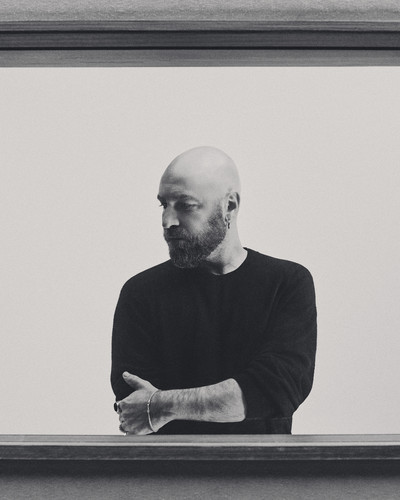
When interrogating the biographies of fashion’s foremost creatives, there’s an anecdote that arises with uncanny regularity. That of an adolescent happening across a magazine, being overcome with awe, and tearing it apart to plaster its pages across their bedroom walls. There are few, however, whose childhood fixations translate to reality as directly as that of Miguel Castro Freitas.
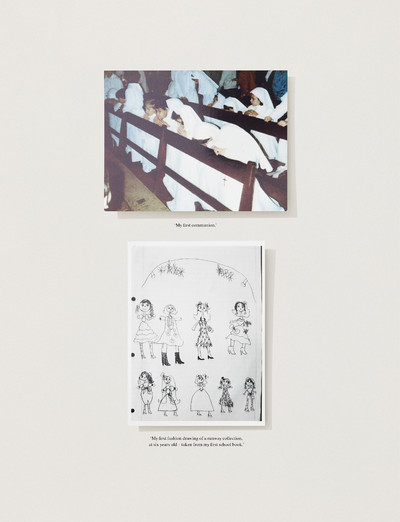
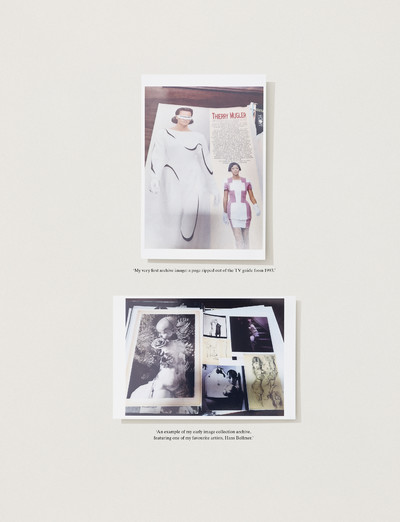
Aged six, living in the Portuguese town of Santarém, he would flick through the only printed matter that came into his family’s home – the TV guide – and pore over its back pages, which were filled with full-colour highlights from Paris fashion shows. It was the mid-1980s, the original heyday of Thierry Mugler, whose runways defined the high-octane glamour of the era, and who first transformed the fashion show into a fully-immersive spectacle. In a small town an hour outside of Lisbon, a young Miguel became besotted with the world Mugler created, and assembled his clippings accordingly.
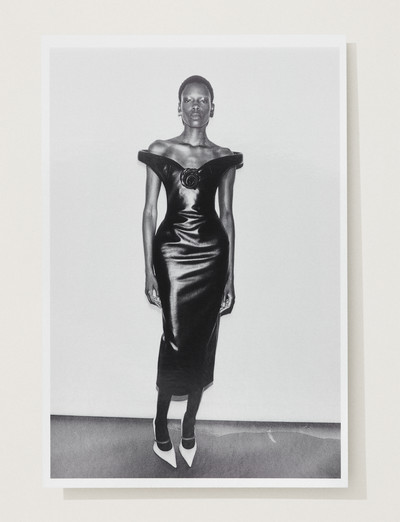
Around the same time, Miguel began drawing his own collections, featuring women with triangular dresses covered in stars, balanced atop sky-high heels. Nearly 40 years later and, after a career spent working behind the scenes with some of contemporary fashion’s foremost designers, last September Miguel staged his runway debut as the creative director of Mugler. ‘Stardust Aphrodite’, a deconstruction and recontextualisation of the showgirl fantasy, traced one of his and Manfred Thierry Mugler’s common obsessions: female archetypes of desirability as seen through the lens of cinema, rendered in a way that appears to draw on some of Miguel’s formative fashion memories.
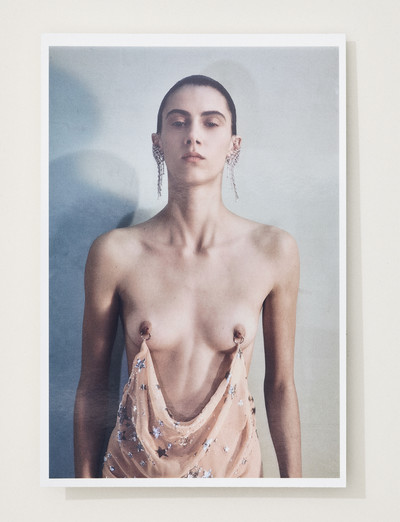
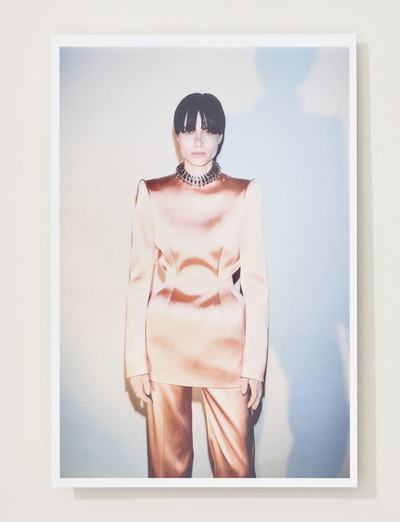
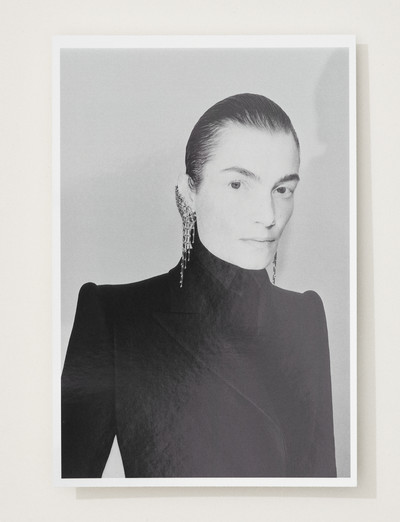
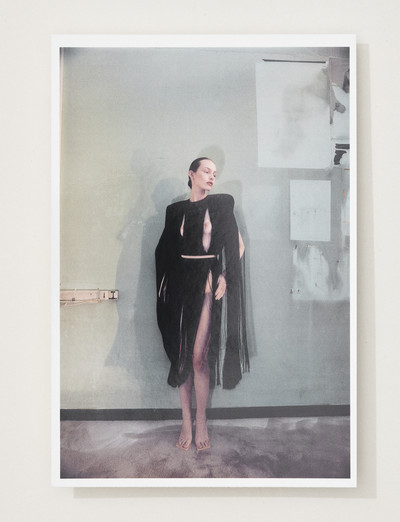
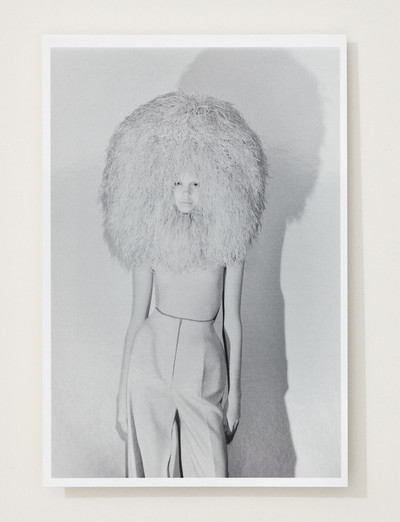
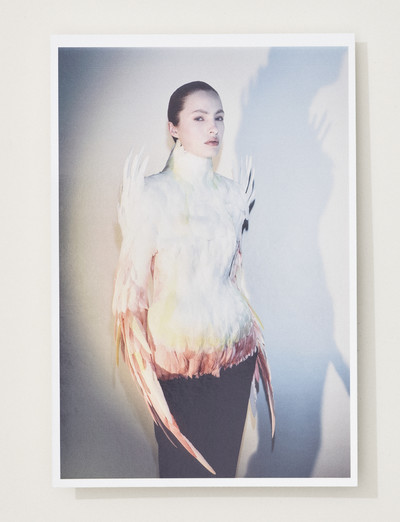
On his runway, the hyper-feminine silhouettes of Golden Age starlets were refigured with exaggerated proportions rendered in glossy leathers, slick latex, austere wools and skin-tight jersey. Their sculpted silhouettes paid homage to the theatrical fetishwear of Mugler’s making, but refracted that sensibility through stark minimalism. Initial reactions from the industry and audience have largely remained on the fence – give or take a more heated response to certain looks, one of which (a re-appraisal of a 1998 archival style, the fabric of its form suspended from a woman’s nipples) was customised and worn by Chappell Roan on the Grammys red carpet. ‘Giggling because I don’t even think this is THAT outrageous of an outfit,’ she wrote on Instagram. ‘The look’s actually so awesome and weird. I recommend just exercising your free will it’s really fun and silly :D.’
‘I wanted my first collection for Mugler to focus on the principle of glamour. To ask: what is glamour and what can it represent in this day and age?’
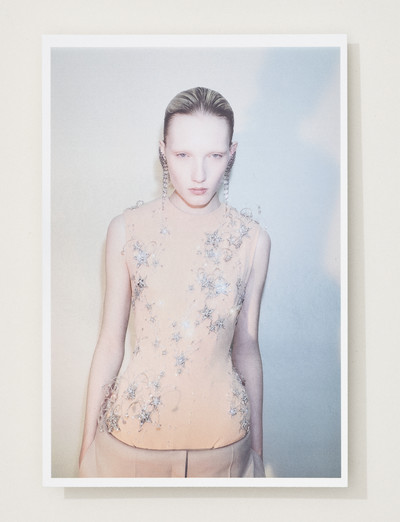
The only decorative element that remained in the collection was the occasional, galactical scatterings of stars. The same type that illustrated Miguel’s adolescent 2D drawings, and, over those same years, became what Thierry Mugler described as his totemic ‘fetish symbol’. So, in more ways than one, what appeared on the runway was something of a Freudian fantasy. In order to get a more rounded look at Miguel’s debut at Mugler, System asked him to assemble a scrapbook which illuminates this particular designer’s unconscious.
Olivia Singer: Were you always interested in fashion? Were the women in your early life interested in clothes?
Miguel Castro Freitas: No, nobody at home had any interest in fashion – not even my mother. The only magazines in the corners of the house would be TV guides and, in the back, they had sections that, periodically, were dedicated to fashion shows. Every time I saw something I really liked – Mugler, Vivienne Westwood, Jean Paul Gaultier, Versace – I had this compulsion to rip the page out. And then, when my mother would go to the hairdresser or the medical clinic, I would be thrilled to go with her because I knew I would find more magazines there. Recently,
I was going through boxes at my mother’s house, and I found them all. She’d kept them…
I’ve interviewed quite a few designers whose introduction to fashion came through tearing pages out of magazines. It’s sort of a proof of their power.
It’s quite reassuring to realise we all come from the same place. When you’re a kid, you don’t realise that the things you’re attracted to can eventually become a job. It took me a while to realise it could become a path. I was very interested in the arts, in film, all of those things. So as much as I would flirt with the idea of fashion, I had other aspirations in parallel.
And your grandfather was a tailor, so did you grow up making clothes?
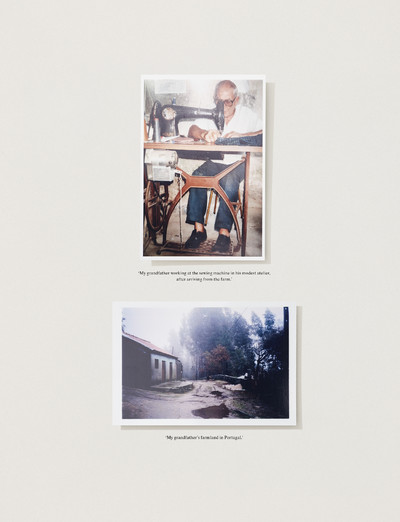
When it was the holidays, I would spend three months in the mountains with my grandparents. I would wake up at six in the morning and go feed the chickens, see if there were any eggs – that was the highlight of the day – and become a Tom Sawyer kind of boy. When I was about 10 years old, I asked my grandfather to teach me how to make a jacket. I spent an entire afternoon with him, at this very modest wooden table under the house. There were two cubicles: a tiny one where he had created his own atelier for sewing, and the one next to it where we kept the farm animals, because he was also a farmer. So cows, pigs, sheep, chickens…
What sort of clothes would he make? Men’s suits?
Yes, for the men around town. When he was 13, he became an apprentice for the most prestigious tailor in the north of Portugal, in the town where my family comes from, and he became a master tailor. But then he was fed up with all of this, and decided to go back to nature. Apparently, he had wanted to escape the destiny that everyone in his family had of being a farmer, so he became an apprentice, but he ended up falling in love with nature on his own terms. I learned how to make a suit with him. I still have the paper patterns for it.
Were you interested in the clothes worn by people around you? Was the way that people dressed something you paid attention to?
Quite frankly, no. The only person in town I can think of, who I thought was the most stylish woman I’d ever seen in my life, was the local prostitute. I spent a lot of time at my grand-aunt’s home. On her street was a brothel. I remember one day I saw this woman in the street. It’s ingrained in my memory: I had never seen anyone look as exotic as her. She was tiny and she would change her haircut and hair colour quite frequently, which was unusual for a small town like mine. She’d wear extensions, or shave her head, and she was wearing leather. Leather suits with 12 centimeters stilettoes, sometimes in varnished red. I was about seven, and I would force my cousin to sit by the window with me, waiting for her to come out so I could comment on her looks. This woman was incredible. She took a liking to me because I was so mesmerised by her. She would – at least once a week – ring my aunt’s doorbell to give me chocolate cigarettes and coins. I’d never been very drawn to fashion besides what I’d see on the runways in the magazines, but she became my first style icon. I thought everyone else dressed boring.
‘When I was 10, I asked my grandfather to teach me how to make a jacket. He was an apprentice for the most prestigious tailor in the north of Portugal.’
What about film? There’s something cinematic about what you’ve started to present at Mugler.
One night, I came across David Lynch’s Lost Highway on TV. That is what really opened my mind to cinema. Then on Channel 2 in Portugal, when I was about 15 years old, they ran a cycle of different directors – one on David Lynch, one on David Cronenberg – and that completely rewired my mind in terms of what film could be.
What was it about their work that interested you? Lynch, Cronenberg, their films are different to what normally comes on TV, they’re like windows into another world.
That’s precisely the point. It opened up different worlds and showed me reality in a way that you don’t necessarily experience in real life. The idea that you can reconstruct the world in different ways and tell stories that come from an abstract place. That things don’t have to reflect how you live life, or how you see life, but rather how you feel it.
So how did you end up moving to London in the early 2000s to go to Central Saint Martins?
The epiphany came when I found a copy of i-D for the first time in my hometown. February 1996, with Kate Moss on the cover. I was like, ‘What the fuck?’ It wasn’t an average fashion magazine. It wasn’t glossy, and I read the last page which was a short Q&A with Alexander McQueen. I was completely obsessed with his work and in the interview he said he went to Central Saint Martins. So I was like, ‘OK, if that guy went there, that’s where I’m gonna go.’ Then I found out that John Galliano went there, too – the designers who really represented everything I aspired to.
What was it about them that interested you so much?
It was the disruptive nature of their work and how it transcended fashion. I discovered clothes were not just clothes, that you could say so much with fashion and that it could be a platform on which you could project so many other things. The same way that cinema is called the ‘seventh art’, I think fashion should be called the ‘eighth art’. There’s something so complete about how we can convey so many different expressions through fashion: it’s a multimedia realm. We don’t work just with fabric, there’s photography, film, the engineering of a garment, the understanding of space and movement.
The world-building?
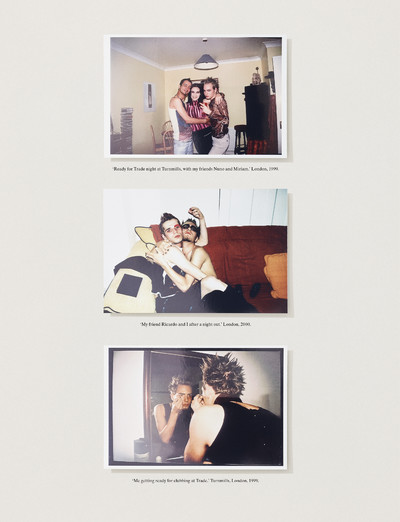
Exactly. So, when I got to Saint Martins, I felt like I was finally in my place, and among people who had the same aspirations and the same kind of interests as I did. I was living in Shoreditch, which back then looked very, very different to how it is now, and I was sharing a flat with four or five friends. There were always people coming and going at our place. We would help each other out – for example, one of my flatmates worked at the George and Dragon, so we could drink there for free. It became like a temple for us.
I miss the George and Dragon.
It’s so sad that it closed. It was like a meeting place for all these people coming from different areas – from fashion, from the art world, from the music scene. Everyone would gather there. And we’d go to Trade a lot, which was our home on the weekends, and with the rise of electroclash we’d go to Nag Nag Nag. People would really dress up.
I remember that period so well, and I am deeply grateful that there aren’t as many photos of it as there would be now.
The outfits! And all the make-up.
So, what was your graduate collection like?
I was interested in the idea of playing with codes of class. I had this image of a family of aristocrats who had lost everything. They had been dropped into the middle of a forest with no access to the rest of the world, and no idea how to exist. It was sort of historical, sort of anachronistic, sort of a time that didn’t really exist. But at its core it was about playing with what you associate with propriety. That idea was shaped by necessity, of course. By the fact that I didn’t have a big budget, and I was making do with what I had. Using poor materials but with elaborate craft techniques, constructing these symbols of class. I do believe that some of the best inspiration comes from necessity. The power of navigating certain limitations to find the best way to express something. It’s so formative, like a blessing in disguise.
‘The only stylish person in my childhood town was the local prostitute in her leather suits and varnished red 12cm stilettos. I’d never seen anyone so exotic.’
Who were the designers you were inspired by around that time? It sounds a bit Margiela, a bit Galliano…
They were both extremely inspiring. I graduated at the end of 2004 and it was the period of Hussein Chalayan, one of the greats who defined that era and the arrival of conceptual design. Martin Margiela has always been a hero of mine, for the fact that he stripped down certain codes of dressing, together with designers like Rei Kawakubo. I’m interested in designers who rip the codes of tradition apart. There is something very poetically disruptive about the work of someone like Margiela or Kawakubo. They understood tradition and therefore are able to deconstruct it.
Like Picasso. They know how to make something in the ‘proper’ way and then choose to do something different.
Exactly. You first need to master something in order to corrupt it. Then, after I had graduated, my first job was for John Galliano at Dior, which was a dream come true.
What a remarkable introduction to the industry. What period was that?
It really was the dream. The first collection I worked on was for the 100th anniversary of the birth of Christian Dior [Autumn/Winter 2005-2006 couture]. The show with all the horses and carriages, everything in tulle. It was a moment of transition between what fashion used to be, and what it would become; when it became much more driven by the corporate system and marketing dominance. For me, especially in retrospect, it was such a privilege to have been a part of that. When we wouldn’t use words like ‘budget’, or even refer to the brand as a ‘brand’. It was the house, the maison. There were no constraints, no creative limitations. To be a part of that, to initiate my career with someone like him and to learn about the grand gesture of fashion was something that informed me for life.
How long were you there?
I stayed for two and a half years, and then I went to Yves Saint Laurent with Stefano Pilati. Very different! But equally amazing.
Wow, a complete 180. What was it that drove you to go and work with Stefano?
I was very, very fascinated by his world and his proposition for Yves Saint Laurent. I felt like I needed to see different tastes, to work with someone who could introduce me to another way of thinking about and seeing fashion. Moving from Dior to Yves Saint Laurent was almost like black and white, yin and yang. It was so extremely opposite. I felt like I needed that challenge to train myself, and it was very in tune with the zeitgeist.
I stayed with him for three years.
I do think you have the most remarkable CV…
Then I went to Lanvin, with Alber Elbaz. That was another incredible experience. I was there for Alber’s 10-year anniversary and we all worked very, very intimately with him – both because the team was small and because he had a very unique way of working. He didn’t make any distinction between senior and junior designers, and it was very important to him that we were close to the materials. It was important to him to see things formed with our hands. It was incredible training because, after years mostly sitting at a desk sketching, working with Alber was more about pulling out rolls of fabric and slashing or draping on the Stockman.
And then?
Back to Dior, 10 years after I had started there, but now with Raf Simons. Which was incredible. One of my favourite experiences. I really identified with his ethos, with his way of thinking, with his approach to fashion. I think the fact that he didn’t come from fashion, that he studied industrial design, meant he had a very different way of responding to an image, to a silhouette, to colour, to texture. It was almost less fashion-driven and more artistic. For me that was very inspiring, to communicate in a way that felt different to what I was used to. It really resonated with me and I stayed until a year after he left.
Then you went to Dries [van Noten]? Sorry, I feel like I’m doing a job interview with you but it’s fascinating to hear about these different approaches that must have influenced you.
Yes, and I moved to Antwerp! I was commuting, spending the weekdays there and the weekend here in Paris.
‘Designing for Mugler is like going back to where it all started for me as a child, to the very beginning of how and why I’d taken an interest in fashion.’
So Raf sold you on Belgium?
Precisely. Not that I wasn’t sold on it before – I was already such a fan of the Belgian school of thought, of that cerebral approach to fashion, that it somehow felt like home. And Dries is a true master. One of the things that always fascinated me about him, and I think was pretty much a mystery to all of us, is how great a colourist he is as well as his sensibility for prints. There’s something quite painterly in the way he approaches fashion which, at the time, felt like a code to be cracked. I am not someone who is very close to the world of prints, and that was all the more reason for me to want to work with him.
When the opportunity for Mugler came up, did you incorporate into your vision what you’d learned elsewhere? What was it about the job that was exciting?
Well, I was flattered, of course. It was like going back to where it had all started for me as a child, to the very beginning of how and why I had taken an interest in fashion. Generally speaking, what I feel is missing at this moment in time is seeing fashion as a way of conveying fantasy. This is something the house of Mugler has always been synonymous with. It felt like there was also a desire on their part to return to what was perceived as its essence.
What do you see as the essence of Mugler?
Mugler is about so many things. I think that’s what I find so fascinating about it. I’m someone who is very interested in paradoxes and it’s a complex world. On the one side, it represents glamour; and on the other, power-dressing. Mugler really ventured into exploring different worlds but – whatever themes he explored, whatever fantasies – he was always empowering women.
It’s interesting that you say that, right now, fashion needs to convey fantasy. What do you mean by that?
It has become pretty beige; driven by a corporate hunger for commerciality. I mean, I have nothing against commerciality. We are an industry, first and foremost, and we shouldn’t pretend to be artists, but nevertheless I think we have an obligation to create something that has depth. Fashion is a great platform to inspire people and I think we have the obligation to propose something that can move people on a deeper level, that has a cultural value beyond just consumption. There is so much that can be conveyed, so much to express in order for a product to carry some soul. I know that’s why I first wanted to be a designer. At some point I started to feel as though, with the changes that were happening, the industry was not what I signed up for; it was no longer what had made me want to do it in the first place. So when Mugler approached me, I felt, ‘OK, maybe there is hope; the opportunity to return to the things I always believed in.’
You mentioned female empowerment. I wonder, because Mugler addressed so much around identity politics – and politics more broadly – and was remarkably progressive in so many ways, is that something that interests you today in your work for the house?
Yes, that’s another reason. Mugler represents everything I believe in, in terms of my values. It’s not just to do with the aesthetics or the creative expression of the brand, but also its humanism.
Do you think fashion has a responsibility to engage with those issues? Do you think it can spark actual change?
I don’t like to think that we have an obligation as designers to be politically engaged, but I do think that if it’s something that is part of our nature, as human beings, then it’s something that bleeds into the work. I don’t know how it transpires in mine, but there are things that matter to me and that inform my work in one way or another.
That leads me into your debut Mugler collection. You went through the archive to excavate commonalities between you and Thierry Mugler, and I know that you came across film as a common point of reference. Can you tell me a little about that, about the idea of the showgirl that informed what you presented?
Of course. It is well known that Mugler was fascinated by old Hollywood and the idea of the femme fatale, the showgirl. There was this glamorous aspect of his work that was close to kitsch and that’s where I wanted to start because I thought it was the most difficult subject to tap into at this very moment. I wanted to make the first collection part one of a trilogy deconstructing the essence of Mugler, and I wanted the first to focus on the principle of glamour. To ask: what is glamour and what can it represent in this day and age? I feel like people are always running away from clichés, but they’re something I really love. They are clichés for a reason, because they are universal statements. There’s a familiarity to them, they carry certain signifiers. I was trying to deconstruct those codes through my own lens.
‘Mugler ventured into exploring different worlds but – whatever themes he explored, whatever fantasies – he was always empowering women.’
How do you make this femme fatale feel relevant in a contemporary landscape of womanhood?
It’s difficult to articulate because it’s not just about what inspires you, but about the context of the now, of the zeitgeist. I exist in this time, but it’s hard to pinpoint because it’s something visceral. You look at things that come directly from the archives because you want to investigate and pay tribute to them. But, at the same time, you also have personal obsessions that are with you throughout your life, together with the things that you are currently interested in. Then, there are questions you ask about the world of today, or about the people around you. All of these things, I think, end up informing what you do. I don’t spend so much time trying to understand why I do what I do, but whenever I feel the compulsion to dive into something I will do it uncompromisingly, knowing that there must be something within that’s informing the work. You have to trust the process, trust that something will happen, almost alchemically.
There was some controversy online around one of the looks you showed – the gown suspended from nipple rings that was reappropriated from the archive. Do you think it’s more complicated today, in the digital age, to have certain conversations with nuance?
Oh my God, yes. It is something that scares me a great deal because it can be very dangerous. People nowadays can look at things in a very first degree way, and are ready to attack at first glance. This dress, more than anything, is a message, a question. It is a symbol and it has a context that lies within its place in the rest of the collection. In isolation, however, it changes the meaning. Like everything in life, it is important to look at things in context. For me, there was something really poetic about it. For some people, it was perceived as misogynistic. For others, it was perceived as sexually empowering. And, of course, the latter was the intention.
What about the cinematic idea of the femme fatale feels empowering to you? I find it interesting in light of what you said about discovering one of your first interests in fashion through a sex worker, a sort of archetypal femme fatale. Can you tell me about the women, or the characters, who inspired you?
There were countless. Mildred Pierce [of Michael Curtiz’s 1941 film of the same name] and three different Lolas: Fassbinder’s Lola [of his 1981 film], Jacques Demy’s [1961] Lola, and Max Ophüls’ [1955] Lola Montès. There was [1929 musical comedy] Glorifying the American Girl, which is the film that Pamela Anderson’s character was obsessively watching in Gia Coppola’s [2024 film] The Last Showgirl, which also inspired me.
I love that Pamela was at the show because she’s the ultimate example of reclaiming agency over that image. Speaking of, I think it’s been interesting over the past decade to see the resurgence of Mugler’s archive through celebrities on red carpets, on women like Kim Kardashian and Cardi B, and now Chappell Roan who wore a custom dress from you for the Grammy Awards. Is that something that interests you, or resonates with what you’re doing?
I think that right now, the industry functions in a certain way. Of course, there’s always been a connection between fashion and celebrity, but it’s not the first thing on my mind.
That feels, to me, quite interesting for Mugler. I mean, Thierry Mugler was really the first person to initiate the bombast of the fashion show, to figure it as pop culture in such a way that even a six-year-old kid is getting excited looking at it. But to me it felt like this show stripped back that side of things.
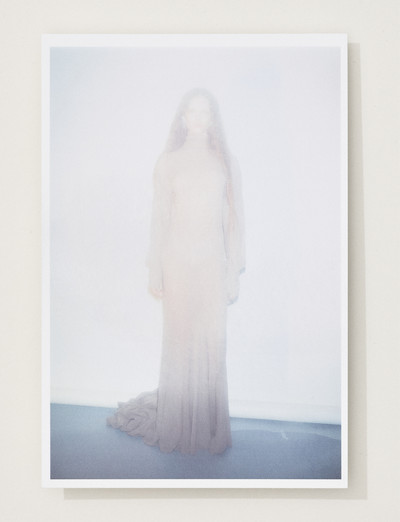
Stripping back is exactly the expression I would use. It was precisely the intention of this first show, and even informed the chromatic scheme, these neutral tones. I wanted to purify things, to put the focus on the totemic element of the collection, which is silhouette, and to focus on the woman behind the clothes. For me the idea of revisiting clichés is also to find ways to disrupt the perception of them. Mugler’s name is associated with theatricality, but right now a lot of people are engaged with a nostalgic idea of things. Even if we need the past to inform the future, fashion is supposed to be looking forward, not backwards. It feels as though we’re in a miasmic time where fashion has become a vacuous proposition which makes people dream of things from the past rather than being excited about what’s coming next. People are very cynical right now.
There’s also such a broad audience for the bombast of fashion now, for commentary from all angles, even people who perhaps don’t understand the context. Does it feel like a complicated time to be doing what it is you do?
I try not to think too much about it, otherwise I will be overwhelmed.
I’m sorry!
I mean, I don’t have any point of comparison because I’m pretty much a debutante. But I try to see things now as a continuation of everything that I’ve done before. I can only do what I know best and try to follow my deepest instincts despite how the work might be received. I don’t know how to do it any other way, so I try to quiet the noise – because there’s a lot of noise right now – and focus on the everyday conquests in our intimate cocoon with all the beautiful, talented people that I work with, who are really committed to the vision and dialogue that we have. I can wake up every morning thrilled to know that I’m going to go into a room and be surrounded by all these creative people, and that we are all in unison to propose something that is meaningful to us and hope that eventually it will resonate with others. I don’t think there’s anything that matters more to me than that.