By Tasha Liu
Photographs by Issac Lam
Once forbidding, the fashion industry has been attracting new designer talent at an unprecedented rate. Applications to the LVMH Prize alone have risen from around 1,000 in 2016 to more than 2,400 in 2026.
The democratisation of access, however, has created a double-edged sword: a fairer chance, yet fiercer competition in an industry accused of eating its young. To emerge independently, then, may now be a bigger risk than ever – one worth celebrating, supporting and questioning.
For a new series, System has paired three industry ‘mentors’ with their chosen up-and-coming designers to discuss the joys and challenges of, well, coming up.
Spanning London, New York and Hong Kong, these inaugural conversations feature writer and editor Olivia Singer, Chinese retailer Labelhood’s founder Tasha Liu, and stylist Gabriella Karefa-Johnson in conversation with Traiceline Pratt, Kinyan Lam and Miss Claire Sullivan, respectively. Together, they begin an evolving survey of who is emerging, where, and why.
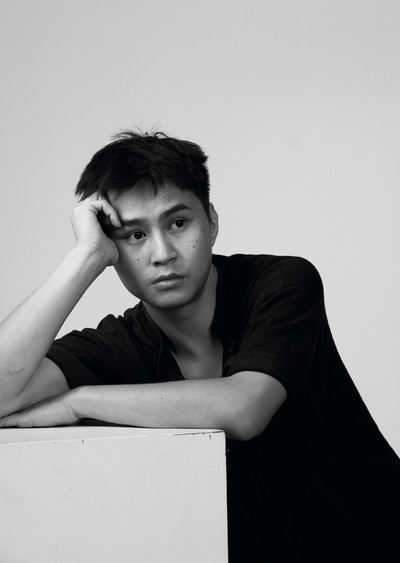
While some emerging designers might chase novelty through silhouette or spectacle, Kinyan Lam, the Hong Kong-based designer, has built his practice around processes that resist speed: natural dyeing, hand embroidery and collaborations with rural craftspeople whose techniques have been passed down over generations. Rather than treating these traditions as artefacts to preserve, he approaches them as living practices that can continue to evolve through contemporary design.
Before establishing his namesake label in 2023, Lam completed an MA at London College of Fashion after spending a number of years developing his expertise in textiles, initially imagining a future centred on material research rather than fashion itself. That foundation remains visible in every collection, where colour, surface and texture carry as much meaning as the garments’ construction. His approach has quickly attracted international recognition, including selection as one of the semi-finalists
for the 2026 LVMH Prize.
Tasha Liu, curator and founder of pioneering Shanghai-based concept store Labelhood, was among the first to encourage Lam to launch his own brand. Here she asks him about the experiences that shaped his approach to design: growing up in rural southern China, moving to Hong Kong, working alongside artisans in Guizhou, and why clothing can act as a nexus between people, place and craft.
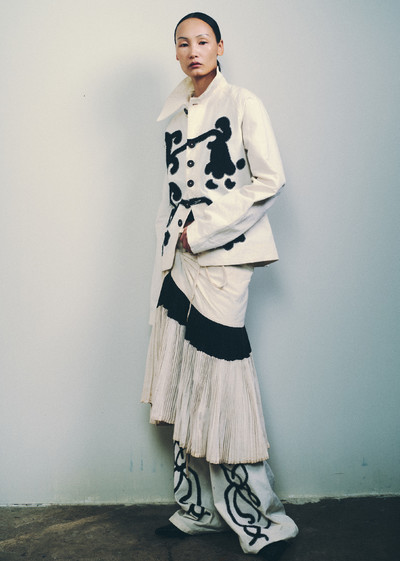
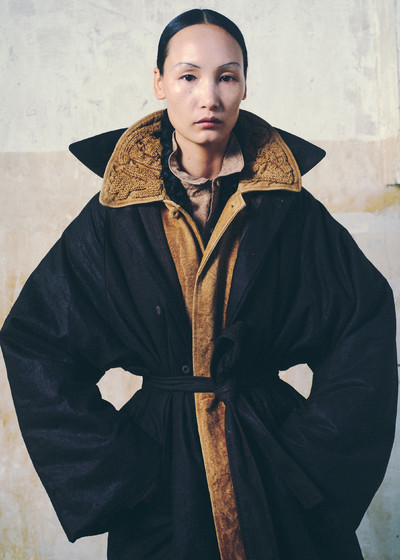
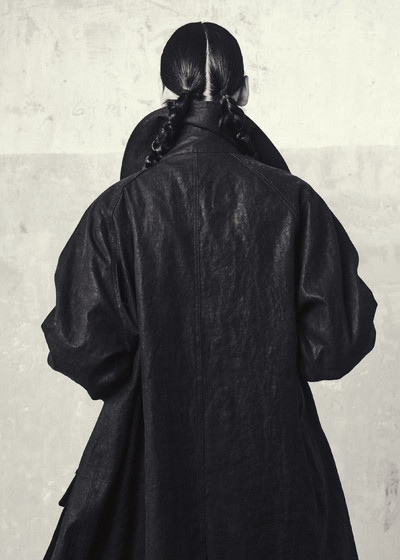
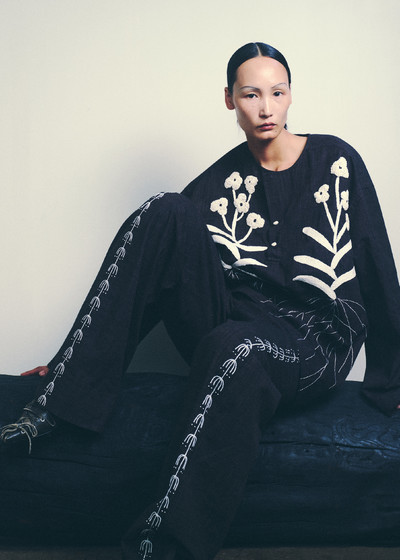
Tasha Liu: It’s been a long time since we sat down properly for a conversation about why you chose this path. When I first met you, you told me you had some ideas about starting your own brand. It took some time, though. Why was that?
Kinyan Lam: I had no experience running a brand and felt that starting one was simply too great a challenge. There were so many issues to deal with: sourcing and developing materials, managing production, and everything else that I had no experience with. So at the beginning I decided to focus on perfecting dyeing techniques. Then, if the opportunity came up, I would move towards designing clothing.
Tell me about your childhood and how you feel this has informed the work you’re creating today.
I grew up in a small village in Guangdong [southeast of Guizhou]. When I was little, I used to love picking up stones from the street and drawing on the ground. Later, I realised I had this creative ability: a sensitivity to colour, to materials, to lines. And because I grew up in the countryside, I think my childhood influenced me a lot. Not just my later ideas, but also my manners, how I relate to people, and ultimately my work. I have put a lot of my childhood experiences into what I do. For example, my environment was all trees and mud. I think that was the only thing that entertained me, the plants and trees. When I later got into fashion and textiles, I thought about using things – the plants, the mud, the trees – that make me feel comfortable. I believe this resonates with others.
You mentioned growing up in Guangdong, but a lot of what you do now involves the Dong ethnic group in Qiandongnan. Why did you choose that particular place to research craft techniques?
When I go back to the village where I grew up, it feels different. It has changed so much because everyone has moved to the cities. But when I go to Guizhou, I feel like I can find the landscape of my childhood. Especially when I see the kids playing there. When I learned about their crafts, the Dong cloth, for example, I knew I had to work with these artisans and figure out how to bring some economic value to the craft in order to benefit the wider community.
‘My environment was all trees and mud. So when I got into fashion and textiles, I thought about using those exact things that make me feel comfortable.’
You live in Hong Kong now and do all your creative work here. Hong Kong is such a fast-paced city with a developed commercial scene, yet what you make has this rural, pastoral quality that feels so different from the city. Do you ever feel uncomfortable producing these designs in this environment?
I only do what makes me comfortable. Hong Kong, Shanghai or London – it does not really affect my creative process. Each place does give a slightly different feeling, though. In Hong Kong, because so many things move at such a fast pace, people wonder why I am doing this here, but once they know my background, they get it. I want to give people a sense of respite, whether through the clothes, or through the atmosphere in our studio.
How old were you when you moved to Hong Kong? How did it affect you?
I came to Hong Kong as a teenager and met different people and interacted with many different cultures, and then I went to London, and later did an internship in Germany. That was when I started to understand how the world works. Gradually, my values began to solidify.
You did your undergraduate degree in Hong Kong?
I applied to the Hong Kong Design Institute, and because I loved working with textiles I chose fashion. One class was on natural dyeing, and that confirmed the direction I wanted to pursue. It has been 12 years, and my first graduate collection lives in the same world as what I am doing now.
You are running a brand and teaching. But unlike other founders, you also spend a lot of time doing fieldwork, working with artisans and experimenting with materials. What does your schedule look like?
The most important part of my schedule is Fashion Week – Paris and Shanghai, two seasons a year. At least once a month, I go to Qiandongnan to work with the artisans. Each trip is at least five days. We still have to go because every season we have new pieces. We develop them in Hong Kong, and then I bring them back to discuss with the artisans. We also do field research, visiting other places to see what techniques might work. One village might be good at one craft technique, another at dyeing.
In that process, are your decisions more driven by your brand identity, or does the human connection – with the artisan, with the wearer – also influence your choices?
Both elements are important, but the human connection plays a bigger role.
Lots of these techniques you work with cannot be fully mass-produced. How do you deal with that contradiction while running your brand?
You’re right, at the moment the artisans I work with cannot really do large-scale production. With some of their techniques, we do part of the work here, then send it to them to finish. For others, I see that their finished product is already excellent, so we just change the fabric or the colour and make it our own. For example, we recently worked with someone on a bag. Their craftsmanship was flawless, but the materials they used were not ideal. They were using plastic and low-quality sequins. So the craftsmanship was there, but the materials were not quite right. I think some changes are necessary for crafts to continue in today’s world. I feel our role is to help them integrate into our lives, into our wardrobes, and become pieces we can wear every day.
Many luxury groups and brands are investing in craft workshops, like Chanel with le19M. Would you set up a similar kind of workshop in the city for the artisans you work with now?
That is exactly what I want to do. I see how traditional crafts in Europe have been maintained because there are brands and the economic support that comes with them behind their preservation. In contrast, many of our artisans in China do not have a systematised structure. We’ve started gradually organising the operational processes of some textile techniques. It does not necessarily have to be under the name Kinyan Lam, but Kinyan Lam can become a resource centre. We hope that other brands can also collaborate with them. That’s what I most want to do right now.
‘The artisans’ craftsmanship was flawless, but the materials were plastic and low-quality sequins. Changes are necessary for crafts to continue today.’
You have two major projects. One is ‘Tones From Mother Nature’. And the other is ‘Shades From One Pot’. Tell me about those projects, and what roles they play in your brand.
They’re both integral to the brand’s approach to dyeing. ‘Tones From Mother Nature’ is part of the brand – the colours we use in our label. ‘Shades From One Pot’ is a technique we use in our workshop. And now that our Hong Kong studio is up and running, customers can engage with it. When they visit, they can choose white, undyed garments. Then we put five or ten pieces into one dye bath, and they’ll come out in different tones – different shades from one dye pot. If we’re dyeing something yellow, the first piece comes out the most intense, and each subsequent piece gets lighter; you get a range from deep yellow to pale yellow. It’s wasteful if we’re only looking for one colour, because the leftover dye gets thrown out. With five pieces, you’ll get different tones.
So, the first project is more about establishing a colour system, and the second one is more tailor-made. But right now, these methods are very experimental, which also brings some instability. How do you view the potential inconsistency in craftsmanship when it comes to market delivery?
It is unavoidable that there are discrepancies and communication errors. There are many uncontrollable factors behind natural colour variations, such as the origin of the dye and weather conditions, all of which can affect colour changes. We do try to keep colours within a certain range and have started to receive feedback about colour consistency. Last season, a customer said a navy skirt was too dark – almost verging on black. From our perspective, this skirt is meant to fade gradually into navy, which will eventually look very beautiful. But we had to dye a lighter one for him. Obviously, that kind of communication and trust takes a long time to build.
Your clothes present a specific process to the customer, because natural dyeing represents a transformation. People might receive them in one colour, and it changes with washing and over time. So that evolution is fundamental to your work, and how your clothes interact with the people who wear them. But often for today’s consumers, what they want is a moment. They want exactly that finished product – identical.
I think some of our clients may need more time to understand the philosophy behind our brand. For example, there is a piece that is persimmon-dyed. It gradually turns dark brown; the colour deepens over time. But many regular customers, after we explain how the colour will evolve, get it and can understand, but maybe they only truly understand after experiencing it themselves.