By Olivia Singer
Photographs by Sasakiavins
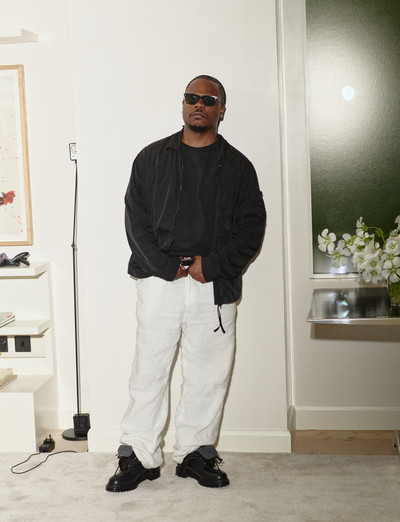
Once forbidding, the fashion industry has been attracting new designer talent at an unprecedented rate. Applications to the LVMH Prize alone have risen from around 1,000 in 2016 to more than 2,400 in 2026.
The democratisation of access, however, has created a double-edged sword: a fairer chance, yet fiercer competition in an industry accused of eating its young. To emerge independently, then, may now be a bigger risk than ever – one worth celebrating, supporting and questioning.
For a new series, System has paired three industry ‘mentors’ with their chosen up-and-coming designers to discuss the joys and challenges of, well, coming up.
Spanning London, New York and Hong Kong, these inaugural conversations feature writer and editor Olivia Singer, Chinese retailer Labelhood’s founder Tasha Liu, and stylist Gabriella Karefa-Johnson in conversation with Traiceline Pratt, Kinyan Lam and Miss Claire Sullivan, respectively. Together, they begin an evolving survey of who is emerging, where, and why.
Traiceline Pratt
by Olivia Singer
It was Lulu Kennedy who first put me in touch with Traiceline Pratt: “I think you’ll like him,” she said. She was right. Not only were the clothes he showed me fascinatingly formed, revolving around the meticulously considered characters of the sorts of women he’d grown up surrounded by in the Bahamas, but they were in possession of an insouciant swagger and elevated ease that appeared at once aspirational and attainable.
Even more compelling was Traiceline himself: a 30-year-old Bahamian transplant to London, whose journey to presenting his first runway show for his brand Goyagoma, as part of Fashion East in February 2026, appears punctuated by an endless stream of fated interactions with others charmed by his cool conviction. They include: the owner of a local Rolex store who funded his move to London to study fashion; and the Bahamian judge and her husband who wrote him a cheque for his Central Saint Martins degree. The money needed to make his first collection? A composite of custom commissions created for A$AP Rocky, courtesy of Matthew Henson, alongside a grant from his country’s prime minister in the midst of an election campaign.
It’s a curious series of events, one that has led to Traiceline establishing one of the most interesting emergent brands I’ve come across in recent years. So, I sat down with him to understand how he got here, and where he wants to go.
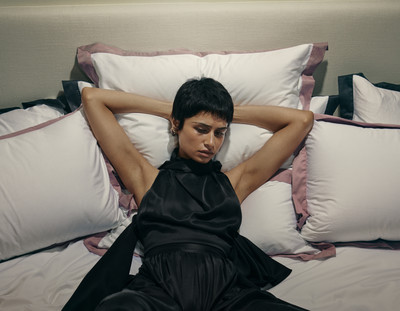
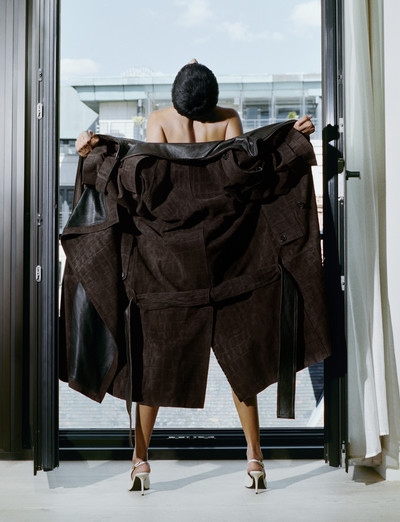
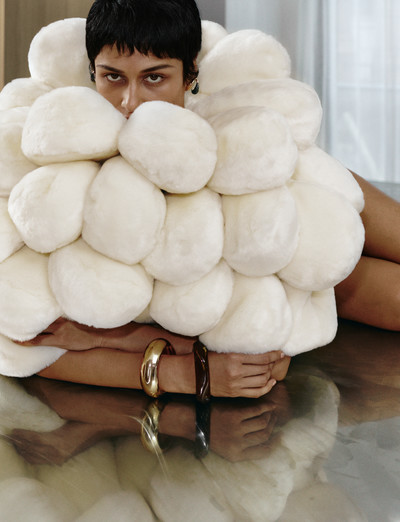
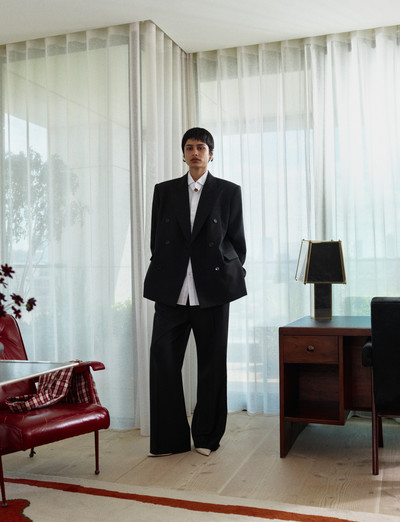
Olivia Singer: OK, let’s start from the beginning. You grew up in the Bahamas – was there a culture of fashion around your upbringing?
Traiceline Pratt: No. I wasn’t interested in fashion at all – I didn’t think it was a job. The closest thing to fashion, for me, was collecting Jordans: taking the lunch money my mum gave me for school and using it to roll dice in the bathroom. I’d walk in with $10 and come out with $150 on a bad day, $300 on a really good one.
And your parents worked on that side of things?
Yes, my mother and father worked together as visual and window display artists for boutiques like Rolex and Cartier. It might sound like a luxurious situation but, in the Bahamas, people don’t see creativity as a job in the same way, so you’re making the same money doing that as someone working in the shop. When I was at home, I started listening in to their conversations, and contributing. Then I started working with them after school and during summers.
What did you do after finishing school?
I was an athlete and when I graduated at 16, I was recruited to run track and field by a school in the US. I was getting paid to do that, but obviously you need to study too. Art is something that runs in my family so I was like, ‘OK, I’ll do fine art, no problem.’ In North Dakota.
When did fashion enter the picture?
I was having the same conversations through my art that I’m having in fashion now. My professor said: ‘Maybe you should think about fashion.’ So I typed ‘best fashion schools in the world’ into my computer.
And, of course, Central Saint Martins came up.
Yup, and I applied to Saint Martins with a visual manifesto – just pictures of things I was interested in: car interiors; a car wrapped in a Louis Vuitton vinyl; Louisiana and Houston rappers; my words and my paintings.
And…?
I got rejected! [Laughs] So I applied for a short course at LCF [London College of Fashion], but I didn’t have the money for it, so in the evenings I started working the night shift at Walmart until I’d saved up enough for my visa and plane tickets. Then, I went back home to the Bahamas and ended up speaking to the owners of the Rolex boutique. I told them, ‘I’m gonna be somebody, will you believe in me?’ They said, ‘No problem.’ They gave me the rest of the money.
‘I’d got into Saint Martins – the first person from the Bahamas to ever do that – but I didn’t have the money. He got out his chequebook. $100,000.’
What legends. So then you came over to London…
Yes, and the first thing I did: I went to Saint Martins. Because LCF is part of UAL [University of the Arts London], I could just tap in with my card. So, I went up to the studio and asked to speak to Fabio [Piras, the Saint Martins MA Fashion course leader], and told him that he’d made a mistake. He sat down with me for an hour, went through my portfolio… He gave me all the gems of what to do to get in. He told me I was an interesting character, and suggested I apply for the graduate diploma, which is like a course between the MA and the BA, and would help me prepare a proper portfolio.
But then I was like, man, I’m in London, I might as well have some fun, too. So I started partying: going to Heaven – which was a real turning point for me in terms of my preconceptions as a straight man from the Bahamas – and Fabric. One night at Fabric, Virgil [Abloh] was DJing with Benji B and I went over and said, ‘Listen, I’m gonna be big. I’m the next big thing.’ Virgil got taken on stage just as I said it, but that moment opened up a portal for me; I thought fashion was like, Yves Saint Laurent and Givenchy – but I saw Virgil and Benji, who looked nothing like what the fashion textbooks were showing me, and they were deep in the clubbing community. I was like: maybe fashion is family-oriented, multi-generational. It was madness.
How did that realisation change things for you?
I applied for an internship at A-Cold-Wall. I saw interviews with Samuel [Ross] and I was into the way that he thought, how he formed ideas and made things that had a reason to exist in that moment, and I wanted to learn that. I found out his studio was at 180 The Strand, and I sneaked in and asked for a job. I started two weeks after my short course finished at LCF. Then, after just under a year, Covid broke out and I had to go back to the Bahamas.
With the idea of coming back to London to go to Saint Martins?
Yes, but I didn’t have the money – maybe I’d saved enough for two months’ rent and my visa, but there were the school fees. I went to work with my mum at a house she was decorating, owned by a woman by the name of Lady Sharon Wilson, who was a big-time judge in the Bahamas – a very feared woman who had put some of the Bahamas’ biggest drug dealers in prison. When she came out, she asked what I was doing there. I told her I was helping my mother, but that I’d got into Central Saint Martins – the first person from the Bahamas to ever do that – but I didn’t have the money yet. The next day, she called my mother and told her to send me back to the house.
Sharon’s husband, Frankie Wilson, controls the oil and the gas – a heavyweight. I hardly thought he was real, but he came out and said his wife had been raving about me, and he asked me to tell him about the school and how much money I needed. I told him that I was gonna do the graduate diploma, and I knew that I’d get into the MA, so we sat down together and did the calculations. He told me I better get into the MA, got out his chequebook and wrote me a cheque. $100,000.
Wow. So you came back to London…
Yes. Then Virgil passed away and I was devastated, but that night I’d seen him in Fabric had been so transcendent for me that I asked Benji B for an internship.
Benji told me that you tracked down his studio address and rang the buzzer until he gave you one.
Yes, and I did that, working on his creative projects while I did my diploma. It was school in the daytime, Deviation [club night] at night.
What did you learn at Saint Martins?
Nothing. [Laughs] Let me set the record straight: Saint Martins is not a school you go to in order to learn how to do fashion. If you want to learn to sew, go to LCF. Saint Martins teaches you how to think, and it certainly changed my thinking. While doing my diploma, I started to think about how luxury isn’t a phone, or a bag, or whatever. It’s about what you make of your every-
day life. When I came into the MA, I had my whole final collection designed and sketched already. I told Fabio, ‘This is what I’ll present in February 2024, in the [MA] show.’ Fabio said, ‘Well, firstly, you don’t know you’ll get into the show – and secondly, why the hell are you going to do the course then?’ I just wanted the piece of paper. I said, ‘Just give me a desk.’ And he did.
‘In fashion, everyone’s back seems to be facing the mirror; I want to turn things around and show you what is beautiful about your life.’
That Saint Martins collection became the first part of what you presented at London Fashion Week in February 2026 – the collection that revolved around six different women.
Six women who I grew up around in the Bahamas. Real women: a mistress, a single mother, a businesswoman, a stripper, a housewife and a thief. Like, the single mother had to think wisely about the clothing she bought, so I designed modular sets. Her yellow jacket was big enough to wrap around her kid, too, and had reflective silver lining like the Mylar that EMTs [paramedics] use to keep people warm because it’s practically what she lives in. I designed it from a psychological standpoint, translating what each of those women did and what they sacrificed to obtain their own version of luxury.
After you presented that, you went to work for Phoebe Philo.
I was very adamant about not starting a company; I felt as though there was no reason for another one, no reason for more clothes, and I could just contribute my vision to someone else’s.
And what did you learn there? Phoebe has her own fascinating approach to luxury, and to women’s realities…
I learned about what actually makes a product luxury – construction, textiles, production – from start to finish. I learned about the Phoebe woman: one who doesn’t necessarily have time to put her coat on a rack, but throws it over the couch. But I also had stuff to say. One thing I’ve learned is that fashion has this obsession with creating worlds for people to step into – but my grandmother always told me, especially as a Black person, that you don’t have the freedom to escape your reality: you make the best of what you have in front of you. In fashion, everyone’s back seems to be facing the mirror; I want to turn things around and show you what is beautiful about your life.
When you staged that first show, with Fashion East, was it a realisation of that?
Yes. As soon as that show finished, Matthew [Henson, who styled the show] had to take me around the corner because I burst into tears. I had a flashback of everything that had happened to me – the crazy situations that I was in growing up, the people who got me here. I was like, damn! It’s madness. It’s special. I’m so grateful for it. I just want to be able to creatively express myself.