By Rana Toofanian
Photographs by Nigel Shafran
Styling by Alice Goddard
Steve Lacy, the Compton prodigy, accidental pop star and Grammy winner, in conversation with Gucci’s music director, Loki.
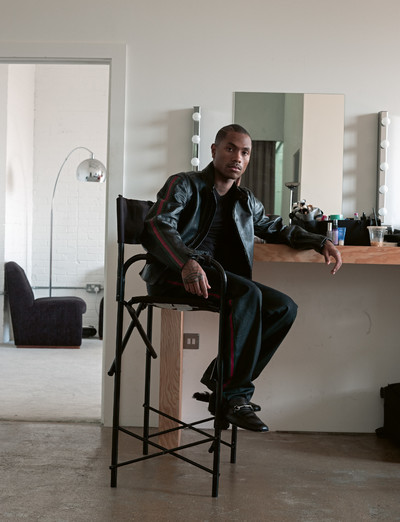
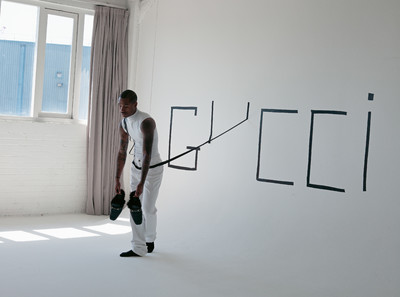
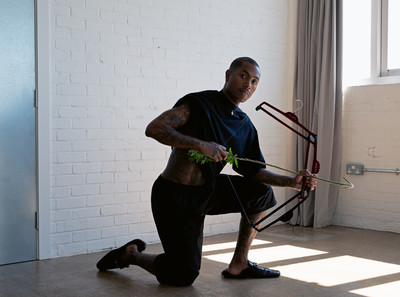
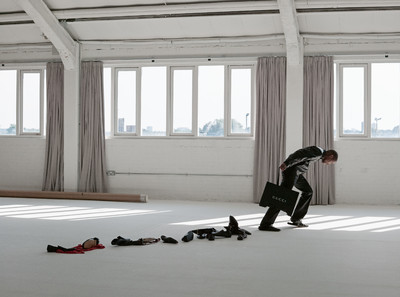
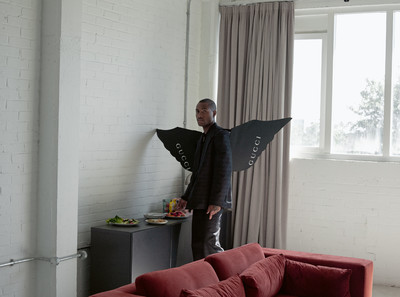

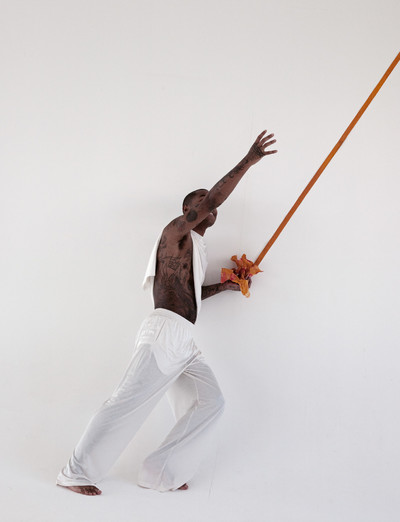
It is a summer afternoon in Hollywood, inside a studio on Sunset Boulevard where Steve Lacy is preparing for an upcoming show. We have taken over an unoccupied rehearsal room – a small stage, a black leather sofa, stray instruments and microphone stands strewn about.
Lacy arrives looking conspicuously off-duty in loose black trousers and an oversized T-shirt, a green crocodile Marlo bag by The Row slung over his shoulder. He grew up in Compton, on the other side of Los Angeles, listening to the music his mother and sister played at home and taking guitar lessons from the guitarist at his church. As a teenager, he joined LA band The Internet and quickly developed a reputation for his DIY approach to recording and producing music on his iPhone.
Lacy’s second studio album, Gemini Rights (2022), transformed him into an unlikely pop star: the single ‘Bad Habit’ became a TikTok phenomenon and reached number one on the Billboard Hot 100, the album won a Grammy, and a vastly larger audience arrived. His new album, Oh yeah?, stretches an already expansive musical range – everything from lo-fi bedroom pop to psychedelic soul to alt-rock guitar – further into the increasingly difficult-to-categorise territory he has made his own.
Sitting next to him is fellow musician Loki, wearing a black tracksuit and Gucci T-shirt, a spiked leather choker fastened around his neck alongside a large Double G pendant, with smudged red lips and black eyeliner. His inky-black hair is twisted into small strands, arranged across his forehead beneath a backwards Gucci monogram baseball cap. Two days earlier, he decided to resurrect the hairstyle he wore at 11 – the one he remembers being bullied for at school.
Raised in a small town in the south of France on his parents’ new wave records, Loki picked up a guitar at nine years old, gravitating towards hard rock, industrial music and metal. Entirely self-taught, he would later spend the better part of a decade recording as BFRND, and became the musical force behind Demna’s most memorable Balenciaga shows. His combinations of techno, industrial and classical music became as integral to the collections as their casting, sets and clothes.
‘I grew up in Compton. I never hung out on Sunset Boulevard as a kid. I didn’t even come over to Hollywood until I started working in music.’
Outside of fashion, his 2021 single ‘French Connection’ revealed another dimension of BFRND, later reaching a wider audience through a Fortnite collaboration. Now both the name and context have changed. Having recently retired BFRND and begun recording as Loki, he has followed his husband and longtime creative collaborator, Demna, to Gucci as the house’s first ever music director. He is also spending more time in Los Angeles, where the couple are renovating a house.
Hollywood feels apt for a conversation between the two about music, fashion and image. It is a place synonymous with image-making, fantasy and pop culture, but, as Lacy observes, “you can smell the broken dreams in the air.” What begins as a chat about taste becomes one about change – how to keep experimenting in a culture that wants to define you, the collapsing distance between artist and audience, and the strange pressures of being seen. At one point, Lacy’s phone begins buzzing. Fans have discovered they can call him directly through TikTok. “It’s scary as fuck,” he says, holding up the screen.
Rana Toofanian: I’d love to go back to the beginning and ask each of you about your earliest memories of music.
Loki: I come from a small town in France. There was pretty much nothing there – no one I could look up to creatively or whatever. My parents only listened to new wave, so I was completely in my own bubble. I didn’t know pop music. For the first 20 years of my life, I basically knew new wave and hard rock, and I was completely resistant to anything else. Then, on my own, I discovered the more brutal side of music – metal, industrial, that whole world – and for a long time I didn’t listen to anything else.
Then, around 20, I started trying to listen to as much as possible. I discovered all these things I’d previously hated, and that really shaped me creatively. I got my first guitar when I was nine and started trying to sing, but I never took lessons for anything. I just improvised until I found something that felt connected to my creative instinct. When I was 14, I started a black metal band with some people from school. We played in a basement.
Steve Lacy: I started falling in love with guitar around nine as well. I think I got my first guitar at ten. I would go to Guitar Center [in LA] and just look around at all the instruments, and I just wanted to be a guitar. You know? I wanted to be inside of it. I wanted to have strings – the whole thing. I just fell in love with the instrument itself.
The guitarist at church ended up giving me lessons, and he was just an amazing guitarist. I loved guitar music as a kid, soulful things, and whatever my sister or my mom played around the house – Sade, Tracy Chapman, John Legend, particularly his album with ‘Maxine’ on it [Once Again, 2006]. John Mayer as well. All types of music.
Musicians have always understood the power of image – Bowie, Björk, Prince, Grace Jones, Madonna, Daft Punk, Marilyn Manson… It’s almost impossible to separate the music from the visual worlds those artists created. Who was the first musician whose style made you realise that clothes could communicate an idea, or made you think differently about your own image?
Loki: I mean, all the artists who influenced me are cancelled today, so I’m probably just going to speak more generally about the industrial and cyberpunk movement. For me, it was the first time I saw this mix of genres – electronic music mixed with metal or whatever – and that really opened my eyes. And fashion-wise, there was no conversation about gender or whatever. Everybody was very fluid and very experimental in the way they presented themselves, so that influenced me a lot too.
Steve: It was probably Jimi Hendrix for me. When I first started playing, I really thought I was living in the 1960s and 1970s. It was ridiculous, but I was fully Jimi Hendrix. I liked Prince, too. I liked his androgyny. And Lenny Kravitz.
I think music has such a huge influence on how you first understand style, whether it’s a piece of clothing, a hairstyle, or even just an attitude. Was there a fashion item you remember really wanting when you were younger – something you saw on a musician and wanted to find for yourself?
Steve: I didn’t think to save up. I didn’t know the cost of things until I had money.
But clothes were important to you?
Steve: They were, but I was only looking at what I could afford at the time. When I was in high school, it was the Tumblr era, and there were these Raf runners – I think they were Raf Simons x adidas, those colourful ones with the strap. I knew they were really cool, but I also knew I couldn’t afford them. I was like, damn, those are so sick. But I never got them.
‘For the first 20 years of my life I only listened to new wave, metal, industrial and hard rock. I was resistant to everything else, and didn’t know any pop music.’
What about you, Loki?
Loki: It’s going to be very cliché for a goth, but New Rock shoes. I was 11, and I was like, I need these shoes. My parents would not buy them for me. They were super expensive, too, like €200. But every goth had them, so I was trying to find my way around it. Trying to look goth.
When you’re at school or working your way up, you start learning about these things you can’t necessarily afford. But I actually think you make better choices because of it. You experiment so much more – you’re just trying to find a way to create the style or the thing that exists in your head.
Steve: Yeah, that’s how you find the swag. It forces you to innovate and work with what you have, which is a good thing. Not knowing how to do it, for sure.
Loki: Actually, two days ago I started doing the hairstyle I had when I was 11. This is what I was doing. And at the time, I got bullied for it.
We were speaking about influence, but I also wanted to talk about taste, which feels like something different and much more active. It’s how we edit, connect seemingly unrelated ideas, and develop a point of view. I’d love to know how you each think about taste, and how your idea of it has changed over time.
Steve: It’s funny, I talk about the word taste a lot. I’m kind of anti-taste. When I have this conversation with my friends, I’m always thinking about taste versus range. I like how you describe taste, and I agree with that. But more broadly, when people talk about ‘good taste’, it’s always such a highbrow thing, and I think it excludes a certain amount of experimentation. There are people with really high taste, but they’re only informed about one thing. They don’t necessarily have a great range of things that they dabble in. It’s like, I have high taste, but I only know black marble. I don’t know about lacquer or any other materials. So, I think taste is very interesting.
Loki: I totally agree. Because, as I said earlier, for 20 years I was only really listening to one particular type of music. I don’t think I would have been a good musician back then. Range makes you richer. It makes you see things from different points of view. For me, curiosity is really important. Curiosity has the ability to shape your taste.
I see taste like a pattern emerging from the different things I’m interested in.
Steve: That’s true. It does kind of form as you get older. But I’m always trying to remove what I know. I think I’m constantly trying to undo or relearn something, or I’ll realise: I’m too stuck in this. So I’m always changing. If you saw me dress over the course of a week, you’d be like, what the fuck? I look completely different. It’s because I’m dressing from a feeling. Today I’m a little looser, but the rest of the week my clothes have been closer to my body because that just felt right. Today I was feeling very slouchy. I had a facial before this and I was like, fuck everything else.
That makes me think of something Miuccia Prada once said: ‘You have to always work against what you did before, even against your taste.’ And what are the things you’ve consciously had to unlearn in order to keep moving forward?
Loki: Well, I literally changed my name recently. After ten years of being BFRND, I was like, I’m not stuck, but I know that if I make this change, I can explore much more. It gives a colour to my sound that it wouldn’t have as BFRND. Maybe that distinction isn’t as clear to other people as it is to me, but experiencing my music through a new identity feels like a way of taking myself out of it. At the same time, maybe that’s also a way of coming back to it in an even better way.
Steve: I’m thinking about the word ‘unlearn’. Maybe not consciously, but I think I’m always editing a process. Working on this album, I definitely unlearned a bunch of things in pursuit of something new that I wanted to achieve. I think one of those things was being satisfied with certain things. I had to be like, nah, that’s not dope. Things that might have made the record two projects ago, I’m just naturally removing now.
As success arrives, how do you make sure that you continue to evolve and experiment?
Steve: I think part of it is by not listening to people. I mean, I just put shit out, and I really have to stop reading shit. People are so hilarious in their demands for what you should be doing based on what you did last. And I’m like, if I listened to you, my shit would suck.
‘I kind of fucked up by using my real name. Maybe it would be easier to hide behind a persona if I had one, but I don’t. It’s 100% me.’
Or it would just sound the same…
Steve: They want to keep you in a certain place. But naturally, I don’t feel like I’ve gone hard enough. I want to keep experimenting and finding new ways. I work with my body, so I’m not really trying to make things that sound like me, per se. I just want the best thing. I think I did a good amount of experimenting on this one.
Do you feel that same pressure from an audience to remain the person they first discovered?
Loki: I think when people first discover you, or really like one of your outputs, they want you to become all of it. It’s a way of reassuring themselves, because people are scared of the unknown. Once they get to know something, they’re scared of it changing into something they might not like. So they really grab on to what they think you are. They create an image of you that might not be what you feel you are, but for them, that’s how they perceive you.
My work in fashion is very different because fashion has this thing where every season has to be different, every season has to be new. Fashion doesn’t like to do the same thing twice; especially not Demna. He’s been amazing at pushing me further and further out of my comfort zone.
We’re really a duo in that sense, so I don’t have to torture myself. We bounce off each other to move forward. And he’s my number one fan in the world. He would never like me being stuck, so I feel really blessed for that. [Steve’s phone starts to buzz…]
Steve: It’s so weird, people have been trying to call me non-stop from TikTok.
Who?
Steve: I don’t fucking know, like random people. And they don’t have a setting where I could turn it off. It’s scary as fuck.
Speaking of TikTok – we live in such a visual culture now. Of course, there’s always been a strong relationship between music, image and performance, but platforms like YouTube, Instagram and TikTok have amplified that enormously. Particularly for younger audiences, the music is only one part of how they experience an artist. Steve, you’ve just put out a new album. When does the visual identity of a project begin for you? Is it something you’re thinking about while you’re making the music, or does that world come into focus afterwards?
Steve: So late. I’m a very musical being, so I start with the music and then I finish it. Then they’re like, ‘OK, you’ve got to take photos and do these other things.’ I’m like, ‘Fuck’. So I’m running around like a headless chicken trying to understand it all. I don’t think I’ve got to fully flesh out a visual world – or how I see it in my head. I’ve come close, but I’m still trying to understand that part for myself because I’m so music-oriented.
When you’re creating that world, are you inviting people into something intimate, or are you building a persona or mythology around yourself?
Steve: I’m just very raw. I’m not pretentious at all. I think there’s a part of this work where you need to be pretentious, but I don’t have that. Everything for me is so in the present moment. It actually fucks me up a lot that I’m not pretentious. I’m like, I need to be more pretentious.
For some artists, the ego or persona becomes a kind of creative fuel. It gives them something to work through, or even something to hide behind…
Steve: Yeah, but I just genuinely can’t do that. I don’t believe in it. I love the human aspect of it – being a human making music.
Loki: So maybe that’s exactly what it is for you. You know what I mean? That’s your identity right there.
Steve: Yeah. It’s fun to play with because we’re constantly changing. That’s why I don’t really like the whole idea of ‘eras’. It’s all just me. It’s my life. And I kind of fucked up by using my real name. Maybe it would be easier to hide behind a persona if I had one, but I don’t. It’s 100% me. I don’t know how smart that was.
Loki: When people ask me what kind of music I make, I’m like: good question. It’s hard to answer. But I guess that’s where my identity is. When you listen to everything I’ve done, you understand who I am – not because of the genre, but because of the approach. Maybe that’s what taste is. You can feel my taste rather than define it. And Steve, when I listen to any of your songs, I know it’s you, even when they’re completely different. It’s still you. That’s why I love that you don’t have this visual fantasy around yourself. It’s the raw you. Maybe that’s exactly who you are, and that’s also why people love you the way you are.
Steve: Thank you. Maybe I’ll be pretentious one day…
‘The diversity in LA is so inspiring. You go to CVS and the cashier is a goth; you see all kinds of families, different bodies, different identities.’
Someone like Prince created an extraordinary mythology around himself, but there’s also something powerful about allowing an audience to have a more intimate connection to who you actually are.
Steve: I think that’s a very modern thing. We kind of have to be. Back in the day, it was easier to be tucked away and just present the work. But as a musician now, you have to be involved.
It’s taxing, but at least for me, it forces me to be a better person, to understand people. We’re on Instagram. We have to speak. I’m doing pretty good, but I can’t delete my Instagram right now, even though I would love to! I still have to be a personable human. You know, it’s just the time we live in.
Loki: That’s exactly where I’m really conflicted in my career. The culture I come from is full of artists who create very strong visual identities, and I love that. I feel like it’s part of me. But at the same time, it feels impossible for me to play the social media game – taking videos of myself or whatever. It has to feel natural. Whether you’re creating visuals or promoting yourself online, it has to feel genuine. That’s my struggle – because it’s not me, I would never feel genuine doing it.
Sometimes there’s just too much information about people online. I’m like, I don’t need to know all of this!
Steve: Sometimes I feel like I’ve definitely said way too much. You know, like after a night when you’re like, fuck, why did I say all that shit? I feel that way about my Instagram sometimes, but there’s too much stuff to archive. I’m like 400 posts deep…
I want to talk about fashion shows because they’re one of the few places where music, image, movement and performance all come together in real time. I have such a vivid memory of watching Alexander McQueen’s ‘Plato’s Atlantis’ [Spring/Summer 2010] on livestream, when Lady Gaga’s ‘Bad Romance’ premiered. It made me understand how music could become completely inseparable from the memory of a collection. There are designers, like Raf Simons and Hedi Slimane, who introduced entire audiences to music and subcultures through their work. At Demna’s Balenciaga shows, the music, casting, set and clothes all felt inseparable – like one complete experience rather than a collection with a soundtrack. When you’re composing music for a show, Loki, what are you actually writing for? Is it the clothes, the designer, the space, the feeling – or all of those things at once?
Loki: It’s all of it, to be honest. The collection comes first. Actually, the research comes first. I’m lucky to be married to Demna, so I see every step. Even before the designers are aware of the collection, I’m already thinking about it. I see the research, the prototypes, and I go to a lot of the fittings because I like to see the models walking in the clothes. I want to understand how something is made, what the intention is, how the clothes vibrate. Then comes the set design, which for the music is almost as important as the clothes, because that’s the context in which you’re going to see them. Very often, if you change the set design, the music will change as well. It all has to work together.
I’m really just informing myself as much as possible, taking everything in and constantly brainstorming with Demna. He’ll say, ‘OK, this season I want a full orchestral soundtrack’, and I’ll be like, I’ve never done that in my life. So that becomes an entirely new source of excitement for me. But it’s also why my album is taking so long. Every show makes me learn so much about myself that everything else suddenly feels outdated. Only what survives five years can make it onto the album. Otherwise, I’m moving ahead too fast.
You’ve collaborated with Demna across two very different houses. Gucci has a different history and cultural memory from Balenciaga. Has that changed the conversation between you, and the way you approach the music?
Loki: 300%. When we [Demna and I] decided to go to Gucci, it wasn’t to do Balenciaga 2.0. Otherwise, we would have just stayed there. Right now, I’m back to composing the soundtrack for the show, and I’m very excited about defining a new identity without falling back into what I love doing most. Even now, I’m thinking: this is so different from what I’ve done before. Do I even want to put it out? Will my fans understand it? And then I think: yeah, that’s exactly what I should be doing. If no one understands it, that means it’s new. That’s where I should go.
You’re also taking on a newly created role as Gucci’s first music director. Fashion houses put enormous thought into establishing a visual identity, but can a house have a sonic identity in the same way?
Loki: I don’t know. I feel like historically it’s often been the other way around: music influences fashion. Artists dress a certain way, and then that bleeds into other cultures and eventually into fashion. So it’s very interesting for a brand to say ‘We know exactly what our sonic identity is.’ But it’s also very specific. I don’t know if every brand can do it, or would even want to. For some, maybe it could actually be reductive.
‘The Gucci Times Square show felt like a festival headline – Demna’s on the main stage, closing it out. I was like, this is proper rock star shit.’
How has composing for fashion influenced the music you make for yourself?
Loki: The show soundtracks are purely instrumental, so it’s very different from writing a song with words. But the influence on my solo music is huge. On my album, every track is a different genre because, after ten years of exploring, I would feel very limited saying, OK, ‘French Connection’1 was a hit, so now everything has to sound like that. It would just be depressing.
Steve, you’re experiencing these shows from the other side. What is a fashion show like for you?
Steve: It’s so fun. I had always just been a watcher because I was a fan of Demna at Balenciaga, but I never went to any of those shows. I have a bunch of the clothes, but the first show I actually went to was his Gucci debut, and that was super dope. Then the Times Square show, which was inspiring. It felt like a headline festival show – he’s on the main stage, closing it out. I was like, this is rock star shit. I love the world-building of it all. But it’s also just fun for me. I don’t have to work. I get flown out, sit front row with all these cool people. It’s great. I love it.
Fashion is a whole other world to me. I know music very well; I know how the shows work, the studio process, all that stuff. But fashion and collections, I’m like, this is crazy. It’s so fast. If I worked in fashion, I’d be like, I’ve got one collection a year, and even that feels fast. But I really appreciate it. I love the advancement of fits and fabrics. For me, Demna is one of the leading designers of innovative menswear. I feel really hot in his clothes in a way that no one else makes me feel. And it’s fun, too. When Demna was at Balenciaga, if I was hosting a party, I would just go to Balenciaga because I knew there’d be something there. It would be funny, but also really hot and serious. They’re great party-host clothes.
We’ve talked about how music influences fashion, but does it work the other way around? Can clothes change the way you experience or make music?
Loki: For me, clothes are like what Steve said – I dress to match my mood. It’s a feeling, not really a conscious decision. It’s about aligning how I am inside with how I am outside, but also responding to the context. I love contrast. I would never wear a suit to a black-tie event; I’d rather do the opposite. That makes me feel like myself. If I’m going to make music, I’m not going to be in my pyjamas. I need to feel like me, and then that inspires me. Sometimes clothes aren’t enough. I need the make-up too because it makes me feel a certain way.
We’re sitting in a rehearsal space on Sunset Boulevard. Hollywood is a place that’s shaped so much of modern music, film and popular culture. It’s a city built on storytelling and image…
Steve: It’s funny because you can smell the broken dreams in the air, too. There’s a lot of hopefulness and the possibility of big things happening, but there’s also a dark side. You feel that, too?
Loki: That’s what LA is, though. Super extremes.
Steve: Yeah. But actually, my first experience of making music and going into a studio was just down the street from where we are, which is really cool.
Loki: How did you feel that day?
Steve: The first day? I don’t know. I was just sitting there. I didn’t know I was going to do any of this. I was there supporting my homie who was making music, so I had no expectations of what would come out of it. I was just a young, stoned teenager, really quiet, sitting there taking everything in. I lived in Compton. I never hung out in these parts of town as a kid. I didn’t come over here until I started working in music.
Do you feel like LA still inspires you creatively? What is it about being here that keeps you interested in the city?
Steve: It’s a great home. My mind is quiet here and I can focus. I like the open space, I like my car, I like driving. And my family is here, so there’s a sense of normalcy in having roots. That’s really helpful, although it can be isolating sometimes. Fun in LA is interesting because if you come from a big city, you’re used to having easy access to people and things happening. In LA, it’s all there, but there’s no one place – it’s kind of a mystery. You have to stay open, and then suddenly you’re like, ‘Oh shit, I can’t believe that happened today.’ Some of the most fun nights I’ve had were when a friend drags me out and I’m like: OK, let me get dressed. And then afterwards I’m like, wait, that was actually the best night I’ve had in a while. You just never know when that’s going to happen.
‘I love contrast. I’d never wear a suit to a black-tie event. And if I’m making music, I’m not in my pyjamas; I need my clothes and my make-up too.’
What about you, Loki? You’re spending more time here now and renovating a house in LA. Why do you feel such a strong connection to the city?
Loki: I don’t know. I grew up in a small town. Even in Europe generally, when you look the way I do, it can be quite hard. LA is the first city where I had this immediate sense of belonging. I came here and just fit in without even thinking about it. And everywhere I go, I’m reminded of that feeling.
I went to HARD festival on Sunday, and everyone was so accepting of me. They didn’t know who I was but people were responding to the way I looked, and I’d never experienced that before. I was actually very emotional by the end of the day because it was a lot to take in. I’d never experienced being at a festival with 100,000 people and feeling that much belonging.
The diversity here is so inspiring. You go to CVS [pharmacy] and the cashier is a goth; you see all kinds of families, different bodies, different identities. Everywhere you go, you never really know what to expect. And if you keep an open mind and embrace all of it, you can become so rich – not financially, but inside yourself. There’s just so much to learn.
Steve: It’s definitely beautiful. I love Cali. I don’t know if I’ll ever leave. It has its quirks, but honestly, I don’t know where else I would even go. I love it, man.
Steve, I heard that you wrote a lot of the record in Paris. I’m curious about what different cities bring out in you both creatively. Do you feel like you make different kinds of music depending on where you are?
Steve: That was my first time. I mean, I’ve made music in other places before. We [gestures to Loki] share our studio at Miraval [in Provence, France], and I’ve worked at Electric Lady in New York. But I ended up getting a lot of work done at Les Studios de la Seine in Paris. There was just this really inviting energy there.
It actually started with a sonic choice. I was working with this engineer who was really informed, and I remember listening back to something we’d made together and thinking: wait, I need to go back and sit with that guy. He made recording feel so easy for me. So I ended up spending a lot of time in Paris. And it was cool because I’ve never lived somewhere walkable. As a kid, and even now, I’ve always been in cars. So when I go to big cities like Paris, it’s fun to cosplay that kind of city life that I’ve never had. I live in LA, but I wouldn’t really consider it a city in that sense. We have all the big-city perks, but you can’t just walk out the door and do stuff.
In Paris I could walk around, look at people, sit in a park and just watch. It did something for me. It cleared my mind and made me feel more connected to people. Otherwise, you can get tucked away and make work in isolation. So I would collect these experiences – seeing people, hanging out with friends, walking around – and then bring all of that back into the work.
Loki: Unlearning your previous life.
Steve: Yeah, exactly – unlearning. And then I’ll come back home and be like: OK, now I can edit that stuff. So there’s this cool conversation between Paris and LA. I like the two cities in relation to each other. Even more than LA and New York, because now that I’ve spent time in Paris, LA and New York don’t feel different enough to me. It’s almost too safe. It’s the same scenario, the same types of people. I’d rather go somewhere that really shifts my perspective.
Loki: It’s so funny, I was here two years ago recording music, and I’ve never recorded so much in French. I don’t know why. I think because here I feel more myself than anywhere else, and because of that, my French [identity] comes out in this really unfiltered way. And no one understands what I’m saying here, so I feel even more free. It just becomes music. Somehow, when I’m in Europe, I sing in English!
How do you go about discovering new music these days? And is there a new musician you’ve discovered recently, or someone you’re just listening to a lot at the moment?
Steve: Oh, I just found this girl on Instagram, Portraits of Tracy. She produces everything herself. I think she’s 21, a super-young Black girl. And you know what the best thing is about being a known artist, or having a little bit of notoriety? My favourite part is being able to message people and tell them they’re dope. I use my access for that a lot. Her, and this dude Junior Mesa – I like him a lot, too.
Loki: I think I did the opposite of discovering new people. For a long time, I’d forgotten about all the music I loved as a teenager, and recently I made a playlist with every single track I used to listen to and love. I’ve just been listening to that. I’m reconnecting with my younger self. Like I told you, I’m even doing the same hairdo I had when I was 11. It feels so good to experiment – you know, with Gucci and this new era – to discover myself in a new way while also reconnecting with my roots, with what excited me back then and how it made me feel. And I love it.
Isn’t is just amazing how music can collapse time like that. You hear one song and suddenly you’re right back inside the person you were when you first heard it.