By Edward Buchanan
Photographs by Mark Kean
Styling by Charlotte Collet
Portrait by Antoine Seiter
Now in his second year at Jil Sander, Simone Bellotti takes a quiet moment to discuss why the work that endures is the work that takes time.
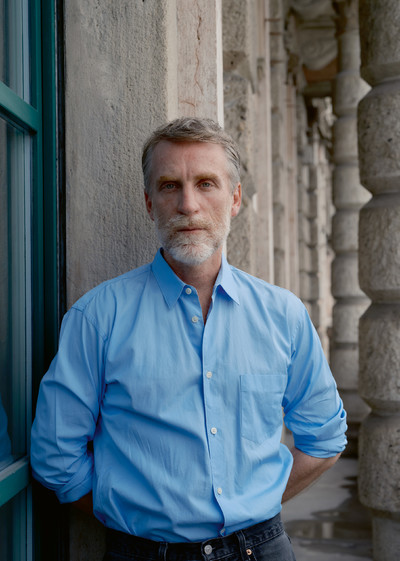
Jil Sander’s Milan offices sit in Piazza Castello, in the very building that once housed Segreta – one of the legendary clubs that defined Milan’s rave and electronic scene in the 2000s. Walking in to interview creative director Simone Bellotti, I couldn’t help but wonder: was this coincidence, or intention?
Simone Bellotti, now well into his second year at the helm of Jil Sander since taking the reins in 2025, believes fashion is a process of continual adjustment: get too comfortable, and a designer risks complacency.
Born into a family of artisans in northern Italy, where furniture restoration and upholstery were part of everyday life, Bellotti traces some of his creative instincts back to an upbringing shaped by proximity to craftsmanship. Those early years were followed by formative ones in Antwerp in the heyday of Martin Margiela and Raf Simons, before a career spanning turn-of-the-millennium avant-garde stalwarts A.F.Vandevorst, Gianfranco Ferré, Bottega Veneta, Dolce & Gabbana and 16 years at Gucci under Frida Giannini and then Alessandro Michele. A well-received stint reshaping Bally followed from 2022, before he landed the creative directorship at Jil Sander.
In this conversation, I spoke with Bellotti about the enduring influence of dance music and Belgian fashion, while unpacking what attracted him to Jil Sander’s work – of which I am an avid collector – and her legacy in the first place. We discussed the value of taking time, the necessity of self-doubt, and why even a house synonymous with purity should always leave room for a bit of mess.
Edward Buchanan: Simone, we meet again. We’ve done this before, but just to underline it: you’re from northern Italy, between Como and Milan, from a family of artisans. And you told me something I was intrigued by, that your father could craft a mattress by hand?
Simone Bellotti: Yes, and not only that, but it was probably the most fascinating object he could make. It was interesting to see the process behind it. Today, mattresses are almost all… Well, mattresses now cost €30,000 when they’re made in an artisanal way. But back then, the mattress was made with virgin wool, all stitched by hand. After a while, people used to bring them to someone like my father to regenerate the wool, and I would sometimes help him do it. You had to open the mattress, take out the virgin wool, and regenerate it with a machine that brushed the wool. You’d throw the wool into the machine, and it had this movement; something would grasp the wool and it came out the other side, super light. Today we throw everything away so quickly. In a way, they were more advanced than us back then, taking the time to do things like this.
‘I found a way to make the collection a bit less precise. Playing with precision, but with something a bit more out of control, a bit dirty, a bit imperfect.’
The proper way.
Yes. And I can see a similarity to what we do as designers. Even if we’re surrounded by too many images and too many voices, at least we still produce something tangible, a product we hope people will love. It’s nice to do something that can be seen and appreciated – or not, but at least it is real.
So before your father passed, your parents were essentially doing restoration.
He was an upholsterer, and my mum worked with him. She did more of the sewing, like curtains, pillows, stitching. And they used to regenerate sofas. Old stuff, new stuff.
The interesting thing is that you lived and worked in the same building.
That’s typical of the area, nella provincia in Italy, especially these productive areas where everyone worked in furniture, like Brianza. It wasn’t unusual to live in the same house as your workshop. The workshop was on the ground floor and we lived on the first floor, a house of two floors. So every day, we worked and lived in the same place.
So, childhood craft and creativity, and then fast-forward to 2001, you run off to Antwerp. You go there at a moment when so much major shit is happening. You’ve talked about it: there were the Rafs, the Margielas, all of those things happening there. And almost immediately, you met A.F.Vandevorst, which is like…
I really loved them. To be honest, I loved almost everyone there even though they were all very different. Walter Van Beirendonck was very different from Ann Demeulemeester, or Raf [Simons], or Dries [Van Noten], or Veronique Branquinho, but I was attracted to all of them.
What was in the air?
At that time, everyone who wanted to run away used to go to London. I thought about London too, but then this scene appeared to me. You remember that periodical called Collezioni?
Yes.
With the shows in it. I think it was about the shows of 1998, so it was probably 1997. I remember seeing the images of – I think it was one of the first Raf Simons shows, the Kraftwerk one – and I said, wow, what’s this? I felt a kind of poetry, but slightly dark, which really attracted me. In those years I also started to discover Carol Christian Poell. We talked about that.
There’s a thread here, though. Especially at that time, these were the rule breakers and the vast majority were also independents.
You feel attraction when you don’t know something, when it’s not in your face all the time. And in those years, nothing was in our face all the time. Today everything is everywhere.
Everything is in your face.
That’s probably because we’re never happy. We get bored more quickly. Before, there was this mystery surrounding that reality. I remember going to see the clothes during the sales at Antonioli and 10 Corso Como in Milan. That’s when I started to see the clothes from Margiela, from Vandevorst, from everyone. I decided to go to Antwerp because it was really fun.
Were you running away from home, in a sense?
Totally.
Let me sidebar quickly. You were talking about ‘home’ in the last show: how home is a place we like to be in, but that it’s also good to be able to step out of it.
I like to think about this in relation to a brand. The idea of feeling good at home was, in a way, about home as a house, as a fashion house. So feeling good at home can mean respecting the codes of a house, in this case Jil Sander. But at the same time, feeling the need to go away from home meant, to me, finding a way to add something of myself, always respecting the idea of the brand, but adding something more personal. The first show, I’d say, was very clean and precise. There was this reference to art, to Richard Prince’s work…
‘In my teens, rebellion took me all over Italy, dancing non-stop for days at a time, discovering DJs and people and ‘real’ fashion that inspired me.’
Did you see Helter Skelter, the Arthur Jafa and Richard Prince exhibition in Venice?
Yes, at [Fondazione] Prada. It was amazing. I saw that car hood he painted, and I loved it – that was the inspiration for some pieces, like the skirt Guinevere [van Seenus] wore in the first look. Then for the second, I was still working with the moodboard of the show, playing with this idea of home and adding something more personal. I found a way to make the collection a bit less precise; playing with precision, but with something a bit more out of control, a bit dirty. It was nice to add this idea of imperfection to a brand everyone thinks is just about clean lines. Which it is not.
I want to hit on that, because I want a real conversation about it. After working with independent brands like A.F.Vandevorst, you went into 16 years at Gucci, going from creative independence to the establishment, let’s say. How did you find that bridge, in terms of being a creative mind?
From the independents, at the beginning, I made small moves into more established companies: [Gianfranco] Ferré, then a short period at Bottega [Veneta] with Tomas Maier, then another short period at Dolce & Gabbana. So it was a slow passage. At the beginning you’re fascinated by these huge machines, and that’s good, because you learn a lot about how a very structured company works. But after many years, I felt I needed a change. I was happy to go back to a smaller company, maybe a bit more naive, but when things aren’t planned all the time, it gives you more freedom to express yourself. In a huge company like Gucci, though, the challenge – as a menswear designer – was always to find a way to follow the rules, to follow the creative director’s vision, while still adding something of yourself. Working with Alessandro Michele, with this fantastic, crazy aesthetic. My personal taste is different, but I was so excited to push myself. I was probably the designer working with him who was the most minimal.
In all the chaos!
I hope he liked that, because he used to like something that balanced the more elaborate with something more neutral, even if it was never really neutral.
I’d think that in those situations, working under other creative directors, they benefit from having someone who isn’t always there to say ‘Yes, let’s do it your way.’ You’re there to propose a different perspective.
He was very open to our proposals. At the beginning the energy was huge, and we all felt we had the chance to propose whatever we wanted, and they had a big budget. That feeling is amazing. When I think about all the moves I made through different companies, I’m happy I saw so many realities. Whether it was a longer or shorter period, I remember everything I did and the feeling I got from these great designers.
I want you to tell me how you started to understand the core ethos of Jil Sander, a company founded in Hamburg, Germany, by a woman in 1968. Do you have a relationship with Germany, and what did that mean to you in the early stages at Jil Sander?
I don’t have a specific connection to Germany. But as I was attracted to Antwerp, to this idea of the north of Europe, I feel a brand like Jil Sander is also more or less part of that sensibility. The idea I had when I started at Jil was that this brand is driven by contrast. You can see this research into rigour, into tailoring and precision, but there’s a counterbalance of something light and pure that lets the body’s expression come out. You see a lot of skin in what she did. So it’s always something classicist, tailored, but with research into modernity, lightness and purity. I like working here with that in mind, learning how to balance these aspects, which I love, because even if they seem in contrast, they are not. They’re just different aspects of one personality. I always think a brand can be seen as a person. We’re so incoherent in our lives: sometimes we’re one way, sometimes the opposite; one day we like something, the next we like other things…
It could be your star sign as well.
My star sign, yes, I’m a Cancer.
I’m a Gemini, so I understand Cancers.
We’re close. And I really like to play with this. What’s fun is that Jil Sander is, let’s say, the queen of minimalism, but I discovered this story many years ago that always fascinated me: she had her house in Hamburg designed by Renzo Mongiardino, who was the opposite of minimalism. That’s what I like about the brand. It’s not just about purity and minimalism; it can be something different too.
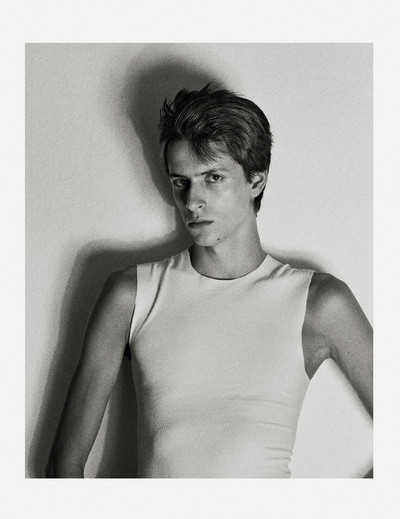
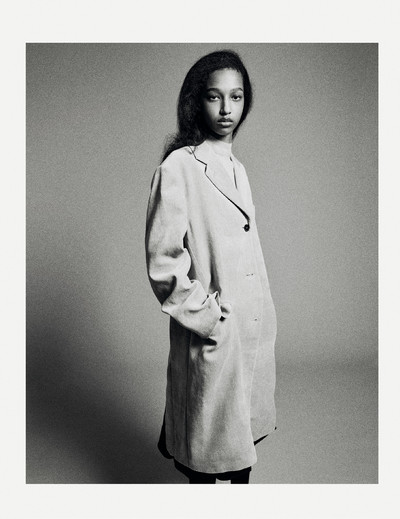
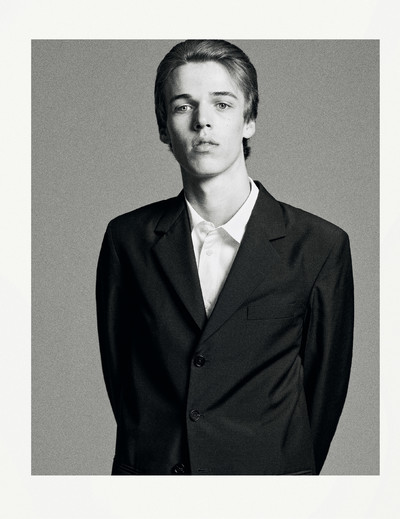
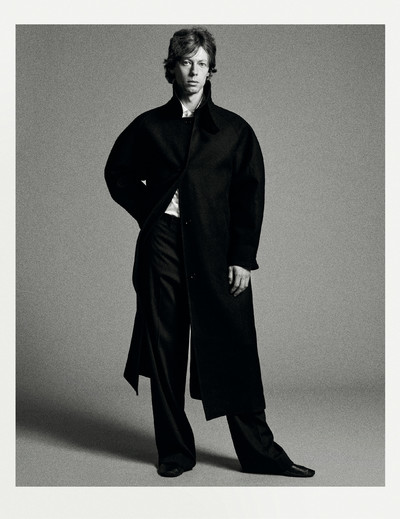
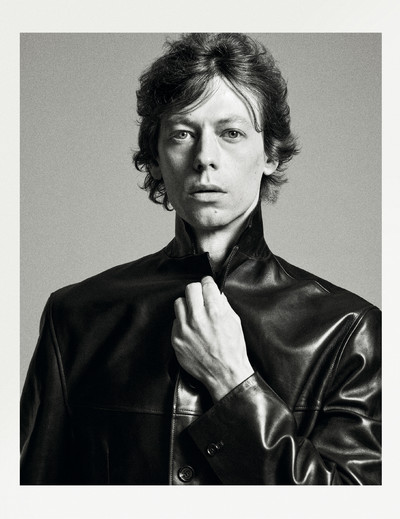
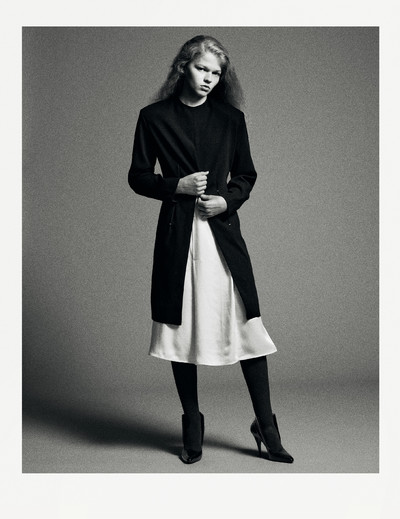
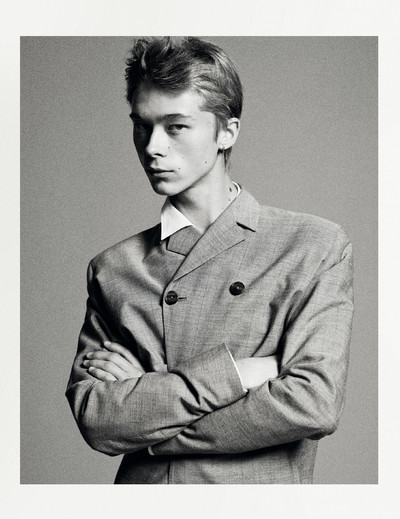
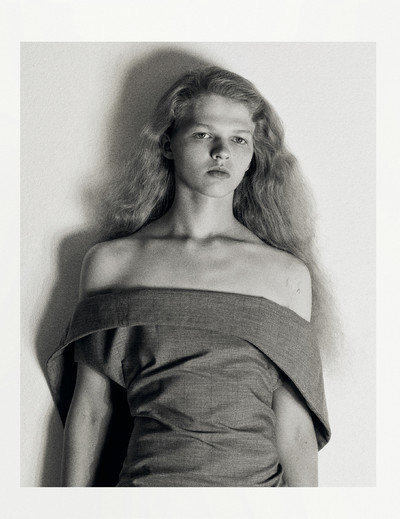
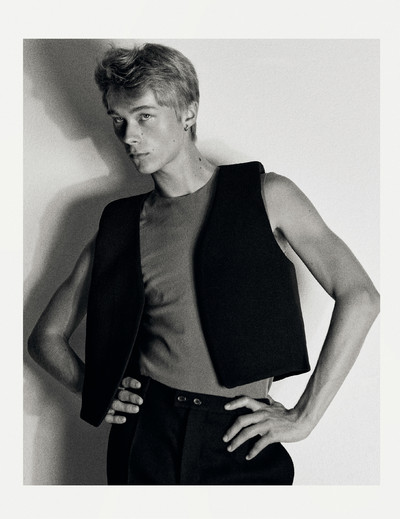
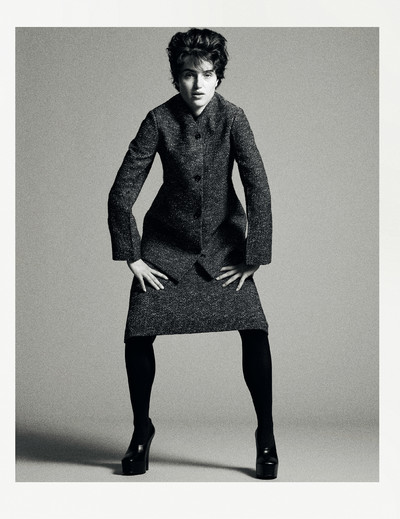
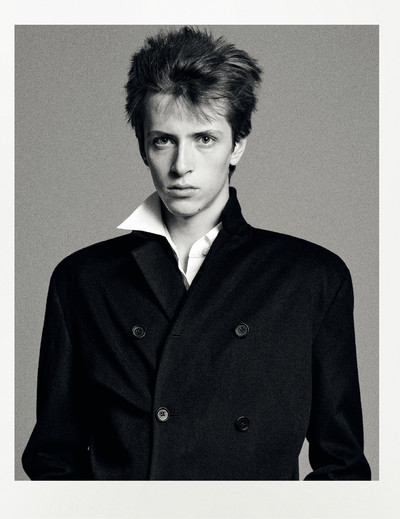
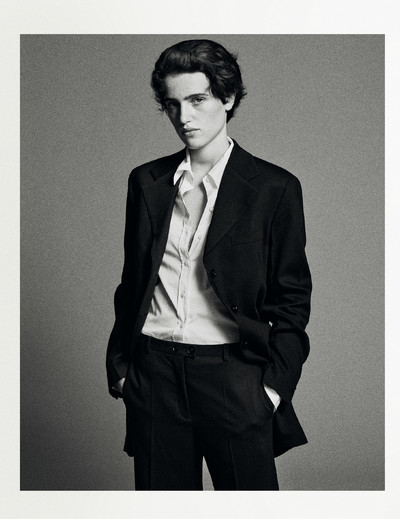
‘Jil Sander, the queen of minimalism, had her house in Hamburg designed by Renzo Mongiardino, who was the opposite of minimalism. That’s what I like.’
Given Jil Sander’s mantra was the word ‘purity’, what about the garments or aesthetic you’re creating that speak to this mantra? Is it a mantra you’re considering in your creative process?
Yes, I consider it. Even in the inspiration. In art, I could be inspired by Donald Judd, Dan Flavin, Agnes Martin, all these minimalist artists. But for the last show I was inspired by very different ones, with a very different approach: Fassbinder, and that Anders Petersen book, Café Lehmitz. Do you know it?
Yeah, of course.
It’s something beautiful, so real, and so unbelievable today, because you see this carnality, this passion, these very extreme feelings right in front of you. It was a café in Hamburg. So, at least for now, I like to think about something with a different starting point, to add that touch of imperfection within the perfection. It doesn’t exist, but maybe it becomes more obvious. That’s why I started to manipulate the clothes, why I made these dirty shoes with the suit. The boots were dirty, and one pair was mine from many years ago. It’s fun to play with something different from what you’d naturally do while thinking about a minimalist brand. Of course you think about the mental process, but we’re not only made of our brain. We have so many things moving in us, and our emotions are a bit crazy sometimes, a bit out of control. It would be nice to find the magic in these things.
The first project you did was a music video for Bochum Welt called ‘Wanderlust’, shot in Hamburg. Why was a music video your chosen way to introduce us to your world? I know you well, so I can imagine why, but I want to hear it from you.
That project, we needed some content to communicate something, but it was before the first show, so I had nothing to show anyone. That’s why I said, ‘OK, if you ask me to do something, I want it connected to music’. That’s how ‘Wanderlust’ came about. I find Hamburg a very interesting city, even if I’m sure it changes, like every city changes, just as Milan does. What I like about it is the contrast you find there. It’s a port city, but it also has this sophisticated, elegant bourgeois aesthetic. And then you have the port, this industrial feeling around you, this roughness. You have this beautiful light, but at the same time this horrible weather. It’s the type of city I love, like Antwerp. So it felt like a good idea to start where the brand started.
It was a beautiful blend of your world and aesthetic as it relates to music and imagery, and of Jil Sander, which began in Hamburg.
Yes. That song gave me this vibe of a subtle dream. It was poetic, and I thought it would be nice to give a touch of warmth to the final result. Even the video is subtle, very human, in a way.
There’s something naive about the imagery too.
Yes, that’s how the idea came out. It’s something I’d love to do again.
Your first look in your debut show was worn by the legendary Jil Sander muse Guinevere van Seenus. She’s wearing a blue cropped sweater, and there was the Richard Prince skirt you mentioned, with this micro heel. I always think the first look really indicates what’s to come, and I liked that presence. What did you want to communicate the first time the global fashion community was seeing Jil Sander through your eyes? When that first look came out, sitting there, it was clear to me where this was going, and I liked it.
I’m happy you felt that way, because many people probably didn’t. What I like about that look is that it seemed so simple, but there was a very special structure in the skirt that you couldn’t see from a phone – only if you were there. That skirt was inspired by those kinds of bevels, but from far away you probably can’t detect it. I like that feeling of something you can appreciate only if you’re there.
I always say the show is the presentation point, where we see the full idea. But the important thing is also the untold story you get at the re-see, when you actually see and touch the garments. A lot of people skip that stage; they’re prepared to judge from an image on their phone, when really you should be required to see it in an old-school way.
Yes, that’s a very nice moment. I’m always here the day after the show, and I get to talk to many people from the press, and some buyers. It’s nice when you see someone touch the product. If they’re happy, I’m happy. It’s difficult, because everything today is based on an overload of images, so we have to work hard to keep this reality alive.
‘People said the cut in the skirt was like a Lucio Fontana, but I’d not thought about that at all. To me it was a way to open the clothes, to create space.’
One more thing on Guinevere: I often think about those images of her, and the work Jil Sander did with Craig McDean in the 1990s. To this day I look at them and think, what the fuck? They’re so modern and cool at the same time.
Guinevere said it wasn’t planned. They were just doing something because they liked it. That feeling is so rare but when you achieve it, it’s the best. She said those images, which are so iconic, were created in a very naive way.
You feel it in the imagery. Specifically the one where the printed flower paper cuts the frame in half. There’s a floral jacquard dress in the Autumn/Winter collection that looks very similar to this pattern. Interestingly enough, I instinctively aligned those two things.
It’s like in the first show, the cut in the skirt. People said, ah, that’s Lucio Fontana, and it’s true, but I didn’t think about Fontana at all. My reference was something else. To me it was just a way to open the clothes, to create space, but I understand that you see it and say it looks like Fontana. And now that you say this, it’s interesting, because that was inspired by my father’s mattresses. In those kinds of families, they were made in tonal jacquards, very classic. Maybe it’s not Jil Sander at all, but it was padded, a little mattress. I loved it.
So you’re a year and a half into your tenure. The third collection is often the one where you’re properly installed and can really begin to make it your own, where people outside, and internally, have an idea of what this is. Do you feel settled in?
No, and I think it’s good never to feel settled. I’ll never be like, ‘Now I feel good’. This feeling of doubt, in a good way, is really helpful, because I’m always questioning what I’m doing, always wondering if I made a mistake. It’s probably my character. Sometimes I’m happy, but I want to do better. In a way, that’s what keeps me going. If you start to believe you’re good, that’s not good, right?
Do you design the men’s and women’s collections together the way you did at Bally?
Yes. I start with one idea and we develop it all together, at the same time.
The Autumn/Winter 2026 show, I loved it so much. I loved the terracotta on the ground. I remember describing how it felt: you started with these precise suits and dirty shoes, and there was an ‘austereness’ at the front. Then, all of a sudden, they started having a party at the back. Everything started to twist and open up. I loved that. It’s more than what you actually think you see.
That’s something I’ve liked for a long time, even before Jil. This idea that something isn’t always in front of you, in your face, but that you can have a little surprise, some fun.
I can remember Cathy Horyn asking you what your sensuality would be, because in this collection there were bustiers and high heels, which I found really nice. I mean, it’s not that Jil Sander as a company was ever devoid of those things…
Raf used to do heels too, remember. I was always a menswear designer, so I’m really having fun discovering this new aspect. And I’m lucky, because I’m surrounded by very good designers.
Did you inherit your team?
Yes. Over time, some left, but mostly it’s people who were here already…
…who have been here a long time.
Womenswear is very important for the brand, so I’m really trying to do my best; learning, playing with volumes. It’s all new for me, which is fun. But it’s always good to ask women. I’m always asking the people in the office, how do you feel about this? It can’t be based on what I’m wearing. I wear clothes in a very boring way. So it’s always good to ask how they feel about something I like. With the cuts in the first show, I was always asking, ‘Is it too much?’ Is it good to have a cut here? Maybe we lower it. I remember going very high, and people were like, ‘What is he doing?’ So I lowered it, and then everyone loved it.
Have you met Jil Sander? Do you correspond with her?
No, no.
I found out something interesting: Jil Sander has a penchant for McDonald’s.
This I didn’t know.
It’s a very interesting duality. She has that surprising, anarchic streak. And I’ve said this to you before, but I think you have this similarly. I always call you punk, the punk that, for me, relates to your thinking, the obscurity, and understanding the classic, but mixing those things together. What do you think your anarchic streak is?
I wouldn’t say anarchic, but like everyone in their teens, I was a bit of a rebel. As I told you before, my father died when I was very young, so those years were very intense. That’s when I started going to clubs. I was a bit crazy, like many of my friends. That was probably my way to escape a very tough moment. I’m not saying I’m the only one; everyone faces this in life. But that rebellion took me all over Italy, dancing and never stopping for two or three days at a time, discovering amazing DJs and music and people. That’s probably when I started to see real fashion that deeply inspired me.
‘I think it’s good never to feel settled. I’ll never be like, now I feel good. This feeling of doubt, in a good way, is what keeps me going.’
I want to come back to that at the end. But I want to jump to one thing. In the BoF article Tim Blanks wrote in 2025, you namechecked the interview System did with Joe McKenna and Jil Sander.
Which is a very beautiful story.
Jil Sander and Joe McKenna created such a wonderful, visual relationship. I imagine it wasn’t always smooth, but it was beautiful. What was it about that interview that caught your eye, and how important is a stylist, a figure like that, in your organisation?
I was really into that interview, because it’s helpful to better understand the person who created this brand. It was her and Joe McKenna who visually helped build these amazing images that still inspire us all. I’m sure they had different points of view, and that’s good. It’s good to have someone who isn’t involved in the everyday life of an office. If you have a good relationship with them, it’s good to exchange and have a different point of view. I’ve worked with Charlotte Collet for many years now.
She’s very different from me, and that’s probably why I like her. I don’t believe that feeling so convinced of your strength and your ideas is healthy. It’s good to question yourself. So you need someone around you who can challenge your beliefs, which then also makes you even more convinced of what you think.
Are there any specific elements of Jil Sander’s work and life that you’re most interested in?
This idea that someone was able to make a project by taking time. Which is a dream today.
She had so many years to build this machine.
Since I’ve been here… Well, let me show you. [Pulls out a stack of catalogues] If you look at how this brand has evolved over the years, it was very different. These are all the catalogues from the 1980s.
Incredible.
You’d never say this looks like how we think of Jil Sander now. But what I like is that these people had the talent and the ability to build over time. For a brand that lasts, this process takes time. We all immediately connect this brand to a specific moment, probably more to the 1990s. But to arrive there took time. What we all need, in general, is time to develop, because it’s through time that you learn, and practice, and understand when you’re doing something wrong. It’s harder today, because everyone is very quick to say something is good or bad, without allowing the proper time. We judge everything in a very superficial way sometimes. But this is the time we live in. Everything is unpredictable. Even the weather is unpredictable.
What is predictable is your love for music, and that’s where I want to end. Last time we talked, you told me the track that gets you every time was ‘Your Love’ by Frankie Knuckles from 1987.
Frankie Knuckles, I remember that. Do you know Gemini? It’s amazing. It’s someone from Chicago, from the 1990s.
For your first two shows you commissioned an original electronic soundtrack from the same Italian producer who scored the film; for the second, Laurel Halo, with Kim Gordon reciting a poem, and the John Cale track. You don’t have to tell me how important music is to you, because I know. I just want to understand: within your creative process, it seems like music is part of your identity, entrenched in how you work.
It’s such a powerful tool, because it has this immediacy that doesn’t need explanation. If you can make something and people don’t need it explained, that’s the final goal. Music has this power – you immediately get what it wants to say, even if you’ve never heard the song. That’s magical. And what I love is that it’s not visible: we’re in an image-driven society, and I think music is getting more and more important precisely because you can’t see it. It gets to you, and you don’t even know why; it gives you an emotion, good or bad.
Talking about the Biennale, when I went, I visited the Vatican Pavilion. It was a sound installation with many artists, from Brian Eno to Dev Hynes to Patti Smith. You were just walking through this beautiful garden with medicinal herbs, and people were amazed by the power of the music. That’s probably what I like about music, and it’s not just me. They say there’s a rebirth of intentional listening. In the last 20 years or so, music became just something surrounding us. But it’s nice when you decide to listen to something, and take your time with it. So now people are crazy about something that was completely normal back in the 1980s.
You once told me you enjoy the thought process around doing something normal, sometimes in a conscious attempt not to be unconventional, which I thought was very interesting. We were talking about how everyone is trying so hard to be something. Is this still a sentiment you feel in your new space here at Jil Sander?
Yes. And I think that is something you understand as you grow older – you don’t have to do things just because you feel you’re missing out. And that’s something I like.
Models: Annie, Annika, David at The Squad, Diana at Wilhelmina, Eleanor at Models 1, Iker at Platform Agency, Paddy and Theo at Storm, Tito at Models 1. Casting: Ben Grimes at Drive Represents.
Hair: Ramona Eschbach at MA+ Group.
Make-up: Thom Walker at Art + Commerce.
Manicure: Chisato Yamamoto at Caren.
Set design: Suzanne Beirne at Bryant Artists.
Digital operator: Alex Dow.
First photographer assistant: Shane Ryan.
Photographer assistants: Wynston Shannon, Alfie Castang.
Stylist assistants: Federica Battistino, Mónica Armario de la Rosa. Hair assistant: Lee Devlin Patrick.
Make-up assistants: Lizzie Checkley, Anete Salinieka, Charlie Fitzjohn.
Set design assistant: Paul Simpson.
Production: Rosie Cartwright Ltd.
Company director: Rosie Cartwright.
Production assistants: Nikodem Postaremczak.