By Alexander Fury
Portrait by Antoine Seiter
Thirty years, a $600 million business and one very dirty Hackney workshop later, Sandra Choi explains how a Jimmy Choo actually gets made.
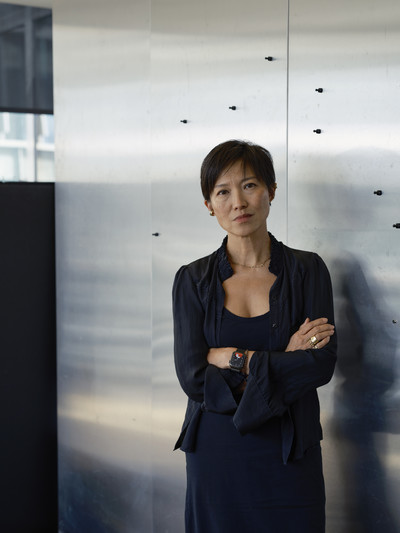
Sandra Choi rolls her eyes, just a little, if the first thing you mention regarding Jimmy Choo is Sex and the City.
She isn’t ungrateful. In 2000, the television show turbocharged name recognition for Choo – fortuitous enough to rhyme with shoe – via the third season premiere in which Carrie Bradshaw famously loses one of her precious heels. It is a characteristically Choo creation, by which I mean characteristically Choi, given that she’s designed every Jimmy Choo ready-to-wear collection since 1996. A delicate, distinctly feminine slingback in a bruised lilac suede decorated with a single pale feather, a quintessential strappy sandal, from the shoemaker that has defined them. Partly in acknowledgement of that seminal pop culture moment, last year the brand reissued the style which was originally designed for a 1998 collection. It almost immediately sold out.
For Choi, however, her 30 years at the helm of the brand’s collections is about far more than those few seconds of small-screen immortality. The name Jimmy Choo means a down-at-heel workshop – politely described in retrospect by Choi as ‘Dickensian’ – in the then-insalubrious streets of 1980s East London. It also means handmaking shoes for royalty in this very Dickensian workshop, where she first learned her trade. It means her hard scrabble to build the ready-to-wear and accessory business alongside Tamara Mellon (née Yeardye), where Choi was the design nous. A 2002 New York Times profile aptly dissected the business, describing Mellon as ‘the Face’, and her entrepreneur father Tom Yeardye as ‘the Money’ (given that he fronted the £150,000 seed capital to start Choo’s ready-to-wear and establish their first boutique on Motcomb Street), while Mr Jimmy Choo was credited as ‘the Name’, and Sandra Choi simply, ‘the Talent’. A role she continues to hold today.
Yes, there’s plenty of glamour in Choi’s story, but more than anything there’s hard work and raw talent. Choi has been working in the shoe business since she was a teenager, learning the craft alongside her uncle Jimmy Choo, who left the brand bearing his name in 2001. She came to the business without any formal training, but with an aptitude for making and a plain love of fashion. This meant that her designs were keyed into the attitude and feel of the moment, which is as tricky and mercurial as it sounds. Choi was also her own best customer, wearing key styles – strappy sandals, mostly – from her earliest collections to dance in all night as the label’s popularity exploded in the late 1990s. She is now a married mother of two daughters (Phoenix, 15, and Cyan, 12), but she still wears Jimmy Choo every day, often drawn to her most extreme creations.
‘There was a page I landed on in Just Seventeen about John Galliano, a deconstructed Prince of Wales jacket. I wanted to know how he made that.’
Starting out making shoes for royalty – both of the Hollywood type, as well as titled nobility – Choi has made shoes for too many household names to properly credit or enumerate. We can, however, list a few notables: Cate Blanchett, for her first Academy Award nomination in 1999; Halle Berry, for her Monster’s Ball win in 2002; Michelle Obama, for her first and second inaugural presidential balls. The Princess of Wales, obviously. More recently, Charli XCX wore Jimmy Choos to get married in (they do a swift trade in bridal and, conveniently, Choo also rhymes with blue). And, as if plucked from a cobbler’s dream, Choi got to literally design shoes for Cinderella, a crystal-embellished pair devised for Lily James to wear to a 2015 premiere of the Disney live-action film, which proved buzzy enough to spin out into a commercially available range.
Jimmy Choo remains one of footwear’s big three, alongside Manolo Blahnik and Christian Louboutin. Acquired almost a decade ago by Michael Kors Holdings, since renamed Capri Holdings, for a valuation of $1.35 billion, its turnover in the period since has increased 50% and now exceeds $600 million annually. It remains one of the few luxury houses helmed by a woman, or a person of colour. It’s also often forgotten that Sandra Choi is now the longest-serving non-founding creative director of a luxury brand. In this conversation, we cover Choi’s earliest forays into footwear design, the importance of sketches as well as the dust and dirt of the factory, and how the name Jimmy Choo, with its biker boots and slippers and pragmatic sneakers, isn’t just about bling and high heels. Although Choi does both of those things exceedingly well.
Alexander Fury: I am going to ask a clichéd question: when and how did you first become interested in fashion? Because I know it was fashion for you, rather than accessories…
Sandra Choi: When I was a teen, I was really into fashion magazines. I remember Madonna, TV, Japan, pop culture. That was when I was about 13, 14. I remember buying bright pink lipstick, because that’s what Madonna and Cyndi Lauper were wearing. And I shaved off half of my hair.
You grew up in Hong Kong?
Yes, with my maternal grandparents. My father moved to the UK when he was around 15 because my grandpa wanted to start a restaurant business. So he moved the family over without his wife. The boys came over and they studied, then moved to the Isle of Wight and started a Chinese restaurant. When my father was in his 20s, he went home and picked his wife and came back. The family was all born here.
When did you go to Hong Kong? How old were you?
Eight months old. It was fairly normal in those days. You find that lots of people my age who are Chinese immigrants…
That’s the experience.
They all have the same background story. Andy Wong is exactly the same.1 We all have the same stories. But I did look at my own child when she was eight months and I went, ‘Oh my God, to have to ship you somewhere far, far away, in a different time zone and leave you there…’ I was devastated to think how my mum must have felt. But I think we are built in a certain way. We just get on with it.
What was it like when you came back to the UK? Was it a massive culture shock?
My grandparents found out that I was bunking off school. I was getting out of hand. So my parents called and said, ‘Enough, you have to come home.’ It was a culture shock. Hong Kong is very vibrant. It’s plugged in, it’s electrifying. The Isle of Wight… It’s not London. There’s nobody on the street. Even just visiting, I hated it. Not only because it was the Isle of Wight, but also because I didn’t really know my parents.
Obviously then Hong Kong was still a UK territory.
I grew up with a lot of Britishness. I knew the government, Spitting Image, Bisto Gravy. I was exposed to a lot of culture, whether it was from my aunt and uncle’s age group, or traditions and heritage from my grandparents. I can’t say that I was deprived or that I was the unlucky one, because whether you grow up with your parents or your grandparents or other family, as long as you’re treated well and loved, that’s all that matters.
‘I was studying, but I was in the Choo workshop all the time, playing with fabric, making. That’s how I met Kylie Minogue, Katie Grand, Jane How.’
How old were you when you came to the UK?
Fourteen. I remember it really well, we used to get dressed up to travel. My grandfather was really strict about it. He had to put a suit on, wear a tie, shine his shoes.
How was your interest in fashion materialising at that point? As a young teen on the Isle of Wight?
Just Seventeen, the magazine. That’s the only thing that I could get my hands on. And Top of the Pops, Dynasty. I also started to make things. I was at school and I couldn’t speak English. I was in a convent school, because my parents found it easier if it was a single sex school, and my dad banned all of us from speaking Chinese at home. Because English wasn’t my thing, I got into maths. I was really good at maths. You don’t need English for that: an equation’s an equation. But I was also good at art. When I was painting I didn’t need to speak to anybody. I was just using my head and my hands. I went into textiles because I wanted to make things. I was brought up by my grandmother who made and fixed everything herself. She taught me how to sew. I remember designing dresses and drawings and I made cushions, then I started to buy clothing patterns.
Then you wanted to go and study design.
I wanted to make things. I had ideas. There was a page I landed on in Just Seventeen about John Galliano. It was 1984, I think, and it featured a deconstructed Prince of Wales jacket. The fabric, the cut of the jacket and how he reimagined it was incredible. I wanted to know how he made that. I consumed: Graduation Show, Saint Martins, John Galliano. Those are the words that I remember taking with me. I was quite fixated and I knew what I wanted, but my parents weren’t supportive.
Did they want you to go and do something else?
I didn’t get along with my parents so I left home when I was 17. I left because my older sister was leaving to go to university and I knew that I could not stay there. If I stayed there, I would’ve just taken care of the restaurant. It would have been a different kind of ending for me. My aunt and uncle lived in London, and my aunt is married to Jimmy Choo, so I went there. I was studying, but I was in the Choo workshop all the time, playing with fabric, making. That’s how I met lots of people – Kylie Minogue, Katie Grand, Jane How. The workshop was a hub for artists and furniture makers, glass makers, set designers – all based in the same building in Hackney. My aunt was working there, too.
Was your aunt involved in the company itself?
She studied shoe design. It’s like, if your family runs a restaurant, you’ll help.
Which I think is universal. It’s not only in Chinese culture.
You peel the potatoes. So I did. I got into Saint Martins for the foundation course and met amazing people trying out all different mediums. All I can remember thinking is, ‘I just want to belong here.’ This would’ve been 1990, 1991. On the fashion course there were Phoebe Philo and Stella McCartney. But I didn’t make it.
You didn’t make it on to the course?
I remember a discussion with the class. The tutor said, ‘What do we think of the importance of shoes?’ A few people said, ‘It’s all about clothes for me.’ I thought, ‘I guess you go out barefoot then?’ I walked away from it. Honestly, I couldn’t concentrate. I knew that Mrs. so-and-so needed her shoes, that she had an appointment on Wednesday at 3 o’clock…
You were thinking very pragmatically, because you’d already been involved in a fashion business.
I was organising the uppers being made, the fittings, magazines were asking for shoes for shoots… That side of the business intrigued me. At this time, we were also involved with fashion shows, doing the shoes for lots of London designers. Katharine Hamnett – that’s how I met Kylie – and Amanda Wakeley, Ben de Lisi, all of those names. We made shoes for Consuelo [Castiglioni] at Marni and for Lanvin. So much was going on. Going to see a show – even if I was standing – just being there, I was buzzing.
And you were designing shoes as well?
Yes. Often I would do a quick sketch for a client, based on a material Catherine Walker had sent, for example.
‘If Princess Diana ordered shoes, we’d keep a last for her – but it was all adapted with car body filler, the stuff you use to fix a car’s chassis.’
Do you still sketch today? Is that still an important part of the process?
If I can’t sketch, I can’t communicate – but I don’t draw everything. The house is very big today. I draw things that I want to communicate, and I think that emotion comes through in the sketch.
The gesture and the humanity of it.
Yes. Back then, Anya [Hindmarch] would be making the bags, we’d be making the shoes. That was the learning process. Then there were the fittings…
What was the experience like with clients?
Jimmy Choo probably had the most sophisticated client list. Lady Bamford and Mrs. Galandras – all the well-to-do Belgravia set. We made Emma Thompson’s wedding shoes. They were all coming to Hackney! Today, Hackney is glossy, but back then you were lucky if you didn’t see a rat running around. Coming from Paris and San Lorenzo and Harvey Nicks… to Hackney?! I was trying to make it as presentable as possible. The only clients we didn’t let come to the workshop were Princess Diana and the Duchess of Kent.
What did you learn from that time?
I learned how to finish something to the highest possible standard. You have to understand, with shoes in general, they were very leather-based back in the 1990s. So everything was very black and brown and tan. Even the big brands like Chanel and Yves Saint Laurent.
I have Alaïa shoes from the 1980s when he was making them with Diego Della Valle. They are black and they are brown, all leather.
But Jimmy Choo was very much event-based, for pairing with gowns. Because of the restriction on materials back then, the only leather that we could get was really basic. So we had to base our business on something else. I would keep scraps of fabric because you never know what you can do with them. Anything that is A4-sized – if you’ve got two pieces and a tiny bit extra you can make a pair of shoes. Today, though, it’s very different. You can buy leather in the UK and the quality is fantastic.
So Jimmy Choo began making shoes from fabric?
Fabric that was colourful, refined, ornate. To make these beautiful shoes you have to keep them as clean as possible… Working out of this small workshop, where there was old machinery, and it was all made by hand… It was hellish.
To make a dress, you can head to Peter Jones or Liberty to find everything that you need. You can’t do that with shoes. You need a lot more internal ingredients for shoes. So we were being creative in sourcing the shape of the insole, which is the core, the skeleton of the shoe. We’d make the shape ourselves. We’d rip things out, glue paper, wrap it to connect to the base of the shoe so that it doesn’t fall to pieces when you actually made the shoe in the shape that we wanted.
Adapting.
You use a block to make shoes, a ‘last’. All of ours were plastic, in all size ranges, but the toe shape and the volume we could adapt as we went. We would use car body filler, the stuff that you use to fix a car’s chassis, to make the toe shape that we wanted. You could go wide, you could go small. If Princess Diana ordered her shoes in consecutive pairs, we’d keep a last for her, but it was all adapted with car filler!
I always remember Azzedine Alaïa telling me that when he was custom-making clothes for clients at the start of his career, he learned so much about what women wanted, about their considerations in clothes. They were concerned about how to show their jewellery, and how dresses would look above a table at dinner, for instance. So the décolletage was all-important. What did you learn from your own clients?
I think I also learned what was important to them. A lot was simply what heel height they could wear. Some were more daring; for others, they were just happy as long as the colour matched, because the dress was the primary thing. Sometimes I pushed them a bit more, giving them an extra strap, just to be different. I learned from the client by listening to what they’re looking for, and trying to give them as much as possible, and then more. Adding value, rather than just playing it safe.
There has to be a pragmatism, a practicality. A shoe can look beautiful, but it has to function.
And the feet are very sensitive. If the shoes don’t fit, it really shows. It’s not like a dress where you can get away with draping a little bit. If a shoe is a little bit loose? No.
‘A shoe factory is dirty. The shoes are still made by hand, but the blokes who make them aren’t the most delicate and certainly don’t wear white gloves.’
It’s interesting that even at that point you could add straps, suggest changes, provoke people through design. It became a conversation through propositions.
It was as couture as couture can be, but it wasn’t a huge atelier, it was a small studio. But the shoes, they went places. They ended up taking some of the most important steps for us. I mean, imagine the car door opening and Princess Diana stepping out of the car. The whole world was looking at her.
How did you and Tamara Mellon launch the first ready-to-wear collection? I’m wondering what the process was, what that experience was like.
I knew Tamara when she was an editor at Vogue. All the editors at the time, they would come in and they would order shoes and we used to charge them 50 quid a pair. Cost price, because they were part of the industry. They would always make sure, whatever happened, that they slipped Jimmy Choos into a shoot. It was a community. Tamara was the accessories editor, and then she moved on and edited a section called ‘More Dash Than Cash’.
I remember that.
Eventually she decided to part with Vogue. She phoned us up saying, ‘I’m looking for projects, and I think we should make shoes in Italy for a collection.’ And I’m like, ‘What? How? Where?’ Tamara knew the workshop. She came and hung out, and came to understand that shoemaking is quite grubby, dirty. That was when we really got to know one another. I was very much framing the business, as well as coming up with designs. And then Tamara and I got her father to back the business – he was a co-founder of Vidal Sassoon and brought it to life.
I’d never done a collection before. It was a completely different experience, a different scale to making one pair of shoes at a time. Going to Italy to get things made, we were two lost young ladies knocking on doors. We didn’t speak Italian. But we got very lucky with our factories. I think what I’m most proud of is that all the people who helped make this brand happen, I can still pick up the phone and call them. That to me is important on a human level. The company was formed in May 1996, and our first collection was Spring/Summer 1997.
We were quite naive. We showed at the Plaza in New York, but the collection didn’t arrive, so I showed sketches. We were in tears. Then somehow, in the middle of it, we decided – OK, enough. We don’t want to see anyone else. So instead of taking the lift downstairs, we walked down however many flights of stairs at the Plaza Hotel in order to avoid any more buyers. We only did a tiny order. I can’t remember how many, I just remember the sketches were all on blue paper.
Was there a moment when you felt that it all clicked? That it was all coming together?
I think it was when I was standing outside Saks Fifth Avenue after they’d bought the first collection. I was like, ‘Whoa, we’re here. This is real.’ That was followed by the opening of the store in New York in 1998 or 1999. I’m trying to remember what I was wearing… We had a store on Fifth Avenue next to St Patrick’s Cathedral, and I was wearing Pam, so that would’ve been 1998.
This is when I was starting to learn about business. So collections, selling pretty things, fashion shows. But there was this underlying feeling of: why? What is all this for, and how do you actually make yourself stronger? Presence is important, but we already had presence, we had this association with high society. We then started to have this stronger association to popular culture, red carpet dressing, and that whole network of celebrities and stylists. People knew that Jimmy Choo could make shoes to complement a look.
Do you see a synergy between what you first created 30 years ago, and what you design now?
I think the constant thread isn’t necessarily aesthetic. It’s that we devote ourselves to finishing and to delivering. That means something. It was the ingredient that really made us. And that is difficult these days, because the industry is much faster. Every three months it’s another collection, another project… I’d love to have time to stop and dream. I always joke about this. I think if I lock myself away, with nobody interrupting me whatsoever, I could design an entire collection within a month. Then again, in the beginning, it was hectic too. If I think about coming up with that first collection, going to Italy, convincing the factory to try new things, to believe in us. Just getting it made was a challenge.
‘The Jimmy Choo hallmark is an oddness. Asymmetry. They’re a pair, but not a pair. Shoes come in pairs – but how can we twist that?’
I wanted to talk a bit about craftsmanship and the exchange between you and the factories in Italy. What is that rapport like? How important is it?
It’s everything. A shoe factory is dirty and harsh. They’re all still made by hand, but the blokes that make all the shoes aren’t the most delicate and they certainly do not wear white gloves. You have to have a dialogue with them, otherwise it will just remain a sketch, an idea. We lean into one another, both to perfect what I have in mind, and to address what they think is the best solution; what I think will make a difference, what they think will actually make a design that is commercially viable. It’s a constant collaboration.
What is the process of making a shoe today? Has it changed over the three decades you’ve been in the business?
It hasn’t changed much. You have to have the drawing. Because you can say that you want to make a simple plain pump. But what does that actually look like? Does it have a thick sole? Is there a straight heel? Is it sexy? High or short? I have to make sure that the proportions are there, so my drawings are very realistic. My job is to make sure that my idea will come through. I always ask my team to think about what they are trying to convey. Drawing is important. In my case, when you’re drawing, you’re already thinking about the texture, you’re already thinking about the volume. How do you enter and how do you fasten? Function is one of my favourite words, even if it’s not very sexy.
After that, you give the drawing to the pattern-maker or you cut the pattern yourself, you make the paper pattern from the form, and then normally you tape up the last to make adjustments and alterations to the silhouette. In dressmaking it’s pinning and draping and pulling and cutting and tucking. In shoes, it’s masking tape. My favourite material of all time is masking tape. Masking tape and Post-it notes. I can’t live without them. Then you get the pattern and you lay the pattern out on paper. You literally make the 3D form on the last, you make 2D to cut out whatever you need as a material. But before that, you need to also bring the shape to life. So you have to make the form, and usually you have to go to the factory to work with the last maker. But you always have your master last.
So you have a Jimmy Choo last?
Yes, over 30 years we’ve established our particular fit.
Then it becomes about whether the toe’s going to be elongated or rounded or pointed or…
…whether it’s a boot, a sandal, or a high-cut shoe. All those things are more methodical. It’s like engineering. Apart from the last, you also have the base of the shoe. Today, I can make high heels with my eyes shut, but when it comes to trainers and more utilitarian styles of footwear, it’s slightly different. It’s a different science.
What are the things that you feel are the design hallmarks of Jimmy Choo?
An oddness. Asymmetry, that’s something I personally love. They’re a pair, but not a pair. Yes, shoes come in pairs, but how can we push that idea? How can we twist it? I think everything has been done before. So you have to question what you do. I’m aware of what is out there, but you have to have a good reason to serve up what you are thinking. Why are you thinking this? How is this different to what was done before?
Is that something you’re constantly asking yourself?
Yes: what’s the purpose? It doesn’t really matter who’s done it before because you can just deliver the most beautiful, most finished, most right-to-your-eyes design. But on the other hand, you have to ask: why are we doing this? Because it’s trendy right now? OK, fine. But if we make it, how do we make it different, so that it’s not just the same thing with a different name on it?
So, finally, what makes a great shoe for you?
You need to satisfy your eyes, whether it’s the shape, the heel height, the finish, the finesse. But the reality of making a great shoe is that it’s to be worn – it’s not just an object. For me, though, if it’s beautiful, that justifies anything.