By Jonathan Wingfield
Photographs by Grace Ahlbom
For Samuel Hine, the fit of a faded T-shirt carries the weight of a bespoke suit.
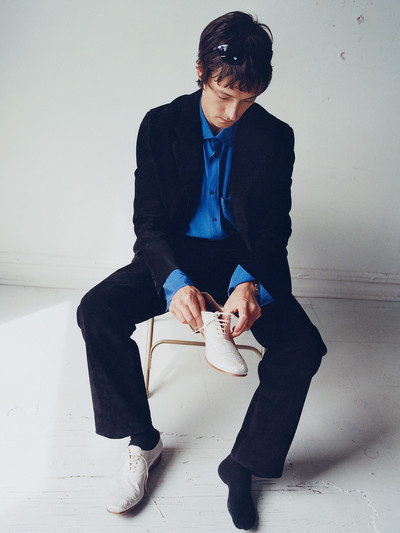
Samuel wears a shirt, a jacket, trousers and shoes by Dior Spring/Summer 2027, and sunglasses by Ray-Ban.
The restaurant is on the seam where New York’s Lower East Side gives out into Chinatown, in the few blocks the internet decided some years ago to call Dimes Square. Samuel Hine lives around the corner, and has been here long enough for people to assume he’s a local fixture. A reputation like that might curdle a man, but Hine wears it the way he wears everything else, lightly and with the sleeves right. In the summer evenings, the city closes the Dimes Square streets to traffic, tables spill out onto makeshift terraces and, as he puts it, “you feel like you’re walking the runway,” because everybody turns to see what you’re wearing before returning to their negronis or natural wine.
Hine grew up in the suburbs of Chicago without being of them – the family arrived when he was in second grade – and it left him with an outsider’s squint aimed east, at New York and at magazines, bylines, clothes. He got all of it. He spent a decade at GQ, arriving in 2016, aged 21, as editor Will Welch’s assistant on the relaunch of GQ Style, and leaving as the most closely read voice on men’s clothing in American magazines. “He brought the perspective of a new generation, who didn’t need the difference between American, Italian and British tailoring explained to them,” Welch told System earlier this year. “Sam’s generation already knew all that.”
His writing veered in both directions. There were straight third-person profiles – Jonathan Anderson, A$AP Rocky, and a three-sittings pursuit of Demna that ended with Hine in head-to-toe “extreme” Balenciaga in Shanghai, on the grounds that wearing the clothes was the only way to understand them. Then he turned the camera on himself and wrote about how to watch a fashion show, and later how to walk in one. The old GQ of cigars, whisky and the cookie-cutter Brooks Brothers man felt aeons in the past.
Since the summer, Hine has had a new job: senior men’s style editor at New York, assembling the magazine’s first standalone men’s style issue and writing New York Look, a weekly newsletter launched in early September. Where The New Yorker can feel like a magazine for cosplaying New Yorkers, New York is for those who actually breathe the city: whip-smart but not smart-alecky, cultured, savvy and attuned. Hine reads much the same way.
‘I was obsessed with the surfer aesthetic – so utterly different from the golfing attire of suburban Chicago. My parents were like, what has got into him?’
And then there’s his image, crowned by a haircut pitched somewhere between Britpop and a soft mullet, which suits him and, in his words, “changed my life”. The rest is classic preppy and tailoring, with inflections of rock ’n’ roll, hints of sportswear and a healthy dose of vintage – much of it under the long shadow of Hedi Slimane. The fit of a faded T-shirt carries the weight of a bespoke suit;
Chelsea boots, Converse, pressed jeans and leather jackets are in constant rotation. Sixty-eight thousand people follow the himspiration on Instagram, where Hine’s roll call of outfits lands with the regularity of a column. During the June menswear shows, as Paris sweltered in a heatwave, he surfaced in a freshly scored vintage red tee, across its chest the words “OUI OUI! C’est Chaud ’81” in faded print.
What none of the selfies or columns quite capture is how genial he is about all of this. Hine is understated to the point of aw-shucks, enthusiastic in a way that cuts straight through the industry’s default cynicism, and quietly, comprehensively informed – he knows the details but never makes anybody feel stupid for not knowing them. For a generation working out where their J.Crew ends and their indie labels begin, he’s about as disarming a role model as the menswear industry currently offers. Whether that makes him the Gay Talese of the Lower East Side, or the Glenn O’Brien of social, remains to be seen – but he is without doubt that particular strain of New York man for whom the cut of a pant matters, and communicating it matters just as much.
We met for lunch in one of Hine’s LES haunts a week before his inaugural New York newsletter landed, to discuss the East Village’s Russian & Turkish Baths, the ruin of Bill Blass’s menswear business, and why the only men left wearing suits are rock stars and artists.
Jonathan Wingfield: Why is now the right moment for a standalone men’s magazine at New York – both culturally and commercially?
Samuel Hine: It was [New York editor-in-chief] David Haskell’s idea. I got a sense of what he was working on when I saw him at the men’s shows in January – his first time attending them. We’d cross paths eight times a day, on the hour, and then at a dinner or a party, so we spent a lot of that week casually talking about what he was there to feel out. He’d clearly recognised a commercial enthusiasm for a new men’s title.
It’s something that I’d heard before – men’s is expanding, and brands have money to spend on it. New York hadn’t been playing in that world at all. The idea was, how do we replicate the success of The Cut, but focused on men’s style rather than men’s fashion. One inspiration was the special Look issue that New York began in 2007 – they only produced three; the financial crisis probably had something to do with that. Look was literally just about the collections: there was a list of every single show of the season, what time it was supposed to start, what time it actually started, who the DJ was, which model opened the show, which model closed it. Really fun, super nerdy, specific. But we’re calling this the men’s style issue, not the men’s fashion issue, because we don’t want it too narrowly focused on the inner workings of the industry. Of course, there are a lot of non-fashion men, in and outside New York, who are very curious about clothing right now – maybe they pay attention to the shows, maybe they don’t. So we want to speak to them, but we also want to speak to New York’s smart and opinionated general-interest readers, introducing them to compelling characters and telling stories that, while grounded in fashion, are also about bigger things.
The stories you’ve written for the debut issue are certainly embedded in broader contexts – lifestyle, human interest, the city – rather than just being fashion with a capital F.
Well, we’re all familiar with the formula of the fashion magazine: celebrity on the cover wearing a luxury house look, and you go from there. We’re really conscious of not wanting to replicate that. We want it to feel surprising – and I think people will get that viscerally from the cover, which doesn’t really show many clothes.
It defines what the title can be through what it chooses not to do.
It started as a commission Jody Quon [now-departed creative director of New York] made, out of a conversation she’d had with Ryan McGinley about the bathhouses in New York, specifically the Russian & Turkish Baths in the East Village, which have been open for like 134 years. It’s a very democratic, very New York kind of institution. I’ve been a bunch of times. You’ll be in the Russian sauna room, which is about 150 degrees, so intense, and you’ll be sweating it out alongside a model, an old Russian guy, an artist, a rabbi from down the street, a skater… Everyone mixes well together. You feel like you’re seeing a real cross-section of the city…
‘My twin brother and I were dressed identically as kids. We still look identical today, apart from our haircuts. He’s a lawyer – he has lawyer hair.’
…without their clothes on.
It’s one of those special New York spaces. Ryan had been wanting to shoot something there, so the initial idea was a portfolio of the regulars, as they are. And at one point in an ideas meeting – I don’t even want to take credit – I think I said, ‘Well, what if we cast talent in this place and turn it into a cover?’ Ryan was super into it, so we started casting artists and musicians and painters and actors, replicating the mix of the place: an age range, gay guys, straight guys. We started with people who actually go to the Baths, like Troye Sivan, who just so happened to be moving to New York right before the shoot. Ryan wanted it to be hot so they didn’t turn the saunas off. It’s going to be a very sweaty cover.
I wasn’t aware of George Davies, the 14-year-old fashion-obsessed model you wrote about. He’s a human-interest piece as much as a fashion piece.
One of my editors, Alexis, said, ‘My friend’s nephew is this kid who’s obsessed with fashion and he’s a model – wouldn’t it be interesting if we tagged along for a day in the life of a SoHo tween model?’ And I recognised him, because I’d seen him walk in the Ralph Lauren show they did in Water Mill two summers ago. He was probably only 13 at the time, and six or seven inches shorter.
How does a kid of that age end up walking a Ralph Lauren show?
I’d assumed he’d been scouted on the street, but he hustled his way in, in that way New Yorkers do. He grew up in Tribeca and started riding the subway by himself when he was nine; he’d go and hang out in the Aimé Leon Dore store and ask the guys who worked there loads of questions. One day he met the founder, Teddy Santis, and Teddy’s like, I need to cast this kid, with his young Leo [DiCaprio] look. He got cast for Ralph Lauren because he kept emailing the Ralph team saying, ‘How do I come to the show? I’ll do anything, I’ll hide in the ventilator, I just want to see it.’ He’s obsessed with clothes in the same way I was at his age. Although I wasn’t DM-ing casting directors.
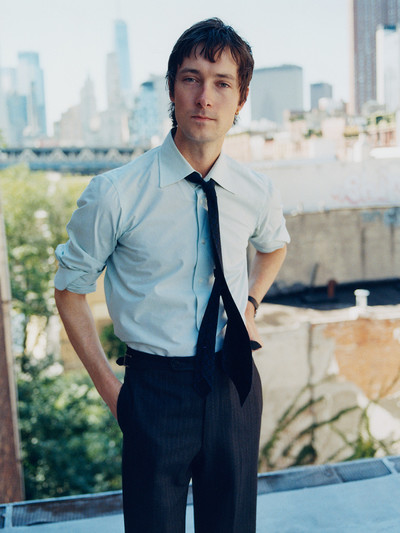
Shirt by Speciale, trousers by Husbands, tie by J. Mueser, and watch by Cartier.
He knows his menswear stuff, though. The precociousness only goes so far.
He has this confidence that I found infectious. One thing he said that I thought was so cute: ‘This is amazing, you talking to me for New York magazine is so exciting, but my dream is to be profiled by Jon Caramanica in The New York Times.’ And I said, ‘That’s great, I know Jon pretty well, I’ll put in a good word.’ And he said, ‘No, don’t. I want to get there on my own.’
You’ve also profiled Wisdom Kaye. Describe him to someone who’s never watched his videos.
I don’t know if this is going to be the New York headline, but… he’s a 25-year-old Nigerian-American kid from Texas who has millions of followers on social media and loves capes and thigh-high leather boots – and he’s straight. His videos went viral because the idea of a kid like that was still very novel, even in 2020 when he started posting. He’s a real style original, he creates his own rules, and at the end of the day he’s an entertainer. If you like watching the Prada show go live on Instagram, you’ll love what Wisdom and his peers are doing, taking fashion and turning it into this hyper-futuristic, maximalist creative expression.
Could you see him becoming a menswear designer?
Yeah, absolutely. The industry went through a period where classical design training was really important, and then that faded, and Virgil Abloh proved you don’t need to go to fashion school to start a brand that can become the biggest thing. You just need an iPhone and a lot of ideas and a lot of connections and a lot of confidence. So why wouldn’t the next phase be content creators teaching themselves creative direction and filmmaking? Wisdom’s content is way more elaborate than most. He’s already been getting styling jobs through it, because of the way he puts himself together.
And how does he differ from you?
Well, he has a lot more Chrome Hearts than I do.
‘I always loved Glenn O’Brien’s GQ column. He was speaking to a real lifestyle – I mean, the guy was friends with Basquiat, which I thought was so cool.’
I meant the dynamic, rather than the wardrobe.
What I’ve always felt was important about my role, whether at GQ or New York, or even just as a person who loves clothing, is figuring out what’s going on – whether that’s reviewing a Dior show or discovering a cool new tailoring brand in Paris. What’s happening, what’s now, what’s new, what’s next? And then explaining why it matters. I don’t think younger social-media users are particularly captivated by luxury marketing, so you look to someone who’s an ‘expert’ or an ‘insider’, who has the authority to interpret this world for you. If you’re an American football fan, you watch the game and then you watch the post-game show on ESPN. Fashion’s the same. You used to get the critic’s review and it would start there. Now you get TikTok, plus anyone on Instagram with an opinion, plus my take in my New York Look newsletter, you get Jacob Gallagher’s take in The New York Times; there’s just a lot more ways to make sense of what you’re looking at now.
David Haskell described you as ‘a journalist with an easy facility across storytelling formats’ – which, today, I guess means a newsletter, a 4,000-word profile, a selfie, a 60-second clip. Has that always come instinctively to you?
Three or four years ago, discussing this job would have freaked me out a little, because I really resisted the social media side of the role. At GQ I wanted to be taken seriously as a writer, and I thought that in order to do that I had to just be a writer – not someone a follower of GQ might also see on TikTok. But gradually I got more comfortable, and I’d turn an article into something for TikTok or a Reel. Now the person I order coffee from around the corner says, ‘Hey, I saw that story you did about the meltdown at SSENSE.’ And I say, ‘Where did you see it?’ ‘On TikTok.’ There you go. What David and I ended up talking about was how to shape something led by me that revolved around the newsletter but could appear on social, in print, on a podcast, in your inbox – all as one idea.
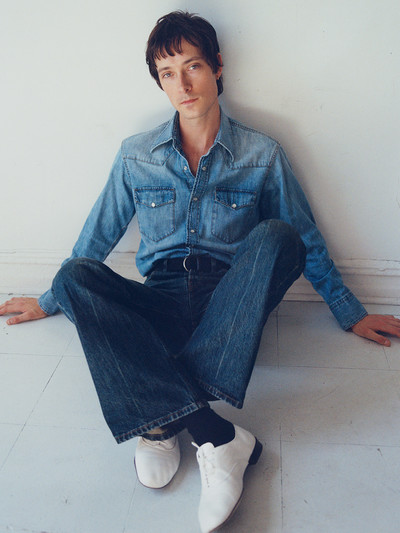
Shirt and jeans by Husbands, belt by Transat, and shoes by Repetto.
How much of you – Sam Hine the men’s style figure – is in the newsletter?
I’m always trying to define that line of how much of myself I’m putting into anything I write. The newsletter lends itself to a bit more voiceyness, writing that doesn’t need to be as formal. One of the things my editor, Eric Maza, has encouraged me to do is take outfit selfies and put one at the end of each edition. Of course, when it was suggested I was like, ‘Oh God, people are going to be sick of me at some point!’ And maybe that’ll be the case, and we’ll stop doing it. But the fact is a lot of people follow me on Instagram, they like my style, they want to know what I’m wearing. So it should be led by my taste.
Let’s go back into your childhood and trace the origins of that taste. Can you recall a specific piece of clothing you had immoderate affection for?
I was probably ten, and we were on a family holiday in Hawaii, and we popped into a surf shop. I grew up in the suburbs of Chicago, so there was nothing like surf culture. And I remember finding this zip-up hoodie by Billabong, the Australian surf brand. It was a faded, garment-dyed red with the Billabong logo across the front, and there was something about it that was just totally perfect. It represented surfing culture, which I knew next to nothing about, but I guess I wanted hibiscus-print board shorts, a gold chain necklace and crazy surfing hair. I was obsessed with an aesthetic so utterly different from the way people in suburban Chicago dressed, which was basically golfing attire. My mom and dad were like, what has got into him?
Was the reality of wearing that hoodie as giddy as the retail dream?
There was definitely a feeling that went beyond the happiness of, like, I wanted this thing and I bought it. It was: OK, I’m trying on a different personality or identity. And that’s one of the things I’ve always been so fascinated by with fashion. Are you dressing to be more like yourself, or are you dressing to be more like someone else? At that time I was definitely dressing to be more like someone else. I didn’t really know who I was at ten or 12. Having a twin brother actually helped, in that it gave me a yardstick to measure myself against.
Were you dressed identically?
We were dressed identically when we were younger, but usually in different colours – otherwise it would have been really hard to tell us apart.
Do you still look identical?
Yeah, but different hair. He’s a lawyer. So he has lawyer hair.
How would you describe yours?
I used to have hair more like his, and then during Covid I came back to the city after being away for three or four months and I got a haircut. I got bangs – more of a soft mullet. And I think that haircut changed my life. It just made me feel more like myself.
‘Virgil Abloh proved you don’t need fashion school to start a brand that becomes the biggest thing. You just need an iPhone and confidence.’
By 15, 16, was there a contemporary figure you were looking at?
There wasn’t really anyone my age I particularly looked up to. At that time I was obsessed with Abercrombie and J.Crew; I wish I’d kept all that stuff, because 15, 20 years later, here we are and it’s back around.
Was preppy simply what was out there, because of American retail?
Yeah, those were the stores accessible to me. They were in the local mall – Abercrombie, Hollister and J.Crew. And then one town over there was an American Apparel and an Urban Outfitters, so my interest went from the preppy mall brands to the more hipster ones. Chicago was a great music city, and I’d go to Pitchfork and Lollapalooza every summer, and I was obsessed with musicians and how they dressed. I graduated high school in 2011, so this would have been 2009, 2010, 2011: Daft Punk were touring with Kanye, The Strokes were headlining Lollapalooza, and we loved LCD Soundsystem – not so much style-wise, but the vibe, because they were from New York, and that represented a scene.
So New York was already a beacon?
My dad grew up in New York and my grandparents lived here when I was a kid, so I spent a lot of time in the city. I wasn’t born in Chicago; we moved there when I was in second grade. Most of my friends in high school had parents who’d gone to the same school – born and raised there, die-hard Cubs fans – and I always felt I wasn’t really a part of that. Funnily enough, really early in high school I visited Condé Nast when it was still at 4 Times Square, because a friend of my dad’s worked at Allure. I remember being in the lift surrounded by these editors, maybe Vogue editors, thinking they were so stylish and beautiful, with Times Square right outside the window, where the ball drops on New Year’s Eve. I felt like I was at the centre of the world of fashion.
When did writing about fashion become the focus?
At some point in college it solidified for me; I was becoming interested in clothes, I was reading GQ, and I always loved Glenn O’Brien’s column. He was speaking to a real lifestyle – this guy was friends with Basquiat, and I thought that was so cool. And then the other stuff I was reading and feeling inspired by was on Tumblr and Blogspot and StyleForum. It wasn’t magazines so much as forums and social media.
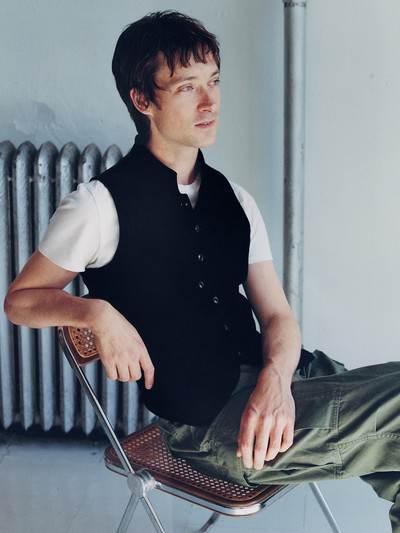
Vest by Giorgio Armani, T-shirt by Calvin Klein, and vintage trousers.
You’ve said you were into clothing without any real conception of ‘fashion’. Is that distinction still available to teenagers now, when they’re bombarded with brand names and industry chat from the get-go?
Well, I was definitely interested in brands – the Abercrombie logo meant something. But fashion just wasn’t in the culture I was paying attention to. Even in the indie music scene, Hedi Slimane was dressing Daft Punk and The Strokes, and I was responding to that without knowing who Hedi was. Nowadays it seems almost impossible to be interested in clothing without being introduced to fashion. Fashion is so much a part of sports, music, Hollywood and art now that it’s hard to imagine caring about clothes and not hearing about these people. Even the magazines: in the last ten years GQ got way more fashion-y, because we were responding to the way fashion was growing into a cultural force. The innocence has gone.
Does that hyperawareness alter how a younger generation builds a personal style?
What fascinates me about the younger generation is that, to them, the secondhand and vintage market is the fashion industry. Unless you’re a fashion client, the stuff you’re buying and looking at is often secondhand and vintage, and that gets you thinking, ‘OK, where did this come from? What era is this?’ That seems a cool way of being introduced to the fashion world, because maybe it encourages you to be more of a connoisseur than a consumer. My cousins, my sister, the younger siblings of friends, they’re all Gen Z, and if they want something they know they can buy it new, buy it used, buy it vintage, or repair something they have. It’s so much more sophisticated than when I was going to the mall and buying Abercrombie.
It’s almost post-consumerist.
And when I’m looking for something specific, I learn a lot every time. When you think you know everything about the history of men’s fashion, you’re like, ‘Oh, wait, what’s this weird thing happening over here?’
‘Younger social-media users aren’t captivated by luxury marketing. They prefer an ‘insider’ who has the authority to interpret this world for them.’
Like what?
This isn’t a shopping anecdote, but my grandparents’ neighbour on Shelter Island is a guy named Tom Fallon who worked for Bill Blass. Now in his mid-eighties, he started with Bill Blass in the late 1960s. He was a key figure at [legendary 1973 fashion show] the Battle of Versailles, going to Paris Fashion Week in the 1970s, partying with Karl Lagerfeld. So when I started working at GQ I’d sit with him on his porch and he’d tell me about all this stuff that happened. He told me the other day about the time when there was a chance Cristóbal Balenciaga was going to come to his apartment for a drink. Tom’s neighbour had a more fabulous place, with great art and stuff, so he made them swap apartments for the evening and, like, gave Balenciaga his neighbour’s address.
Tom sounds like he’s anecdotes on tap.
Two days ago I was having a glass of wine with him and he was telling me about the rise and fall of Bill Blass’s men’s business. Pierre Cardin blazers were a thing in the mid-1960s, so Bill Blass started a licensed menswear business and it was going great. And then he got on the wrong side of the clothing unions because he started importing European fabric and finishings and they made his life really difficult. The whole thing crashed and burned. And that was a lesson Calvin Klein and Ralph Lauren looked at. They said, ‘OK, we’re not going to let what happened to Bill Blass happen to us.’ So out of the wreckage of one of the first Euro-American designer menswear brands in America, it planted the seeds of the two that are still the largest today. None of this stuff happened that long ago, and that’s what I’m always fascinated by. The history of men’s fashion is basically 40 or 50 years. In a couple of generations it went from zero to Virgil Abloh.
Back to your story. When did you move to New York?
When I graduated from college, in 2015. I ended up working at a custom shirt showroom. I was there Tuesday through Saturday, just measuring dudes’ necks and suggesting what collars they should order. It was actually really cool. Although I was 21 and showed up hungover half the time, so I wouldn’t say it was a particularly enjoyable experience, but I noticed that a lot of the guys coming in were quite young – early-20s professionals, bankers or lawyers or whatever, sultans. And they were asking me, a little tentatively and then maybe opening up a little bit, like, ‘What’s up with this red colour?’ They wanted a more Italian look, or they were ordering a fabric that was nicer than the one worn by the other interns at their bank. They were like, ‘Oh, I like your blazer, where’s that from?’ And at that point I’d decided I don’t want to work for a brand, I want to write about menswear. GQ at the time didn’t speak to what I was looking for. And I was like, someone should be doing this, and it might as well be me – which is such a 21-year-old thing to say.
What made you think you could?
In college I had taken over a blog that was basically the Gawker of the NESCAC – the New England Small College Athletic Conference. I got such a kick out of trying to find weird, funny stuff to write about an intercollegiate athletic conference. I was also an editor of the college newspaper; at one point I had a crush on a girl, and I asked if I could do an article about her style, because she dressed differently from most of the female students, who mostly wore Uggs and sweatpants. And we ended up dating for a while. So I learned something from that, I guess.
And then you met GQ’s Will Welch.
Through a random mutual connection. I went in very naive – I’m just getting coffee with this guy – and walked into an immediate job interview. He was looking for an assistant, and I think he’d been looking for a month or two and was getting desperate. He told me he was relaunching GQ Style as a quarterly luxury fashion supplement. It was going to be the exact thing that I was looking for and I wanted to write for. I’d have started that day if he’d let me. I took a massive pay cut from retail, lived with four roommates, ate a lot of frozen Trader Joe’s dinners, and made it work.
‘The fact is a lot of people follow me on Instagram, they like my style, they want to know what I’m wearing. So the magazine should be led by my taste.’
Will told me that, prior to his editorship, GQ had been a cookie-cutter magazine – squeeze yourself into the GQ mould and you’ll succeed, you’ll get laid, you’ll be cool – and that by 2019, if you still fitted into it you were considered wack. Were you conscious of that shift, or were you part of it?
I was very aware of it, because my friends and I were living it. People I’d gone to college with were, like me, going deeper than ‘I want to buy some cool clothes’. There was a whole generation of men growing up wanting to read about the people driving the men’s fashion world and the people whose style was really amazing. I remember thinking that we were entering a period where all of the traditional rules about men’s style were getting detonated. I started at GQ in 2016: Virgil was really taking off with Off-White that year, Riccardo Tisci was at Givenchy, luxury streetwear was becoming real – the stuff people were wearing on the street was becoming fashion. The menswear world I’d been learning about on the blogs still had a lot of rules; Thom Browne was doing quite avant-garde stuff, but the foundation was a strict uniform. And I was seeing all of that get blown apart from the bottom up. I’d landed at GQ in the middle of a perfect storm.
And Will had you writing immediately.
He saw how passionate I was. I’d never written for a magazine before, but he started giving me assignments in my first week. I was not the best assistant in Condé Nast history, because half the time I had my nose in my computer researching or writing a story. One early story I still think of really fondly was about Belgian Shoes. Belgian loafers have become a catch-all for that dainty bow-tie loafer-slipper thing, but the original is the Belgian Shoe, and you have to buy them from the store. I remember noticing three young, cool designers wearing them all the time: Antonio Ciongoli, who I’d interned for; Matthew Williams; and Brendon Babenzien who’d been [design director] at Supreme. It was basically the Bernie Madoff shoe – an Upper East Side finance guy, grandfather thing. But those guys made them feel almost punk.
What did Will Welch teach you about covering fashion?
Everything. I had to learn on the job, because I didn’t go to journalism school. I observed him closely, even the way he carried himself in meetings, the way he pitched ideas. An early story I wrote was for the debut issue of GQ Style, about the undercut, where you’d shave the sides. In 2016 that was the cut every man wanted. We jokingly referred to it as the White Boy Fade. And I completely bricked it. I turned in 1,200 words for something that probably ran at 400, and it was just academic drivel about the history of haircuts. I was trying to impress Will with how much I knew. He called me into his office and I was like, ‘Oh, great, I’m going to get fired.’ He pulled up a chair and rewrote it with me, explaining why he was taking this out and moving this paragraph up here. What I learned from his own writing took longer: he let his enthusiasm guide those stories, and at first I thought it was a style I could mimic. Then I was like, OK, you can’t teach that. You have to be a deeply curious person who’s obsessive about a topic, and pours all of it onto the page.
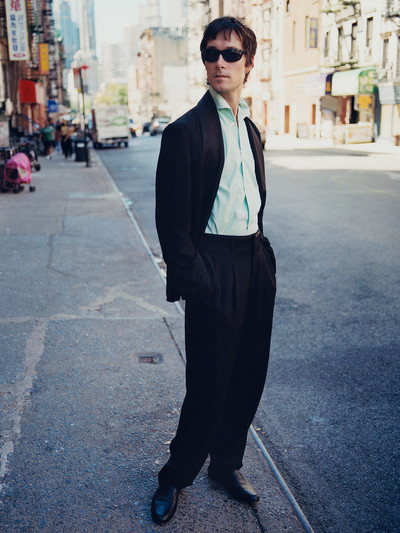
Jacket, trousers and shoes by Loro Piana, shirt by Anderson & Sheppard × George Cortina, and sunglasses by Ray-Ban.
You were at GQ for ten years, about the equivalent of Malcolm Gladwell’s 10,000 hours – so what would you say you became an expert in?
Making stories happen. Having an idea is 20% of it; the remaining 80% is making it happen. Like, how do you get the right person on the phone? How do you book the talent for the shoot? Will was incredibly good at the relationship game behind some of the best stories we did. There’s the official way you do it, and then there’s the, ‘Hey, I can just text this person who’s that person’s friend or manager.’ And the other thing I got really good at was going out.
Which is a real skill. Cathy Horyn once told me that after her son had gone off to boarding school, she made the conscious decision to go out every night of the week for 16 years – to be on the ground, reporting. She said it changed her perspective on the industry.
I realised early on that as exhausted as I might feel on a Friday morning after a week of events and parties and shows, the more I did it, the more story ideas I had, and the easier it was to make things happen. When I started at GQ I was probably 15th on the list for show requests. I was an assistant; I wasn’t even supposed to go to the shows. But there were so many editors that someone would always RSVP and then be like, ‘Nah, I’m good’ – and I was always the first person to grab that ticket. And then there’d be a party after, so I’d figure out how to get into that too. Even before GQ, I was out at China Chalet one night with some friends – it was this notorious downtown club in a Chinese restaurant, where at night they’d turn the tables and it would become this crazy party, people smoking inside. And through the crowd I spotted these two guys clearly wearing head-to-toe Thom Browne. And I just walked straight up to them and said, ‘Hey, guys, you obviously work at Thom Browne – what’s it like there?’ And one of those guys was Daniel Roseberry. I only put that together later.
‘The guys wearing suits today are way different from the guys wearing them ten years ago. They’re rock stars, artists, dandies, designers, creatives…’
Which GQ feature that you wrote do you remember most fondly?
The story that’s most emblematic of me testing how much of myself I can put in was my profile of Demna.
The one with the portrait of Demna, his hat pulled over his eyes?
Yeah. That was a challenging reporting subject. The initial access – as you know, it’s getting harder and harder to get quality time with designers – was exactly 50 minutes, slotted into his schedule in Paris. And I remember leaving feeling like he’d said some stuff he doesn’t normally talk about. And then the Balenciaga PR came back and said, ‘Demna would love to continue the conversation, he’ll be in New York after the Met Gala, and we’re doing this show in Shanghai, we’d love for you to be there.’ So I ended up with three interviews, at a critical moment in his career, when he was starting to open up again after feeling angry at the fashion establishment. He’d done the mud collection and he’d been feeling dark, and now he wanted to get his portrait taken again. Anyway, I was struggling with the draft, and what unlocked it was that in Shanghai they offered to send a look to my hotel. I don’t really wear Balenciaga, but I was curious how it would feel to wear it.
Did you choose the look, or did they?
They sent a few looks and I picked the most extreme one, because that felt the most representative of Demna’s work at the time. Slip-on loafers two feet longer than my actual feet. A blazer with enormous shoulder pads. And the tiniest hoodie – I got it and I was like, there’s no way I can fit into this, but somehow it was tailored in a way that it was extremely small but just right. My first draft had been a very objective, third-person reporter’s perspective, and then I thought, what actually ties this all together is when I wear Demna’s Balenciaga collection. Because that was the moment I really understood what he’d been telling me about how he constructs garments. I liked it so much that I wore it again to the GQ China event the following night.
How has your own style changed over the past decade?
It’s evolved a lot. I look at photos from 2018 and I’m like, ‘Wow, what was that?’ I’ve always been interested in classic clothing – suits, ties, boots, sweaters. And I’ve always been very inspired by my grandfather, who’s an old-school preppy guy. He’s like a Mad Men ad man, like Don Draper. I just thought he always looked amazing.
Do you raid his wardrobe?
I have stolen so much of his stuff. And he’s been very generous.
And what about that tension – ‘dressing to be yourself, or someone else’ – that you’d spoken about earlier?
In the last ten years, part of it was probably trying to dress to be someone else and see what felt right on me. I went through a phase where I probably dressed more ‘streetwear’ than I do now. But my personal style has stabilised a lot – partly just growing up a little bit and feeling like there’s a silhouette and a system that works for me. But also, one of the biggest parts of my job is spending a lot of time around people who make clothes and who I love to buy clothes from. I find it really hard to walk into the Husbands store in Paris and not leave with a new suit. I mean, even right now [points to his jacket and T-shirt] this is Husbands, this is Husbands. These khaki pants I bought from a friend I met through work, Tommy Dorr, who has a showroom just on the other side of the street. This belt I got in Paris last season from two guys who’ve started a brand called Transat. It was literally their first season showing at market, and they have about three products – white flared jeans, moleskin jeans that I also left with, this belt and some T-shirts. They’re based in Saint-Tropez, so they’re all about a 1970s Saint-Tropez vibe, which looks really fresh.
Do you generally buy clothes in person?
Very rarely do I sit at home and open my laptop and start looking at clothes. What I find exciting is seeking something out and having an exchange with someone, and understanding why they’re making what they’re making. In this business it’s easy to get jaded by quite how much stuff you’re seeing, especially during the shows. I’ve found myself dispirited before – God, it’s just so much stuff, and what am I really supposed to say about all this versus all that? So putting my shopping hat on gets my blood pumping again.
‘The people who are cool are the ones whose clothing reflects something about who they are. Jonathan Anderson wearing his T-shirt and trainers is cool.’
We were talking before we started about the co-ed shows. How does menswear show up in the industry and on social now, compared with women’s?
Until recently I felt like I was one of the only people at the [co-ed] collections actually paying attention to the menswear. Creatively, someone like Demna doesn’t think of menswear as an afterthought – it’s a critical part of a cohesive vision. But I always got the sense that the audience wasn’t there to see the menswear; it was sort of an accessory to the womenswear. Backstage in the scrum, I’d be one of the only people asking anything about the menswear, and a lot of reviews don’t even touch on it. Now a lot of brands are combining their shows for commercial and logistical reasons. But there has to be a distinction between the two, because menswear doesn’t change as fast, or evolve as much. All that got scrambled two years ago with the great designer merry-go-round, but now everything’s stabilised and you’re not seeing a big new idea every season. Womenswear just has more room to push things conceptually.
Where’s the energy in menswear?
Right now, it’s less about the design of the clothes and more about the styling, how you put things together. Some of the designers who are most successful, critically and commercially, are focused on fabric and silhouette, but also on how you mix things to create something stylish and contemporary. Michael Rider at Celine is a great example. What he’s been doing has resonated really strongly with the male consumer of fashion, and I’m interested to see how far menswear can be pushed in that sandbox.
Pre-pandemic, it felt like menswear was going through a brilliantly revolutionary period – tailoring was really interesting, streetwear was booming. Then the narrative swung back to womenswear, with all the new designer appointments. I was at a Nick Cave show in Brighton in the summer: the band all showed up in great suits, but there were also men in the audience wearing nice suits. On the other hand, the suit remains an emblem of the worst type of masculinity in politics, while the Wall Street suit has been replaced by tech-bro non-fashion. What does a 21-year-old think about a suit jacket now?
I love the idea of men wearing suits at a Nick Cave show. That’s almost like a band T-shirt at a concert – something approximating a Haider Ackermann or a Tom Ford suit. One thing that has broken open the world of tailoring is that, like you said, Wall Street guys and tech guys aren’t wearing suits any more. Even in New York, the only people who really wear suits, or even ties, are lawyers. The business suit has died, at least in America. So the guys you’re seeing wearing suits now are way different from the guys who were wearing them ten years ago. They’re rock stars, artists, dandies, designers, creatives. I really like Husbands, and I love what Haider Ackermann is doing – it feels a little bit more aggressive. It feels powerful and edgy. It creates a silhouette, with a good shoulder and a sharp lapel, and trousers that are fuller and a bit more dramatic and look great with boots. So the suit has gone from something that anonymises to something that makes you stand out and gives you more of an aesthetic personality.
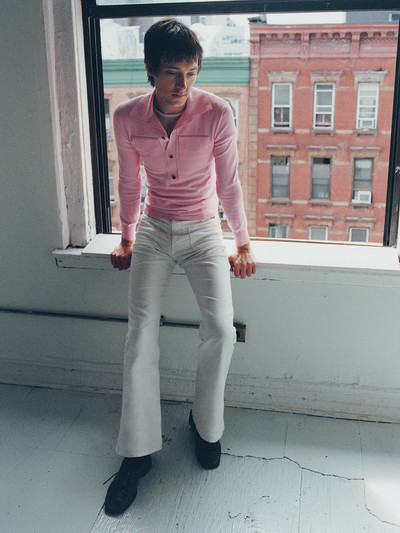
Knitted polo shirt, T-shirt and shoes by Bottega Veneta, and trousers by Transat.
What do you find hardest to articulate about menswear now? The clothes have moved on, and what they mean has moved on, but the language around menswear remains quite traditional.
The hardest thing to put your finger on with clothing is still what makes something cool. What I try to do is explain why an Emily Dawn Long shirt is cool, even though it’s basically just a T-shirt with a little screen print on it. And the way you explain that is you have to contextualise. Where does this thing come from? Who made it? Who’s wearing it? What scene is it part of? That still takes work, which is why I still have a job. You can talk for hours in a showroom about the way a shoulder is constructed – and, for sure, I find that interesting – but it can tend to make people glaze over. At the end of the day, some stuff is just a feeling. You look at something and you’re like, ‘Wow, that is so cool.’
Who encapsulates that now?
Young people especially are really good at sniffing out artifice. So the people who are cool are the ones who dress like themselves, whose clothing reflects something about who they are and what they do. You can even look at Jonathan Anderson when he wears a simple T-shirt and trainers, and something about the way he dresses is cool – although part of that is just the classic creative director uniform. It’s funny – when I was starting out there were men I kept tabs on and tried to emulate.
‘There’s a silhouette and a system that works for me now. So I find it very hard to walk into the Husbands store in Paris and not leave with a new suit.’
Give me an example.
Once when I was in college I visited New York on a fall break, and I was walking around the West Village when I saw a guy in a hot pink suit sitting at a table outside a restaurant. I literally circled back around the block, because it was Nick Wooster. I wasn’t trying to dress like him – he takes tailoring to a whole new dimension – but I was so inspired by the way he took a suit and made it feel totally different. I told him that story years later and he was like, ‘Yeah, well, that was just an average day for me’. But it had a full-on effect: I was totally rubbernecking on the street.
And what about today?
I know this sounds pretentious, but I still feel inspired by the people I see on the street in New York. I hadn’t been feeling inspired recently, and then I was running errands the other day around here and I passed a guy wearing a tiny T-shirt and pressed raw-denim jeans with a slight flare, and white Repetto Zizis – which I own a pair of and love. It was the first time in a while I’d stopped in my tracks and kind of creepily turned and watched a guy walk down the street – but the way the jeans and the shoes looked together was so great. I filed it away, because if I can find a pair of jeans like that, that’s a pretty killer outfit.
Where’s good to people-watch?
I moved a couple of blocks away, so I love being back down here, because people try really hard. No one leaves the house down here without putting an outfit together, for better or worse. And in Chinatown – sometimes at the weekend they close off the streets to traffic and set tables outside, and I’ll be grabbing groceries or whatever, and you feel like you’re walking down a runway, because everybody turns to see what you’re wearing, and then goes back to their drinks.
Who’s the New York menswear designer who best embodies what’s happening here now, regardless of scale?
One is Marcus Allen and The Society Archive, because he’s watching the culture. He didn’t set out to start a brand the way plenty of people do. Marcus is a stylist, he has archival clothing that’s digitally archived, and he has been hammering an aesthetic that he’s obsessed with, that he finds sexy, that looks fresh – he’s taking Abercrombie and J.Crew and stuff from the 1990s and 2000s but remixing it in a way that feels new. The preppy trend comes and goes, and he seized on it at the right time. Bar Oliver is the place near here where you go and half the people look like they’ve stepped out of a Bruce Weber ad from the early 2000s – cargo shorts, flip-flops, a bandana around their head, and a bunch of shell necklaces. Launching a clothing brand out of that energy is smart. And wherever Marcus goes, he’s with a bunch of hunky guys – those he works with and guys who model for him. He’s created a real subculture.
Is he based down here?
His office is near. So I’m curious to see how the clothing is received, because he’s already laid the groundwork for the cultural side of it. Besides Marcus, there’s a guy named Dillon Maxwell Clarke, who we’re profiling in the men’s style issue as well. I met him as a model on set, and he offhandedly mentioned, ‘Oh, I make suits.’ He’s beautiful, he’s 25 or something, and he has a fully bespoke tailoring business, like farm to table. He makes them in his apartment. He studied traditional Florentine tailoring, and apprenticed in London with a guy who has a brand called Speciale, where I buy a lot of shirts. He can make maybe ten suits a year, because they take forever. They are gorgeous.
All word of mouth, right?
Totally word of mouth. He has no followers on Instagram. And going into something like that, you have to be OK with the fact that it’s going to be small. A lot of young designers, people my age, don’t necessarily want to be the next Dior or start the next Ralph Lauren. They’re OK with something being the size that it should be. Which is exciting, because it means there’s room for a lot of different things to happen at the same time. Maybe they grew up like me and became interested in fashion at a young age – I went one direction, they started a brand. I really admire that, because that route is way harder.
Lastly, who would you love to interview, dead or alive, about menswear?
Hedi Slimane. Of any fashion designer, Hedi has probably been the biggest influence on how I dress and what I’m interested in. The fact that he’s a bit reclusive just makes me want to sit down with him even more. Plus, he’s photographed a lot of my friends, so there are these weird connections. He was staying at a hotel down here for a few months when he was working on the indie sleaze collection [‘The Age of Indieness’, Celine Winter 2023], which was one of his last, and I felt weirdly close to what he was doing. I’m enamoured of how rigorous his aesthetic is, and also how much goes into it.
‘Hedi has probably been the biggest influence on how I dress. The fact that he’s a bit reclusive just makes me want to sit and chat with him even more.’
What would you ask him?
I’d ask him how he keeps going. People say, ‘Oh, it’s always the same’ – it’s really not. There’s clearly some cycle of creative reinvigoration that happens within his palette. And then I’d ask him what he had for breakfast, what the last book he read was, what he dreamt about last night… I obviously love chopping it up with designers about the collection and the inspiration, but I’m way more interested in what this person’s life looks like. How do they move through the world?
Do you think designers have reached a level of fame where your average New Yorker is as interested in reading about Hedi Slimane as they are about a great musician or actor?
Yes, for better or worse. I was in Shanghai with Rick Owens for a Moncler exhibition-slash-fashion-show. Walking through a crowd with Rick Owens was one of the more heavy-metal experiences of my life. It felt like I was with the Pope walking through Rome. It was unbelievable. Everyone was respectful, but you felt this energy, like they were being visited by a deity. And I think that happens anywhere he goes in the world. Most fashion designers can fly a bit more under the radar. But celebrity is really scary. It’s a force that’s spinning out of control in our culture right now.
Is celebrity going out of fashion, or only becoming more central?
It feels like it’s more aspirational to be low-key and not a celebrity.
At some point, everybody’s a celebrity, at least in their own social feeds, which obviously makes it less appealing.
Moving through the world with no privacy is horrible. I get a kick out of someone tapping me on the shoulder and saying, ‘Hey, I love the newsletter.’ But there’s a big gap between that and being a celebrity. The celebrity-fashion blood oath of a decade ago has run its course. I’m less interested in X celebrity or Y designer – I’m not sure you can learn all that much from that any more. But when you’re covering a fashion show and someone like Madonna walks in, it’s hot. It makes me think, OK, this is still worth the insanity of it all. Fashion still has that gravitational pull.
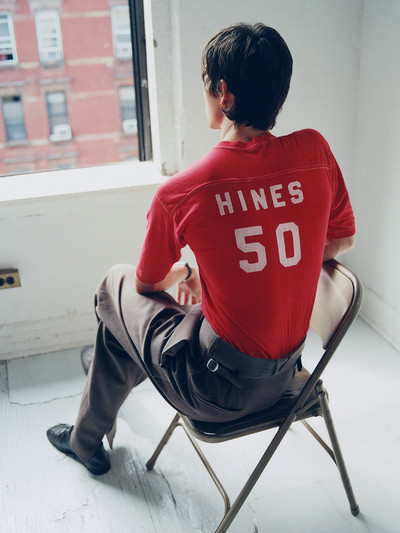
T-shirt by Emily Dawn Long, trousers and shoes by Bottega Veneta, and watch by Cartier.