By Jérôme Gautier
Repro photographs by Ole Wei-Yang Ripper
From 1971 to 1988, Claude Brouet brought fashion’s new guard to the pages of mainstream Marie Claire, championing the designers and photographers who would define an era.
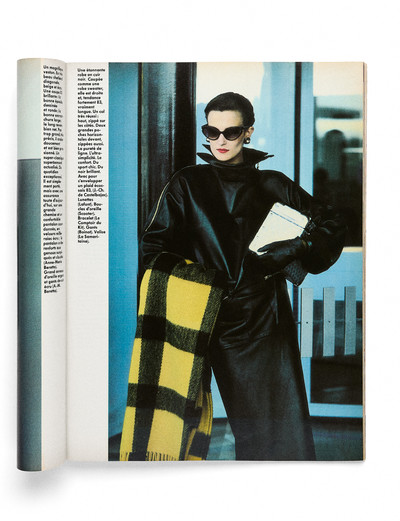
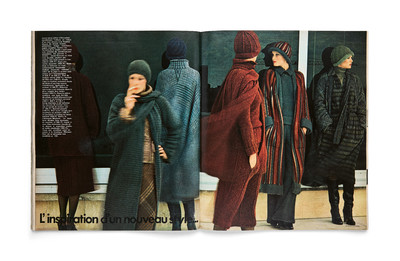
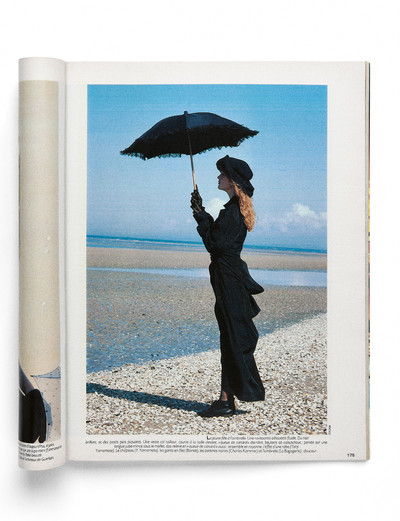
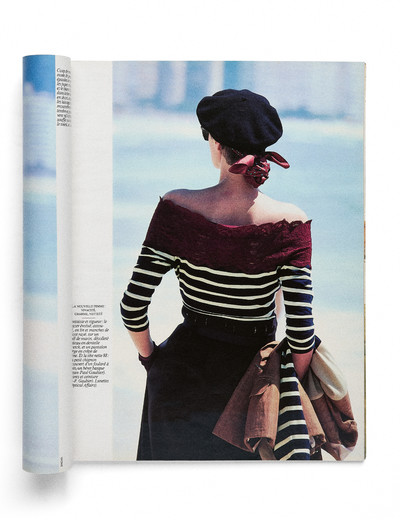
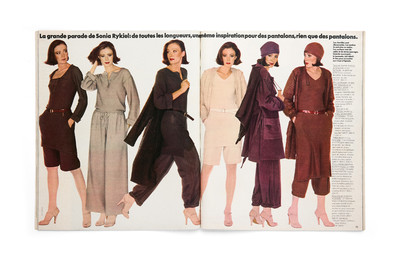
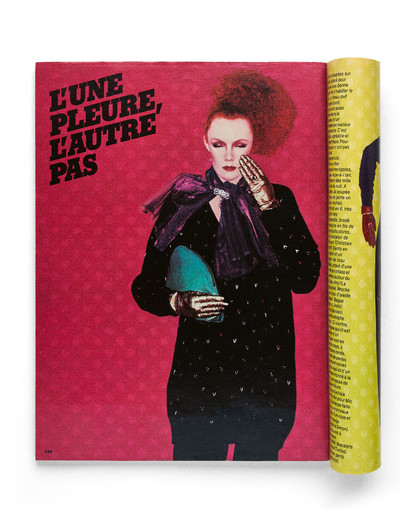
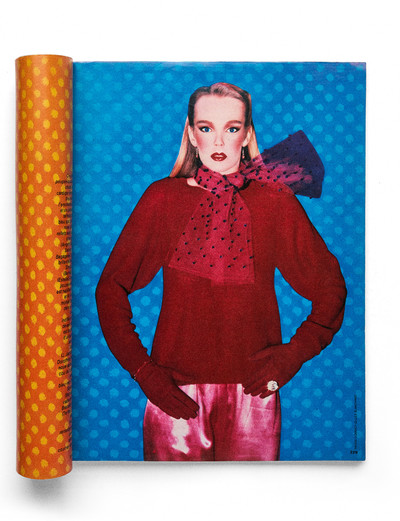
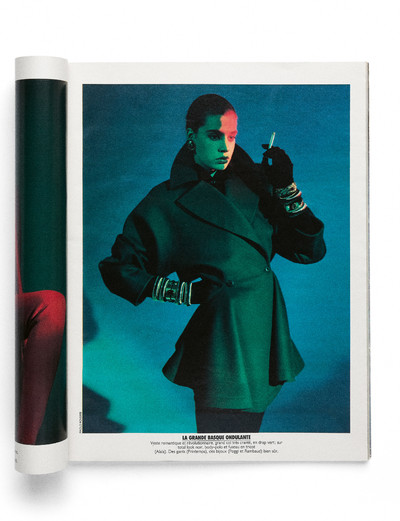
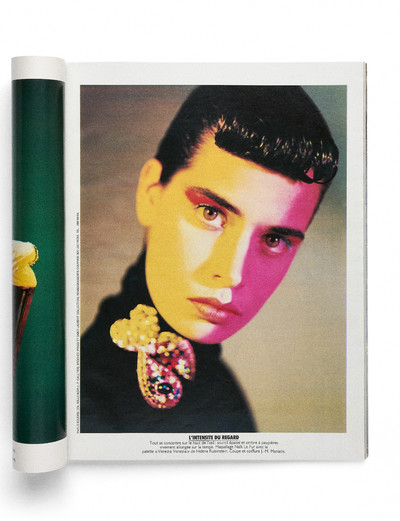
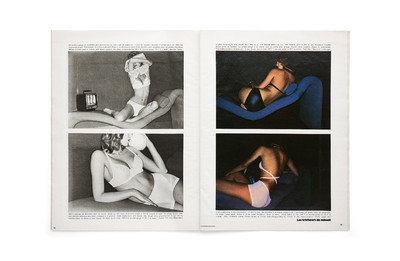
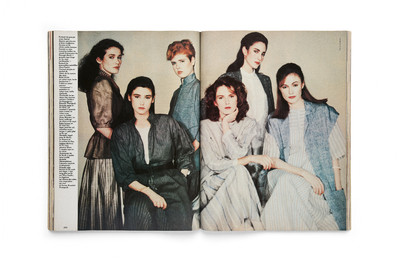
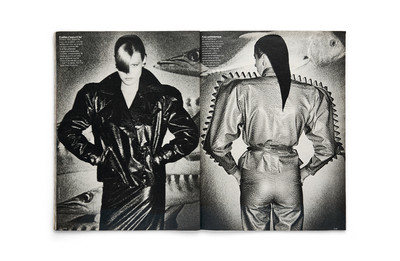
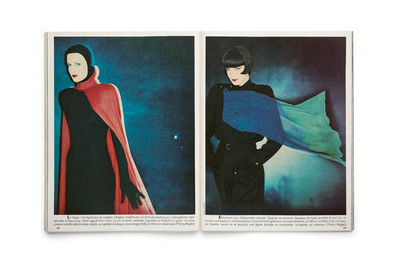
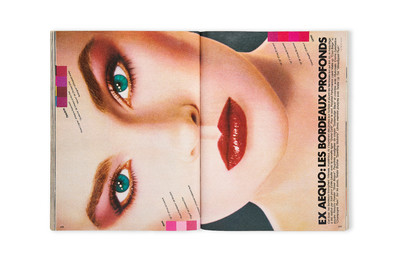
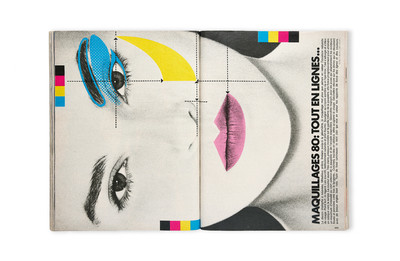
“She subscribes to Marie Claire… she’s a liberated woman…” A pop anthem that’s been ringing out since 1984. The lyrics to Cookie Dingler’s hit ‘Femme libérée’, written by Joëlle Kopf, paint a portrait of the modern 1980s Frenchwoman: independent, cultured, self-sufficient, emancipated. In other words, free. She was the Marie Claire reader being addressed by Claude Brouet, the magazine’s formidable editor-in-chief for fashion, beauty and cooking from 1971 to 1988, and a true grande dame of the industry herself.
At a time when women’s magazines were at the height of their independence from advertisers, Brouet made Marie Claire as much a style guide as a manifesto for women’s emancipation. Through the powerful images she commissioned from photographers on the cusp of greatness – Paolo Roversi, Peter Lindbergh and Sacha van Dorssen among them – she helped change the way women looked at fashion and the way they dressed. For that alone, her influence endures.
Brouet grew up behind the scenes of haute couture (her mother was directrice de salon at Schiaparelli and then at Jacques Fath) and fashion was a language she spoke from an early age. She began her own career in 1950 at the magazine Vive la Mode. Three years later, she joined Elle, which had been the magazine for her ever since its inaugural issue. Founded by Hélène Gordon-Lazareff in 1945, amid the optimism of post-war France, Elle would accompany its female readers through the profound social changes that reshaped their lives over the Trente Glorieuses [France’s three post-war boom decades].
Brouet was there during those crucial years of awakening, self-discovery and emancipation. She established the magazine’s ready-to-wear pages, championing the emerging movement before almost anyone else at Elle, and in 1965 she landed the ultimate job: taking charge of the magazine’s hallowed fashion department. By then, however, ‘Tsarina’ Hélène was entering the twilight of her life. Alzheimer’s was taking hold, and for Brouet the work became increasingly difficult – painful, even. And when Peter Knapp, the magazine’s legendary art director and her dear friend, left, Brouet decided that her own time at Elle had come to an end, too. She walked away in May 1969, never imagining that, two years later, she’d begin a new chapter every bit as decisive, at Elle’s sworn enemy, Marie Claire. In truth, they were courting the very same reader: la femme libérée.
‘Mugler, Montana, Alaïa and Gaultier. Brouet championed the new generation of grands créateurs to the hilt, giving them pride of place on her covers.’
In the years that followed, fashion underwent one upheaval after another, as haute couture gave way to a new generation of designers – Karl Lagerfeld, Sonia Rykiel, Kenzo and Emmanuelle Khanh leading the way – and later the grands créateurs: Thierry Mugler, Claude Montana, Azzedine Alaïa and Jean Paul Gaultier. In Marie Claire and its sister title, Marie Claire Bis (“devoted to fashion’s great seasonal manoeuvres,” as the editor’s letter in its Spring/Summer 1980 debut issue announced), Brouet championed these names to the hilt, giving them pride of place on her covers, translating their creative vision into accessible images for her readers – the women she would spend her career encouraging to become femmes libérées.
Jérôme Gautier: In 1971, you joined Marie Claire as editor-in-chief for fashion, beauty and cooking. What made you leave Elle and cross over to the enemy camp?
Claude Brouet: It was a shock for me to even contemplate working for a rival magazine – rather like an act of betrayal. That said, I’d left Elle two years earlier and had no intention of going back. Peter Knapp had gone too, and Hélène was losing her grip [to Alzheimer’s disease]. I needed to work, so when my friend Jacqueline Bénard asked me to take over from her, it seemed like the obvious thing to do.
What would you say was the key difference between Elle and Marie Claire?
Elle was shaped by the spirit of Hélène Lazareff herself. At Marie Claire, the editorial side was run by a man, Jacques Garai. He put complete trust in me and always went along with whatever I proposed. I worked the same way I had at Elle, except that here I was free.
That freedom began with being able to hire your own team.
Yes, and it just so happened that when I arrived at Marie Claire, Le Jardin des Modes was folding. Back when I was at Elle, I’d already tried, unsuccessfully, to hire one of its best editors, Catherine Lardeur. And now I was able to take her on as my right hand, along with a few other members of the Jardin des Modes team, in addition to two or three Marie Claire editors who stayed on.
What memories do you have of Catherine Lardeur? [This interview took place on Wednesday 11 March 2026. As fate would have it, Catherine Lardeur died that same day, aged 90.]
She had great rigour and focus, qualities I’d already noticed in the pages of Le Jardin des Modes and which remained a hallmark of her work. We worked hand-in-hand for 17 years, without so much as a single quarrel. I tended to favour a slightly more flattering look, whereas nothing was ever too austere for Catherine – even though she adored Jean Paul Gaultier.
And what was your ambition for Marie Claire?
To present fashion that was more considered, more coherent. I wanted fashion to have meaning, and beauty to tell a story too. I was also in charge of the cooking pages, and there again the idea was to bring something new – some originality, or ways to save our readers time.
You also hired a new art director?
Yes, because there was a head graphic designer but no art director. I was recommended Émile Laugier, an artist, a sculptor, an exquisite man, very sensitive. We hit it off straight away, and I introduced him to Jacques Garai, who hired him. Later, Émile said to me: ‘You know what the clincher was for me? You welcomed me into your home wearing jeans.’ It’s true – I wasn’t the typical editor-in-chief all done up in her finery.
What was your conception of the Marie Claire woman?
My idea was that every woman should be able to bring out the best in herself, without being at the mercy of fashion. Our role was to help the reader develop her eye, get to know herself better and find what suited her among the trends. The same was true of beauty. What mattered was that women felt good in their bodies, comfortable in the way they moved and true to themselves.
Beyond the designers, you also shone a light on ‘good-value’ fashion.
Fashion isn’t a question of money – though of course it’s nicer to have beautiful fabrics and great quality. I championed the fashion I loved: comfortable clothes you could walk in, move in. Little frills, flounces and fiddly bits were never my thing.
‘We saw ourselves in the models Peter Lindbergh cast: beautiful, interesting, not ‘cute’. If one turned up looking too cute, we’d make sure she didn’t look it.’
You were never particularly keen on haute couture.
I was always so much more drawn to designer ready-to-wear. Haute couture ended up taking up very little space in the magazine. We gave it a few pages at first, but soon preferred reportage from the shows to shooting it in the studio.
And how were the images meant to express your idea of fashion?
They had to make sense to a normal woman: intelligent, civilised, modern, but normal. Not someone driving around in a Rolls-Royce or lying naked in handcuffs.
So Helmut Newton’s fantasies had no place in your pages?
I had the great pleasure of working with Helmut Newton. He had some rather fun ideas. Once, he wanted to shoot a giant he’d brought over from London. To play up his height, we chose the smallest possible model – though she still had to fit into the dresses [December 1973]. He also created those famous images of champagne spraying over the clothes the models were wearing [October 1973], or of a model falling into a swimming pool [June 1974]. He shot that one first for Marie Claire, then went on to repeat the idea – for American Vogue and plenty of other magazines. And I let him know: ‘You’re pushing your luck!’
You’re one of the few editors to have said no to him.
Marie Claire was a mainstream magazine, read by women from all walks of life. So I couldn’t go along with all of his ideas. Once, he wanted a waiter in a fancy restaurant to be so transfixed by the models’ décolletés that he’d tip the dishes all over them – sauce running down their fronts and all! Another time, he wanted to photograph evening gowns on models scrubbing the floor, using their dresses as mops, Cinderella-style. I said no. Our readers would never have understood why we’d do a thing like that.
Newton’s photograph of Arja [Töyrylä] on all fours, cleaning the floor with Monsieur Propre [Mr Clean], was eventually published in Vogue Paris in February 1976.
That’s the very series I turned down. But Francine Crescent [editor-in-chief of Vogue Paris from 1968 to 1987] was Madame ‘Whatever you say’. She let him do everything and anything. Newton told me at the time that he wasn’t very well paid at Marie Claire, so what he really wanted was to enjoy himself. But I couldn’t ask for him to be paid more than the others; there was no reason to make an exception. We eventually stopped working together, though we remained friends.
It’s worth recalling that a good many photographers worked for both Marie Claire and Vogue – Arthur Elgort, Eric Boman, Helmut Newton and even Guy Bourdin, though to a lesser extent. Did you expect them to produce work for you that was clearly different from what they did for other magazines?
Those photographers had a great deal of freedom. They did, however, have to understand what we as a magazine wanted to express. If what you want the fashion to say is ‘green’ and the girl is running, without your seeing the buttons or the pockets, it doesn’t matter: it still says ‘green’. But if you want to say ‘redingote’, you really need to see the cut, the waist, the buttons… That goes without saying! You want to see the clothes, but you also trust their talent to let them make their own images.
The first photographer you chose to work with was Hans Feurer. Why him?
I’d noticed Hans Feurer’s photos in the Sunday Times, and they’d greatly appealed to me. I called him in London, where he was living at the time, and he said: ‘Yes, I’ll be there.’ Together we did my first cover and fashion story for Marie Claire [November and December 1971].
At the time, working for Marie Claire was such a big deal for a young photographer. Paolo Roversi told me he jumped for joy when you gave him his chance.
Paolo had begun as an assistant to Laurence Sackman, who was already working for us, and then we gave him his own start. After that, Peter Lindbergh came along. It was Friedemann Hauss [Marie Claire art director who succeeded Émile Laugier] who had spotted him in the German magazine Stern. There was also Steve Hiett, who made very poetic and beautiful images. He worked for us for a very long time, right up to the end.
‘Helmut Newton wanted gowns shot on models scrubbing floors, their dresses serving as mops. I told him no: our readers would never understand.’
You also worked a great deal with Sacha [van Dorssen], one of the few women photographers at the time.
I first got to know Sacha when I was at Elle, but it was on holiday in Procida [an island in the Bay of Naples] in 1969 that we really hit it off. We watched the first man walk on the Moon together, on television, from the roof terrace of a house. She went on to become one of Marie Claire’s signature photographers. She had a wonderful eye for women: alluring, but never overtly ‘sexy’.
From the late 1970s, Sacha, Paolo Roversi and Peter Lindbergh became the three pillars of Marie Claire’s fashion stories. How did you decide which photographer was right for which trend?
Oh, you just felt it. With Sacha, we knew there would always be a certain gentleness. Her images, often shot outdoors, were light, clear and sensitive, poised somewhere between the figure and the landscape. They transported you somewhere happy without ever becoming frivolous. We’d give Paolo the more sophisticated clothes – pieces with a strong line, shape or volume – knowing he would bring out their full beauty. From Peter, we expected images full of energy, often in black and white.
Black and white didn’t bother you?
Oh no, I love it, because it expresses a shape so well. When there’s no real colour feature in the garments, it’s perfect.
How do you recognise a good fashion image?
A good fashion image has to show why we chose those particular clothes in the first place. If we chose them for their line, you have to see the line. If it was for a detail, that detail has to leap out at you.
Let’s talk about the models you chose to embody the Marie Claire woman. You dared to feature girls with strikingly unconventional looks in a mainstream magazine.
Well, what we didn’t want – and what we didn’t like, or at least I didn’t – were ‘cute’ girls. What mattered was that they had real character. We saw ourselves in the models Peter Lindbergh cast, in his different vision of beauty. I wanted girls with an unconventional beauty: beautiful, interesting, with a certain strength, but not cute – voilà!
There were still cute girls who were beautiful and interesting.
Of course. But if a girl turned up looking too ‘cute’, we’d make sure she didn’t look it in the picture.
And what makes a good cover photo, in your view?
When it’s utterly simple, yet just irreverent enough. The simpler, the stronger!
How did you decide on the fashion stories with your team of editors?
It started with a big planning session after the shows, with Catherine Lardeur and Jackie Malissen. We’d map out the whole season, identify the key trends and overall direction, and agree on the stories for Marie Claire and for Marie Claire Bis. An idea couldn’t run in Marie Claire Bis if Marie Claire was already featuring it. Then we’d meet with the full team of editors and assign each of them their stories.
The shows were hugely important to you and your team. What were they like for you?
I was always delighted, always excited, hoping we’d find a wealth of things we loved and couldn’t wait to photograph. Otherwise there’s no pleasure in the work. When a collection let us down, it was sad, because we still had to fill the pages with things we liked and put clothes in front of our readers that we genuinely thought were good. There were designs we loved, too, that simply weren’t right for Marie Claire. You have to know who you’re working for.
The 1970s marked the emergence of a crop of talented designers who rose to become major names.
They all started small. Then they very quickly grew in scale, with collections that were stronger and stronger. By the end of the 1970s, especially with the shows at the Palais des Congrès, those collections were magnificent. Then came Gaultier. Before he arrived – and this was never deliberate – practically every cover of the ready-to-wear special carried a Karl Lagerfeld design for Chloé, because that was where we found the strongest work. After that, it was most often Gaultier’s collections that ended up on the cover of our ready-to-wear specials, because that was ultimately what we wanted on the cover: those ideas, that spirit, that woman.
What was Gaultier’s strength?
Gaultier has incredible classic savoir-faire at heart, but then he ‘adds the champagne’: there’s always something in the fabric, a detail, a twist, an idea you haven’t seen before. And there were so many ideas in his shows – which literally flew past, several looks at once – that there were bound to be things we hadn’t properly seen or even properly understood. So we’d spend a whole morning with him, going back over the collection in detail. He’d explain everything, sometimes putting the clothes on himself, and we’d laugh ourselves silly. He must have appreciated us, because we always gave him plenty of coverage in the magazine – and we were only too happy to be there, because we loved what he did.
At the time, Gaultier had no perfume and didn’t advertise – and that had no bearing at all on the number of pages you gave him?
I always had editorial freedom. If I had to sum up my years in magazines, it’s one of the things I’d put in big letters: ‘EDITORIAL FREEDOM’ – enormous letters! I had it at Elle and I had it at Marie Claire. Of course, there were certain things you had to do in the beauty pages, like crediting the main advertisers, but never in fashion.
How much freedom did you have in the way you presented the designers’ clothes in Marie Claire?
We respected the designers, so we showed their looks [in the collections specials] – if we’d liked the collection, of course. But beyond that, in the other issues, if we wanted to feature the most beautiful jackets, say, we didn’t have to stick to the designer’s total look: we’d style them the Marie Claire way.
Do you appreciate today just how much your Marie Claire era has become a landmark in publishing?
I don’t think of it that way. What I do know is that there’s no longer a magazine like Marie Claire was then. Because no one has that degree of editorial freedom any more, and because no one offers a point of view.
In 1988, Claude Brouet was called in by Hermès chairman Jean-Louis Dumas to bring her fashion instinct to the venerable house. For the next decade, she ran the Hermès design studio, where, alongside her team of designers, she championed her own vision of style. A singular point of view – one that had always been hers, and always would be.