‘It takes more than a huge billboard for people to remember an image.’
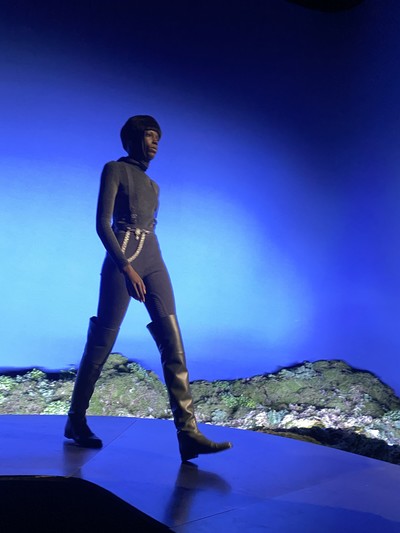
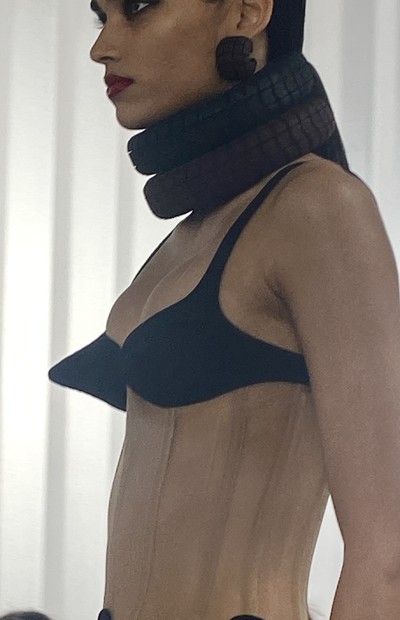
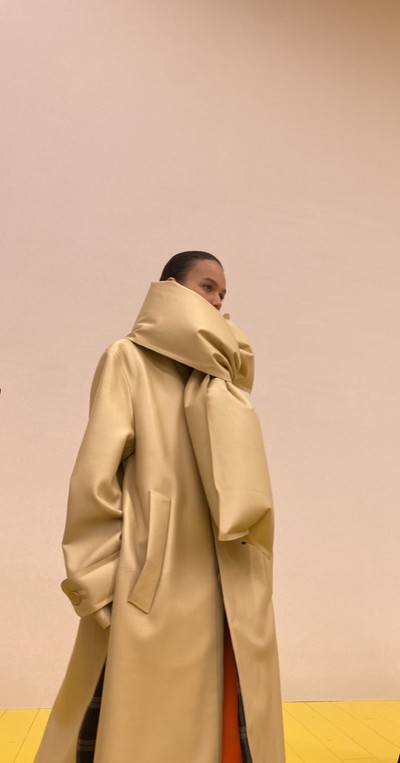
Art direction duo Carina Frey and Stefanie Barth operate their namesake studio between two countries: France and Italy. Frey works with a small team in Paris, while Barth mirrors the setup in Milan. This geographic split gives each side of the partnership the freedom to research and develop ideas independently, immersing themselves in the distinct fashion cultures of both cities. It’s a dynamic that not only defines their practice, but also helps keep both their business and, as they explain to System Collections, their long-standing friendship feeling decidedly fresh.
Frey and Barth’s work spans editorial, publishing, and creative consultancy, with a particular interest in the image as a printed object. The pair originally met while studying in Germany, but their professional partnership began later, when they joined Double magazine as co-art directors in 2009. In the role, which they held until 2024, Carina and Stefanie helped shape the title’s energetic fashion-meets-art blend of photography – pushing established names such as Richard Kern, Jack Pierson, and Walter Pfeiffer to produce exuberant new work, while championing emerging female talent including Talia Chetrit, Brianna Capozzi, and Moni Haworth.
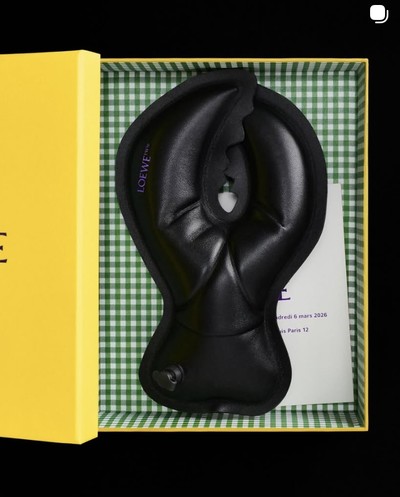
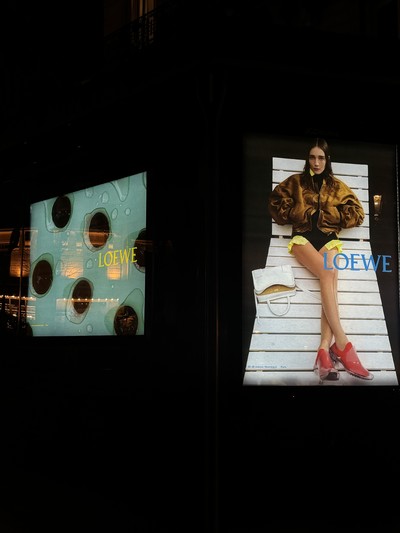
Known for visuals that are both punchy and playful, they became a favourite of Phoebe Philo, developing the pared-back branding for her namesake label, as well as Hermès, Bottega Veneta, and Burberry. At Loewe, they recently art directed the first campaigns under Jack McCollough and Lazaro Hernandez, helping to establish a vibrant new visual direction for the house; while their ongoing collaborations with emerging labels such as Setchu reflect a continued optimism about fashion’s future, even as the conditions for building a brand grow increasingly complex.
Their approach to art direction is particularly process-driven, focused on how an idea is constructed, translated into imagery, and sustained over time. In contrast to a contemporary fashion landscape often dictated by the rapid cadence of fashion weeks, their work offers a more enduring and considered perspective. In the following conversation, Carina and Stefanie reflect on their favourite shows of the season, their commitment to concept-driven image-making, and on the evolving role of photography and print within an accelerated fashion system.
‘With the two of us living in different cities, Paris and Milan, it brings different energies and influencesto our work – it also protects our friendship.’
Thomas Lenthal: We should start from the beginning. When and how did you meet, and in what context did you begin working together?
Stefanie Barth: We met at university studying visual communication in Frankfurt, which at the time was a very good school.
Carina Frey: It was actually in Offenbach, next to Frankfurt. The first few years, you do a bit of everything, and then you choose what you want to do. They have printing machines, and we had to study art history and sociology.
Did you build your shared practice from the get-go, right after university?
Stefanie: We were friendly at school, but I was in a different circle of people.
Carina: And then Stefanie moved to New York…
Stefanie: I was based over there for about eight years.
Doing what?
Stefanie: I had a small studio in Chinatown. Junior projects, but fun.
Carina: I came here [to Paris] directly, and was working at Self Service. Then Fabrice [Paineau, Double founder] asked me to work for Double, and in the meantime Stefanie had moved to Milan. We’d been in contact because I’d been to New York for a shoot, and was printing in Milan. I thought it would be great to work on Double together.
Stefanie: We had talked about it before, that we would love to do a magazine together. I did some publications, but I was in a different world.
Carina: The fashion thing was always more what I was in.
Stefanie: I come from the other side, more of an art context: art, design, moving image. I did some small projects in fashion, but only a few.
So then you guys started working at Double together as co-art directors.
Stefanie: It was very fluid. It was like, ‘Let’s try, let’s see.’ Then it worked in a very flowing way. There wasn’t a rigid structure.
Carina: After about a year and a half there, we started working with Hermès. This became a long-term client, having started with the menswear cravat catalogue, then working on womenswear art direction. And then we did Vestiaire, the whole concept.
Have you always been based in different cities?
Stefanie: Yes, we’re still based between Milan and Paris.
Carina: Paris is more international, so there is a constant exchange. Since Covid this has become even more the case, and there are so many young creatives who have moved here. It’s pulsating. Milan has also changed a lot in the past 10 years, but for me it remains a very Italian city. There is such a rich history of architecture, design and craftsmanship there. Stefanie has been very close to this world, as well as our clients Dedar and Setchu who are in Milan, and I think that has shaped our practice. We know about materials, textures, fabrication… Us not living in the same city brings different energies and influences to our work – and I think it also protects our friendship.
Stefanie: Having lived in New York City for eight years, I like how things are quieter in Milan. There are different influences: I love the old-school chic of Milan, not to mention Prada and its influence on the city. The quality of production and fabrication is still here – everything that in other cities is problematic to find. There are definitely things that make this dual-city working method special: these different influences and people from different countries working with us enrich our work.
‘I love the old-school chic of Milan. The quality of production and fabrication is still here – not to mention Prada and its influence on the city.’
Before you went to university, what were the reasons behind you choosing this particular career path?
Carina: You know what? I didn’t even know what ‘art direction’ was. When we were in school, it was graphic design. It was not so clear for me that art direction existed. I was always very drawn to photography and fashion photography and tried to collect anything I had access to. I would take my bike to the train station in our small town to get the international magazines: there was maybe sometimes a Harper’s Bazaar or a Marie Claire Bis – or an i-D if you were lucky. I noticed all the great Jil Sander and Helmut Lang ads that were in my parents’ newspaper supplements. Sometimes there was a phone number printed on them that you could call to order the catalogues. So I had some of those Jil catalogues photographed by Nick Knight, and Strenesse by Juergen Teller. We also had German MTV which I watched all the time. This was a great influence, all the incredible music videos and shows in the late 1990s and 2000s. Jean Paul Gaultier VJing, Cindy Crawford, MTV Unplugged… I loved Steve Blame. Then when I came to Paris, I realised this thing called ‘art direction’ was what I wanted to do.
Stefanie: It was basically the same for me – I didn’t know anything about the world of ‘art direction’ either. I was very much into visuals, but didn’t know anything about the industry. I was learning about it bit by bit and then started collecting catalogues for brands like Esprit. I found out later these Esprit catalogues came out when Ettore Sottsass designed the headquarters’ interiors. There was this energetic moment and a modern-feeling 1980s language.5 From design school onwards all the British magazines drew my attention – i-D, The Face – and my roommate, who was much more fashion-savvy, introduced me to Margiela. I loved music and motion; film trailers, animations, things like that, so ended up working on projects for MTV in New York.
The term art direction can mean many different things in fashion. How do you define your own practice?
Stefanie: I would say what is particular about us is that we have a strong design background. You know, our work isn’t about putting moodboards together. We’ve always worked across image, film, digital, design, animation… We’re developing real concepts, all the way down to the tiniest details. That sets us apart from some others. It’s more rounded. We try to find a concept and then everything stems from that. For example, we did a special book project for Daniel Lee’s Bottega show during Covid in London. It was a set of books and vinyl in a specially-made tote bag. Since only a few people were able to attend the venue, the rest had to experience it through this group of objects. It included a softcover magazine showing Daniel’s inspiration; a softcover book documenting the show by Tyrone Lebon; and a book documenting the process by Rosemarie Trockel – for four weeks unfinished clothes were sent to her atelier in Berlin which she then photographed and interpreted in her own style. This is probably still one of our favourite projects. I’d also add that as two women, we bring in a women’s perspective – something that I feel often gets lost in this industry.
Do the two of you have quite different skill sets? How do you work together?
Carina: We’re two people and we began with different skill sets, but now we’ve been working together for so long that I’ve learned a lot from Stefanie, and she’s learned a lot from me.
Stefanie: ‘Overlap’ is a good word to use for how we work together. It’s good that we’re not in the same place. Because we each have our offices, we can start working with our own teams to develop an idea, and then share it as a complete thing.
Carina: It’s then the conversation between us that brings out the essence of what we’re trying to do, or sometimes it triggers something entirely new. Sometimes we’ll say, ‘Oh, this is what you did, it’s actually the stronger direction, so let’s go there.’
What makes a good image in fashion?
Carina: A good image is something that tells us about the times we’re living in.
Stefanie: But it’s also an emotion –something that sticks out because you’re not used to it. Like the earlier Helmut Lang images and advertising, there’s something abstract in them that made you curious.
Carina: Or it’s something you’ve not seen for a long time; when something in fashion comes back at the right moment, and how it comes back, or why.
Is this something you think you recognise intuitively?
Stefanie: It’s a sensation, backed by society and cultural references.
Carina: Like the Spring/Summer 2026 Versace campaign by Steven Meisel. For me, it looks like an image by him I have maybe seen before, but it feels right for this moment. A group of young people close to each other. They look like a gang. It brings coolness but also warmth and togetherness in a moment where young people feel estranged and lonely.
Fashion imagery specifically deals in seduction, attraction and immediate engagement. That’s always something that intrigues me – how art directors are able to not be fooled by immediate seduction.
Stefanie: Well, sometimes we fall into this trap too.
I find it quite intriguing, actually. How we still fall into traps, how we spend our time thinking: ‘Is this really good, or…?’ We are part of this environment in which aesthetics are shifting all the time. How do you keep your sanity within a system that still imposes a certain prescribed taste?
Carina: You always have to be awake and curious and look at things outside of fashion. That’s very important, especially now that there are so many images around.
‘Double magazine had unconventional themes like ‘Procrastination’, or the Wham! song ‘Everything She Wants’, which pushed us to think differently.’
Some people in this industry build an entire career focused on a few specific components. It’s kind of watertight, and nothing else really comes in.
Carina: We get bored if we do that.
Stefanie: But you also need a vision of what you like and what you want to say.
Is your approach today different from when you started?
Carina: We have a lot more experience, and that changes you.
Stefanie: I do feel that the amount of things we need to produce is growing, and the work is becoming faster and faster… It wasn’t like that when we started, of course. Maybe clients are more demanding now. They need to produce more things. So, that’s a difference.
Carina: Also, the work at Double, I must say, pushed us into thinking differently. Fabrice gave us guidance.
When you begin working with a specific designer, with Jack and Lazaro at Loewe, for example, what is the first conversation usually about? Images, references, ideas, something more abstract?
Stefanie: They come with an idea of what they would like to have and then we interpret that.
Carina: Or maybe it’s not even what they would like to have, but some vision, the spirit.
Stefanie: Even some images, or just a word, or maybe a broader idea.
Carina: Like with Nadège [Vanhee, artistic director of Hermés women’s ready-to-wear], for example, she always had something a little more abstract, like a painting.
Stefanie: Or the environment of a film. As a starting point, that’s kind of interesting. But the question is, what does that do? Where do you go with that?
Carina: One season Nadège showed us pictures of the Jean-Luc Godard movie La Chinoise. The movie set is very graphic: white with primary colours. Her inspirations are often abstract details, but the way she talks about them is clear and inspiring. So we built a set inspired by that.
Carina: With Burberry, it was more often something resurfaced from their archive, like old imagery that they have.
How do you strive to be different today? Is it a mindset, is it a method?
Stefanie: Are we different from the rest? You never really know, right?
You have to have some kind of singularity, otherwise there’d be one person doing everything.
Carina: It’s not something conscious.
Is it in your method?
Stefanie: It’s more the mindset. We don’t have a method, it’s an instinct.
Carina: It really starts with an instinct or a memory.
Then you build up the method…
Stefanie: I don’t even think method is the right word. We like to start making things from many different angles. Perhaps a designer starts making something from random posters and we’re like, ‘Oh, interesting!’ Then it flows together.
What’s the best thing about having a magazine as a platform?
Stefanie: Working with Double and with Fabrice for 14 years, it was like a courtyard where you’re able to exchange ideas.
Carina: And you meet a lot of people, you exchange, and that’s beautiful. That’s the best part, right?
Stefanie: Or when there’s a theme. It’s fantastic to work on a theme.
Carina: Fabrice sometimes had very unconventional themes like ‘Procrastination’, or the Wham! song ‘Everything She Wants’, so it was fun and pushed you to think differently. It was always a total surprise how people would interpret it. Then there was the translation of this into the layout of the magazine. We didn’t really have a formula for the layout. Each time it felt like a new start.
Are you looking to do that again?
Carina: A magazine? You never know.
Stefanie: I miss the exchange, this way of meeting photographers. But I don’t feel like we have the time to think about missing the magazine because we’re working with some younger designers, and they take up a bit of that space.
Carina: Since we left the magazine, we’ve made three books.
Stefanie: We couldn’t have done that before, we didn’t have this extra time for books.
Carina: We did this book for Brianna Capozzi, which just came out. We did a book for an artist friend who’s in LA, Carmen D’Apollonio, and we did a book for the designer Lukas Gschwandtner from Vienna. He is between furniture, design and art.
Stefanie: With a magazine, it’s always about the schedule, you know what I mean. There’s a different flow for a book. It’s a longer and deeper exchange. It’s very gratifying.
‘What I find sad about fashion photography today is that quality doesn’t seem to matter so much. It’s more important if there’s a celebrity in the picture.’
Talking of schedule, you don’t really do the whole Fashion Week, do you?
Carina: We do a bit – just clients, friends or brands we like or are close to.
How did this last one feel for you?
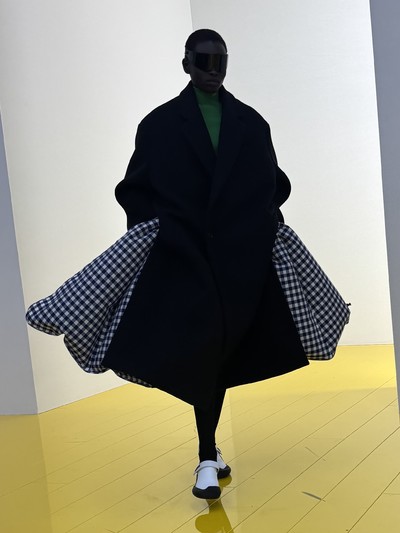
Carina: That exciting things are happening again. But there are so many shows. I don’t know why everybody needs to do one; it’s just not necessary if you don’t have something strong to say. Still, I thought there were some nice things, like what Haider [Ackermann] is doing at Tom Ford is really interesting, I am really happy for him. I really like what Sarah Burton is doing at Givenchy. I wasn’t there, but it really looked like a proposition from a woman. We love what Duran [Lantink] is doing at Gaultier. It was a really good show this season. And of course, Loewe looked great, but we didn’t work on the show itself.
Stefanie: I like to see the smaller brands doing something more experimental, when it is a fun expression, you know? Those are the things that I was interested in, more this kind of expression and the artistic side of things.
Carina: Like August Barron. It’s like the old Margiela, the whole community around it. It feels so nice and more real. That’s something to support. Things are so hard for young designers.
I’d like to understand how you regard fashion photography today versus what it was 10 years ago, 20 years ago. What role does it now play in fashion?
Stefanie: I feel like we’ve recently been working more with artist photographers. There is a point of view that comes from an artist that we are particularly interested in. You can get a different angle on things, a different point of view from pure fashion photography.
You’ve been working with Talia Chetrit, for instance. Because she comes in as an artist rather than a fashion photographer, does that allow her to have a more oblique take on fashion?
Stefanie: Talia comes in with a really different view on fashion because she’s not dealing with it every day. She’s constructing imagery from a totally different point of view, and that’s why it’s interesting.
Carina: What I find a bit sad about today’s fashion photography is that quality doesn’t seem to matter so much anymore. It’s more important if there is a celebrity in the picture.
In such a fast-paced image cycle, can fashion still create images that linger in one’s memory?
Stefanie: Yes, it can. But I think it’s connected to idea and concept, not just image. It needs to have a little bit more to it; something that allows you to see things from a different side or something that can surprise. If you manage to do that, it’s really a bit different than the rest. But I don’t think it stays as it stayed before.
Carina: It’s the way we consume.
Stefanie: It’s not that the image is less good. But all we’re used to too many images today. That’s why we work with printed matter – because if it’s on your bookshelf, you’re more likely to remember it. When we did the teaser campaign for Loewe, we printed a booklet of 12 images as a poster, because we wanted to create something that stays. The printed, the object – the small book is something worth keeping.
Carina: When you print something, people react to it. For example, we did this project with Walter Pfeiffer for Bottega – a really nice printed book – which people really remember.
You’re saying that in order for time to slow down, you need printed imagery?
Stefanie: Or for people to have it on their coffee table or whatever.
Carina: It takes more than a huge billboard for people to remember an image.
Which person working within the industry do you most admire today?
Carina: Mrs. Prada is still somebody I admire. The way she has managed to keep things so relevant for so long, at such a high level. Then somebody like Rick Owens, who has managed to be so true to himself. So beautiful and strong. Phoebe [Philo] also, because what she does is very relevant to us as women.
Thinking about Rick Owens, I can’t see him thinking to himself, ‘Who’s the cool model this season?’ Some people are so single-minded and produce great work which doesn’t get old.
Carina: That’s so inspiring – somebody who’s constructed his own world and has managed to remain a bit different.
Art directors couldn’t do this, they’d become irrelevant.
Stefanie: Maybe you just become irrelevant faster. It’s boring to talk about the 1990s, but all of the things going on then were freer and not so commercial. Fashion wasn’t yet such a huge, crazy system. It was driven by ideas and experiments.
Carina: It’s also what we grew up on.
Stefanie: But, I mean, Margiela is still relevant to everyone.
It seems 20-year-olds today have a nostalgia for the 1990s. They’re like, ‘You were so lucky to work in that period.’
Carina: My daughter says that too.
The size and scale has made fashion a bit less charming.
Carina: It’s the size, for sure, but it’s also become so much hard for the smaller designers.
Stefanie: And if you don’t do a show, you’re off the map. But young designers can hardly afford that. It should go into your production. This system of all the image-making, the social, the film – you can only put the quality into some parts. You’re producing so much imagery and it’s endless.
Perhaps that’s a good ending.
Carina: No, we should end more positively! I don’t want to end on: ‘It was all better before’, because there are super creative people around now. It’s just harder for them.
Stefanie: To end on a more upbeat note, we’re lucky that we’re able to work on some of these projects with great photographers and teams, it’s exciting. We’re really excited to work on these projects and we’re excited to receive these images. And they’re the really beautiful part of this job.