Interview by Jonathan Wingfield
‘Phoebe Philo is emblematic of the designers who are nimble or are thinking differently – you know, the way Matthieu is trying to reinvent the Chanel suit, or the way Dario Vitale cut through the ideas of class and luxury at Versace. More than ever we should be looking to these designers – the ones who can add a little vinegar and spice to the industry.’
For last year’s inaugural issue of System Collections, Cathy Horyn, fashion critic-at-large at The Cut, was called upon to cut through the noise of Fashion Month. Just a year ago the industry was less sure of itself, shifting and shaking under the weight of brand reboots and the looming threat of Trump’s tariffs. A year on, while creative directors are settling into their new roles at some of fashion’s biggest houses, the industry continues to grapple with myriad existential threats – a stagnant market, the uncertainty of war, and AI’s increasing dominance. Widely considered one of fashion’s most authoritative voices, Horyn’s attention remains fixed on what matters most: ‘the clothes, always.’
What emerges in the following conversation is not so much a recap of Fashion Month as a sorting through of it – an attempt to separate the collections that merely fed the cycle from those that will continue to matter once the churn has passed. That process of distinction becomes, in Horyn’s telling, a question of clarity. From Marc Jacobs in New York to Prada, Miu Miu, Gucci, Dior and Chanel, she reflects on the collections that made an impact and on the broader contradictions they exposed: fashion’s fixation on wealth, the growing centrality of VIC [very important client]culture, and the unease of an industry that continues to court power while rarely confronting it. As Horyn highlights, perhaps even at its most intelligent, fashion can still seem oddly sealed off from the world around it.
Jonathan Wingfield: Fashion Month is a sensorial overload, whether you’re at the shows or looking at it via Instagram. When you look back, what is it that sticks in your mind most this season? The music, the front row, the set design? Or does it still come back to the clothes?
Cathy Horyn: For me, it’s about the clothes, always. I’m thinking about Marc Jacobs’ show in New York, which I really loved and which for me remained a pillar during the rest of the collections, because he cut through so much of his own thinking. It was about condensing a lot of his thoughts. He did that brilliant press note, which he called ‘Credits and Receipts’, in which he mentioned the collections he had been thinking about over the years. It was really interesting to see a designer with Marc’s depth of experience weave those thoughts through.
By the time things began to accelerate in Milan, I started to see the collections that would matter and those that wouldn’t. I knocked Burberry off the list because it was so disappointing. It was just this dark, gloomy thing, which seemed more like the London underworld than anything else. But then you got to Milan and we all saw Prada – a really intelligent show, a really daring way to present a collection, with just 15 models. It was very confusing to people. Gucci – an important show, polarising, which we kind of expected from Demna. And then once you got into Paris, it just kind of went and went and went. Jonathan Anderson’s really strong bid to be part of the conversation. Sarah Burton’s much clearer Givenchy collection – you felt a woman’s hand in that collection, for sure. I don’t really read online commentary very much, but someone said to me, ‘Oh, people hated that collection.’ And I was like, ‘They don’t know what they’re talking about.’ I mean, let’s not even go there. She fumbled last season, and she really recovered this season. So, to answer your question, I start by separating the collections that are going to matter from those that really aren’t. A lot of it came down to clarity.
‘When reviewing a season, I start by separating the collections that are going to matter from those that really aren’t. A lot of it comes down to clarity.’
So the accumulation actually intensifies the clarity for you.
It does. It felt like Miu Miu was right in the conversation about what was going on. I love that when they drop the silhouette at Miu Miu – drop those pants and lower the line – it just always works. And they do it in those fabrics that look worn and washed, and the leather that’s just kind of dripping off one of the male bodies. It looks really cool. And I think it also fits into this thing that’s going on that Prada was part of – the question of how luxurious do you want to be? How rich do you want to look? This is one of the big contradictions in the fashion world right now – that houses invite all the billionaires to the shows, they direct their clothes at them, they’re very much part of the conversation. And yet Lorenzo Bertelli [Prada CMO] told me he thinks the biggest threat to the luxury-goods industry is inequality, and the fact that the ultra-wealthy who buy these clothes may begin to feel uncomfortable about wearing them, for fear of being judged or criticised or threatened.
I actually wanted to ask you about the VICs, who seem to have become such a lodestar for the fashion houses. There’s now a whole ecosystem around selling to them.
It’s business. The fashion world has always catered to them. It’s just on a different scale now. It sort of bothers me that we see so much of that, and that that’s often the focus in the clothes. You know, we used to count on what Demna was doing at Balenciaga to be sort of political, or a comment on the world of some kind. It’s something I’ve sensed about the industry for a while. Why can’t it make clothes that people actually want to wear?
I might sound a bit contradictory because, when I think of collections like Gaultier – Duran Lantink’s second collection, which I loved – I thought it was really interesting because of the way he thought about Gaultier’s tailoring, but also Gaultier’s treatment of the body and sexuality. And Duran just saw it in a way that I couldn’t even put my finger on. I couldn’t even really understand it, but I was really curious about it.
What comes through this season is sex, money, and power, which feels timely given the ongoing Epstein revelations. But do you think fashion is actually in conversation with the wider world right now, or is it mostly detached from it?
I think the number of designers who are aware of what’s going on in the outside world, who are thinking about it, is really small. Demna, Raf Simons and Miuccia Prada… maybe Jonathan Anderson, though I don’t think the clothes reflect that. I think they reflect the fact that he’s trying to get the imagery at Dior straightened out. He did that with couture and he’s doing it with ready-to-wear. So I think he has a situation that he’s really focused on. Demna too, he’s in transition. He’s sort of in love with the machinery of Gucci at the moment – the industrial manufacturing machinery and what that can do. And he’s obviously in love with the sexiness of Gucci and the body-consciousness of it and that style, which is so different from what he was doing at Balenciaga.
It’s a very, very small number of people who are thinking about what’s going on in the world. During the collections I didn’t feel like anybody was talking about what was happening in Iran and other parts of the Middle East with the bombings. I felt like we were in the bubble more than ever. We were just running from show to show, appointment to appointment. No time to think about it. Maybe it’s the same thing that many people around the world, at least in the Western world, feel – that they can’t keep up with the chaos and the political change and the tumult.
‘The fashion world has always catered to VICs. But it bothers me that we see so much of it now, and that it’s often the focus of the clothes themselves.’
Let’s talk more about Demna’s debut show for Gucci. When his appointment was first announced, there was all that talk about how he was going to ‘Demna-fy’ it. Now that we’ve seen the first show, how do you read his approach?
I think I read his approach as the first floor of a building under construction. He is starting in the most elemental and direct way, with the body. That’s really how I would read the runway show. There were some flaws, some problems. It was a huge, long runway. Maybe five or six times longer than anything Tom Ford had used. I didn’t really see it as spinning off Tom Ford’s Gucci. I mean, obviously Tom’s Gucci was very glamorous. It was sexy, of its time. I felt that Demna’s was extremely contemporary, and also that I didn’t completely understand who some of the people were, or who the audience was. I found myself really entertained all the way through the show. It was almost stereotypically the sexy woman thing, whereas the guys got the really easy shoes and, I felt, the better clothes. Well, that’s what I said to him. The girls got the short skirts and the high heels. So it touched on that stereotype that is certainly debated around the industry.
What did Demna himself have to say about that?
Gosh, I don’t remember now, speaking of things that get forgotten. He had not read any of the reviews when I spoke to him. So it’ll be curious, when I talk to him next, how he has processed some of that. I don’t think he intended them to be stereotypes. I think he intended them to be a kind of acknowledgement of reality, that a lot of girls want to dress like that. He said to me that the girls in his studio all want to dress that way. And you can see that in the general population everywhere. It’s not surprising.
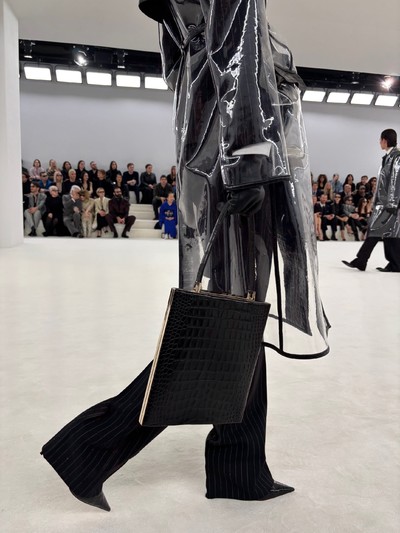
There’s an element of just cutting to the chase with those clothes. Acknowledging that a lot of people really aren’t interested in what the brand is. They’re interested in what Gucci is and what it represents. They don’t care how they get there. They don’t care whether it’s a slinky little top or something else. I liked everything in the show, and then I liked it even better in the re-see because it was so unencumbered. There was no excess about it. It appealed to that sense that you want things that are light. You want things that are careless. I mean, as careless as Daisy Buchanan, in that kind of throwaway way, but in 2026. I loved the fact that it just shed a lot of things. It was about the handbag, the way they were coming down the runway with the handbag like it was on a pedestal, but on an arm. I found myself more intrigued, in a way, by the audience.
The audience that was in the room or the broader audience?
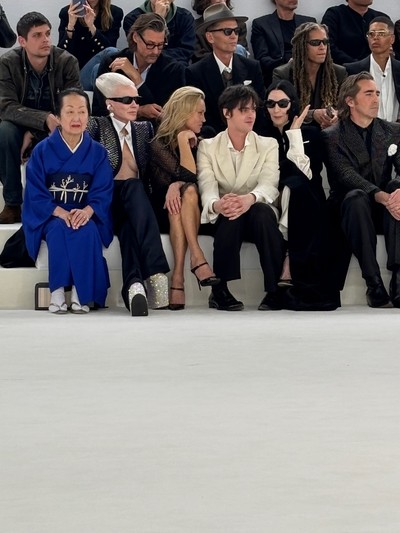
The broader audience. And the kinds of people – archetypes, whatever you want to call them – that he invited to be in the show and will probably be in the New York show in May. Now I’m jumping backwards to the Burberry show, and I don’t think it’s what Daniel Lee necessarily intended, but I kept seeing references to something I recently read: Flesh, David Szalay’s book. It just had that feeling of bleakness. It’s expensive cars, people in property development, people in finance. There’s an emptiness. They don’t care about the aesthetics of it. They just care about the look and the name. I have a feeling that Demna tapped into that, for right or wrong, and I find it kind of breathtaking in a way, because this is an industry that is so judgemental. This is a guy who came out of Balenciaga, who did these incredible collections bringing together the world of Cristóbal Balenciaga and Demna’s own world. So I don’t know, but of all the collections, I would say Gucci’s in that top small number that I actually really like to think about.
You mentioned Jonathan Anderson at Dior, and he’s clearly dealing with a very different scale and sense of institution there than he had at Loewe. Dior comes with all that reverence – both from its recent history and its deeper past. Do you think he’s succeeding in creating his own language there?
I think he is. In fact, I was pleasantly surprised by his recent ready-to-wear collection. With the two men’s shows that we’ve seen, in June and January, it’s still an open question as to what they are.
I wasn’t down for the Poiret reference. It seemed really scatterbrained in the January men’s show. It just seemed a weird reach, and not believable, actually. But then you look at the October ready-to-wear for women – pretty good. A little bit all over the place. When I first saw that Adam Curtis film in Jonathan’s studio, the preview, I was like, ‘Wow, this is great, this is fun.’ It was tying together the Dior story, bringing in the cannibalistic attitude or behaviour of the fashion press and the people around the fashion world who are just hungry for more and more and more. Eat you up, spit you out. I thought that was really funny. The horror film relation to the industry as a metaphor – pretty funny. Jonathan is pretty dark, I think. The show was reasonably entertaining, and he was starting to set up a shape in that collection, that sort of teacup skirt. But then, a few days later, we saw Matthieu Blazy’s first Chanel collection, and it had such a joyous spirit to it, positive and very genuine, and it sort of left behind the Curtis darkness that I felt Jonathan was trying to go for.
But then Jonathan did the January couture and, again, I thought it was a pretty good step up for him. There was a lot going on, and in some outfits there was probably an entire collection. I think that he put enough out there in that romance. He wasn’t fighting with what Dior is, which is a romantic, pretty label. And at the same time, he was finding ways to inject his own personality, his own ideas about things, things that feel a little bit undone. I went to that thing that Dior does called Villa Dior, which was really eye-opening. It’s set up in the evening for the VICs – them again – and some press, but not too many. It’s a way of showcasing in a very intimate, elegant space, rather than doing it in the couture house. They didn’t have the space in the couture house, but they do all the fittings there during the first week or so after the collection. They have the fine jewellery upstairs. So it’s one-stop shopping. Jonathan was going around, meeting and greeting all these people, having his picture taken. It was a huge commitment on his part.
‘I think Demna intended those archetypes to be an acknowledgement of reality, that a lot of girls want to dress like that. He said the girls in his studio do.’
Do you sense that he’s at ease in that meet-and-greet persona? Or do you think he’s kind of like, ‘Jeez, I didn’t realise I was signing up for all this’?
Well, he doesn’t have to do it. That’s the thing. Traditionally, couturiers don’t meet the client, and I wonder if John Galliano ever did. I know Lagerfeld never did unless they were friends of his.
Did Christian Dior do that?
There are photographs of him meeting famous women, the celebrities of the time, such as Marlene Dietrich and Ava Gardner. But I don’t know that, on a regular basis, he did. Maybe he had a social life with one or two of these women. Balenciaga didn’t. He might have had lunch with Bunny Mellon6 and he had lunch with some of the editors occasionally.
But not pressing the flesh, like now.
No. Lagerfeld used to joke about that. He never did a fitting with a client. In contrast to, say, Azzedine Alaïa, who did his own fittings. Back to your question, I think that Jonathan can be really charming. And to his credit, he jumped feet first into that whole meet-and-greet thing. It was probably really stressful, because it’s the same day as the show. And he’s probably been working through the weekend, and the week before that. He was pretty organised. He moved up the production schedule of things. Still, it’s just a lot of people all around you. His parents were there too. He set up that whole scenography in the Villa Dior. And unlike his predecessor – I mean, I never looked at the Maria Grazia shows and saw great accessories and great shoes. That’s what couture typically has been, that total look. Lagerfeld used to be the best at that, at least in recent memory, presenting you with a lot of things. But Jonathan did it, and he did things that weren’t actually on the runway, things that were presented exclusively at Villa Dior that people could see and then order.
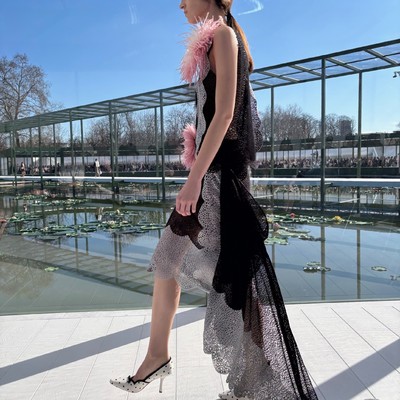
When I saw the Dior ready-to-wear this season, I was like, first of all, the setting was terrific – opening up the house. It was a metaphor, having that almost hexagonal runway around the reflecting pool in the Tuileries with the fake lilypads, being able to see the sky. I’ve always wondered why somebody didn’t do an outdoor show that was an indoor show, effectively. I think the knitwear was maybe one of the strongest things in the collection. It was a little hard to tell, but they looked almost like they had an 18th-century influence, these little skirts with the ruffles tucked underneath. Whether anyone buys that, it was a compelling look for what Dior can be today. It’s not what Raf did. It’s definitely not what Maria Grazia did. But then he puts in those things that I thought were really sharp, like the coats. There are some great coats in the collection, which are probably the things that people are going to buy, along with some of the embellished jeans, things like that.
‘When I saw Matthieu Blazy at his first Chanel collection preview I said, ‘I think people are going to be a little confused.’ And he replied, ‘I hope so.’’
Which brings us to Matthieu Blazy and Chanel. What’s striking is that it seems to have generated a shopping frenzy around the clothes themselves. Not the image, not the debate, but an actual desire to own them. Do you think that’s about the collector mentality around a debut collection, or is it simply that the clothes are genuinely irresistible? Did you have that feeling yourself, about desperately wanting to buy the collection?
No, I did not go into the store, I didn’t have the time, but I heard about it from everybody. My colleagues were in there trying to score shoes, and I got into the car one day and there were three pairs of Chanel shoes that they had successfully scored. And they talked about the lines just to get to a salesperson. I think women found something that they loved. Matthieu presented something that was just fresh and different, that people were waiting for. That’s the remarkable thing about the collection. There were all these people waiting for something, and they recognised it. I remember when I saw Matthieu at the first preview for that collection and I said, ‘I think people are going to be a little bit confused.’ And then he said, ‘I hope so.’ He said they had transitional collections that sort of ease people into it. Then the show happened, and I thought, nobody’s going to be confused by this. It’s so great. It’s so upbeat.
One of the things that I really love about what Matthieu is doing – and he kind of emphasised it again, or took it in a slightly different direction in his Fall collection in March – was using separates, using knits. That’s how a lot of women want to dress. It looks cooler, more casual, it looks like you’re less fussy, but at the same time, as Matthieu said, ‘You put it on and you don’t need to question anything.’ And that appeals to a lot of people. I honestly don’t see a lot of that –high-quality clothing – elsewhere in the industry. Phoebe [Philo] does it, for sure. Everything is considered. Everything is at work. Do I see a woman’s life here? I felt that in the March Chanel show.
Matthieu Blazy framed it as a work in progress, but it already feels as if he’s taken authorship of the house in a very deft way. Chanel is such a broad house, and in many ways it hasn’t really changed in decades, but he seems to have shifted it almost seamlessly, without being heavy-handed or trying to be revolutionary. Do you think he’s already got there?
Yes, and so quickly. If you think about the January couture show, which I just absolutely loved when I saw those transparent suits, that confidence and that bid to say to a woman, ‘There are no rules here – you can wear a seafoam green coat that’s embroidered with mushrooms and butterflies over this beautiful drop-waist dress.’ The whole transparency of that collection and the way he handled that. Many of us were waiting for a lighter version of Chanel. He did that in the October show. And then he went radical with it for the couture show, in a really convincing way. But it’s interesting that when I spoke to him in March for the preview, he said at the end of the conversation – and I think he wanted to plant the thought – that the story of Gabrielle Chanel is so solid, but that there are all these satellite stories around her that are still unknown. In that sense he still knows that there are things that he’s interested in finding and discovering. And then he quickly said, though, ‘You know what I’m really looking forward to? In two or three years’ – I think it was two or three years that he said – ‘I’m going to move beyond all of this and do something that is very different. What is Chanel without Chanel? What if Chanel were not Chanel?’ That’s what he said. And I was like, that’s really interesting.
That’s so enticing, isn’t it? And the confidence to be able to say it.
It’s just an intention. It’s what he should be doing. He should be thinking like that. He can’t be wedded to this, he can’t be confined to this Chanel box. It’s a huge box to play in. And it must be so much fun to think about. He’s not nostalgic about it at all. But I think he’s right. He has to start thinking that way. If I had had time, I would have asked Matthieu where this thinking is coming from. If these conversations that he’s been having with his circle, with his team or friends or whatever, if they are prompting this. I don’t think it’s dissatisfaction. I think it’s more curiosity. It’s knowing that you have this enormous atelier and all the satellite ateliers at your fingertips. He obviously has this vision of what Chanel can be, and he’s very dexterous with it. That is really exciting. Of course, when I wrote about that in my review in The Cut, right away people were coming online and saying how terrible, how disrespectful it is to Chanel. And you’re like, this is exactly why he needs to be doing that.
‘There’s no brand more ripe for the picking and tempting for a redo than Giorgio Armani. Someone just needs to take it further into the 21st century.’
To also bear in mind what she represented in her time, which was…
Freedom.
It’s almost perverse that people don’t consider that today. Now, tell me about Nicolas Ghesquière’s Louis Vuitton collection this season.
It made more sense than his last collection, for sure. I guess from an image point of view and a storytelling point of view, there were things that translate well in pictures, in videos. He had enough ballast, you might say, from those cute dresses that Nicolas can still do. It reminds me in some ways of the very early Balenciaga that he did when he didn’t have very much money. They were kind of patchwork-y, but now they’re done at a very high quality. He had some great leather jackets. He had some other coats that were really good, things that you could definitely see in the store. And then in between there were a lot of things that just didn’t really matter, and they were there for the decoration of the runway. His last show was all about being at home, supposedly, or being sort of in an interior world, but…
I sometimes feel the enormity of Vuitton prevents any lightness of idea or a nimbleness to explore different things.
I think that’s not true. I think that we’ve seen it time and time again – it’s a big brand, but in the recent numbers, and I haven’t looked at them in a year or so, it was only a couple billion dollars ahead of Chanel. Chanel was around €19 billion. Vuitton was around 21, something like that. Obviously Chanel is a couture house, so that’s its real foundation, its strength. Vuitton makes leather goods. Marc Jacobs used to say that the clothes were just window dressing for the bags. Then we saw, obviously with Marc – and it was a different time, it was all upward trajectory at that point – from the late 1990s, Marc and his [business] partner Robert Duffy really had to fight with the powers that be at Louis Vuitton to get the ideas and the freedom that they needed, and eventually they got it. It’s not too big to create something that feels really interesting and hot. You could put Hedi Slimane there and he would probably do it, on one side or the other, men’s or women’s. You could have put Jonathan Anderson there and he would have done that. I remember talking to Vuitton executives who said that Demna would have been a great fit for Vuitton. So I think, with imagination and the willingness of the CEO, it can work. I think people actually expect it from Vuitton. And Nicolas is without doubt one of the legendary designers. It’s hard to really tell: does he have the chops at this point in his career to put an edge into his clothes? Is he expected to do that, or is anyone asking? Are they satisfied? I don’t know.
That’s maybe not the priority of the house. Who knows?
I think all these houses, though, come to a point, and we’ve seen this historically. You look at Chanel in the four or five years after Lagerfeld’s death. The brand continued with his style and his type of sketches and his type of cuts and silhouettes. It just continued with that. And it was successful. I remember a stylist telling me at one of the Chanel events somewhere, ‘Oh, they’ll never fire Virginie [Viard] because she makes too much money for them.’ And I’m like, I don’t think that’s actually how the Wertheimers [Chanel owners] think. Nor is it how Bruno [Pavlovsky, Chanel’s president of fashion] thinks. I think when they were ready, they made the move. And then you see what happens. You just see it’s always possible. It will happen, one hopes, at Giorgio Armani – and there’s no brand, I would say at the moment, more interesting and more ripe for the picking, and tempting for a redo. It will always be important, because of his style and the things that he came up with and the way he cut a jacket. So someone just needs to take it a little bit further into the 21st century.
Lastly, is there anyone else this season who deserves an honorary mention?
Well, Phoebe is a different story because she’s not doing runway shows. So she’s not forced to do all of this extra stuff that designers have to do – the meet-and-greets, the interviews. And I think it’s made her the envy of the industry because she can so carefully focus on what she’s designing, on building out this wardrobe concept which has never gotten boring. I think there should be more space for designers to do that, to focus on this – for want of a better term – ‘problem solving’. Because it’s really about figuring out the clothes and what works for today.
What is it about the clothes themselves that you are drawn to?
I think the way Phoebe looks at clothes and women: she’s always landing on a precise point between something masculine and feminine, between soft and hard; between something that’s worn every day and something that’s sensational. She’s always doing that. And she’s doing it in her own space. Her latest collection followed the ready-to-wear shows, and she followed the Oscars, which was pretty dreary. She’s emblematic of the designers who are nimble or who are thinking differently – you know, the way Matthieu is trying to reinvent the Chanel suit, or the way Dario Vitale cut through the ideas of class and luxury at Versace with his collection. More than ever we should be looking to the designers who can add some vinegar and spice to the industry.