Interview by Anders Christian Madsen
‘For me, it’s been interesting to look at fashion from a bit of a distance and to not be consumed by the tiniest machinations within the industry. It gives you a different perspective that, in many ways, is more in line with the conversation that civilians have about the fashion industry.’
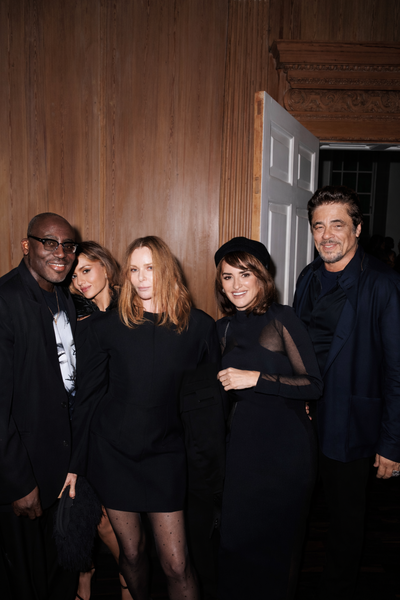
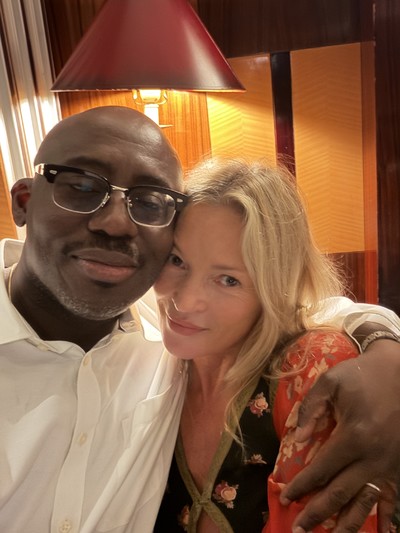
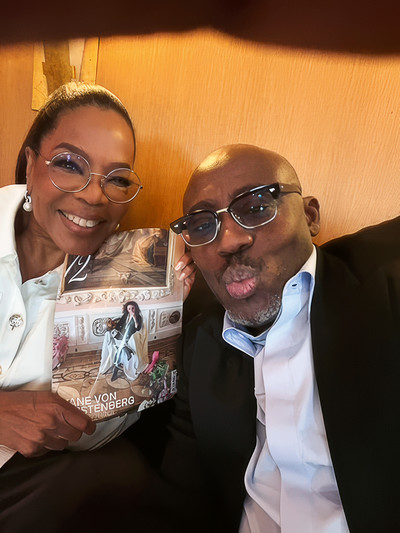
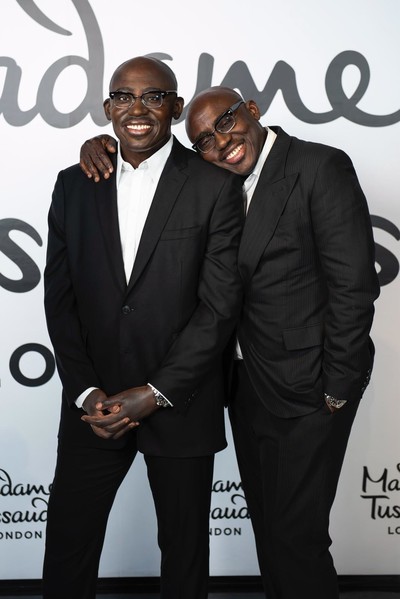
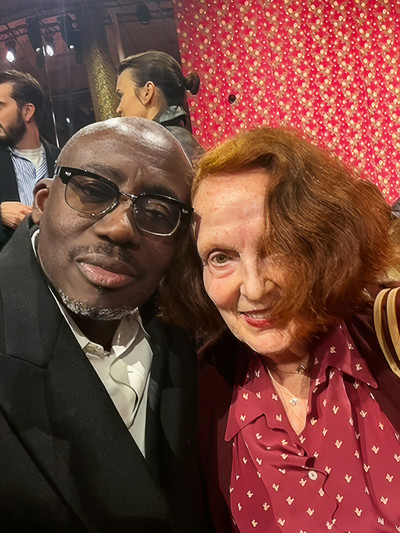
There is a distinct shift in perspective that comes with stepping back from the churn of Fashion Week. In the following conversation, Edward Enninful and Robin Givhan – two of fashion’s most authoritative voices – speak from altered positions. For just over a year, Enninful has been building EE72, the media and entertainment company he co-founded with his sister Akua, and where he serves as chief creative officer. Givhan, meanwhile, left the Washington Post last summer after 25 years – where her work had evolved from fashion criticism into a broader critic-at-large role – to become a contributing opinion writer at the New York Times. In different ways, both are now looking at fashion from a little further out – less bound to the rituals of the industry, and perhaps more alert to what those rituals fail to address. That distance sharpens the conversation. They discuss the Autumn/Winter 2026-2027 season not merely via shows and collections, but as a reflection of what fashion is willing – or unwilling – to explore at a moment shaped by political anxiety, corporate power and extreme wealth. ‘I longed for someone to speak up and say something about the moment’, Givhan tells guest interviewer Anders Christian Madsen.
Edward Enninful: Congratulations are in order for your new life. How does it feel?
Robin Givhan: I’m probably the only person who feels an element of guilt when I say, ‘Oh, I’m writing for the New York Times,’ because, you know, the Post has been home for so long that I feel like I’m cheating.
Anders Christian Madsen: Maybe we should start there, with how your new lives and roles have changed your relationship with fashion and the industry.
Edward: I spent 40 years going to fashion shows, leaving my hotel at 9am and coming back at whatever time. Some shows that you loved and others where you had to show up because, you know, you had advertising demands. The beauty of my life now is I go to the shows that I want to go to. In my new role at EE72, we’re not so reliant on advertising. That’s the biggest takeaway from my new role.
Robin: For me, it’s been interesting to look at fashion from a bit of a distance and to not be consumed by the tiniest machinations within the industry. It gives you a different perspective that, in many ways, is more in line with the conversation that civilians have about the fashion industry. Someone asked me if I missed going to fashion shows. And no disrespect to every designer who mounts a masterful runway show, but no, I do not.
Edward: I’m the same!
Robin: I mean, there are those moments when a show just takes your breath away, either because it’s absolutely stunning or because the designer has made this attempt to say something that is just so eloquent and so thoughtful and so interesting. But those moments have always been rare. Most of them are lovely and fine, and then there’s the occasional one that is, you know, Lindsay Lohan at Ungaro.
Edward: Oh, I remember that!
Robin: Don’t we all?
Edward: What I don’t miss is the chaos. But I miss the work of the people I respect. The great designers, the great storytellers.
Robin: There is something quite specific about being in the room, right? I remember one season, I was called to go and cover Michelle Obama pitching Chicago for the Olympics – I can’t even remember where this was happening, but it was somewhere in Europe – so, the Post decided that I was the closest person to wherever this was. I left Paris Fashion Week for two days, and when I came back, I had missed a lot of shows. I thought it would be interesting to try to write about the collections from the many different ways that they could be consumed. There’s the version of the collection that you see when you’re sitting right there in the audience. Then there’s the collection you see in the showroom. And then there’s what you see when you look at the video. There’s even a different version you get from the still images. I was really struck by how different a collection can look depending on the way in which you see it.
‘Thinking of Chanel, there’s a lot of conversation around joy and optimism. Whenever the world is in the state that it is in, we do need some optimism.’
So, through that lens, what were your takeaways from the season? What stood out?
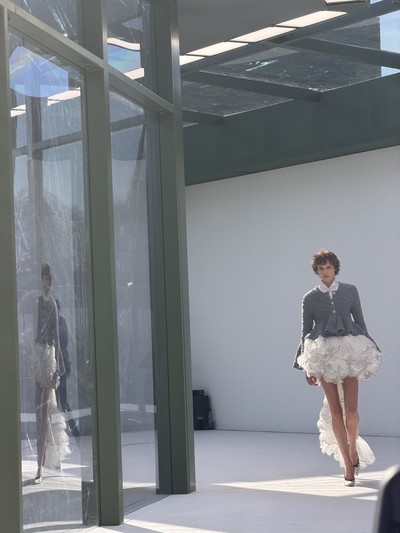
Edward: Because of my background as a stylist, my first impressions are what the feeling is. There’s a lot of conversation around joy and optimism, which we always love – I’m thinking of Chanel. I think whenever the world is in the state that it is in, we need some optimism.
Robin: It’s funny that you mentioned Chanel, which has been on my mind. For me, Chanel was always a bit of a difficult show. And part of that was really because of where it fell in the calendar, right? I would be hanging on by a thread.
Edward: Did you ever go to Karl’s ‘accessorisations’?
Robin: No, no.
Edward: We had to. Every season, every person, we’d all go and watch him prepare the show.
Robin: That might have been the death of me. I mean, Chanel would land just when you were so exhausted. I would feel like I was walking around seeing double, I was so tired. It was always this really fascinating universe, these customers who would turn up in the full Chanel kit, and I would think to myself: no one is in their right mind. It always felt a little bit like Karl was pulling one over on the customer. I feel like this version of Chanel is so much kinder to the customer. There’s air and there’s life in it in a way that feels so contemporary. The other thing that occurred to me was that as much as I do love the sense of optimism and the beauty in that, I longed for someone to speak up and say something about the moment.
Edward: Yes, people need to speak up.
Robin: I want someone to be ballsy. I want someone to be blunt. I want someone to be political. Maybe I just want a good story.
‘When it comes to designers, I want someone to be ballsy. I want someone to be blunt. I want someone to be political. But maybe I just want a good story.’
Why do you think designers are not speaking up?
Edward: Well, there’s a sense of fear, isn’t there? I remember when the Japanese first arrived in Paris and everybody was in black and they rebelled against everything that was going on at the time. I remember when Helmut Lang arrived, I remember when so many incredible designers arrived, and they brought a conversation with them about the times in which we lived.
Robin: I agree, I think there is an element of fear. I think people are also not sure what to say. It is difficult to know exactly what it is that you want to say and not have it feel like you are screaming into the void. I also think that people feel it’s not a designer’s place to say something, but that is a very weak argument because fashion is global. It’s billions of dollars. It’s consumed, and more importantly, made by a lot of people who are targets of a lot of the worst elements of politics right now. I don’t think it’s a small thing that so much of fashion has become corporatised. We certainly saw the head of one of those big corporations sitting handily at the inauguration of Donald Trump. The politics of it are inescapable when fashion companies have to deal with tariffs. Fashion companies have to deal with the cost of fuel going up because of a war in Iran. All these things have an impact on the industry. So I don’t think that designers should ask themselves, ‘Oh, is it my place?’ Of course it’s your place.
Edward: I feel designers are not just designers anymore, they have to be so many things. They have to be ambassadors. They have to create PR. They have to be advertising directors. Look at Jonathan Anderson: he’s the perfect example of a designer today, right? Great at PR, great at concepts, stores, advertising. You have to be good at everything.
This whole conversation is also reflected, I think, in a season where we talked about corporatism, commerciality and wearability more than ever. Maria Grazia Chiuri’s debut at Fendi, which was very ‘wearable’, versus Nicolas Ghesquière at Louis Vuitton, which is then labelled ‘hyper creative’.
Edward: And I like both. I mean, that’s the beauty of fashion. I looked at Maria Grazia and I was like, ‘Oh my God, I want some of these coats.’ Then I saw Nicolas’ show and I thought, ‘What a great narrative, what a great creative moment.’ So, I think they can both exist side by side.
Robin: I think they should exist side by side. But I think we also need to be a little bit careful with those characterisations. Not that I think it was wrong characterising Maria Grazia in that way. But there’s also that element of the male designers being the creative geniuses.
Do you think increased public attention is changing the way that fashion is presented and perceived, and as a result, operated?
Edward: Of course. Influencers are so important at shows these days. Sometimes I do feel like the shows are not necessarily for ‘the insider’ or the editors. But it’s more about which celebrities are coming to your show.
Robin: I feel collections are really for people watching on Instagram, not for people in the room. But, speaking of accessibility, I just need to address the price issue.
Edward: Are we surprised people are heading to Zara?
Robin: I mean, things have become so insanely expensive. The only explanation for it is greed. It’s just grotesque. There, I’ve said it!
Going back to Chanel, for instance…
Edward: Last week I went into the store to look at the bags and the clothes. Yes, it’s great workmanship, but at the end of the day, when I left the store everything still seemed very classic. There are the Chanel bags in different colours, the beautiful knitwear, the drop waists – which I love. But it wasn’t anything that would scare a woman out of a store.
Robin: I think that’s smart. Like, it’s still incredibly desirable, but approachable.
Did you stop by Chanel as well, Robin?
Robin: Good Lord, no, I’m a working journalist!
Edward: I went to look, I didn’t buy!
It was so interesting to see how many editors went and bought a piece. They were carrying around the carrier bags at the shows. I saw them at the airport as well. They had their trophies.
Edward: We’ve all been in this for a long time. It’s the moment! I just hope that it’s not a moment, and it’s something that will last season after season.
Do you think industry frenzy can have an effect on the real consumer?
Edward: It can create desire, right?
Robin: Yes. I think it’ll be really interesting to see what the trickle-down effect will be, what the knockoffs will look like.
Edward: The two-tone shoes. I see that already.
Robin: And in that way, it’s very old-school fashion, right? This idea that comes from the atelier and it trickles down. It will be interesting to see how people rally around those ideas and whether or not they become part of the cultural fabric. It’s going to be really interesting to see how that changes fashion, how it changes the way that people respond to it when those front rows are filled with billionaires.
Edward: Let’s go back to the price architecture. For me, that’s the real topic of now. Like how do they arrive at these prices?
Robin: Just because they can.
Edward: Well, is it fabrication, is it workmanship?
Robin: I would love to see a pie chart showing me what percentage is materials, what percentage is craftsmanship, what percentage is overhead and what percentage is profit.
Edward: Me too… We all heard last week about John Galliano and Zara. Was I surprised? No, I wasn’t at all.
Robin: I’m curious to see how it will work with John. He is not known as a designer of sportswear, right? Or of minimalism, these easily reproducible things. He has always been celebrated for the dreamy, experimental, creative aspect of his work. So, I’m curious to see how that will translate into a Zara garment. Maybe he’s got a simple sportswear collection in him that’s just been yearning to get out; he’s got a series of hoodies that he’s longing to do.
‘I think the question ‘Is fashion diverse ‘enough’?’ trips people up because it suggests there’s some number to hit and then the problem is solved.’
Looking at this season, is fashion diverse ‘enough’? Where do we stand?
Edward: Fashion’s never diverse enough. If it was, we wouldn’t be having this conversation. You wouldn’t be asking us this question if there wasn’t a diversity issue. So that’s your answer.
Robin: I think the question ‘Is it diverse ‘enough’?’ trips people up because it suggests there’s some number to hit and then the problem is solved. My ideal version of diversity is more organic than that: the widest possible expression of creativity, desire and aspiration. I don’t know that there’s an answer to ‘enough’.
Edward: I’m sick of teaching people about diversity. We all know what our industry needs. Yes, we will keep on fighting and yes, we’ll keep on talking about inclusion. But come on now. It can’t just be us. It can’t just be people of colour. Everybody has to be able to make this industry a little more diverse, whether it’s from behind the scenes or elsewhere.
Robin: Someone in the States once asked me to be on a panel about diversity, and I said I wouldn’t do it if it was only people of colour. Because, I said, ‘I know how we feel about diversity!’ I was surprised when the panel didn’t happen. I thought, ‘Was that a deal breaker?’
Edward: People have to educate themselves at this point. We’ve been having this conversation for years – about size, age, skin colour, all of it. I look at the shows and see a bunch of beautiful women from all over the world – the majority are white girls, Asian girls – and then I’ll see six women from Sudan all with short hair and super dark skin. What is that about? There are 36 different shades of Black. What does that say about diversity?
Robin: I have noticed the exact same thing. I’m fascinated that so often it becomes a type. Then that is the only type that gets cast in a show – overwhelmingly. There’s usually a much broader range of white models on the runway, but there’s a particular type of Black model that’s on the runway. And I say ‘usually’ because I did live through the period when it seemed that every model was very pale and very blonde.
Edward: There were no Black models anywhere, I remember.
Robin: And it was like: a redhead, ooh diversity!
Edward: Or maybe sometimes there was an East Asian model… I remember designers would say things like, ‘Oh, we don’t need a Black girl, we have a girl from China,’ and you would be like, ‘Wow.’ There was a beautiful model called Chrystèle [Saint Louis Augustin]
from Paris. And they’d be like ‘We can’t have Chrystèle because we have Alek Wek.’ And it was like, what?! The goalposts were always being moved.
Robin: Who says that?! I mean, I honestly just…
Edward: It would be designers telling you, it would be the casting people pushing the designer. A roomful of people. Don’t forget, back then I was probably one of the only Black stylists around. I would enter these rooms and hear all these conversations. What would I do? I would keep pushing. I never stopped pushing for what I thought was right.
Robin: I honestly don’t know what the mechanics are to change the situation. Whose lead are they following? Because it’s not a matter of not knowing. It’s choosing the easy way, perhaps.
Edward: We live in a Technicolor world. The more that’s reflected, the better. You know, for me, it’s not a conscious decision. It’s what I know from deep inside. It’s what I’ve always known. It’s what I’ve always believed in. We shouldn’t even be having this conversation right now. It’s a little bit sad.
Do you feel there is someone in the industry right now who is doing something that feels particularly meaningful – and making a real difference.
Robin: That’s really hard. I would like to think so, but I don’t know if someone immediately comes to mind. Honestly, so often the people who are really doing the heavy lifting do it behind the scenes and you don’t even realise what they’re doing until the task is accomplished.
Edward: Think about Virgil. Whatever he was doing, you knew he was doing something right. Something that was changing culture. Something that felt new. Something that felt inclusive. I don’t know if I can put my finger on anybody like that right now.
‘There’s a designer in London I love called Tolu Coker. She’s got incredible irreverence, understands culture and loves fashion. She’s one to watch.’
The Trojan horse for the mind, as he called it.
Robin: I will say, on that note, one of the things that I have been so struck by, as I have talked to people about our book, Make It Ours, is the number of young people – but particularly young men of colour – who have talked about feeling seen. Feeling like someone has told their story and like they have been given permission to pursue something creative. That has been fascinating to me. I didn’t realise the degree to which so many of them felt like they needed a kind of permission. They needed a sign-off or something, particularly because theirs is a generation that really forges ahead, demands things and speaks truth to power. It has also been really gratifying because I feel like we don’t yet know what will come out of all of those people that Virgil inspired. These people who feel so distant from the centre of fashion, but are inspired to do their thing.
Edward: That’s what you hope, isn’t it? The Nike sneakers he made, to this day, every time I wear them, somebody will come up and go: ‘Virgil’s trainers!’ Literally every day, and they are really regular men.
Robin: That’s what’s so cool about it. They are not fashion dudes.
I’m going to shift the topic again because we cannot do this call without talking about Gucci.
Robin: It was a bit like Gucci memory lane. Part of me respects the desire not to murder everything that came before and to move it forward in some way. But ultimately it wasn’t one of those debuts that stopped the world from spinning. Did it make me want to see more? Yes. And that, ultimately, is the important thing.
Edward: I feel like a lot of times we go in on a first collection and are like, ‘Oh it’s bad.’ It wasn’t bad. It wasn’t the most earth-shattering collection, sure, but I want to see what the next one is like because all these designers are now in their second collections. So, let’s give it a moment. But Kate Moss closing that show, I loved it. Took me right back.
Robin: I’m curious, was there ever a collection that made you feel ‘Oh, everything’s different for this brand now’?
Edward: Yes, Alessandro [Michele]’s first collection for Gucci. I remember watching that show and saying, ‘Oh my God, this person is going to do something incredible.’
Robin: I agree. I also think Tom Ford’s Mod collection. That was the other one where you’re like: everything’s different. I wonder, were we looking at this debut at Gucci waiting for another bolt of lightning?
Edward: What I always say about Gucci is that Gucci represents how women dress during a particular time. I remember when Tom came, grunge needed to die. He gave you this glamazon. Everybody wanted to wear those blouses, and it brought in a different way of dressing. When Alessandro came in, I guess Gucci had been over-glamour-ified, so it needed that touch of androgyny. That was what was going on in the world then, too. Maybe Demna’s touching on the world right now, and the place we’re in right now is dark and, like you said, the oligarchs are ruling over us. Maybe there is something going on there too. We’ll see.
The question with Demna is always: is it a mirror that he’s holding up or is it his passion? Does he think it’s good or is he trying to say something?
Edward: You’ll have to ask him.
Robin: With Balenciaga it always felt like there was so much on his mind. There was so much troubling him. It came out in really interesting, provocative ways. Maybe this is a reflection of him being in a different place.
Is there another show that you want to mention before we finish?
Edward: I thought Prada was very clever with the idea of taking off layers of clothing. Also, I remember how models back in the day would change a thousand times. And I remember sitting there seeing Julia Nobis coming out for the third time, and me turning around to the woman next to me, Sara Moonves from W magazine, saying, ‘Am I going crazy?’ I literally thought I was. I hadn’t seen that in years, so that tickled me.
Robin: I did not go to that show, but I enjoyed it. I mean, I had the chance to talk to Mrs. Prada and Raf. I love her over-intellectualisation of everything. It just brings me so much joy.
Edward: Me too. There was a certain lightness at Dior that I also enjoyed, a certain mad creativity, playing around with the rules of what is French and what is not. Haider [Ackermann for Tom Ford] was great. It really surprised me. It was incredible. The soundtrack was amazing. The lighting, everything about it felt like somebody who had really harnessed or distilled what a house is.
Robin: Isn’t it interesting how much the music can have an impact on how you feel about a collection?
Edward: Robin, what did you like from far away?
Robin: I did a very cursory watch.
Prada, Gucci, Chanel. I did not see Celine. I think I looked at Loewe, and I liked that. Certainly, Rachel Scott’s premiere at Proenza Schouler. I loved Diotima, I thought that was gorgeous. And Ralph Lauren fascinates me, it just keeps chugging along.
Edward: At Vuitton, I also loved the way the bags were carried on the sticks. Nicolas can still surprise you!
Robin: I really liked Marc Jacobs. I love the idea of acknowledging your inspiration in that way.
Edward: There’s a girl in London that I love. Her name is Tolu Coker. She’s got this incredible irreverence – she understands culture and obviously loves fashion. She’s exciting, she is one to watch.
She had a visit from the King as well.
Robin: Wow, fancy. Wait, do I get to call you Sir Edward?
Edward: No!
Robin: Oh, darn.
Edward: That was fun. We said a lot!
Robin: Now, what exactly have we said Edward?!
Edward: Oh, who cares at this point? What can they do? You will always be Robin. I will always be Edward.