Interview by Jonathan Wingfield
‘With the high-end European brands all focused on trading up and serving the rich, there’s been quite a significant price umbrella that has been created for brands to serve the aspirational consumer and the lower end of the luxury goods audience. You don’t want to spend €100 on a jacket, but you don’t want to spend €3,000 either. And maybe you find a good one at Zara for €300 or €400. I think this mid-price segment is definitely one of the areas that could grow the most.’



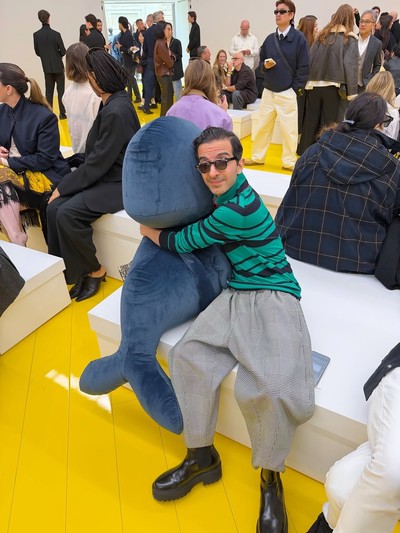
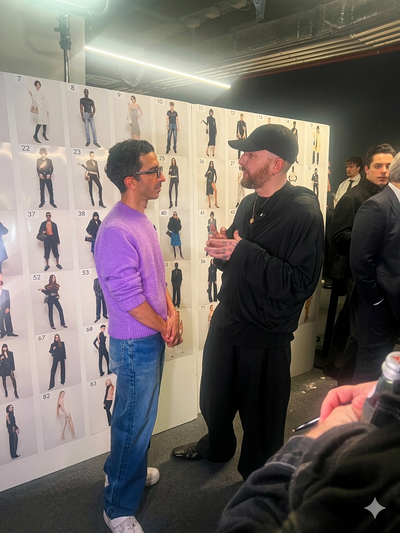
This is the third time that Imran Amed and Luca Solca have come together for System Collections to take stock of the luxury fashion industry, and each conversation has landed at a moment of market turbulence. Amed, founder and editor-in-chief of The Business of Fashion, brings the perspective of someone permanently embedded in the industry, talking to its executives and decision-makers daily. Solca, senior analyst of global luxury goods at Bernstein, provides the view from the market – tracking the major groups and watching where the numbers diverge from the narratives. Here, against a backdrop of sustained geopolitical uncertainty, softening demand and sweeping creative change at the major houses, they reflect on what the current season reveals about the state of the industry, which fashion role AI is most likely to replace, and where fashion’s attention economy might be heading.
Jonathan Wingfield: To begin with, a broad question. Can you give an overview of how the luxury fashion market is currently performing? Are the overall results still trending towards modest growth, are they mainly stagnant, or are they characterised by more decline?
Luca Solca: Looking at it from a distance, the global luxury market has been improving in the first few months of 2026. After the major growth we experienced post-Covid, 2024 and 2025 were meagre years to a large extent. Starting in mid-2025, we saw an incremental, albeit U-shaped, recovery of Chinese demand, as well as a number of measures that luxury goods companies have implemented, like more compelling entry price points and more compelling newness. And this has been starting to work for a handful of quarters. Then clearly the third Gulf War has brought a dark cloud of uncertainty over the broader economy, not just the luxury sector. We’re not going to see that in the first quarter numbers to a large extent. But what I think the stock market is currently discounting is quite a negative impact on global demand going forward – as many of the stocks we cover are close to the lower end of their trading range. And that will depend very much on how long this Gulf War lasts.
‘I think it would surprise people to know just how much companies are focusing on AI cutting costs, particularly in the creation of fashion imagery.’
Imran, as someone who’s constantly in contact with brands and executives, are the narratives behind the market headlines as uncertain as they suggest?
Imran Amed: I think this idea of narratives around industry recovery or industry downturn are from a different time in the world, when you could plan for three or five years into the future. As Luca just pointed out, we started to see a recovery of the luxury sector: new creative directors bringing newness to the houses, some restructuring of the pricing pyramid and a focus on entry-level price points. And then you have yet another black swan moment appear and create another cloud of uncertainty. This idea that there are these big grand arcs around the way our industry is progressing is kind of shattered by the fact that, if you consider the past six years, what we in the global community have been forced to reckon with – Covid, inflation, the war in Ukraine, and now an impossible-to-understand situation in the Middle East when it comes to geopolitics. Every day, every minute, things are shifting. And you can see that in the way the markets are responding. Even as we speak, everything is changing. So it’s very hard to talk about grand narratives right now because things move so quickly, so unexpectedly. I guess the only good thing that comes out of it is that the industry has become more adept at responding to these kinds of situations. If we think about the shock that the industry had to contend with when Covid happened, and all of the changes that happened in the push into digital and live streaming and clienteling over WhatsApp, not to mention the way we all started to work internally within the industry, we’ve just become more adept at dealing with a very uncertain global climate.
Luca, would you agree that the one thing that is certain is just the sheer scale of market uncertainty?
Luca: Well, I think that the geopolitical balance is no longer in the same kind of environment. Discussing President Trump’s decisions, we haven’t even mentioned Liberation Day and the import duties, which was another major disruption that we had to go through last year. So indeed, we are in a paradigm shift which is demanding for all of us. The luxury and fashion industry is no exception. Never mind the disruption that artificial intelligence is providing to a lot of industries. Welcome to the changing world.
Imran: We used to have these kinds of moments once every 10 years, right? If you think of 9/11 in 2001, and then the global financial crisis in 2008, there was space and time between these moments. Now we’re living in a world where these kinds of earth-shattering, unexpected things are happening more and more frequently. So I guess what we do is try to focus on the things that are within our control. That’s why there is cost-cutting, there is re-evaluation of long-standing operations and processes, to try to figure out ways to manage the things that you can manage.
How else are brands responding?
Imran: There are so many things I could mention, but the one I will mention now is probably the most controversial: the use of artificial intelligence. I think it would surprise a lot of people to know just how much companies are beginning to focus on where AI presents opportunities to cut costs, particularly in the creation of once very expensive fashion imagery. Any time we write about this on BoF, it elicits an almost universally negative reaction, understandably so because a lot of people’s livelihoods are connected to the creation of the imagery that helps to weave the myths of the luxury sector and create desire around its products. But the truth is, the amount of money that’s spent on marketing and image creation in our industry is a very significant cost line. So, if you’re a manager of a big luxury company and the industry is facing headwinds, one of the places you’re looking at is the spend on image creation. I’m not necessarily talking about images that are in campaigns. I’m talking more about the images that populate websites and e-commerce; every product now has about 10 images and videos from a variety of different angles that help to show it to a potential customer. A lot of that can now be created with AI at a fraction of the cost.
I wouldn’t be able to give you a sense of the magnitude of how much is actually being saved. People who are operating in the AI space tell me they’re helping companies to save – but I don’t yet have companies telling me themselves what they’re actually saving, because I think people are being quite under-the-radar about it precisely because it creates this online backlash. We saw that when Gucci released some AI imagery before Demna’s debut runway show in Milan. Recently we saw Prada do what I thought was a really interesting campaign where AI was used as a creative tool to augment what creative people can do. Just to be clear, that doesn’t mean I think AI replaces creativity, or that humans aren’t necessary in our industry, because they absolutely are. But there are some parts of the industry where there’s low levels of differentiation and a lot of duplication of steps, which is ideal for the kind of work that AI can do.
‘The Chinese customer is more focused on authentic storytelling, not marketing mumbo jumbo. They see through the smoke and mirrors of the industry.’
But one presumes there might be a proliferation of AI use across all aspects of image creation in the industry.
Imran: There’s this smart quote I heard that I’ve been using with my team, because BoF is obviously also thinking about the AI transformation: AI won’t replace your job, it’s someone who knows how to use AI that’s going to replace your job. And I’m encouraging all of our team to learn how to use these tools to find those low-value, high-admin, duplicative things that we have to do, where there’s opportunity to do things much more efficiently. Whether and how that extends into high-value work remains to be seen. But some people in Hollywood are saying entire movies can now be made in AI. So this isn’t just a question for the fashion industry. This is a question for all creative industries grappling with where value is really created – and that is within human creativity. But how the human expresses and pursues their creativity might be up for grabs now. It’s how we work with AI as a tool that I think is going to be really interesting. We’re not at that stage yet, but in the not-too-distant future, we may be.
Luca: In the past 30 or 40 years, we’ve seen the impact of globalisation, delocalisation, and immigration on the blue-collar working class. What we are about to see with artificial intelligence applications is the impact on the white-collar working class. These applications will completely change the way we work, and that is going to be both good news and bad news. On the one hand, you could do a lot more things more efficiently. The bad news is that there’s a lot of people today doing stuff which is relatively menial and yet they get a salary, they earn a living, and they sustain our industry and other industries. So I think the issue is going to be the speed of this revolution and how society is going to be able to repurpose people, invent new jobs and train people for new jobs. There’s a huge number of sectors that are going to be impacted. We now see applications that can create models almost automatically, and that causes some of our clients to reconsider how many juniors they need to build models, for example. The risk is that we get even more wealth and income polarisation in our societies. That is going to be a very important problem that we will have to collectively address.
When it comes to the industry itself, as Imran was saying, this would be a great way to address the issue of producing content for social media. I think another major application is CRM [Customer Relationship Management]. Creating an intelligent dialogue with your clients through artificial intelligence can be done very effectively and very appropriately. Today, with the exception of the very top clients, most of us are getting mass emails that are not necessarily relevant for us. We started with operations, but we’re getting more and more into client-facing processes and functions, and I think we are going to continue to see a lot of that going forward. It’s happening very quickly.
‘We all need Demna to succeed – in order for Gucci to succeed, for Kering to succeed, for the wider luxury industry to feel more buoyant.’
Before we paint a picture of complete doom and gloom, let’s talk about where we are seeing spending right now – in which sectors, which markets, which specific products, which brands?
Imran: Well, if I was a big brand CEO right now, I’d go to where the numbers tell me to go, which is to the two biggest consumer markets in the world: the US and China. In a market where you’re not seeing a ton of growth, you really have to focus on scale. I just came back from Shanghai a couple of days ago, and that market has completely transformed since I was last there seven years ago. The one thing that hasn’t changed is just how big it is. Even though it’s flat or shrinking or slightly growing depending on who you talk to, that market is still really dynamic. The Chinese customer is now much more discerning, much more demanding, much more focused on authentic storytelling as opposed to marketing mumbo jumbo. They see through all of the smoke and mirrors of the industry. But if what you’re creating is special, if you’re offering value, and you find ways to connect with them on a deeper level, then that’s a really interesting market for the taking, because not everybody’s able to do that.
The other market, of course, is the US. In spite of all the challenges that are going on there domestically, by all reports that market is still performing reasonably well and customers are still really engaged. You could see high-end customers going gaga over Matthieu Blazy’s first Chanel collection when it dropped there recently.
Luca: From my perspective, I think we’re going through quite a significantly strong cycle for jewellery. Jewellery has become cheaper relative to leather goods, as consumers now have the option to spend $5,000 or even $10,000 for a reputed brand handbag, but they can spend the same amount of money, or even less than that, for a piece of jewellery or a watch from Cartier. So we’ve seen jewellery as a category outperform soft luxury. Another thing we’ve seen is that with the high-end European brands all focused on trading up and serving the rich, there’s been quite a significant price umbrella that has been created for brands to serve the aspirational consumer and the lower end of the luxury goods audience. We’ve seen some American brands make the most of it – take Coach or Ralph Lauren, for example. But beyond that, if we look at mass fashion retailers like Zara, I think their ability to come up with more refined and more expensive versions of their products is very material indeed. You don’t want to spend €100 on a jacket, but you don’t want to spend €3,000 either. And maybe you find a good one, from a content viewpoint, at Zara for €300 or €400. I think this sort of mid-price segment is definitely one of the areas that could potentially grow the most, and has been growing the most in the past few quarters.
Imran, you mentioned the appetite for Matthieu Blazy’s Chanel collection. Is it too early to tell if the industry ‘buying frenzy’ can translate into wider sales?
Imran: It’s too early for us to know, but the people running those businesses are definitely starting to get some signals around how things are working, and whether these resets are registering. The wider question around Chanel is whether it is alienating the old Chanel customer. We won’t know for a long time because they only report results on an annual basis with a significant delay. But for LVMH brands and Kering brands, as we start to see their quarterly results come through for Q1 2026, we should have a pretty good sign. Jonathan Anderson’s first Dior drop happened, I think, on January 2nd, so parts of his collections have been in the store and available online since the beginning of the year. On the question of industry hype and whether that matters, when I saw that absolute frenzy – and it was a frenzy because I saw it for myself, I didn’t just watch it on Instagram, I went to the Chanel store on Avenue Montaigne to see what was going on – you could feel a different energy inside that Chanel store. It wasn’t just that it was busy. It was the way I saw people engaging with the new product that made me think, wow, this could actually be something real. I thought it was really smart that they dropped the first products in Paris just when Fashion Week was happening. Then the week after, the products also dropped in London and New York, and you saw the same phenomenon happen there. What a powerful organic viral marketing strategy to get people aware that Matthieu Blazy’s products are in the store, and to show the emotional response people were having to them. Then I started thinking: could this be a bit dangerous? Making it too ubiquitous so that hype and potential overexposure dilute rather than amplify desirability? We are operating a luxury industry in an age of saturation – fashion imagery, content, videos, reels, TikToks, hot takes. At some point, will just seeing it all the time make it less desirable?
‘Could the Chanel buying frenzy be a bit dangerous? Making it too ubiquitous so that hype and potential overexposure dilute rather than amplify desirability?’
Luca, for the likes of Chanel and Dior, what evidence do you see of any broader shift in strategy beyond the appointment of a new creative director?
Luca: I’ll use a sailing analogy: if the wind is very strong, then you need to manage the boat in a different way than if the wind is weak. We are in a weak-wind condition. If the wind is consumer demand, there’s not a lot of it at the moment. So your tactic and how you manage to get this wind is very important indeed. In this circumstance, as Imran was saying, it’s not just a matter of having newness in the stores, but becoming hot, becoming the talk of the day, attracting consumer attention and driving traffic to your stores. We saw, for example, assessing traffic in China, that traffic developed in the first quarter. We measured the weekend before Chinese New Year and compared it to the same measure in 2025. Traffic was up 47 per cent overall in 10 shopping malls. Looking at the brands in our list, traffic was incredibly concentrated, and those at the top of this newness and re-energising effort, like Chanel and Dior, were miles ahead. Those who had been doing more of the same were actually seeing a decline in traffic. So I think competition is changing. There’s a lot more focus on trying to create hype and grab the limelight. In that same vein, you see not just fashion shows or creativity but also events and temporary stores. Think, for example, of the temporary store that Vuitton has opened in Shanghai in the shape of a ship.1 It has attracted a huge amount of media and social media commentary, and a huge amount of people coming to the store, and has revived the fortunes of Vuitton at a time which was difficult for the brand. So I think that this effort to grab attention is the core of what luxury goods companies are trying to do today.
Imran: I would add that this notion of attention for attention’s sake is also slightly problematic. I think we’re in a potentially dangerous situation where people see reports after Fashion Week saying such and such brand ‘won’ because they got $85 million of earned media value from their front row. And I’m like, does it really matter? Does that really do anything? Not really. We’re spending a lot of time and energy on things that don’t really translate to the bottom line. As an industry, I think we’ve become addicted to metrics like earned media value, which for me is just the equivalent of asking: is your brand making noise? Noise alone is not enough to get people to convert, and what we really need is the kind of attention that gets people excited enough to come into your store. That Louis Vuitton store in Shanghai is a good example. I was very sceptical of it when I first heard about it. Only when I went there and literally saw thousands of people outside, hanging out, queuing to get in, and then people in the store at the end of the exhibition buying things, did I realise: OK, this is the kind of attention and ‘marketing activation’ that actually works.
Luca: This is sometimes a negative ricochet from attracting attention, because the temptation could be to be over the top when it comes to communication. We’ve seen scandals in recent times – such as the Balenciaga advertisement that was lambasted because of the paedophile innuendo – which suggests that by sailing very close to the wind, at one point you capsize.
In terms of ‘hotness’, the designer most under the spotlight is Demna. Will the divisive reaction to his Gucci runway debut increase pressure on Kering?
Luca: Well, if Kering wants to revive, Gucci has to revive. And my view is that Gucci can only revive if it finds its soul again. The attempt in the past three years under Sabato De Sarno to make Gucci a ‘quiet luxury’ subdued kind of brand was not working because it wasn’t what people have in their minds as the Gucci identity. It was as if Gucci was camouflaging. It didn’t sound compelling. It didn’t look compelling. What I think’s good with Demna is that he’s trying to go back to what Gucci is, which is a bit over the top, leaning on the sexy side. One positive element I could pick up is that fashion with skimpy dresses and all of that is more Gucci than what we had seen for a few years. Then when it comes to handbags and footwear, we received a much more mixed reaction, and I would say overall negative reaction, as this failed so far to excite. Which is causing us to be prudent on the Gucci revival. We don’t see the prospects of a V-shaped quick recovery. We see a step in the right direction, with a lot more steps still needing to be taken.
Imran, what do you think Gucci can be doing right now to reverse its fortunes?
Imran: That’s probably one of the most important questions for the whole industry. We all need Demna to succeed – in order for Gucci to succeed, for Kering to succeed, for the wider luxury industry to feel more buoyant. There’s a lot resting on this. In my view, the show we saw in Milan did not resolve some of the questions I had around Gucci’s future. I left it feeling somewhat more confused about where the brand is going. What I’m told is that the show they’ll be doing in New York in May, which is called Gucci Core, is focused more on the bottom half of the pyramid. It will flesh out more clearly what the overall strategy is. So that’s what I’m waiting for. The thing that really resonated with me when I once spoke to Mr. Pinault about Gucci is that he told me Gucci has always been about setting the fashion agenda. And when Gucci was at its height under Tom Ford and then under Alessandro Michele, that’s what it was doing. I think that’s why the Sabato De Sarno moment didn’t work, because Gucci went from being ahead of the industry to following it with this quieter luxury approach, which was not consistent with the DNA of that brand. What I’m not sure about is whether the fashion agenda that’s being set now – what Luca called ‘skimpy dresses’ – is the one that’s going to push the whole industry ahead. What I’m looking for from Demna is more of a sense of the joy and happiness that I see in him personally, and which I think, in a world that is so dystopic and so challenged, tends to resonate with people. Like that Balenciaga show he did that was themed on The Simpsons, or the very first moment that he had for Gucci, ‘La Famiglia’, in that theatre they created in Milan. What made those moments good is that there was a levity about them. Going back to Matthieu Blazy and Chanel, part of the reason why I think that is resonating is because there is this connection that people have right now with brands that spark a sense of joy.
‘Our industry celebrates young talent more visibly than ever, but it’s become harder than ever to build an independent business. The economics are brutal.’
Let’s shift our attention to Prada’s acquisition of Versace, and the subsequent appointment of Pieter Mulier.
Luca: I will be quite transparent about it. To use the understatement of the day, the market didn’t like that Prada bought Versace. This seems like a digression, a potential distraction. If we think about Helmut Lang, Jil Sander, Church’s – Prada has a poor track record of M&A [Mergers and Acquisitions]. And I think the very significant downward trajectory of the Prada share price is revealing. The big question mark on Versace is whether the house is a Sleeping Beauty or a corpse. Clearly there’s huge notoriety around the brand and, provided you inject the relevant newness – both relevant to what the market wants to see now, and to what people have in their minds as Versace’s DNA – then I think you could potentially come back. The question is how you interpret the Versace character in a way that is up to date and compelling. Let’s see what Pieter Mulier will be able to achieve.
Imran: I would say Versace is neither a Sleeping Beauty nor a corpse. Versace is a strong, powerful woman in need of a wonderful makeover. And I think she has a lot of potential. But the amount of work that’s necessary to do that makeover is significant, and we shouldn’t underestimate it. You could say it’s one of the most underleveraged names in the entire industry. Versace has all of the ingredients to be a megabrand, but recently they just haven’t been deployed in a way that’s in keeping with the competition. Prada has successfully shown that it knows how to build and cultivate luxury brands. And Versace is really differentiated from what Prada does or what Miu Miu does. So I do think there’s a really big opportunity here. And I would also say that if you look at the landscape of fashion brands at the moment, including some of the recent resets at Dior and Chanel, I don’t see a beautifully sexy brand. There was a time when Roberto Cavalli,
Dolce & Gabbana and Versace had that kind of va-va-voom factor that Italian fashion does best. I think there’s an opening in the market for something really sexy. Maybe that’s the space that Gucci is also trying to play in, but I’m looking for something a bit more polished and a bit more desirable.
Lastly, I’d like your thoughts on emerging designers. While prizes like the LVMH and Woolmark generate significant attention, many graduates are opting not to launch their own brands, instead choosing the stability of working within established houses. How might this shift shape the long-term future of the global fashion industry?
Luca: With the continuing shrinking of multi-brand distribution and the rising stakes in competition, this environment is making it very difficult for anyone wanting to establish a new business and start a new brand. That is very different from when the modern fashion and luxury industry started in the 1970s and 1980s. You need big bucks. You need to be able to hit the ground running. And that is almost never the case. So my view is that the LVMH Prize for young designers is a great tool for LVMH to get a competitive advantage against competitors trying to secure the best talent. And I understand that these designers have an incentive to build a career in a group like that because if they make it, one day they become the chief designer of one of the major LVMH brands. So I struggle to blame them. What we see from the other side of the fence is the risk that the overall offer could be poorer, and that the choice consumers will have could be poorer, because of this consolidation and because of this difficulty of finding a channel to reach consumers. So, in my view, this represents a huge opportunity for a number of players trying to get to the same result: creating a viable multi-brand environment where new propositions could thrive, where consumers could find more choice, and also more price depth relative to what we’ve seen recently. It’s still a work in progress. We haven’t seen a winner emerge at this stage.
Imran, what’s your advice to a young designer looking to launch and grow their own brand today?
Imran: We’re in a paradox at the moment. Our industry celebrates young talent more visibly than ever, but it’s become harder than ever to build an independent business. The economics are brutal. Production costs have increased. The wholesale market has collapsed. To compete with the big brands, you need a lot of capital and marketing. And so more than ever, my advice would be: go join a house, develop the skills, build a professional network, learn how the business works. That’s not a failure of ambition; it’s the market reality. If you still want to build your own brand, then don’t rush. Spend a few years working inside different companies to learn how product development works, how merchandising works, how a commercial strategy works. Build those factory and supplier relationships. And once you’ve got an understanding of the whole business of fashion and how it works, then think about: can I create and offer something new to the market that doesn’t already exist? When you’re launching a business, you need to think like an entrepreneur, not just a designer. This old romantic idea of the lone genius launching a brand from a studio on their own doesn’t really happen anymore. The designers who succeed independently today understand that fashion is a business. And even then, going out and building your own business is one of the riskiest things you can do. Most fashion companies fail. Ninety-five per cent of startups don’t work out. So if you’ve had those five to seven years of experience and you launch your own business and it doesn’t work, you still have that experience to rely on later.
The system that we operate in now is so unfair to young designers. So, in order to succeed in that system, you need to be very strong, and very clear about what you have to offer. I recently wrote a piece, ‘The Industry Eats Its Young’, and got an avalanche of emails and messages from people all around the industry saying: ‘I don’t work in the traditional fashion system, I’ve built my own business my own way. I don’t do the runway shows and the PR to try to get my collection into Vogue.’ There are new ways of building businesses, too, that don’t rely on this antiquated system that is so challenging for smaller businesses to navigate. So, think of new ways of doing business. We’re at a moment of great change in the way everything works in the world. And this is one of those opportunities to find new ways of connecting with customers.