Interview by Anano Shalamberidze
‘In the moment, there’s the immediate response from people on the ground. But this is a different layer. We’re not covering shows in the traditional way through reviews. With the Lyst Index, we’re measuring what they leave behind.’
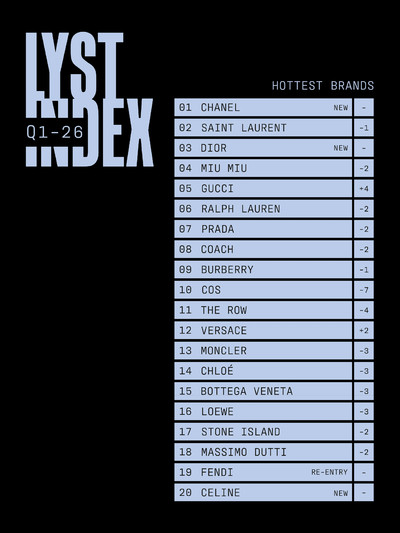
The Lyst Index for Q1 2026.
In an industry historically reliant on taste and intuition, understanding what people truly want is an increasingly powerful force. As fashion navigates a landscape defined by an overload of choice, shifting consumer expectations and new technologies, platforms like Lyst are reshaping how brands and consumers understand what resonates and why. Founded in 2010 to streamline the fragmented experience of shopping across multiple retailers and consolidate products into a single platform, Lyst sits at the intersection of fashion, technology, and culture. With over 27,000 brands and 160 million users, the platform has turned its most valuable asset – data – into something more than just infrastructure.
From early on, Lyst recognised that data could function not just as insight, but as a communication tool: a way to tell stories about what people want to wear, to validate journalists’ instincts, and to give creators access to analysis they can’t get anywhere else. That approach has granted the platform authority, while becoming a central USP. This is most visible in the regular quarterly publication of the Lyst Index, which launched in 2017. Released online as a report-style ranking, it typically takes the form of Top 20 ‘hottest brands’ and Top 10 ‘hottest products’ lists. The Index has evolved from a simple hierarchy into a sprawling data touchpoint, offering a broader view of fashion consumption patterns while generating industry debate.
Today, the Lyst Index has become a barometer of brand performance, a feedback loop for the industry and, increasingly, a reference point for shoppers and creators alike. In a landscape saturated with opinion, it offers something closer to objectivity, grounded in the behaviour of hundreds of millions. ‘In a world where taste is for sale,’ says Katy Lubin, vice president of brand and communications at Lyst, ‘data is the last honest voice in the room.’ In the following conversation, Lubin and her colleague Connor Downey, Lyst’s senior social media manager, discuss how data became the foundation of their platform, why the Index evolved into a cultural force, and how the company is rethinking e-commerce for a new generation of consumers.
‘Having a famous list – like the Billboard 100 or the Michelin Guide – felt like something that only Lyst could do using the insight that we have access to.’
Anano Shalamberidze: To start, could you tell us what the initial goal was when creating Lyst?
Katy Lubin: Lyst was founded to solve a deceptively simple problem. Shopping for fashion online used to be fragmented, messy, frustrating, confusing and slow. That problem still exists. Fashion itself is amazing. Creative, full of world-building and self expression, but shopping for it online – not so much. That’s why we were founded, and that remains the core problem we are trying to solve today. Shopping has changed so much so fast. And I think we all feel that shopping online has become a little bit boring. We’ve traded in that thrill of serendipity for convenience. And often it’s not even convenient, right? It doesn’t work. It’s littered. I can’t find it in my size, or that piece is sold out, or there are too many options. But we’ve always been a company with technology, data and analytics at our core. We don’t actually hold inventory or even manage logistics; instead, we connect audiences to a vast inventory from thousands of brands, stores and retailers.
The e-commerce component of the company obviously generates incredibly valuable data that, in 2017, you strategically opted to leverage for what became the quarterly Lyst Index. When and how did that happen?
Katy: The Lyst Index was launched in 2017, but you can’t really differentiate the two, in my mind. The Index is a relatively small part of what Lyst does, but it looms so large. Before we had that insight, there wasn’t a shared language for what the customer really wanted. One of our challenges is to remind people that the reason we have this insight is because we are a shopping platform, so we track signals about what people actually want. There were a number of reasons why it felt like a smart idea for us. We’re called Lyst, and I thought it would be cool to have a famous list – like the Billboard Hot 100 or the Michelin Guide. As a brand that operates at scale, it felt like something that only we could do using the insight that we have access to. Our brains love lists. There’s so much noise around. And I think there’s something clarifying and easy to understand about a Top 20 or a Top 10. So we felt that this would be a nice way to take all the chaos that was happening out there and try to distill it down into something that would actually serve the industry.
Let’s speak a little bit about the metrics that go into it.
Katy: The methodology has always combined distinct data streams into this one single proprietary algorithm. We’ve never fully disclosed the formula. This is our secret sauce, and its authority relies on that breadth of different signals, not on any one single metric. Although, of course, people ask us all the time: ‘What can I change to move up the list?’ At a very high level, as it says on the report, those signals measure shopper behaviour on and off Lyst, as well as on social media and sales. It’s released quarterly, as we wanted it to have this industry cadence to align with when people do their quarterly earnings reports. But two, three months also feels about the right measure to be able to track the rate of change and pace in fashion, and to be able to analyse it in time and say something meaningful. We have tweaked and evolved that formula over time as new social platforms have taken priority, but this year, it felt like the right time for a bit of a recalibration of how we approach the methodology.
What other elements of the metrics formula – your ‘secret sauce’ – have evolved over time? And what made now the right time for a rethink?
The formula has always been this living document. We’ve always quietly adjusted it, but it felt like we were capable of measuring much more. At the start of a new Index year, it felt like a good time to play this out and see where it lands. We look at it quarter on quarter, we look at what’s gone up and what’s gone down. It’s really interesting to look at it going back over the last decade, or even year on year. From there, you can see what we’re not capturing as well. New signals have become available, and new technology makes them readable at scale in a way that just wasn’t possible before. There are new measurable data points that exist beyond what we could originally capture. We’ve always tried to measure that cultural heat element that lives in social conversations, but our original formula coupled that within this commercial outcome. And of course, there’s a whole world of brand heat that doesn’t always directly correlate to e-commerce performance. That could be social buzz about queuing for a brand you can’t buy online, or a small, independent designer building momentum that doesn’t have that footprint yet. Those signals have always existed, those early desire signals, but they’ve been really hard for us to track. Now new AI tools are making it possible to process and weigh them reliably at scale. It’s still human insight, it’s still about real shopper behaviour, but the instrument is going to get much sharper. Our space moves so fast, I think it is not OK to stand still. This next stage of the Index, which is opening up the playing field, is a big leap forward that supports the evolution of our core shopping products. It will be very interesting to see the reaction that it provokes. We’re prepared for some chaos.
‘Four years ago, you couldn’t type ‘Carolyn Bessette Kennedy style’ into a search bar on an e-commerce platform and get a meaningful result.’
How have you reacted to AI-driven changes in the industry?
Katy: With the new tools AI has unlocked, we can leverage the scale of our data in unprecedented ways. That means there has been this significant shift on the customer side. Expectations have changed in what customers want when they’re shopping online. Our own Lyst data shows a structural shift in how people discover fashion online – questions, inspiration-led queries, and product search. Shoppers aren’t just searching for specific pieces. They’re asking about brands, trends, occasion, context, feeling. Four years ago, you couldn’t type ‘Carolyn Bessette Kennedy style’ into a search bar on an e-commerce platform and get a meaningful result. It’s about the ‘silent criteria’, that below-the-line context of what you couldn’t or wouldn’t expect to have put in a search bar in the olden days. Shoppers don’t want to press 4,000 filters. They don’t want to see things that aren’t relevant. This means we’re fundamentally transforming our core shopping experience and overall product selection to make it more intuitive, joyful, and personalised so more people will start and complete their shopping journeys on Lyst and be able to transact directly on our platform.
Would you say that the brands themselves are now hyper-aware of those changes? Are they increasingly adapting their products or product descriptions for this new landscape? Indeed, is that something that you discuss with them as part of your business?
Katy: This is where Lyst can become a strategic partner for the industry. We’re a small team of highly skilled experts across different areas like technology and innovation, communications and new marketing channels, brand storytelling, and AEO, helping brands surface themselves in different ways. As innovators in the space, part of our role at Lyst is to always be one step ahead. The way brands partner with us is a win-win: if we help them find new or better customers and tell their stories in interesting, creative ways, it benefits both sides.
Connor Downey: I think that’s also where the Index comes in. Brands are hyper-aware of it and use the Lyst Index as a barometer of performance. If something is working or not, they look to the Index as a signal and then adjust their own strategies accordingly.
Do you think those brands, which previously used the Lyst Index primarily as a feedback tool, are now actively trying to optimise for it?
Katy: It has the power to make a product category explode. While I don’t know how the internal creative and merchandising teams at the brands try to preempt the Index, I know that it’s important to how they record and feed back into their next wave of thinking. We know it’s a KPI for internal teams. It appears in board decks. It’s in financial reporting, not mentioning all of the press and media coverage that comes from the release. Creators online talk about the results for individual brands. So, yes, I think there is a feedback loop there in the same way that a number one song in the charts gets listened to more when you open the charts list on Spotify. There’s this feeling that if something is hot and popular, more people are going to want it. It has an afterlife beyond the original release date.
Connor: Even a brand like Uniqlo – they had posters in their stores that featured them being in the Index. When their cross-body bag was a really big moment, they absolutely wanted to communicate that to their customers in their stores.
To what extent does Lyst’s ‘fee-to-see’ visibility model indirectly shape what ends up ranking highly on the Index? How does Lyst balance being both a marketplace and an authority on what’s ‘hot’ in fashion?
Katy: This is a shop, fundamentally. It’s called the Lyst Index because it pulls from our shopping data. While it’s very important that the Lyst Index report page isn’t flooded with affiliate links, we know that there are people who are interested in shopping for those products as soon as we list them on that page. So, we actually make alternative routes for people to buy those products – the Lyst Index world that exists on a separate page. I don’t want to conflate the two, but it would be crazy not to close that loop.
‘In any one meeting, we might have data scientists, engineers, stylists, editors, and social media experts alongside product designers and analysts.’
You have previously mentioned that when creating the Index, you were worried about not seeing enough changes to report and dissect from quarter-to-quarter. Have you noticed increasing movement in between quarters as time has gone on?
Katy: There’s always some movement, even if it doesn’t feel like there’s much movement within the top three, or even the top 10. There are always stories to tell within the data. Part of the reason for it being the ‘hottest’ brands, and not the ‘biggest’ brands, is to ensure that we are capturing that movement. Anyone could create a list of the biggest brands based purely on sales data or the scale of the business or quarterly earnings reports. This had to be something about online shopper behaviour. But I’m always surprised by the amount of different stories to tell within the data. We share the insights every quarter with the press and we’ll highlight the key stories that we think there are to tell.
Something I love about releasing this information, is that we give you the facts, but it’s open to your interpretation of the stories that you want to tell. We’re there to facilitate putting the data in your hands, and for you to write your own
story around it.
Connor: Fashion is never standing still. Even if you think about this past week: John Galliano going to Zara and Christopher Kane going to Mulberry, there’s so much happening in less than a week. I don’t think it ever feels stagnant. It changes all the time. It might be small changes, but it’s a turbulent industry and always has been.
Do you ever see a time when Lyst could evolve into a B2B-first company, both in terms of the company ethos and the revenue model?
Katy: We’re a platform business, and we see it as a flywheel. We are a B2B and B2C; one hand feeds the other. If we didn’t have amazing supply for the store, we wouldn’t be able to serve any customers with the things they want.
Is there a cultural shift towards relying on data? And are people starting to lean more towards objectivity as a result?
Katy: In a world where taste is for sale, data is the last honest voice in the room. People have access to all kinds of data at their fingertips now, and can use that in all kinds of different ways, but we’ve reached this moment where data has massive cultural currency beyond just being a fact-check moment in communications.
What goes into packaging that data in a way that’s easily digestible?
Connor: We’re constantly evolving the Index in how we present it. Over the years, there have been many iterations, and we’ve always wanted it to feel social-first and digital-native. A few years ago, we revamped how the Index appears by creating chart assets and data visualisations, by leaning into storytelling. If a brand is number one, the focus is on why: what product is driving it, and what data supports this. It gives users context around why a brand is trending or not. More recently, we’ve started using greenscreen videos to tell the story of a brand, its journey and how that leads to its position in the Index.
It’s not just about the list, but also about the voices around it. We’ve built a network of cultural fashion voices, shared the Index report with them, and enabled them to tell their own stories on their channels. Sometimes their perspective on why a brand ranks highly is completely different from ours, and that opens up a conversation. It becomes very online, and that’s what helps the Index gain traction. The report itself may be subjective, but people bring their own opinions, which creates ongoing dialogue. This isn’t just data that sits with us, it extends far beyond the Index. I’m still getting tagged in posts about the last Index, and that was almost three months ago. The conversation is constant. People want facts, and data supports the emotion behind why they like something.
‘People want facts, and data supports the emotion behind why they like something. I think people seek ‘permission’ to invest, especially in big-ticket items.’
How does a platform like Lyst approach Fashion Week coverage?
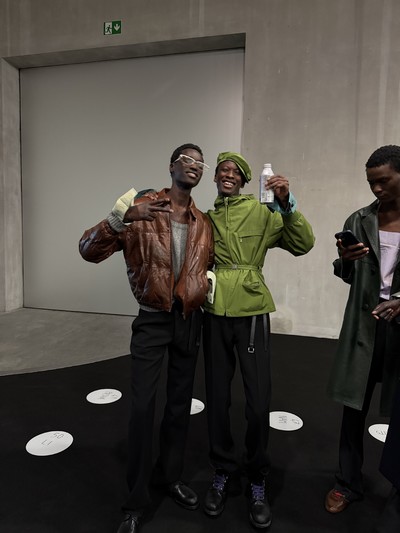
Connor: Fashion Month is huge for us. We see strong performance not just on social, but also in revenue and app traffic – it all increases during that period. It adds credibility to the conversation we’re building around the Lyst Index, giving us an insider view of what’s happening and allowing us to comment on it in real time. That, in a way, reinforces the claims we make. When I first joined Lyst [in 2021], we had around 200,000 followers and weren’t doing anything around Fashion Month. The first season I covered we only went to three shows, and I was seated at the back. So I went out with an iPhone and focused on creating social content. That was the same weekend we launched our TikTok page. Over that weekend, we grew to around 40,000 followers just by creating content that went viral and understanding the platform’s language. From there, each season has grown: more shows, more access, more scale. The first time I went, it was just for a weekend. I’ve just come back from six weeks of shows.
Katy: We started a Substack recently, and over the last four weeks we’ve been sharing, in real time, the search impact of shows on Lyst as they happen. That’s a very different approach to analysing what’s happening compared to the social content we create on the ground. At any one time, we’re thinking about this high-level view of everything the shows represent, and how we’re covering that across channels. The Index has a time lag. It’s released in the same month each time, but it encompasses the full show season. So for the industry, it shapes how those shows are read retrospectively. In the moment, there’s the immediate response from people on the ground. But this is a different layer. We’re not covering shows in the traditional way through reviews. With the Index, we’re measuring what they leave behind.
As we’ve seen in recent seasons, what happens when a brand suddenly becomes super hot, or conversely, when a brand’s heat rapidly subsides?
Katy: Miu Miu’s trajectory was a complete brand story. Remember that viral miniskirt? That was around Q1, 2022, and at that point it was averaging around 900 searches a day for six months. Then came the ballet flats, which were one of the most searched shoes on Lyst for a couple of months. Then in Q3, 2023, Miu Miu hit number one for the first time. Throughout 2024, it held a top three position in every quarter. In Q1, 2025, Miu Miu had three products simultaneously in the top 10 hottest products, which was a first for any brand. I think that’s an amazing example of how a brand can start with one hot product, and you can see that momentum grow over time as more products are added and how that product-level desire contributes to an overall increase in demand and brand heat.
After years of doing this, I’m assuming there are distinct patterns you start to recognise – signs that a brand is about to become really hot, or that a particular product is about to take off. Do you think Lyst could eventually move into prediction, or, by extension, even product design itself, given the amount of data you have?
Katy: That would be a really fun challenge, and is something we’ve definitely talked about over the years. Our insights are very valuable, but I think part of what makes Lyst unique is that we offer them freely. We’re not gatekeeping. The Index isn’t behind a paywall or limited to industry subscribers. That’s what makes it interesting: it’s shared by shoppers, brands, and the industry that creates it. I just like the idea that we’re platforming and hosting insights that help others fuel their ideas and creativity.
Do you think, generally, that shoppers are looking for guidance to navigate the vast space of online shopping? And do you see Lyst as that kind of guide?
Katy: Totally. I think people seek permission to invest, especially in big-ticket
items. Lyst’s authority and credibility as an objective source backed by signals from millions of shoppers endorsing products through searching and buying on our platform, make it a really interesting voice in that conversation. Especially in this moment of non-fashion-specific LLMs [large language models] giving advice on everything from where to book your holiday to what to eat for dinner. Fashion is so nuanced, and so credibility, taste, and knowledge are highly valued. That’s why, when we think about how to guide shoppers and give advice that matters, we approach it by bringing together diverse, multidisciplinary teams. In any one meeting, we might have data scientists, engineers, personal stylists, editors, and social media experts alongside product designers and analysts. We get into some quite intense conversations where data might suggest one thing, and a stylist will challenge it, saying it doesn’t reflect how people actually think or behave. That tension is valuable. It creates a culture of deep expertise without ego. I believe that approach to problem-solving – combining product thinking, expertise, and data – is what can take us to a better place in terms of recommendations and guidance.
What’s the future like for Lyst?
Katy: Our mission is to help shoppers make better fashion decisions. In a world of choice overload, complexity, and just too much stuff, I believe better decision-making is key to a better, brighter future for the industry.