‘I used to get so annoyed listening to interviews with designers because the journalists didn’t know how to speak to them. I’d always think to myself, ‘Why did you ask that?’ The background I had in pattern-making and running my own brand was the impetus for me to start The Cutting Room Floor – even the name, I got that from being in a factory – and it’s why I know to ask certain things.’

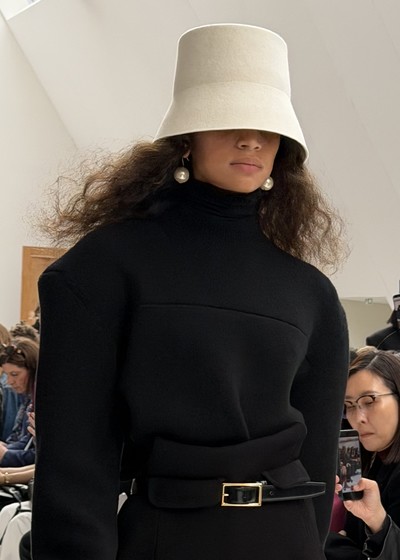
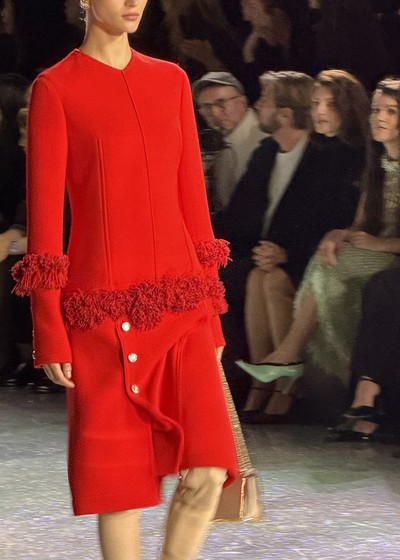
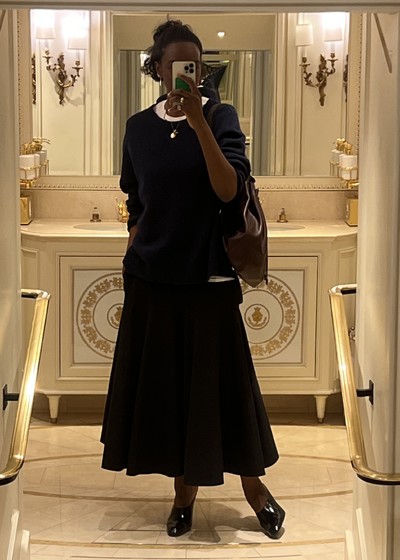
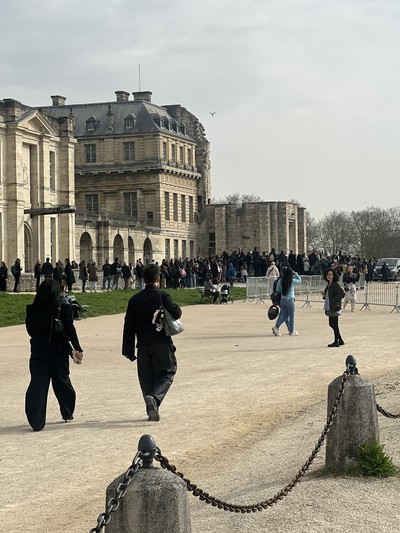

As the founder and host of fashion’s favourite podcast, The Cutting Room Floor, Recho Omondi has built a repu-tation for slicing through fashion media’s surface, drawing out the kind of candour fashion insiders often resist. While she has a natural instinct for interviewing, a career in media wasn’t always the plan. An early pivot from medicine to fashion design marked her first major shift, followed by roles across retail and pattern-making – from Barneys to Calvin Klein and Theory – before launching her own label Omondi, which she ran for six years.
In 2018 she turned to podcasting as a response to her growing dissatisfaction with the industry at large. The Cutting Room Floor has since evolved into a multi-platform operation and a space to dissect and challenge fashion from the inside, with guests including Marc Jacobs and Gwyneth Paltrow, as well as Lauren Sherman, Law Roach and Paloma Elsesser. In the following conversation, Omondi reflects on the experiences that shaped her perspective – from a disciplined upbringing and technical training to learning how to ask sharper, more informed questions of the industry at large.
Jonathan Wingfield: Did you grow up with fashion?
Recho Omondi: I grew up dancing, so I spent a lot of time on stage – recitals, costumes, competitive dance. I really liked role-playing in stage shows and school plays. ‘Fashion’ was not even in my lexicon, but I liked getting dressed up. And I knew how to sew because I’d have to sew my elastics onto my ballet shoes every time I got a new pair – that was just the reality of competitive dance. My father is an immigrant from Kenya and was always adamant about me and my siblings being involved in the arts, but not as a career path.
Why the arts in particular?
I grew up with a single father. I think he had a deep reverence for the arts. He studied English, and then he realised he had three kids and needed to make a significant living so he pivoted to medicine. But earlier on, I think if he could have had his way, he would have had a career in the arts. I think he ingrained that in us. Education was a key part of social mobility, and he was very big on grades, very big on excellence and trying your best. Those things were absolute non-negotiables.
‘The people I looked up to knew how to drape.They weren’t about a moodboard, they were great pattern makers. Yohji, Rick, Alaïa were my gods.’
Were you a grade-A student at school?
Yes, I had no choice. His thing was always that the way you pay rent in this house is with your grades. ‘You have no other responsibility other than that, and in return I will take care of everything.’ And he did. He paid for college. But in return, my job was to get good grades. I don’t think that’s ever left me. He was very big on what would have been described back then as being ‘cultured’. That meant travelling a lot and reading a lot. There was very little emphasis on entertainment. Entertainment was always consumed in moderation in our house.
Your father moved from the arts into medicine, and in some ways you made the reverse move. How did he respond when you decided to go into fashion?
It was definitely a risk, but he supported it. I was originally studying medicine at the University of Illinois, but I had this other side of me which I don’t think came as a surprise because I’d been doing all of these extracurriculars. So I started looking at schools and thinking about where I could go and researching it all on my own. I wouldn’t dare bring this to my father without being fully prepared. By the time I did tell him about it, it was a presentation – a sit-down PowerPoint presentation. I had pamphlets out, I had brochures from all the schools. It wasn’t a half-assed idea. It was very much: here’s what I’ve decided, here’s what I’m thinking. This is the man who made me write a five-page paper at the age of nine because I wanted a new bike. His thing has always been: state your case. So I always had it in my mind that if he does support this, it has to seem thoughtful. You have to remember, I’m also asking him to foot the bill for this. So I think his number one question was, ‘What kind of job can you get?’ And I was like, ‘I don’t know, but I know what you’ve taught me.’ His whole thing was, I don’t care if you sell coconuts on the side of the road, but you better be the most diligent, the best-prepared coconut seller there is. So, he did support it. He paid for me to go to school. He didn’t want me to have student loans. He knew how hard that was because he did it himself.
Who first excited you in fashion?
I have two older sisters who are five and six years older than me, so they had a huge part in framing how I saw anything. I saw a lot of things around the house before I really had context for them – they watched Sex and the City, and there were magazines in the bathroom. I always had a point of view, even from a young age – ‘I want the blue sweater, not the red one.’ My first kind of aha moment was being at a Chanel store at London Heathrow. We used to travel a lot because my dad’s family was in Europe. So when we’d go on summer vacation, we’d go back to Kenya, but we’d always stop in some European city where my aunts were – Paris, Stockholm, Brussels or London. I remember going to an airport Chanel store and I was like, ‘Oh, OK, I get it.’ But in terms of my adolescence, who was important? Marc Jacobs was everything.
You mean his own brand or his work for Louis Vuitton – or a bit of both?
I think Vuitton. But, also, just his name. Marc Jacobs. Back in high school, that was a big thing, Marc by Marc, and being able to buy one little thing because it was more affordable. Then Tom Ford – I remember when I was in high school, I wrote a paper about Tom Ford leaving Gucci. I’m 17, it’s 2003, Tom Ford is leaving Gucci, and I wrote a paper about it in a small Midwestern high school! I always had a fixation on Chanel because of that experience when I was at Heathrow, but by the time I got to college, I was obsessed with [Alexander] McQueen, especially where it intersected with Lady Gaga and Steven Klein and pop culture. I was also very interested in Chloé.
I used to get annoyed at fashion school because I never felt that my peers were as invested in it as I was. I went to Savannah College of Art and Design. It’s a smaller school in Georgia, it wasn’t Parsons. I wanted that rigour. I wanted to be around people who also knew what I was talking about. But it was a Southern school, and they groomed their students to get jobs at brands that I wasn’t that interested in. I was like, I want to go all the way.
How did founding and running your own brand shape the way you now interview designers?
I think the only reason I can interview people the way I do is because I’ve had my own brand. Studying fashion design, that major would have people drop like flies. They couldn’t take it. They’d go, ‘Oh, I’m going to transfer to fashion marketing’ or ‘I’m going to become a stylist,’ because it’s such a rigorous thing to do, to be sitting at a sewing machine all day, every day.’ A lot of people couldn’t hack it, but I was headstrong. I decided I was going to study pattern-making because no one’s ever going to catch me off guard saying, ‘I don’t know what this is.’ I’m going to know how to cut it. I’m going to know how to read a tech pack. I’m going to know what a gusset is. I wanted to know everything, so that’s what I studied. Because the people that I looked up to were great pattern makers.
‘The fashion-media landscape had become like, ‘Six dresses to wear on New Year’s Eve’. I couldn’t believe the conversation had become so stale.’
People who could make a dress. Yohji, Rick…
… Alaïa. It wasn’t about a moodboard. They knew how to drape. These people were my gods. So, I moved to New York. I got my degree, my BFA in pattern making, fashion design, and my first job was actually as an assistant pattern maker. My boss at the time – Tomo, this Japanese pattern maker – really taught me everything I know to this day about patterns. Draping, fabric, being in factories, production – and the difference between the sample and the production. I spent a lot of time in that back of house during those years. Very unglamorous, mind you. At this point, my peers all worked in media. They were editors or stylists, working in magazines and doing glamorous jobs. And I’m slogging away in midtown Manhattan, sweating it out with the immigrants, essentially, because that’s who runs this business. But I loved it.
The whole time throughout school I was working in luxury retail for
Jeffrey Kalinsky, who had the store in Atlanta called Jeffrey. Then I worked at Barneys, and learned about wholesale. Eventually I started my own brand. All the mistakes that you make as a young designer I made, full stop. I had the brand for five years, and I raised about a quarter of a million dollars to do it. It really wasn’t that much money, but it was enough for me to make the mistakes that I made. We did a couple of collections. You learn about retail and wholesale and PR. Which is funny, because PR was the part of the business that I was always the least interested in and knew the least about, but now I work in media. That was the foundation. Now I look back and it was part of the impetus for starting The Cutting Room Floor. Even the name, I got that from being in a factory. I couldn’t do the interviews I do now if I hadn’t done that. I used to get so annoyed when I would listen to designer interviews and no one knew how to speak to a designer. They only spoke to them like journalists, like media people. I would always think to myself, ‘Why did you ask this?’ That foundation in design and pattern making is how I know to ask certain things.
Why did podcasting feel like the right format for you?
I started the podcast in 2018, when blogs were on their way out. We were getting off of desktop. Everyone was on their phone. I knew everyone was on Instagram and the habits and behaviours of how people were consuming media were changing.
When you launched The Cutting Room Floor, was it presented as both audio and video from the start?
Only audio. Video we started three years ago, and that changed everything. I think that’s why a lot of people feel like they just discovered the show in the last two years, because that was when it became easier to discover us. But no, I’ve been doing it for seven years. A big, big, big influence was Serial. That was huge, it made my brain explode. When I heard storytelling in audio form I was like, ‘I could do this.’
Was it the depth of research?
I love research! It was one of those moments where something in your brain breaks – you’re like, oh my God, this is brilliant. One thing I did when I still had my own brand was obsessively listen to interviews all the time – on my headphones or on my speakers while I was sewing. And then Serial came out in 2014, and that blew my mind. Because my dad never really let us watch TV – it was a treat, on the weekend for a couple of hours – we listened to a lot of musicals, and I would create a whole movie in my mind just based on the music I was hearing. So when I heard Serial it reminded me of being a kid and putting together the movie in your head. I wasn’t listening to any other podcasts, but I think Serial had introduced the idea to me and it was a low barrier to entry. I also didn’t like writing. I never wanted to write. So that was also very attractive to me – I can just say something and then publish it.
‘Editors are not product developers. They’re just like, ‘This is fab.’ Whereas I’m like, ‘I have questions: it’s a luxury brand, but is it a luxury product?’’
Let’s turn our attention to the show season. What’s your rapport with Fashion Month?
This season, we decided as a team that I would show up in Paris and actually see all the shows. It was my first time, so I have a new relationship with it. But when I was younger, when I was in college, I looked at everything. I lived on style.com, that was all I did. When I started building the podcast, I had less time to do that, and we weren’t covering it. I felt that it was already being covered everywhere else, so we focused on long-form conversation.
How did you find the experience?
Overwhelming, but in a wonderful way. I walked out with a deep respect for the people who cover this every season, in every city. It’s a lot of work, and I don’t know if people realise that. I was only in Paris, but people were coming in from Milan, and I know journalists are writing in the car to file by a certain time. Everybody has a different reason to be there. You have stylists, buyers, celebrities, whatever. I really approached it as an observer. I think it would be very obnoxious for me to come out the gate and be like, ‘This is what I think!’
Were you not tempted, like so many others, to voice an immediate opinion?
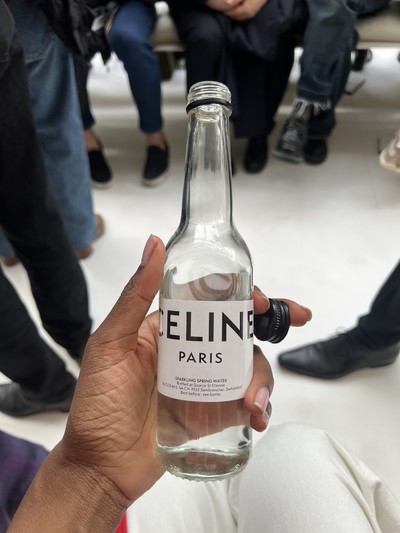
No, not really. I went to Chanel, I went to Loewe, they were these big productions, which were wonderful, but the only show that truly moved me was Celine. I couldn’t believe I was in the room. When I was younger I loved Phoebe Philo’s Céline, and now it’s Michael Rider. So at the age of 39, it was very special to see a Celine collection at the precipice of my maturity.
As a podcaster, how do you feel your perspective differs from others?
Maybe it was confidence, or arrogance, but when I began this, I felt like I could do it better than other media outlets. If for no other reason, I was going to create the thing that I myself wanted to hear because I was bored. As a teenager, I read Robin Givhan, Sarah Mower, Cathy Horyn – the people I looked up to when I was in high school. But somewhere along the way the broader fashion-media landscape became like, ‘Six dresses to wear on New Year’s Eve’. The business of fashion itself had grown, becoming consolidated, but I just couldn’t believe the conversation had become so stale. I thought to myself, ‘I have a lot of conversations with my colleagues about what’s actually going on, can’t fashion media reflect that?’
Looking back at McQueen, this is someone who took their own life and who made very clear the amount of pressure and stress he was under. That only gives me a peek into what the experience could be like for some others working today. When I went to see Dior, the first thing I thought was, ‘I want to know how Jonathan Anderson is doing, how’s his mental health?’ Every time I see him being interviewed, he looks more and more tired. Is he OK? He has JW [Anderson], he has Dior, he’s doing X amount of men’s and this and that, and he just came from Loewe, so you’re jumping from one house to another. I want to know how the guy’s doing.
I know these people have teams but I have a lot of questions about these big businesses. I have a lot of doubts. That’s really what I was thinking when I was seeing these big, big shows like Chanel. I didn’t know the Chanel show was that big. I was like, this is huge! I’d never been to the Grand Palais. And then what kills me is – don’t get me wrong,
I bought two pairs of the shoes that week at the store – I don’t think the quality is as good as it used to be. That begs a lot of questions. I’m someone who’s worked as a product developer, right, so I’m looking underneath things and I’m looking at seams and I’m looking at how they finished things, and I’m looking at the quality of leather, and I have a lot of questions. Unfortunately the editors are not product developers. So they’re just like, ‘This is fab.’ But I’m like, ‘Well, I have questions because it’s a luxury brand, but is it a luxury product?’
When you’re talking about things like product development and profit margins, who would you want to ask those questions to? Is that a CEO question?
Yes, but there’s no CEO who’s going to answer that on the record with me on video. That’s not going to happen. Sometimes I don’t know who the person to talk to is until I meet them.
Is there a disparity between the conversations you have off the record with people in the industry and what people will say when they’re filmed for The Cutting Room Floor?
Slightly, but that margin is very small because I do a lot of vetting before people even sit down with me. Let’s not waste each other’s time. If you’re not willing to talk or be open, this isn’t the show for you. You can go to many other places. I think I’ve done a pretty good job of letting it be known that if you’re coming here, you’re prepared to talk about something real. So people usually say the same off the record and on the record.
Could there come a day when you’re more embedded in the industry, and so less forthcoming with your criticism?
I’m not married to the idea of being at fashion shows. A lot of people don’t say things because they’re afraid of not getting invited, but there’s no part of me that’s fearful of not being allowed to go again. And so in that respect, I don’t really mince my words.
When it was announced that Demna was going to Gucci, there was talk about him Demna-fying the house. How did you read his approach to his debut Gucci runway show this season?
I didn’t care for it. He did Demna-fy it. And that, to me, is what I would have expected. Now comparing that to what I loved at Alessandro [Michele]’s Gucci – that was also a huge turning of events. The brand was kind of dead prior to Alessandro taking over; I remember I was working at Barneys just before then and we literally took Gucci off the shelves because it wasn’t selling. Demna’s Gucci, though, I thought the nod to Tom Ford was low-hanging fruit. We all remember the shaving of the G, the thong, and Kate Moss. This kind of feels like old dog-and-pony tricks. It didn’t feel fresh to me, the way that Jonathan’s Dior felt fresh. But this is the weird thing about ageing: now being 40, I sometimes lose my grip on what feels fresh or what feels old to me.
Do you think it feels fresh to somebody who’s 21?
I honestly can’t tell. But you have to remember, I have deep reverence for the designers; I think there’s nothing more obnoxious than someone who doesn’t have the context bashing the work they’ve done. I don’t know how much time Demna had to do that collection. I don’t know what kind of things happen internally that people don’t realise. So I try not to bash them for bashing’s sake.